
In the context of global energy challenges and environmental concerns, the utilization of solar energy has emerged as a critical pathway toward sustainable development. As a researcher in renewable energy systems, I have focused on addressing the inefficiencies in traditional solar applications, particularly in agricultural settings such as greenhouses, where high electricity costs and wasted thermal energy are prevalent. My work centers on the design and optimization of a concentrated solar photovoltaic/thermoelectric (PV/TE) hybrid system, which aims to maximize energy conversion by integrating multiple technologies. This solar system leverages parabolic concentrators, photovoltaic cells, thermoelectric modules, and a triangular heat pipe structure to simultaneously generate electricity and harvest thermal energy. In this article, I will detail the design principles, mathematical modeling, and experimental performance of this innovative solar system, emphasizing its potential for practical applications in energy-intensive environments.
The core motivation behind this solar system stems from the limitations of conventional photovoltaic panels, where only a fraction of solar radiation is converted into electricity, with the remainder dissipated as heat, leading to elevated temperatures and reduced efficiency. By incorporating thermoelectric modules, I have enabled the recovery of waste heat for additional power generation, while a heat pipe mechanism facilitates thermal storage for later use. This integrated approach not only enhances overall efficiency but also aligns with the goal of creating self-sustaining energy solutions for remote or off-grid locations. Throughout this discussion, I will repeatedly reference this solar system to underscore its multifaceted design and operational advantages.
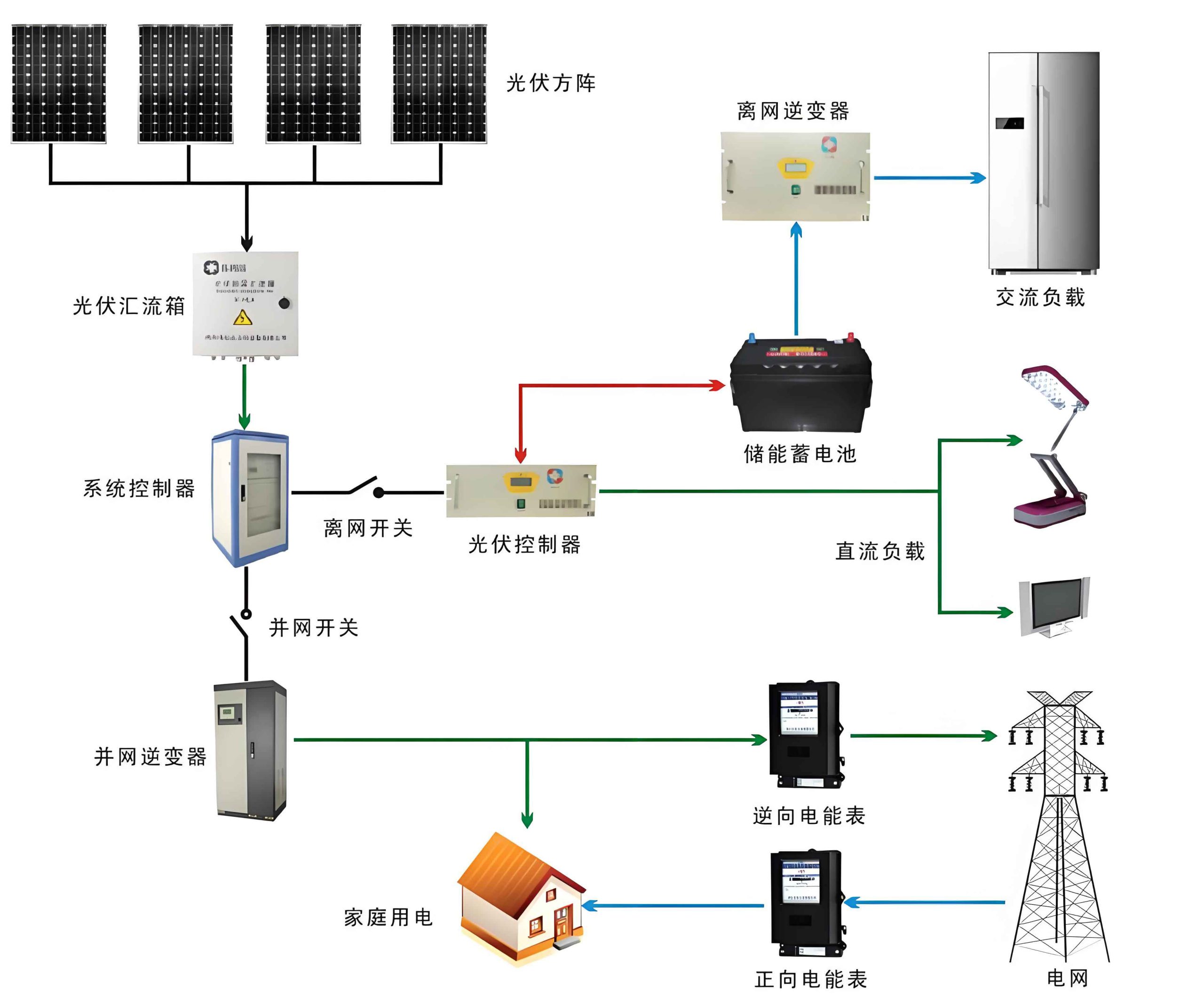
The structure of this concentrated solar system comprises several key components: a parabolic concentrator, photovoltaic cells, thermoelectric modules, a triangular heat pipe, a heat storage tank, and a heat exchanger. The parabolic concentrator focuses sunlight onto the photovoltaic cells, increasing the incident radiation intensity and thereby boosting electrical output. The photovoltaic cells, typically made of polycrystalline silicon for cost-effectiveness and environmental safety, convert a portion of the absorbed energy into electricity, while the remainder is transformed into heat. This heat is then transferred to the hot side of the thermoelectric modules attached to the back of the photovoltaic cells. The thermoelectric modules, based on the Seebeck effect, generate additional electricity from the temperature gradient between their hot and cold sides. To maintain this gradient, a triangular heat pipe, filled with water as a coolant, is used to dissipate heat from the cold side of the thermoelectric modules. The heat pipe’s design—featuring an evaporator section in contact with the thermoelectric modules and a condenser section connected to a heat storage tank—allows for efficient heat transfer and storage. This solar system operates by tracking the sun’s movement using a stepping motor, ensuring optimal light concentration throughout the day. The overall configuration enables a dual output of electrical and thermal energy, making it a versatile solution for applications such as greenhouse lighting, environmental monitoring, and space heating.
To analyze the energy conversion processes within this solar system, I developed comprehensive mathematical models for electrical, thermal, and exergy efficiency. The electrical power generated by the photovoltaic cells can be expressed as:
$$P_{pv} = \tau_g \alpha A_p G \eta_{pv}$$
where \(\tau_g\) is the transmittance of the glass cover, \(\alpha\) is the absorptivity of the photovoltaic cells, \(A_p\) is the surface area of the photovoltaic cells, \(G\) is the solar irradiance, and \(\eta_{pv}\) is the photovoltaic conversion efficiency. The efficiency \(\eta_{pv}\) varies with temperature and is given by:
$$\eta_{pv} = \eta_{p0}[1 – \beta(T_p – T_{p0})]$$
where \(\eta_{p0}\) is the reference efficiency under standard conditions, \(\beta\) is the temperature coefficient, \(T_p\) is the photovoltaic cell temperature, and \(T_{p0}\) is the ambient temperature. For the thermoelectric modules, the electrical power output is derived from the Seebeck effect:
$$P_{TE} = \frac{\alpha_{TEM}^2 (T_h – T_c)^2 R_L}{[R_{TEM} + R_L]^2}$$
where \(\alpha_{TEM}\) is the Seebeck coefficient, \(T_h\) and \(T_c\) are the hot and cold side temperatures, respectively, \(R_{TEM}\) is the internal resistance of the thermoelectric modules, and \(R_L\) is the load resistance. The total electrical power of the solar system is then:
$$P_{com} = P_{pv} + P_{TE}$$
The thermal energy harvested by the solar system is calculated based on heat balance equations. The heat generated by the photovoltaic cells is:
$$Q_h = A_p G (1 – \eta_{pv})$$
This heat is partially lost to the environment through convection and radiation, and partially transferred to the thermoelectric modules and heat pipe. The convective heat loss is:
$$Q_{conv} = h_{conv} A_p (T_p – T_{p0})$$
and the radiative heat loss is:
$$Q_{rad} = h_{rad} A_p (T_p – T_{p0})$$
where \(h_{conv}\) and \(h_{rad}\) are the convective and radiative heat transfer coefficients, respectively. The useful thermal energy collected by the heat pipe and stored in the heat storage tank is:
$$Q_H = Q_h – Q_{conv} – Q_{rad} – P_{TE} – Q_{loss}$$
where \(Q_{loss}\) represents other thermal losses in the system. The thermal efficiency of the solar system is defined as:
$$\eta_H = \frac{Q_H}{Q_h}$$
Furthermore, the exergy efficiency, which accounts for the quality of energy, is evaluated using:
$$\eta_{ex} = \frac{\Delta E}{GA(1 – T_{p0}/T_{sun})}$$
where \(\Delta E\) is the exergy gain of the system, \(T_{sun}\) is the sun’s temperature, and other terms are as previously defined. The exergy gain can be expressed as:
$$\Delta E = m[h_2 – h_1 – T_{p0}(s_2 – s_1)]$$
where \(m\) is the mass flow rate of the coolant, \(h_1\) and \(h_2\) are the specific enthalpies at the inlet and outlet of the heat pipe, and \(s_1\) and \(s_2\) are the specific entropies.
To validate the performance of this solar system, I conducted extensive experiments over a full year, covering spring, summer, autumn, and winter seasons. The test setup included monitoring equipment such as K-type thermocouples, data acquisition cards, flowmeters, and pyranometers to measure temperatures, solar irradiance, and coolant flow rates. The key parameters tested included electrical power output, thermal power output, and efficiencies under varying conditions of solar irradiance and coolant flow rate. Below, I summarize the critical parameters of the photovoltaic and thermoelectric components used in the system:
| Component | Parameter | Value |
|---|---|---|
| Photovoltaic Cell | Open Circuit Voltage | 4.44 V |
| Short Circuit Current | 1.81 A | |
| Peak Voltage | 3.23 V | |
| Peak Current | 1.05 A | |
| Efficiency | 15.75% | |
| Thermoelectric Module | Model | SP1848-27145 |
| Maximum Voltage | 15.2 V | |
| Maximum Current | 6.0 A | |
| Internal Resistance | 2.05 Ω | |
| Thermal Conductivity | 1.6 W·m⁻¹·K⁻¹ |
The experimental results demonstrated that this solar system significantly outperforms non-concentrated PV/TE hybrid systems. For instance, during winter tests, the maximum electrical efficiency reached 20.98%, the thermal efficiency reached 39.81%, and the exergy efficiency reached 32.5%. These values were consistently higher across all seasons, as shown in the following table summarizing seasonal performance under optimal coolant flow conditions:
| Season | Solar Irradiance (W/m²) | Ambient Temperature (K) | Electrical Efficiency (%) | Thermal Efficiency (%) |
|---|---|---|---|---|
| Spring | 766.07 | 276.59 | 21.01 | 40.16 |
| Summer | 782.44 | 299.03 | 21.99 | 43.78 |
| Autumn | 775.87 | 289.36 | 21.11 | 42.79 |
| Winter | 754.86 | 261.09 | 20.98 | 39.81 |
The data indicate that the solar system achieves peak performance in summer due to higher solar irradiance and ambient temperatures, but it remains effective even in winter, showcasing its robustness. The coolant flow rate was found to be a critical factor; increasing the flow rate from 2 to 5 L/min enhanced both electrical and thermal efficiencies, but beyond 5 L/min, the efficiencies plateaued due to limited heat availability. This behavior is captured by the following relationship derived from the thermal model:
$$\eta_H \propto \frac{1}{1 + \frac{R_{th}}{h_{pipe}A_{pipe}}}$$
where \(R_{th}\) is the thermal resistance of the heat pipe, \(h_{pipe}\) is the heat transfer coefficient of the coolant, and \(A_{pipe}\) is the surface area of the heat pipe. The optimization of this solar system involves balancing these parameters to maximize output.
In addition to efficiency metrics, I analyzed the temperature distribution across the photovoltaic cells using finite element simulations. The results, plotted against solar irradiance, showed that cell temperature increases linearly with irradiance, leading to higher thermal losses. For example, at an irradiance of 700 W/m², the cell temperature reached 363.86 K, with thermal losses accounting for up to 24.62% of the absorbed energy. This underscores the importance of the heat pipe in mitigating temperature rise and improving overall performance. The simulation data can be represented by the equation:
$$T_p = T_{p0} + \frac{G \alpha A_p}{h_{conv} + h_{rad}}$$
which highlights the direct proportionality between irradiance and temperature.
Comparing the electrical output of this solar system with standalone photovoltaic or thermoelectric systems revealed significant gains. The hybrid configuration generated an average electrical power of 76.3 W over a 6-hour test period, compared to 28.85 W for a non-concentrated system. This represents a 164% improvement, attributable to the concentrated solar design and efficient heat recovery. The thermal power output averaged 158.73 W, which can be stored for heating applications, further enhancing the utility of the solar system. The following equation summarizes the total energy yield:
$$E_{total} = \int (P_{com} + Q_H) dt$$
where the integration is over the operational time period.
The exergy analysis provided insights into the quality of energy harvested by this solar system. The exergy efficiency peaked at 32.5% under high irradiance conditions, indicating that a substantial portion of the solar energy is converted into usable work. This is superior to many conventional solar thermal systems, which often exhibit lower exergy efficiencies due to high thermal losses. The exergy performance can be optimized by adjusting the temperature gradient across the thermoelectric modules, as described by:
$$\eta_{ex} = \frac{P_{com} + \Delta E}{GA(1 – T_{p0}/T_{sun})}$$
This formula emphasizes the role of both electrical and thermal exergy in the overall efficiency of the solar system.
In conclusion, the concentrated solar PV/TE hybrid system I have designed and tested demonstrates remarkable potential for enhancing solar energy utilization. By integrating photovoltaic conversion, thermoelectric generation, and thermal storage, this solar system achieves higher electrical and thermal efficiencies compared to traditional approaches. The mathematical models developed provide a robust framework for optimizing system parameters, while experimental results validate its performance across varying seasonal conditions. This solar system is particularly suited for applications such as greenhouses, where it can supply electricity for lighting and monitoring systems, as well as heat for crop growth. Future work will focus on scaling up the design and integrating smart control systems to further improve adaptability and efficiency. Ultimately, this research contributes to the advancement of renewable energy technologies, offering a sustainable solution that maximizes the benefits of solar resources through innovative engineering.