
As we navigate the evolving landscape of electricity systems, I see a pressing need to maximize the value of distributed energy resources (DERs) while ensuring grid stability and reliability. The integration of DERs, such as solar PV systems, batteries, and controllable loads, presents both opportunities and challenges. In my view, the concept of “fully flexible loads” is pivotal to unlocking the potential of DERs in virtual power plants (VPPs) and beyond. This approach involves treating diverse DER assets as aggregated, dispatchable resources that can respond to external signals for energy market and grid services. Throughout this article, I will delve into the intricacies of managing these flexible loads, emphasizing the role of solar systems, and using tables and formulas to summarize key insights.
First, let me outline the core components of flexible loads. In a DER management context, a flexible load comprises at least one energy resource connected at a shared grid point, capable of responding to control signals—for instance, from a DER management system (DERMS). These resources vary in flexibility, and their coordinated operation can optimize system performance. To illustrate, I have categorized common flexible load types in Table 1 below.
| Resource Type | Flexibility Degree | Primary Control Actions | Typical Response Time |
|---|---|---|---|
| Solar PV System Inverters | Medium | Generation curtailment (load increase), export de-limiting | Seconds to minutes |
| Battery Storage Systems | High | Charging/discharging for load increases/decreases | Milliseconds to seconds |
| Controllable Loads (e.g., water heaters, EV chargers) | Variable | Load shifting, on/off cycling | Minutes to hours |
From my perspective, solar systems are a cornerstone of this framework. Their widespread adoption, especially in residential areas, can lead to issues like reverse power flows and voltage fluctuations when unmanaged. However, by integrating solar systems into flexible load portfolios, we can mitigate these challenges and enhance value stacking—where multiple services are derived from the same asset. For example, a solar system can not only generate energy but also provide grid support through controlled curtailment. The energy balance at a grid connection point can be expressed as:
$$ P_{\text{grid}}(t) = P_{\text{PV}}(t) + P_{\text{battery}}(t) – P_{\text{load}}(t) $$
where \( P_{\text{grid}} \) is the net power flow to the grid, \( P_{\text{PV}} \) is the solar generation, \( P_{\text{battery}} \) is the battery discharge (positive) or charge (negative), and \( P_{\text{load}} \) is the uncontrollable load. By adjusting these variables, we can manage local network constraints.
To effectively dispatch flexible loads, I believe in a merit order approach based on intervention levels. These levels reflect the impact on asset owners and grid needs, ranging from neutral to significant interventions. Below, Table 2 summarizes these levels, akin to the color-coded spectrum often used in industry discussions.
| Intervention Level | Description | Examples | Typical Compensation |
|---|---|---|---|
| Level 1 (Neutral/Beneficial) | Actions with minimal or positive impact on owners | Scheduling discretionary loads (e.g., pool pumps), PV export above default limits | None or minor incentives |
| Level 2 (Economic Impact) | Actions that may affect energy costs but not comfort | Moderate PV curtailment, battery charging during peak times | Financial payments or tariff adjustments |
| Level 3 (Significant Impact) | Emergency actions with comfort or financial consequences | Aggressive load shedding, deep battery discharge for grid stability | Substantial compensation or contractual agreements |
In my experience, the dispatch merit order can be optimized using mathematical models. Consider a VPP aggregating multiple solar systems, batteries, and loads. The objective is to minimize costs or maximize value over time intervals \( t \). Let \( C_{\text{grid}}(t) \) be the grid electricity price, \( C_{\text{curtail}}(t) \) the cost of curtailing solar generation, and \( C_{\text{battery}}(t) \) the degradation cost of batteries. The optimization problem can be formulated as:
$$ \min \sum_{t} \left( C_{\text{grid}}(t) \cdot P_{\text{grid}}(t) + C_{\text{curtail}}(t) \cdot P_{\text{curtail}}(t) + C_{\text{battery}}(t) \cdot |P_{\text{battery}}(t)| \right) $$
subject to constraints such as:
$$ P_{\text{PV}}(t) – P_{\text{curtail}}(t) \leq P_{\text{PV,max}}(t) $$
$$ SOC_{\text{battery}}(t+1) = SOC_{\text{battery}}(t) – \frac{P_{\text{battery}}(t) \cdot \Delta t}{E_{\text{rated}}} $$
where \( P_{\text{curtail}} \) is the curtailed solar power, \( SOC \) is the state of charge, \( E_{\text{rated}} \) is the battery capacity, and \( \Delta t \) is the time interval. This highlights how solar systems contribute to flexibility when integrated into such frameworks.
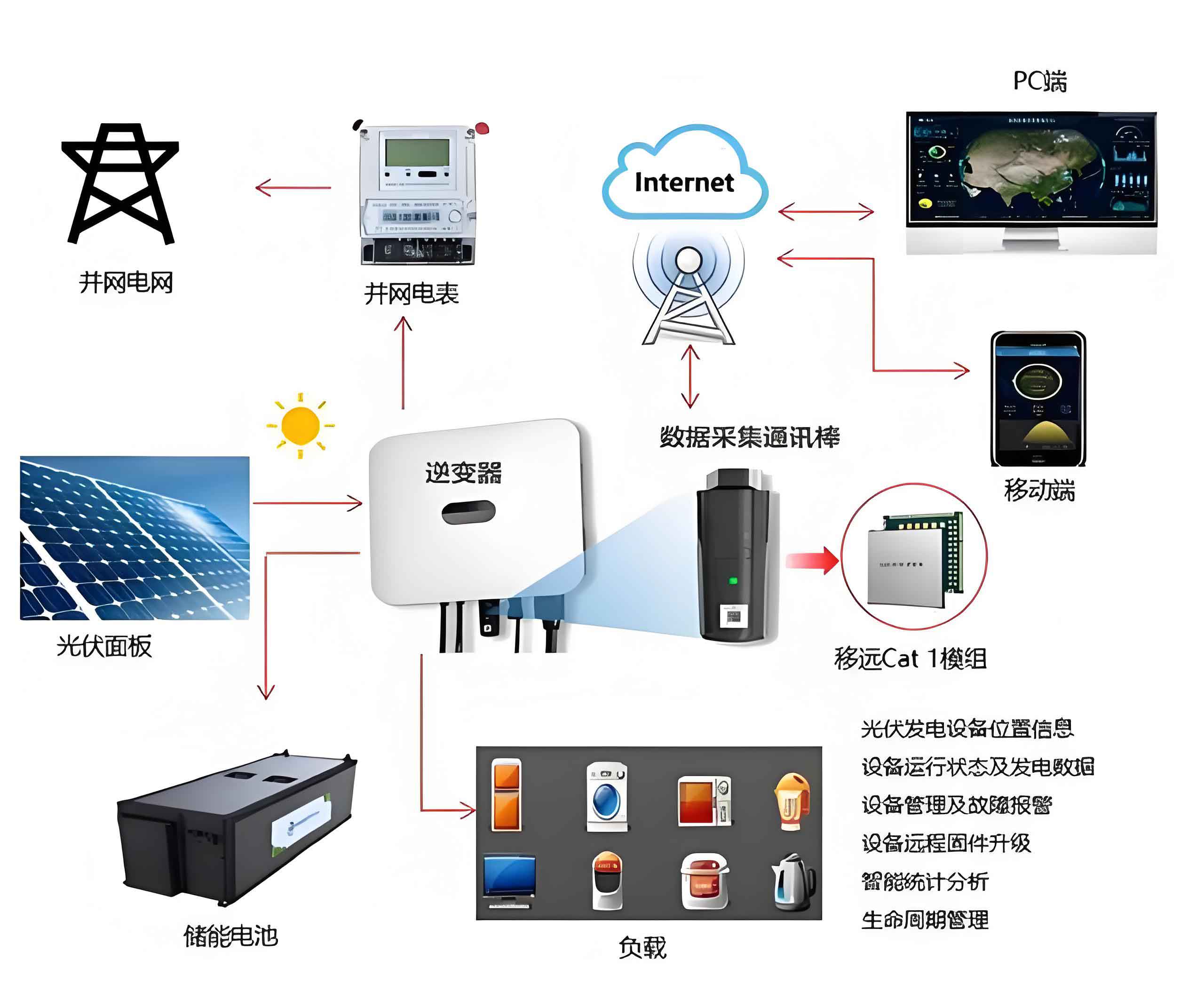
Looking at practical implementations, I recall a regional pilot project in Western Australia that demonstrated the efficacy of flexible loads. This project involved around 30 residential sites with solar systems, batteries, and controllable devices, all connected to a single transformer. The goal was to increase solar penetration while managing reverse power flows and peak demand. By using a cloud-based platform for real-time monitoring and control, the project achieved closed-loop network management. Data from the transformer and households enabled dynamic dispatch of resources every 5 minutes, aligning with wholesale market intervals. Key outcomes included reduced transformer overload and enhanced solar utilization, as shown in Table 3.
| Metric | Before Management | After Management | Improvement |
|---|---|---|---|
| Peak Transformer Load (kW) | 150 | 120 | 20% reduction |
| Reverse Power Flow Incidents | Frequent during midday | Minimal | Over 90% decrease |
| Solar Curtailment Energy (kWh/day) | 0 | Controlled as needed | Optimized for grid constraints |
From my analysis, this pilot underscores the value of treating solar systems as flexible assets. The solar system at each site could be curtailed strategically to prevent grid issues, while batteries and loads provided additional balancing. The total value stacked from these resources can be quantified as:
$$ V_{\text{total}} = V_{\text{energy}} + V_{\text{network}} + V_{\text{ancillary}} $$
where \( V_{\text{energy}} \) is revenue from energy sales, \( V_{\text{network}} \) is savings from deferred infrastructure upgrades, and \( V_{\text{ancillary}} \) is income from grid services like frequency regulation. For a solar system, contributions to \( V_{\text{network}} \) are particularly significant when curtailment avoids transformer upgrades.
Looking ahead, I envision a future where DER management expands beyond simple battery control. The optimization of tomorrow’s energy system will require granular visibility and control of diverse assets across multiple levels—from individual sites to low-voltage networks and energy markets. In my opinion, key enablers include advanced forecasting, standardized communication protocols, and dynamic pricing mechanisms. For instance, forecasting solar generation from distributed solar systems is crucial for proactive dispatch. A simple forecasting model can use historical data:
$$ \hat{P}_{\text{PV}}(t) = \alpha \cdot G(t) + \beta \cdot T(t) + \epsilon $$
where \( \hat{P}_{\text{PV}} \) is the predicted solar output, \( G(t) \) is solar irradiance, \( T(t) \) is temperature, and \( \alpha, \beta \) are coefficients. Integrating this into DERMS allows for better scheduling of flexible loads.
Moreover, I see opportunities for algorithmic trading in markets. By aggregating solar systems and other resources, VPPs can participate in energy and ancillary service markets. The bidding strategy can be formulated as a stochastic optimization problem. Let \( R_{\text{market}}(t) \) be the revenue from market participation, and \( P_{\text{dispatch}}(t) \) the aggregated power from flexible loads. Then:
$$ \max \mathbb{E} \left[ \sum_{t} R_{\text{market}}(t) – C_{\text{operation}}(t) \right] $$
subject to reliability constraints. This highlights the economic potential of leveraging solar systems in such portfolios.
To further elaborate on technical aspects, I have developed Table 4 to compare different control strategies for flexible loads, emphasizing solar system integration.
| Strategy | Description | Advantages | Challenges |
|---|---|---|---|
| Centralized Dispatch | DERMS sends direct commands to all resources | High coordination, optimal for grid support | Relies on robust communication, single point of failure |
| Decentralized Autonomous | Resources respond locally to signals (e.g., voltage/frequency) | Scalable, resilient | May not achieve global optimum |
| Hybrid Approach | Combines centralized oversight with local autonomy | Balances efficiency and reliability | Complex implementation |
In my view, the hybrid approach is promising for managing high penetrations of solar systems. It allows for real-time adjustments based on local conditions while adhering to broader grid objectives. For example, a solar system inverter might autonomously curtail output if voltage exceeds a threshold, but also receive setpoints from a DERMS for market-driven dispatch.
Another critical aspect is the cybersecurity of these systems. As we increase connectivity, protecting data and control signals becomes paramount. I recommend encryption and authentication protocols for all communications involving solar systems and other DERs. The risk of unauthorized access can be modeled probabilistically, but that is beyond the scope of this article.
Furthermore, customer engagement is essential. For flexible load programs to succeed, asset owners must be compensated fairly and retain control over their comfort. This involves transparent contracts and real-time feedback mechanisms. I suggest using mobile apps to show how their solar system contributes to grid stability and earns rewards.
In terms of scalability, cloud computing platforms can handle the data-intensive tasks of monitoring and optimizing thousands of solar systems. The computational complexity for a VPP with \( N \) sites can be approximated as \( O(N \log N) \) for certain algorithms, enabling efficient management even as DER numbers grow.
To conclude, I am convinced that the future of energy management lies in fully flexible loads. By embracing solar systems as integral components of these loads, we can achieve value stacking, enhance grid resilience, and accelerate the transition to sustainable energy. The journey requires collaboration among utilities, technology providers, and policymakers, but the benefits—both economic and environmental—are immense. As we refine these approaches, continuous innovation in algorithms, hardware, and market design will be key to unlocking the full potential of distributed energy resources.