
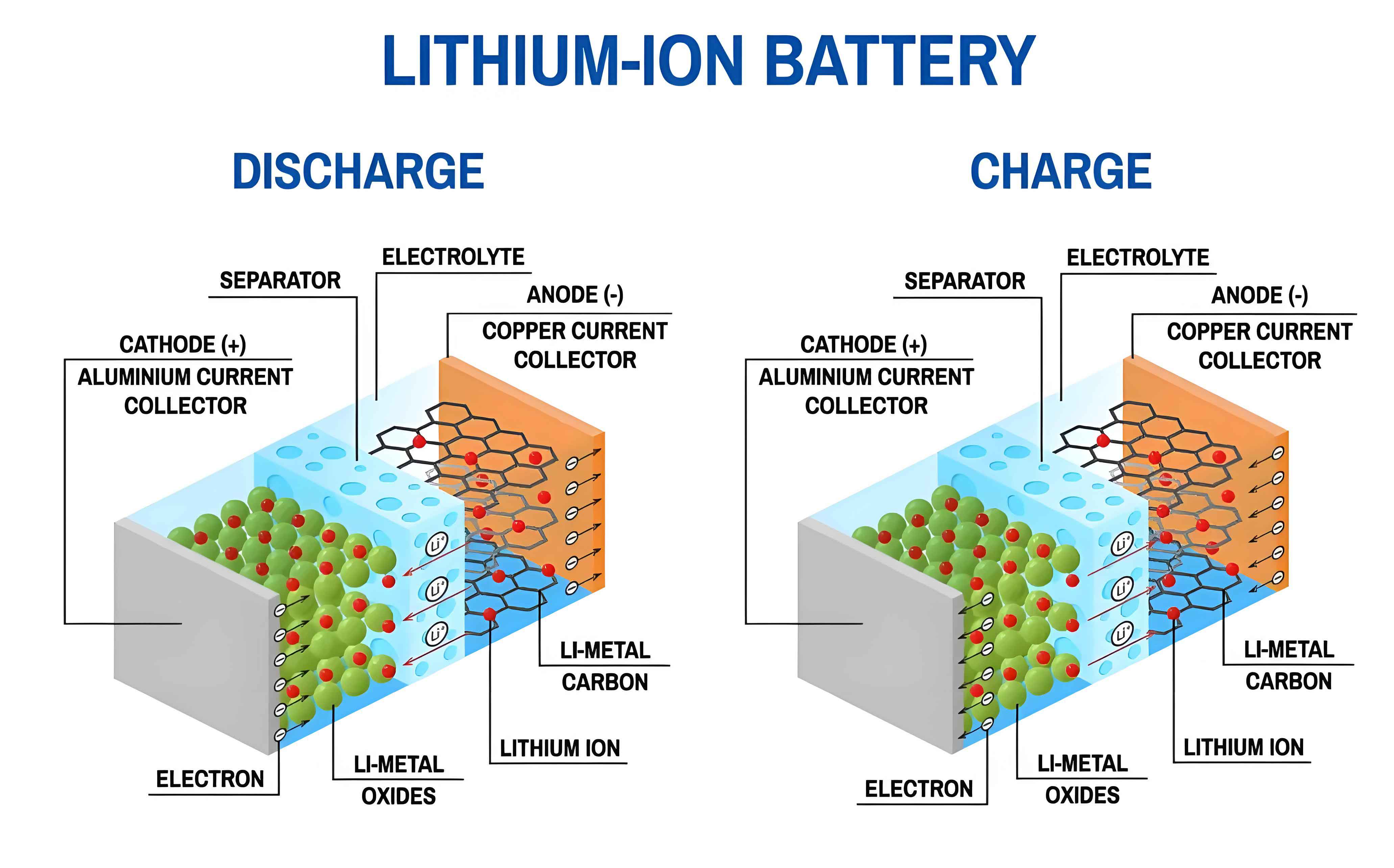
With the rapid growth of the lithium ion battery industry, recycling facilities face critical challenges in maintaining product purity while optimizing operational costs. This paper systematically analyzes metal contamination risks and proposes integrated engineering solutions through equipment selection, facility design, and process optimization.
1. Metal Contamination Mechanisms
Critical metallic impurities (Fe, Cu, Zn, Ni, Cr) primarily originate from:
- Raw material residues (0.5-3.2 ppm)
- Equipment wear (rotary kilns: 0.8 μm/hr erosion rate)
- Structural corrosion ($\Delta m = k \cdot t^n$, where $k$=corrosion rate constant)
2. Multi-stage Purification System Design
The purification efficiency ($\eta$) can be modeled as:
$$ \eta = 1 – \prod_{i=1}^{n} (1 – \eta_i) $$
Where $\eta_i$ represents the removal efficiency at stage $i$. Typical configuration includes:
| Stage | Technology | Efficiency | Cost (USD/m³) |
|---|---|---|---|
| Primary | Magnetic Separation | 85-92% | 120-150 |
| Secondary | Eddy Current | 78-85% | 200-230 |
| Tertiary | Electrostatic | 93-97% | 350-400 |
3. Facility Design Optimization
The total cost function for structural design considers:
$$ C_{total} = C_{mat} + C_{lab} + C_{energy} $$
Where material costs follow:
$$ C_{mat} = \sum (A_i \cdot \rho_i \cdot P_i) $$
$A_i$ = material area, $\rho_i$ = density, $P_i$ = unit price
3.1 Comparative Analysis of Air Handling Systems
| Parameter | Galvanized Duct | Fabric Duct |
|---|---|---|
| Installation Cost (USD/m²) | 450 | 130-200 |
| Maintenance Cycle | 5 years | 8-10 years |
| Contamination Risk | High | Low |
4. Energy Recovery Systems
Thermal efficiency in rotary calcination processes can be enhanced through:
$$ \eta_{thermal} = \frac{Q_{recovered}}{Q_{input}} \times 100\% $$
Advanced heat exchangers achieve 72-85% recovery rates, reducing energy costs by 30-40%.
5. Process Water Optimization
The closed-loop water system reduces consumption by:
$$ \Delta V = V_{initial} – \sum_{i=1}^{n} V_{recycle,i} $$
Typical water recovery rates exceed 92% through multi-stage filtration and ion exchange.
6. Economic Analysis
The net present value (NPV) for contamination control measures:
$$ NPV = -C_0 + \sum_{t=1}^{T} \frac{C_t}{(1+r)^t} $$
Where $C_0$ = initial investment, $C_t$ = annual savings, $r$ = discount rate. Typical payback periods range 2.5-4 years.
7. Advanced Monitoring Systems
Real-time impurity detection using LIBS (Laser-Induced Breakdown Spectroscopy) achieves:
$$ LOD = 3\sigma = 0.2-0.5 \, \text{ppm} $$
Enabling immediate process adjustments when contamination exceeds thresholds.
8. Lifecycle Management
The degradation model for lithium ion battery cathode materials:
$$ \frac{dC}{dt} = -kC^n $$
Where $C$ = capacity, $k$ = degradation rate, $n$ = reaction order. Proper contamination control reduces $k$ by 40-60%.
9. Future Directions
Emerging technologies like AI-driven material sorting and superconducting magnetic separation promise:
- 15-20% improvement in metal recovery rates
- 30-50% reduction in energy consumption
- Purity levels >99.95% for battery-grade materials
This integrated approach demonstrates that comprehensive contamination control in lithium ion battery recycling plants not only ensures product quality but also delivers significant economic benefits through optimized resource utilization and energy efficiency.