
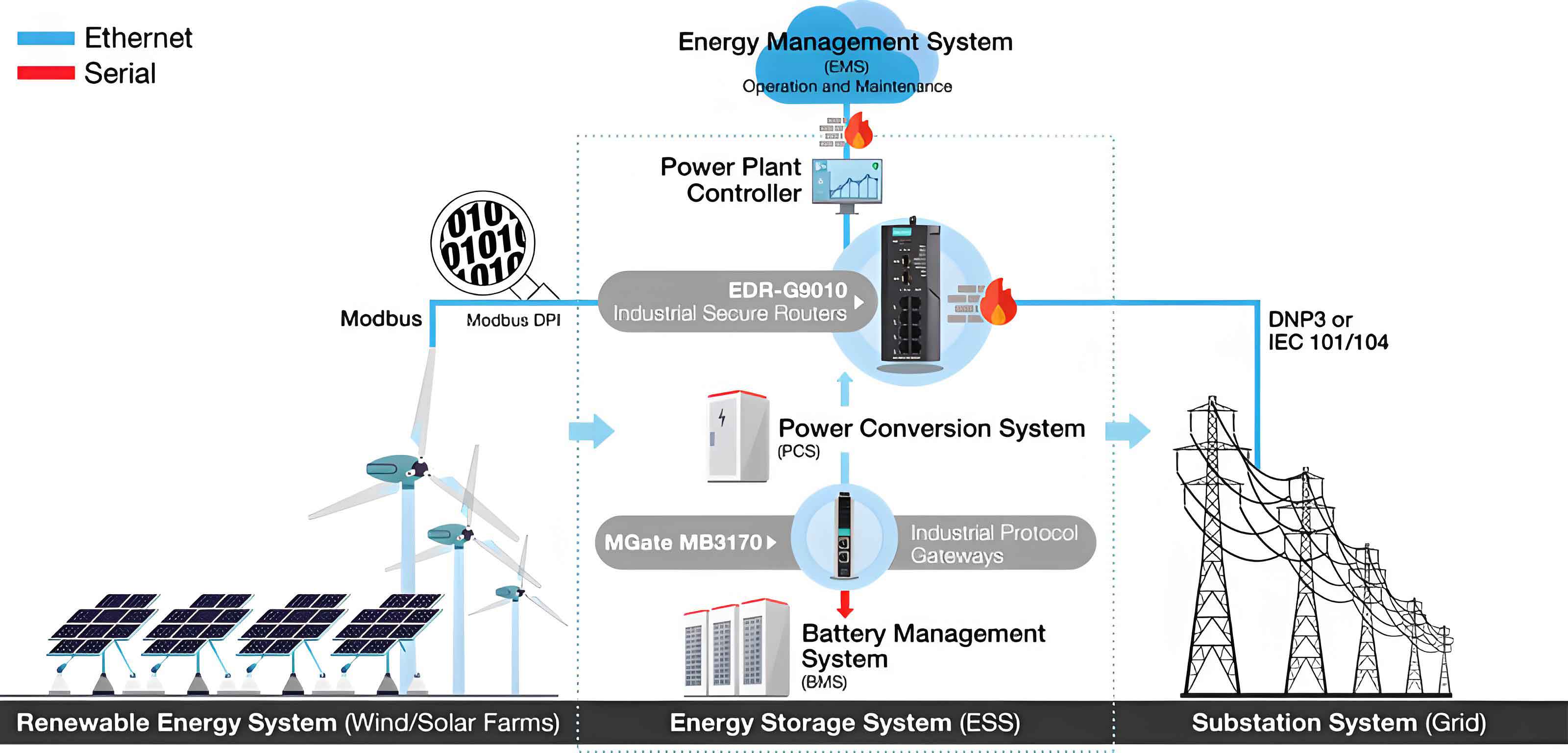
The rapid transition from fossil fuels to renewable energy sources has intensified the demand for efficient energy storage systems. Lithium-ion batteries (LIBs), with their high energy density and extended cycle life, dominate modern energy storage applications. However, their inherent risk of thermal runaway—a self-sustaining exothermic reaction—poses significant fire and explosion hazards. This article explores fire suppression methods tailored for lithium-ion battery energy storage systems, emphasizing early detection, cooling efficacy, and propagation control.
1. Thermal Runaway Mechanisms in Energy Storage Systems
Thermal runaway in LIBs arises from uncontrolled heat generation due to internal short circuits, overcharging, mechanical damage, or external thermal exposure. The process can be modeled using the Arrhenius equation to describe temperature-dependent reaction kinetics:
$$ \frac{dQ}{dt} = A \cdot e^{-\frac{E_a}{RT}} $$
where \( Q \) is heat generation, \( A \) the pre-exponential factor, \( E_a \) activation energy, \( R \) gas constant, and \( T \) temperature. When heat dissipation fails to offset \( \frac{dQ}{dt} \), cell temperatures exceed critical thresholds (e.g., 80–120°C for separator meltdown), triggering cascading failures.
| Stage | Process | Temperature Range |
|---|---|---|
| 1 | SEI decomposition | 60–120°C |
| 2 | Electrolyte decomposition | 120–250°C |
| 3 | Cathode material breakdown | >250°C |
2. Fire Suppression Methods for Energy Storage Systems
2.1 Water-Based Systems
Traditional sprinklers and water mist systems exploit water’s high heat capacity (\( C_p = 4.18 \, \text{kJ/kg·K} \)) for cooling. However, LIB fires require 5–10× more water than conventional fires due to reignition risks. The cooling efficiency \( \eta \) can be approximated as:
$$ \eta = \frac{\dot{m}_w \cdot C_p \cdot \Delta T}{P_{bat}} $$
where \( \dot{m}_w \) is water flow rate, \( \Delta T \) temperature reduction, and \( P_{bat} \) battery thermal power. Challenges include electrical conductivity (\( \sigma = 0.5 \, \text{S/m} \)) inducing short circuits and HF gas generation from PF₅ hydrolysis.
2.2 Inert Gas Systems
Inert gases (N₂, CO₂, Ar) reduce oxygen concentration below combustion thresholds (typically <15% O₂). The required gas volume \( V_g \) for suppression in a confined energy storage system is:
$$ V_g = \frac{V_{enclosure} \cdot (C_{O2,initial} – C_{O2,target})}{C_{O2,initial} – C_{O2,gas}} $$
Limitations include poor cooling capacity and inability to prevent thermal propagation between modules.
2.3 Clean Agent Systems
Fluorinated ketones (e.g., Novec 1230) and hydrofluoroolefins (e.g., FM-200) suppress flames through radical scavenging. Their effectiveness depends on design concentration \( C_d \):
$$ C_d = \frac{\dot{m}_a \cdot t}{V_{enclosure}} $$
where \( \dot{m}_a \) is agent discharge rate and \( t \) discharge time. Toxicity concerns persist due to HF formation at high temperatures.
| Method | Cooling Efficiency | Reignition Prevention | Toxic Byproducts |
|---|---|---|---|
| Water mist | High | Moderate | HF, CO |
| Inert gas | Low | Poor | None |
| Clean agents | Medium | Good | HF (thermal decomposition) |
3. Integrated Strategies for Energy Storage System Safety
Effective fire protection in lithium-ion energy storage systems requires multi-layer approaches:
- Early detection: Combine voltage monitoring (\( \Delta V/\Delta t > 50 \, \text{mV/s} \)), temperature gradients (\( \nabla T > 2°C/cm \)), and gas sensors (CO, H₂).
- Compartmentalization: Implement fire-rated barriers with thermal conductivity \( \lambda < 0.1 \, \text{W/m·K} \).
- Hybrid suppression: Sequence inert gas for flame knockdown followed by water mist for cooling.
For large-scale energy storage systems, the critical heat flux \( \dot{q}”_{crit} \) to prevent thermal runaway propagation is:
$$ \dot{q}”_{crit} = \frac{k_{eff} \cdot (T_{crit} – T_0)}{\delta} $$
where \( k_{eff} \) is effective thermal conductivity, \( T_{crit} \) critical cell temperature, \( T_0 \) ambient temperature, and \( \delta \) inter-cell spacing.
4. Conclusion
No single suppression method fully addresses the unique challenges of lithium-ion battery energy storage systems. Successful strategies must integrate:
- Real-time thermal monitoring
- Multi-physics modeling of heat transfer (\( \nabla \cdot (k \nabla T) = \rho C_p \frac{\partial T}{\partial t} \))
- Case-specific hybrid suppression systems
Future energy storage system designs should prioritize modular architectures with intrinsic thermal barriers and advanced electrolyte formulations to reduce fire risks while maintaining energy density.