
Perovskite solar cells have emerged as a promising technology for next-generation photovoltaics due to their high efficiency, low cost, and tunable optoelectronic properties. Among them, inorganic perovskite solar cells based on CsPbX3 (X = Br, I) materials offer superior thermal stability and environmental robustness compared to their organic-inorganic hybrid counterparts. Specifically, CsPbIBr2 perovskite solar cells have gained significant attention because of their balanced bandgap and stability, making them suitable for single-junction, tandem, and semi-transparent solar cell applications. However, the performance of CsPbIBr2 perovskite solar cells is still limited by interfacial recombination and defects, particularly at the buried interface between the electron transport layer and the perovskite layer. In this work, I present a novel buried interface engineering strategy using a dipolar molecular interlayer to enhance the photovoltaic performance and stability of CsPbIBr2 perovskite solar cells.
The buried interface in perovskite solar cells plays a critical role in determining the quality of the perovskite film and the efficiency of charge transport. Defects at this interface can lead to significant non-radiative recombination, reducing the open-circuit voltage and overall power conversion efficiency. To address this, I employed 6-amino nicotinic acid (ANA) as a dipolar molecule to modify the TiO2/CsPbIBr2 buried interface. The ANA molecule features a polar structure with a carboxyl group (-COOH) that strongly interacts with the TiO2 surface, forming a stable dipolar interlayer. This interlayer not only improves the wettability of the TiO2 substrate for the CsPbIBr2 precursor solution but also optimizes the energy level alignment and reduces interface defects.
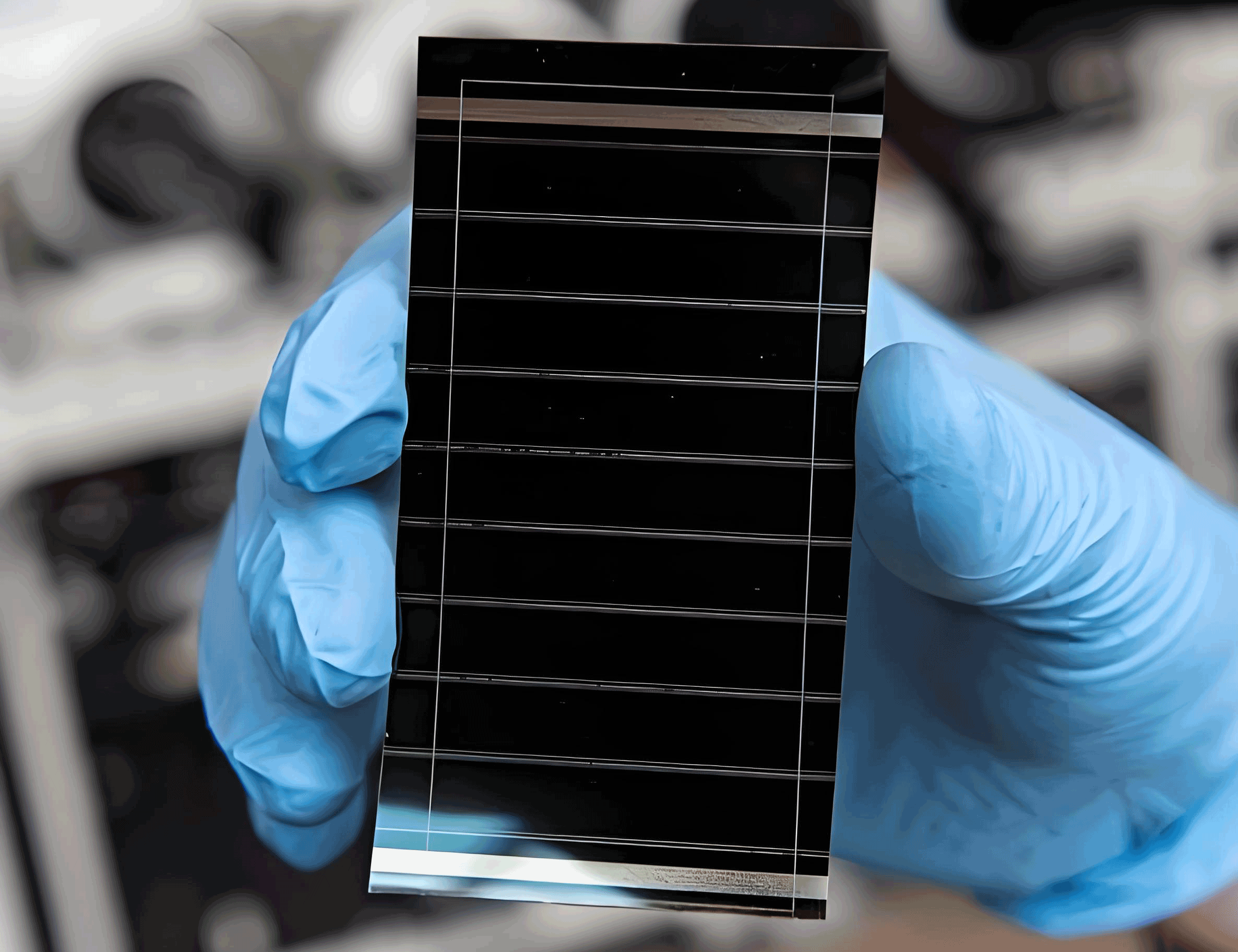
The formation of the ANA dipolar interlayer was confirmed through various characterization techniques. The adsorption energy of ANA on the TiO2 surface was calculated using density functional theory (DFT) simulations. The adsorption energy (E_ad) is given by the equation:
$$ E_{ad} = E_{ANA-sub} – E_{ANA} – E_{sub} $$
where E_{ANA-sub} is the total energy of the ANA-TiO2 system, E_{ANA} is the energy of the isolated ANA molecule, and E_{sub} is the energy of the TiO2 substrate. The calculations revealed that ANA molecules adsorb preferentially via a bidentate coordination of the -COOH group to TiO2, with an adsorption energy of approximately -1.5 eV, indicating a strong and stable interaction. This dipolar interlayer modifies the work function of the TiO2 layer, as evidenced by ultraviolet photoelectron spectroscopy (UPS) measurements. The work function (Φ) of TiO2 shifted from -4.34 eV to -4.18 eV after ANA modification, which facilitates better electron extraction and reduces energy losses at the interface.
The impact of the ANA interlayer on the perovskite film morphology and crystallinity was systematically investigated. The wettability of the CsPbIBr2 precursor solution on the TiO2 surface was evaluated by contact angle measurements. The contact angle decreased from 11.9° to 6.1° after ANA modification, indicating enhanced wetting and more uniform coverage. This improvement in wettability promotes homogeneous nucleation and growth of the CsPbIBr2 perovskite, leading to larger grain sizes and reduced grain boundaries. Scanning electron microscopy (SEM) images showed that the ANA-modified films exhibited a dense, pinhole-free morphology with an average grain size of approximately 1 μm, compared to 0.5 μm for the control films. The enhanced film quality was further confirmed by X-ray diffraction (XRD) analysis, which showed increased crystallinity and preferred orientation in the ANA-modified samples.
The electronic properties and charge carrier dynamics at the buried interface were studied using time-resolved photoluminescence (TRPL) and electrochemical impedance spectroscopy (EIS). The TRPL decay curves were fitted with a bi-exponential function to extract the carrier lifetimes. The average carrier lifetime (τ_avg) is given by:
$$ \tau_{avg} = \frac{A_1 \tau_1^2 + A_2 \tau_2^2}{A_1 \tau_1 + A_2 \tau_2} $$
where A1 and A2 are amplitudes, and τ1 and τ2 are decay time constants. The ANA-modified samples showed a shorter carrier lifetime (5.64 ns) compared to the control (7.95 ns), indicating faster electron extraction and reduced recombination at the interface. This is consistent with the improved energy level alignment and enhanced interface contact. The series resistance (R_s) and recombination resistance (R_rec) were derived from EIS Nyquist plots using the equivalent circuit model. The ANA modification reduced R_s from 25 Ω to 18 Ω and increased R_rec from 500 Ω to 800 Ω, demonstrating lower charge transport losses and suppressed recombination.
The photovoltaic performance of the CsPbIBr2 perovskite solar cells with and without the ANA interlayer was evaluated under standard AM 1.5G illumination. The current density-voltage (J-V) curves were measured, and key parameters including short-circuit current density (J_sc), open-circuit voltage (V_oc), fill factor (FF), and power conversion efficiency (PCE) were extracted. The results are summarized in Table 1 for different ANA concentrations.
| ANA Concentration (mg/mL) | J_sc (mA/cm²) | V_oc (V) | FF | PCE (%) |
|---|---|---|---|---|
| 0 (Control) | 10.21 | 1.24 | 0.63 | 7.99 |
| 1 | 10.85 | 1.28 | 0.64 | 8.87 |
| 3 | 11.56 | 1.32 | 0.72 | 10.98 |
| 5 | 11.02 | 1.30 | 0.68 | 9.74 |
The optimal ANA concentration of 3 mg/mL yielded a PCE of 10.98%, which is a 37% improvement over the control device. This enhancement is attributed to the synergistic effects of improved film quality, optimized energy level alignment, and reduced interface recombination. The stability of the perovskite solar cells was also investigated under continuous illumination and ambient conditions (25°C ± 3°C, 30% ± 5% relative humidity). The normalized PCE as a function of time is shown in Table 2.
| Time (days) | Normalized PCE (%) – Control | Normalized PCE (%) – ANA-modified |
|---|---|---|
| 0 | 100 | 100 |
| 15 | 75 | 95 |
| 30 | 50 | 92 |
| 45 | 30 | 90 |
The ANA-modified devices retained over 90% of their initial PCE after 45 days, whereas the control devices degraded to 30% of their initial value. This superior stability is due to the passivation of interface defects and the suppression of ion migration and phase segregation. The light-soaking stability was tested under continuous illumination at 100 mW/cm² for 120 minutes. The ANA-modified cells maintained over 95% of their initial performance, while the control cells showed a 20% drop, indicating enhanced photostability.
To further understand the role of the ANA interlayer in defect passivation, I performed theoretical calculations using DFT. The density of states (DOS) for the TiO2/ANA and TiO2/CsPbIBr2 interfaces was computed. The bandgap (E_g) and defect states were analyzed using the following formula for defect formation energy (E_def):
$$ E_{def} = E_{tot,def} – E_{tot,perfect} – \sum n_i \mu_i $$
where E_tot,def and E_tot,perfect are the total energies of the defective and perfect systems, n_i is the number of atoms of type i added or removed, and μ_i is the chemical potential of species i. The calculations showed that the ANA interlayer reduces the density of mid-gap states associated with oxygen vacancies in TiO2 and halide vacancies in CsPbIBr2, thereby minimizing non-radiative recombination pathways.
The charge transport properties were modeled using the drift-diffusion equation for electron current density (J_n):
$$ J_n = q \mu_n n \frac{dE_c}{dx} + q D_n \frac{dn}{dx} $$
where q is the electron charge, μ_n is the electron mobility, n is the electron concentration, E_c is the conduction band energy, and D_n is the diffusion coefficient. The ANA interlayer enhances electron mobility by reducing interface scattering and improving the energy level alignment, as evidenced by the higher J_sc and FF in the modified devices.
In conclusion, the incorporation of a dipolar ANA interlayer at the buried interface of CsPbIBr2 perovskite solar cells significantly enhances both the photovoltaic performance and stability. This work demonstrates the importance of interface engineering in perovskite solar cells and provides a scalable strategy for improving the efficiency of inorganic perovskite solar cells. Future studies will focus on optimizing the molecular structure of the interlayer and extending this approach to other perovskite compositions for tandem and flexible applications.