
I am a graduate student in industrial engineering and management, and this article presents my research on optimizing the day-ahead clearing of an electrochemical energy storage system when it participates in peak shaving and frequency regulation trading. The core objective is to develop a systematic clearing optimization framework that allows both electrochemical energy storage units and conventional thermal units to coordinately provide auxiliary services in a market environment, while ensuring system security and maximizing economic benefits. Throughout this work, I focus on the term “energy storage system” as the key subject, because the electrochemical energy storage system acts as a flexible resource that can rapidly adjust its charging and discharging power to meet the dual requirements of peak shaving and frequency regulation.
1. Introduction and Background
Fossil energy consumption has led to resource depletion and severe environmental issues. Under the pressure of climate change and emission reduction targets, many countries are actively developing renewable energy sources such as wind and solar power. However, renewable generation is inherently uncertain and intermittent, which increases the difficulty of balancing supply and demand in the power system. The traditional regulating capability of conventional thermal units is no longer sufficient to fully absorb renewable generation and smooth load fluctuations. As a result, the operation of the power system has become more complex and uncertain. To guarantee the safe, stable, and economic operation of the power system, the development of energy storage technology has become an inevitable trend.
An electrochemical energy storage system has excellent regulation performance in auxiliary services such as peak shaving, frequency regulation, and reactive power support. It can respond within milliseconds, provide precise power control, and be flexibly deployed at different scales. When large-scale renewable energy is integrated, the electrochemical energy storage system can charge when surplus energy exists and discharge when demand peaks, thereby easing the pressure on conventional units and improving the host capability of renewable energy. In addition, the energy storage system participates in the ancillary service market as an independent entity, generating revenue through market clearing prices. This dual role – technical support and market participation – makes the energy storage system a valuable asset in modern power systems.
In China, the construction of electrochemical energy storage projects has accelerated rapidly. From the first hundred-megawatt battery energy storage demonstration project to the recent sodium-ion battery storage station, the scale and performance of energy storage systems continue to improve. However, the market framework and clearing mechanism for energy storage participation are still at an early stage. Many existing energy storage resources remain underutilized. Therefore, it is crucial to design a proper clearing optimization strategy that can fully exploit the flexibility of the energy storage system while satisfying the market trading rules.
2. Literature Review
Many researchers have investigated the development of energy storage technology, the technical aspects of peak shaving and frequency regulation, the clearing optimization strategies for energy storage systems, and the market trading of storage in ancillary services. I summarize the key findings from the literature as follows.
2.1 Energy Storage Technology Development
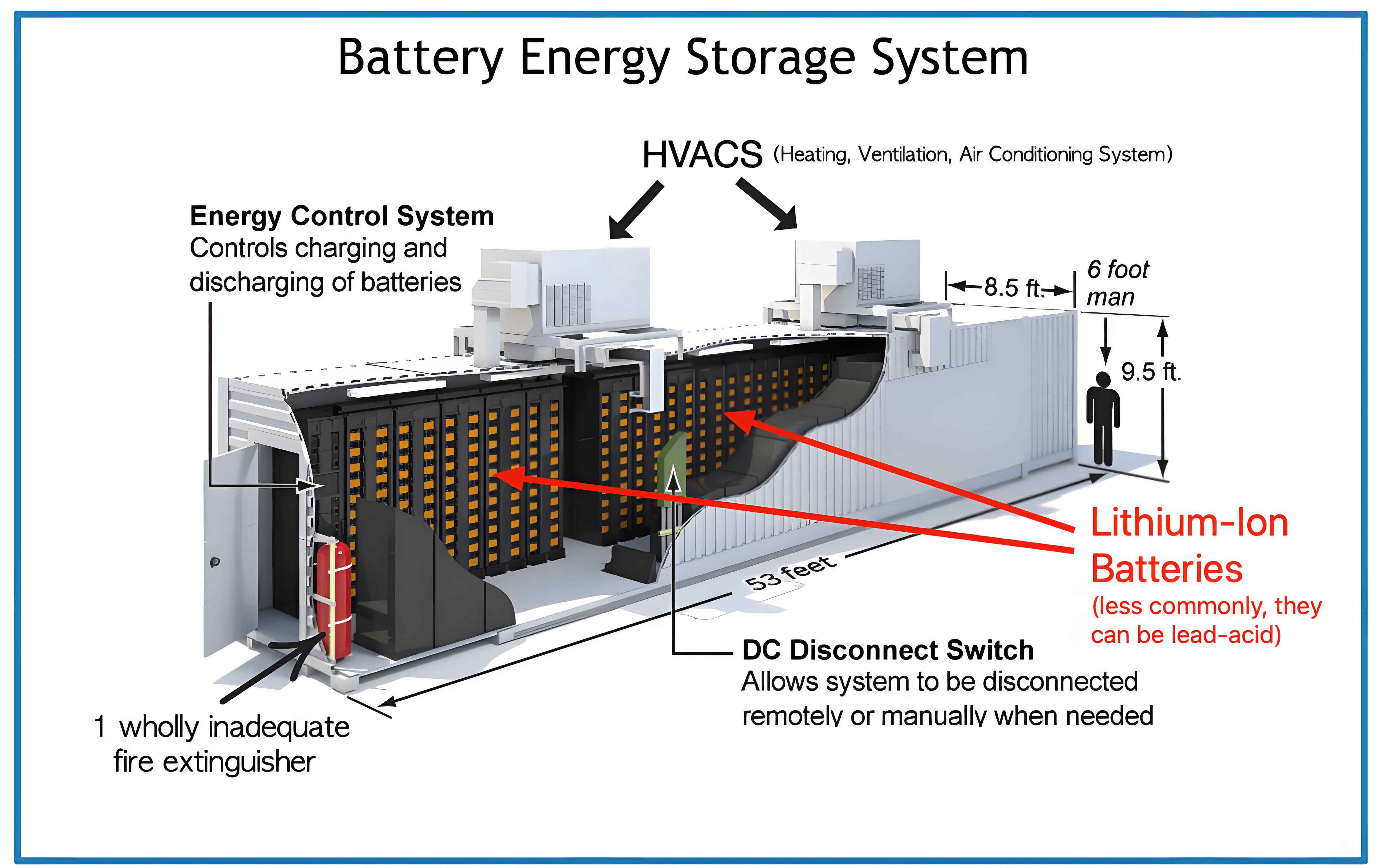
Energy storage technologies can be classified from multiple perspectives. According to the form of stored energy, they include electrical storage (electrochemical batteries, supercapacitors, superconducting magnetic storage), mechanical storage (pumped hydro, compressed air, flywheel), thermal storage, and chemical storage. In the power system, energy storage applications are usually divided into user-side, generation-side, and grid-side storage. The table below summarizes the main characteristics of different storage technologies, showing the time scale, advantages, disadvantages, and typical applications. This comparison helps explain why the electrochemical energy storage system, especially lithium-ion and sodium-ion batteries, is preferred for peak shaving and frequency regulation.
| Technology | Time Scale | Advantages | Disadvantages | Applications |
|---|---|---|---|---|
| Lithium-ion battery | millisecond | high energy density, long life, stable performance | high cost, safety risk | mobile devices, grid-side storage |
| Sodium-ion battery | millisecond | low cost, high safety | lower energy density, immature technology | large-scale storage, distributed storage |
| Flow battery | second | designable energy and power, long life | low energy density, large volume, high cost | large-scale storage stations |
| Lead-acid battery | second | mature technology, low cost, reliable | low energy density, short life, pollution | small storage, backup power |
| Supercapacitor | millisecond | high power density, fast charge, long life | low energy density, high cost | power-type devices, fast frequency regulation |
| Superconducting magnetic storage | millisecond | high power density, infinite life, high efficiency | extremely high cost, complex technology | power-type devices, fast frequency regulation |
| Pumped hydro | day | mature, large capacity, long life, low cost | geographic limitations, long construction | grid-side large-scale storage |
| Flywheel | millisecond | high power density, high efficiency, fast charge | high cost, low energy density, self-discharge | fast frequency regulation, high-power demand |
| Compressed air | minute | low cost, wide power range, environmentally friendly | geological constraints, low efficiency | large-scale storage, renewable integration |
Among these, the electrochemical energy storage system stands out because of its flexible siting, fast response, and high controllability. In my research, I focus on the battery-based electrochemical energy storage system, which is the most widely deployed technology for grid-side ancillary services today. The continuous improvement of battery materials and production processes has reduced the cost of the energy storage system, making it economically feasible to participate in the peak shaving and frequency regulation market.
2.2 Peak Shaving and Frequency Regulation Technologies
Peak shaving and frequency regulation are two essential ancillary services. Peak shaving adjusts the active power output of generators or the charging/discharging power of energy storage to follow the system load curve. Frequency regulation maintains the system frequency near the nominal value by balancing active power. In China, the peak shaving market and the frequency regulation (AGC) market are the two most active auxiliary service markets. Many studies have explored the use of the energy storage system for peak shaving, e.g., charging during low-load periods and discharging during high-load periods, while other studies have focused on fast frequency response using the energy storage system’s millisecond response capability.
Prior works often formulate an optimization model that minimizes the total operating cost or maximizes the revenue of storage owners. Some studies propose hierarchical optimization for deep peak shaving with the cooperation of thermal units and storage. Others design coordinated frequency regulation controllers that adjust the state of charge (SOC) of the energy storage system in real time. However, most existing studies treat peak shaving and frequency regulation separately. In a realistic market, the same energy storage system can provide both services simultaneously, which requires a joint clearing model that allocates power and capacity between the two services. This gap motivates my research.
2.3 Clearing Optimization Strategies for Energy Storage System
Clearing optimization determines the day-ahead or real-time schedules of market participants. For the energy storage system, clearing optimization involves deciding when to charge, when to discharge, and how much regulating capacity to bid into the ancillary service market. The objective can be cost minimization from the system perspective or profit maximization from the storage operator’s perspective. Some studies have proposed joint energy and frequency regulation market clearing models that include storage as a price-maker. Others use two-stage stochastic programming to handle uncertainties in load and renewable output.
Recent research has also introduced robust optimization and bilevel models for storage bidding. The energy storage system can act as a price-taker in the energy market but as a price-maker in the frequency regulation market due to its small capacity. This behavior requires a more sophisticated clearing model. In my work, I adopt a system-oriented view: the energy storage system and conventional units are jointly cleared in a combined peak shaving and frequency regulation market, and the resulting schedules must satisfy security constraints such as power balance, line flow limits, and reserve requirements.
2.4 Market Trading of Energy Storage in Peak Shaving and Frequency Regulation
The market participation of the energy storage system has been discussed in various contexts. Some studies optimize the bidding strategy of the energy storage system in the day-ahead and real-time markets, considering the SOC dynamics and market price uncertainty. Others analyze the economic value of battery storage in the joint energy and frequency regulation markets. There are also studies on shared energy storage business models where multiple users share a single storage system. The revenue streams of the energy storage system include peak-valley price arbitrage, capacity leasing, capacity compensation, and ancillary service payments. In this paper, I concentrate on peak shaving (arbitrage) and frequency regulation (capacity and mileage payments) as the two main revenue sources.
3. Market Framework for Energy Storage Participation in Ancillary Services
To model the clearing optimization of the energy storage system, I first establish the market framework based on the current development of China’s ancillary service market. The Chinese auxiliary service market has gone through four phases: free provision, planned compensation, market-oriented exploration, and accelerated marketization. Now, the market covers six regional grids and more than 30 provinces. The market products include regulation, reserve, reactive power support, black start, and emerging products such as fast frequency response, ramping products, and inertia support.
3.1 Domestic Ancillary Service Market Development
The table below summarizes the evolution of China’s ancillary service market. It illustrates how the energy storage system has gradually been allowed to participate as an independent entity.
| Stage | Time | Characteristics |
|---|---|---|
| Free provision | before 2002 | Generators must provide frequency and reserve for free |
| Planned compensation | 2002–2015 | Administrative compensation based on cost |
| Market-oriented exploration | 2015–2020 | Pilot markets for peak shaving and frequency regulation in several provinces |
| Accelerated marketization | after 2020 | Nationwide construction, independent storage participation |
Since 2024, the National Energy Administration has issued several important rules to standardize the participation of new types of storage in the market. The energy storage system can now provide auxiliary services such as peak shaving, frequency regulation, reserve, ramping, and black start, and be paid according to market clearing prices. The ancillary service market framework consists of three core parts: the market operator, the service providers, and the trading support system. The market operator includes grid companies, power exchange centers, and dispatching centers. Service providers include generators, the energy storage system, demand response resources, and virtual power plants.
3.2 Trading Mechanism of the Energy Storage System in Peak Shaving and Frequency Regulation
When the energy storage system participates in the peak shaving market, it can earn revenue through direct bidding, peak-valley price arbitrage, or shared storage business models. In the frequency regulation market, the energy storage system submits its capacity bids one day ahead, and the system operator clears the market based on the regulation requirement and the submitted prices. The energy storage system can provide both up and down regulation capacity because it can charge and discharge quickly. The revenue of the energy storage system from frequency regulation includes a capacity payment and a mileage payment, both multiplied by the performance score.
The clearing process used in this paper follows the joint energy and ancillary service market clearing mechanism similar to CAISO. The day-ahead market performs co-optimization of energy and frequency regulation via a security-constrained unit commitment (SCUC) and a security-constrained economic dispatch (SCED). The following flowchart-like list shows the main steps:
- The system operator forecasts the net load curve based on renewable output and demand predictions.
- The peak shaving demand is derived from the net load curve, and the frequency regulation demand is derived from the ramping requirements of the net load.
- Each unit submits its capacity and price bids for both the energy and ancillary service markets.
- The SCUC model determines the unit commitment status to minimize total cost while satisfying security constraints.
- The SCED model calculates the economic dispatch, nodal prices, and cleared quantities for the energy storage system and conventional units.
- If the system lacks sufficient regulation capacity, the energy storage system is dispatched at its maximum available capacity, and the bids are adjusted iteratively.
3.3 Clearing Optimization Models for Energy Storage Participation
There are several types of models suitable for clearing optimization of the energy storage system in peak shaving and frequency regulation trading. I briefly present three common ones:
| Model | Objective | Solution method | Advantages | Limitations |
|---|---|---|---|---|
| Multi-objective optimization | minimize cost and maximize revenue/safety | evolutionary algorithms, weighted sum | balances conflicting objectives | heavily dependent on weighting, Pareto set not unique |
| Two-stage optimization | minimize first-stage cost, then optimize second-stage dispatch | decomposition, mixed-integer programming | handles uncertainty and sequential decisions | coupling may reduce global optimality |
| Robust optimization | minimize worst-case cost | robust counterpart, MILP | immune to parameter uncertainty | overly conservative, high computational burden |
For my study, I choose the security-constrained unit commitment and security-constrained economic dispatch framework. This framework is widely used in market clearing and can naturally incorporate the operational constraints of the energy storage system, such as SOC dynamics, charging/discharging power limits, and minimum up/down time constraints for thermal units.
4. Day-Ahead Clearing Optimization Model for the Energy Storage System
4.1 Clearing Principles
I design the clearing principles based on the coordination between the energy storage system and conventional units. The key principle is that conventional units provide the base-load capacity and participate in depth peak shaving when necessary, while the energy storage system responds quickly to the remaining peak shaving and frequency regulation requirements. The energy storage system should prioritize charging during low electricity price periods and discharging during high price periods to maximize arbitrage profit. For frequency regulation, the energy storage system should only be called upon when the frequency deviation exceeds the threshold that conventional units cannot handle alone, unless the market price justifies its participation. However, from the market perspective, the energy storage system can also provide frequency regulation voluntarily when it is profitable to do so, as long as the system security constraints are satisfied.
Another important principle is the coordination between different time scales. Peak shaving is scheduled on a 15-minute basis in the day-ahead market, while frequency regulation is a real-time service that requires reserved capacity. In the day-ahead clearing model, I reserve a certain amount of power and capacity from the energy storage system for frequency regulation, and the remaining capacity is used for energy arbitrage. This ensures that the energy storage system can respond to frequency deviations without violating its SOC limits or charging/discharging power limits.
4.2 Objective Function for SCUC Model
The first stage is the security-constrained unit commitment (SCUC) model. Its objective is to minimize the total operating cost over the next day with a 15-minute resolution (96 time periods). The total cost includes the operating cost of conventional units, startup and shutdown costs, the charging/discharging cost of the energy storage system, and the frequency regulation costs of both conventional units and the energy storage system. The mathematical formulation is:
$$\min \quad C_{total} = C_{G-O} + C_{G-UD} + C_{B} + C_{G-F} + C_{B-F}$$
where:
$$C_{G-O} = \sum_{i}\sum_{k}\sum_{t} \lambda_{G} \cdot P^{G-O}_{i,k,t}$$
$$C_{G-UD} = \sum_{i}\sum_{k}\sum_{t} \left( C^{G-U}_{i,k,t} + C^{G-D}_{i,k,t} \right)$$
$$C_{B} = \sum_{i}\sum_{k}\sum_{t} \left( \lambda_{Bc} \cdot P^{Bc}_{i,k,t} – \lambda_{Bd} \cdot P^{Bd}_{i,k,t} \right)$$
$$C_{G-F} = \sum_{i}\sum_{k}\sum_{t} \left( \lambda_{E}^{G} \cdot E^{G}_{bid,i,k,t} + \lambda_{D}^{G} \cdot D^{G}_{bid,i,k,t} \right)$$
$$C_{B-F} = \sum_{i}\sum_{k}\sum_{t} \left( \lambda_{E}^{B} \cdot E^{B}_{bid,i,k,t} + \lambda_{D}^{B} \cdot D^{B}_{bid,i,k,t} \right)$$
In these expressions, \(\lambda_{G}\) is the generation cost coefficient of conventional unit \(k\) at node \(i\), and \(P^{G-O}_{i,k,t}\) is the power output dispatched to the peak shaving market in period \(t\). \(C^{G-U}\) and \(C^{G-D}\) are startup and shutdown costs. \(\lambda_{Bc}\) and \(\lambda_{Bd}\) are the charging and discharging price bids of the energy storage system, respectively. \(P^{Bc}\) and \(P^{Bd}\) are the charging and discharging powers of the energy storage system. In the frequency regulation part, \(\lambda_{E}^{G}\) and \(\lambda_{D}^{G}\) are the capacity and mileage clearing prices for conventional units, while \(E^{G}_{bid}\) and \(D^{G}_{bid}\) are the cleared capacity and mileage quantities. Similarly, superscript \(B\) denotes the energy storage system.
4.3 Objective Function for SCED Model
After the SCUC determines the on/off status of conventional units and the charging/discharging status of the energy storage system, the SCED model is executed to maximize the total market surplus or equivalently maximize the total profit of all participating units. In my model, I maximize the total income from energy and ancillary services:
$$\max \quad I_{total} = I_{G} + I_{B}$$
where the income of conventional unit \(i,k\) is:
$$I_{G} = \sum_{i}\sum_{k}\sum_{t} \left[ \lambda_{i,t} \cdot P^{G}_{i,k,t} + \lambda_{E}^{G} E^{G}_{bid} + \lambda_{D}^{G} D^{G}_{bid} – C^{G-O}_{i,k,t} – C^{G-UD}_{i,k,t} – C^{G-F}_{i,k,t} \right]$$
and the income of the energy storage system is:
$$I_{B} = \sum_{i}\sum_{k}\sum_{t} \left[ \lambda_{i,t} \cdot P^{B}_{i,k,t} + \lambda_{E}^{B} E^{B}_{bid} + \lambda_{D}^{B} D^{B}_{bid} + \lambda_{C} \cdot P^{B}_{i,k,t} – C^{B}_{i,k,t} – C^{B-F}_{i,k,t} \right]$$
Here, \(\lambda_{i,t}\) is the locational marginal price (LMP) at node \(i\) in period \(t\). The LMP is obtained from the dual variables of the power balance constraint. \(\lambda_{C}\) is the compensation price for the peak shaving service provided by the energy storage system. The node price is calculated as:
$$\lambda_{i} = \lambda_{0} – \sum_{k} \gamma_{i,k} \left( P_{k}^{+} – P_{k}^{-} \right)$$
where \(\lambda_{0}\) is the reference bus price, \(\gamma_{i,k}\) is the power transfer distribution factor (PTDF) from node \(i\) to branch \(k\), and \(P_{k}^{+}\) and \(P_{k}^{-}\) are the upper and lower limits of the branch power flow.
4.4 System Constraints
Both SCUC and SCED models must satisfy a set of operational and physical constraints. I list the constraints below.
4.4.1 Energy Storage System Capacity Constraint
The stored energy in the energy storage system must remain within the rated capacity bounds. The energy balance equation includes the charging and discharging losses:
$$0 \leq E^{B}_{t} \leq E^{B}_{rated}$$
$$E^{B}_{t} = E^{B}_{t-1} + \eta_{c} \cdot P^{Bc}_{t} – \frac{1}{\eta_{d}} \cdot P^{Bd}_{t}$$
where \(E^{B}_{t}\) is the total stored energy at time \(t\), \(E^{B}_{rated}\) is the rated capacity, \(\eta_{c}\) and \(\eta_{d}\) are the charging and discharging efficiencies, and \(P^{Bc}_{t}\) and \(P^{Bd}_{t}\) are the total charging and discharging powers of the energy storage system.
4.4.2 State of Charge (SOC) Constraint
The SOC of each energy storage unit must be kept within its minimum and maximum limits, and the final SOC should be restored to a prescribed value for the next day:
$$S_{\min} \leq S_{i,k,t} \leq S_{\max}$$
$$S_{i,k,t} = S_{i,k,t-1} + \left( \eta_{c} \cdot P^{Bc}_{i,k,t} – \frac{1}{\eta_{d}} \cdot P^{Bd}_{i,k,t} \right) \frac{\Delta t}{E^{B}_{i,k,rated}}$$
$$S_{i,k,T} = S^{N}_{i,k}$$
In the above, \(S_{i,k,t}\) is the SOC of the energy storage unit \(k\) at node \(i\) at time \(t\), \(S_{\min}\) and \(S_{\max}\) are the lower and upper SOC limits, \(S^{N}_{i,k}\) is the required SOC at the end of the day, and \(\Delta t\) is the time interval (15 minutes / 60 = 0.25 hours).
4.4.3 Charging and Discharging Power Limits
The charging and discharging power of the energy storage system must not exceed its maximum power rating, and the system cannot charge and discharge simultaneously:
$$0 \leq P^{Bc}_{i,k,t} \leq u^{Bc}_{i,k,t} \cdot P^{Bc}_{\max,i,k}$$
$$0 \leq P^{Bd}_{i,k,t} \leq u^{Bd}_{i,k,t} \cdot P^{Bd}_{\max,i,k}$$
$$u^{Bc}_{i,k,t} + u^{Bd}_{i,k,t} \leq 1$$
where \(u^{Bc}_{i,k,t}\) and \(u^{Bd}_{i,k,t}\) are binary variables indicating the charging and discharging states.
4.4.4 Conventional Unit Output Limits
Each conventional unit has a minimum stable output and a maximum rated output. The unit can also provide frequency regulation capacity within its operating range:
$$u^{G}_{i,k,t} \cdot P^{G}_{\min,i,k} \leq P^{G}_{i,k,t} \leq u^{G}_{i,k,t} \cdot P^{G}_{\max,i,k}$$
$$P^{G}_{i,k,t} + E^{G-F}_{i,k,t} \leq u^{G}_{i,k,t} \cdot P^{G}_{\max,i,k}$$
The ramping constraints are:
$$P^{G}_{i,k,t} – P^{G}_{i,k,t-1} \leq R^{U}_{i,k} \cdot \Delta t + P^{G-RU}_{i,k} \cdot \left( 1 – u^{G}_{i,k,t-1} \right)$$
$$P^{G}_{i,k,t-1} – P^{G}_{i,k,t} \leq R^{D}_{i,k} \cdot \Delta t + P^{G-RD}_{i,k} \cdot \left( 1 – u^{G}_{i,k,t} \right)$$
Here, \(R^{U}_{i,k}\) and \(R^{D}_{i,k}\) are the ramp rates, and \(P^{G-RU}_{i,k}\) and \(P^{G-RD}_{i,k}\) are the startup/shutdown ramp limits.
4.4.5 Minimum Up/Down Time Constraints
Conventional units have minimum up and down time requirements. I model these constraints with binary variables and timer logic. The mathematical formulation is omitted here for brevity, but it follows the standard MILP formulation used in unit commitment problems.
4.4.6 Frequency Regulation Reserve Constraints
The total frequency regulation capacity provided by the energy storage system and conventional units must be sufficient to cover the system regulation requirement. I express this as:
$$\sum_{k} E^{G-F}_{i,k,t} + \sum_{k} E^{B-F}_{i,k,t} \geq R^{F}_{t}$$
In addition, the regulation mileage requirement must be satisfied:
$$\sum_{k} D^{G}_{i,k,t} + \sum_{k} D^{B}_{i,k,t} \geq M^{F}_{t}$$
where \(R^{F}_{t}\) is the required regulation capacity and \(M^{F}_{t}\) is the required regulation mileage in period \(t\).
4.4.7 System Power Balance Constraint
At every time step, the total generation of conventional units plus the net output of the energy storage system (discharge minus charge) must equal the system load:
$$\sum_{i}\sum_{k} P^{G}_{i,k,t} + \sum_{i}\sum_{k} \left( P^{Bd}_{i,k,t} – P^{Bc}_{i,k,t} \right) = P^{L}_{t}$$
4.4.8 Line Flow Constraints
The power flow on each transmission line must be kept within its limits. I use the PTDF-based DC power flow model:
$$-P^{l,\max}_{m} \leq P^{l}_{m,t} \leq P^{l,\max}_{m}$$
$$P^{l}_{m,t} = \sum_{i} \gamma_{m,i} \left( P^{G}_{i,t} + P^{Bd}_{i,t} – P^{Bc}_{i,t} – P^{L}_{i,t} \right)$$
where \(\gamma_{m,i}\) is the PTDF of line \(m\) with respect to node \(i\).
5. Solution Methods
The proposed SCUC and SCED models are mixed-integer linear programming (MILP) problems because they contain binary variables for unit commitment and charging/discharging states. I solve the model using three different methods and compare their performance.
5.1 Traditional MILP Method
The traditional MILP method uses the branch-and-bound algorithm. I first relax the integer variables and solve the LP relaxation, then branch on non-integer binary variables and bound the objective value. This method is implemented in CPLEX. The branch-and-bound algorithm is widely used but can be slow for large-scale systems because the search tree expands exponentially. The solution quality is good, but the computation time may be high.
5.2 Two-Stage Method
The two-stage method splits the problem into two subproblems. In the first stage, I solve the unit commitment problem without considering the detailed network constraints and without the integrality constraints of the energy storage system. This subproblem determines the on/off status of conventional units and the approximate charging/discharging pattern of the energy storage system. In the second stage, I fix the integer variables from the first stage and solve the economic dispatch problem with full network constraints. This decomposition reduces the complexity but may lead to suboptimal solutions because the first-stage decisions are not co-optimized with the second-stage dispatch.
5.3 Improved MILP Method
The improved MILP method uses the branch-and-cut algorithm, which combines branch-and-bound with cutting planes. During the branching process, I dynamically add valid inequalities to tighten the LP relaxation and eliminate fractional solutions. This approach reduces the number of branches and accelerates the search. I implement the improved MILP method with CPLEX’s built-in cut generation features. The improved MILP method is expected to achieve a smaller optimality gap and faster computation time than the traditional MILP method.
6. Case Study and Results
6.1 Test System
I use the IEEE 39-node system to simulate the power system. The system consists of 39 buses, 46 branches, 5 conventional generator units located at buses 30, 31, 32, 33, and 34, and 2 energy storage units located at buses 10 and 13. The simulation is performed in MATLAB with YALMIP and CPLEX. The load profile is a typical daily curve with a peak in the evening and a valley in the early morning.
The input parameters for the energy storage system and conventional units are listed in the following tables.
| Parameter | Unit 1 | Unit 2 |
|---|---|---|
| Bus number | 10 | 13 |
| Discharge price (yuan/MWh) | 450 | 450 |
| Charge price (yuan/MWh) | 200 | 200 |
| Base capacity (MWh) | 100 | 100 |
| Max charge/discharge power (p.u.) | 0.2 | 0.2 |
| Initial SOC (p.u.) | 0.3 | 0.3 |
| Max SOC | 0.9 | 0.9 |
| Min SOC | 0.1 | 0.1 |
| Charging efficiency | 0.9 | 0.9 |
| Discharging efficiency | 0.9 | 0.9 |
| Regulation capacity price (yuan/MW) | 12 | 12 |
| Regulation mileage price (yuan/MW) | 13 | 13 |
| Performance score | 1.0 | 1.2 |
| Regulation capacity ratio | 0.2 | 0.2 |
| Historical mileage/capacity ratio | 12 | 12 |
| Parameter | G1 | G2 | G3 | G4 | G5 |
|---|---|---|---|---|---|
| Bus number | 30 | 31 | 32 | 33 | 34 |
| Base power (MW) | 10 | 20 | 20 | 30 | 40 |
| Pmax (p.u.) | 1.5 | 1.2 | 1.2 | 1.1 | 1.2 |
| Pmin (p.u.) | 0.15 | 0.2 | 0.2 | 0.1 | 0.1 |
| Generation price (yuan/MWh) | 350 | 400 | 400 | 450 | 500 |
| Ramp rate (p.u./h) | 0.35 | 0.25 | 0.3 | 0.35 | 0.25 |
| Min up/down time (h) | 2 | 2 | 2 | 2 | 2 |
| Startup cost (yuan) | 1750 | 2000 | 1500 | 1500 | 1750 |
| Shutdown cost (yuan) | 1250 | 1000 | 750 | 750 | 1000 |
| Regulation capacity price (yuan/MW) | 12 | 12 | 12 | 12 | 12 |
| Regulation mileage price (yuan/MW) | 15 | 15 | 15 | 15 | 15 |
| Performance score | 0.5 | 0.5 | 0.5 | 0.5 | 0.5 |
The load forecast data for a typical day is given in the original thesis. For conciseness, I only show a subset here. The full load curve has 96 15-minute periods, with the minimum load around 69.75 MW at period 21 and the maximum load around 125.08 MW at period 74.
| Period | 1 | 12 | 24 | 36 | 48 | 60 | 72 | 84 | 96 |
|---|---|---|---|---|---|---|---|---|---|
| Load (MW) | 83.35 | 74.01 | 73.25 | 90.55 | 97.83 | 102.19 | 118.61 | 118.15 | 85.09 |
6.2 Results from the Traditional MILP Method
The MILP method produced a feasible solution with an objective value corresponding to a total system profit of 96.90 ten thousand yuan. The energy storage system charged during the early morning valley hours (periods 12–24) and discharged during the evening peak hours (periods 76–84). The utilization rate of the energy storage system was about 52%, which is relatively low. The conventional units with lower generation costs, G1, G2, and G3, were kept online for most of the day. G4 and G5 only generated during high load periods. The frequency regulation market was mainly served by the energy storage system during periods of high load ramping, while the conventional units contributed only a small amount of regulation capacity.
6.3 Results from the Two-Stage Method
The two-stage method improved the utilization of the energy storage system to about 65%. The storage system performed two charging cycles and two discharging cycles, which aligned better with peak demand. The system profit increased to 100.10 ten thousand yuan. However, the two-stage method had a higher optimality gap of 1.22%, because the first-stage solution did not fully account for network congestion and regulation coupling constraints. The constraint satisfaction rate was 97.7%, indicating that some line flow constraints were slightly violated in the first-stage solution and then corrected in the second stage.
6.4 Results from the Improved MILP Method
The improved MILP method, using branch-and-cut, achieved the best solution quality. The total system profit was 101.41 ten thousand yuan, the optimality gap was only 0.16%, and the constraint satisfaction rate was 99.7%. The utilization rate of the energy storage system exceeded 95%, meaning that the energy storage system was actively charging or discharging in almost every period. The storage system charged during two distinct valley periods and discharged during the morning and evening peaks, thus maximizing the peak-valley arbitrage profit. In the frequency regulation market, the energy storage system captured a larger share of the regulation capacity because of its higher performance score compared to conventional units. This result demonstrates the economic and technical advantages of the energy storage system when a more efficient clearing algorithm is used.
6.5 Comparison of Solution Algorithms
The table below summarizes the performance of the three solution methods.
| Algorithm | System profit (104 yuan) | Computation time (s) | Constraint satisfaction rate (%) | Optimality gap (%) |
|---|---|---|---|---|
| Traditional MILP | 96.90 | 130.6 | 100 | 0.45 |
| Two-stage method | 100.10 | 50.1 | 97.7 | 1.22 |
| Improved MILP | 101.41 | 87.4 | 99.7 | 0.16 |
From the comparison, I observe that the improved MILP method achieves the highest system profit and the smallest optimality gap, while maintaining a high constraint satisfaction rate. The computation time is longer than the two-stage method but still acceptable for day-ahead clearing (less than 1.5 minutes). The traditional MILP method has the longest computation time and a moderate optimality gap. The two-stage method is the fastest but sacrifices optimality and constraint satisfaction. Therefore, I conclude that the improved MILP method is the most suitable algorithm for solving the proposed joint clearing optimization model of the energy storage system.
7. Discussion and Managerial Insights
The numerical results confirm that the cooperative clearing of the energy storage system and conventional units can significantly improve the economic efficiency of the power system. The improved MILP method enables the energy storage system to provide both peak shaving and frequency regulation services without violating SOC or power constraints. From a market design perspective, allowing the energy storage system to participate in both the energy and ancillary service markets simultaneously increases market liquidity and reduces the overall system cost.
One important insight is that the frequency regulation market can be a profitable revenue source for the energy storage system. The performance score of the energy storage system is typically higher than that of a thermal unit, so the storage system can earn higher capacity and mileage payments for the same amount of regulation service. In the case study, the energy storage system received frequency regulation revenue of approximately 0.2–0.5 ten thousand yuan, which, although smaller than the arbitrage revenue, contributes to a more diversified income stream. Moreover, providing frequency regulation does not significantly reduce the arbitrage profit if the charging and discharging schedule is optimized jointly.
Another insight is the importance of choosing an appropriate solution algorithm. A naive MILP method may lead to a suboptimal dispatch of the energy storage system, leaving the storage idle for a large fraction of the day. The two-stage method reduces computation time but may produce infeasible or non-optimal results if the coupling constraints are not handled carefully. The branch-and-cut based improved MILP method offers the best trade-off between solution quality and computation efficiency. In real-world operations, the system operator can implement this algorithm in the day-ahead market clearing engine to fully realize the value of the energy storage system.
Furthermore, the proposed SCUC/SCED model provides a transparent price signal for the energy storage system. The locational marginal prices derived from the dual variables reflect the value of energy and ancillary services at different nodes and time periods. This can guide storage investors in deciding where and at what scale to build new energy storage plants. The model also supports the integration of renewable energy by allowing the energy storage system to absorb surplus renewable generation during low-demand periods and release it during high-demand periods, thereby reducing curtailment.
8. Conclusion and Future Work
In this thesis, I have developed a comprehensive optimization framework for the day-ahead clearing of an electrochemical energy storage system participating in peak shaving and frequency regulation trading. The main conclusions are as follows:
- The proposed SCUC and SCED models can effectively coordinate the energy storage system and conventional units in a joint ancillary service market. The models consider the physical constraints of the energy storage system, such as SOC, charging/discharging power limits, and regulation capacity reservation, as well as conventional unit constraints such as ramp limits and minimum up/down times.
- The improved MILP method using branch-and-cut is superior to the traditional MILP method and the two-stage method for this problem. It achieves a lower optimality gap, a higher constraint satisfaction rate, and a larger system profit, with a computation time that is suitable for day-ahead clearing.
- The energy storage system can significantly increase its utilization rate from about 52% under the traditional MILP method to more than 95% under the improved MILP method. This demonstrates that the clearing algorithm has a direct impact on the operational flexibility of the energy storage system.
- The revenue of the energy storage system comes primarily from peak-valley arbitrage, while frequency regulation revenue provides an additional but non-negligible contribution. The joint optimization of the two services allows the storage system to earn extra income without sacrificing its primary arbitrage function.
For future research, I plan to extend the model to include uncertainty in renewable generation and load forecasts using stochastic programming or robust optimization. I also want to explore the multi-time-scale clearing framework that combines the day-ahead market with an intraday rolling market, which can better reflect the fast response capability of the energy storage system. In addition, I will consider the degradation cost of the energy storage system as an explicit term in the objective function to avoid excessive cycling and prolong battery lifetime. Finally, I intend to study the strategic bidding behavior of the energy storage system in a competitive market using game theory, because the profit of the storage system depends not only on the system operator’s clearing algorithm but also on the bidding strategies of other market participants.
Overall, this research contributes to the growing body of knowledge that supports the large-scale deployment of electrochemical energy storage systems in modern power markets. By optimizing the day-ahead clearing process, the energy storage system can not only help maintain the security and stability of the power grid but also achieve superior economic returns. I hope that the insights from my work can provide useful reference for market operators, energy storage investors, and policy makers who are committed to building a low-carbon, flexible, and efficient power system.