
In my years of experience in the photovoltaic application field, I have observed that the efficient utilization of roof-mounted solar systems remains a critical research topic. Early solar applications often leaned toward large-scale power plants, and when these were adapted to rooftops, they faced significant limitations. Most building roofs have limited area, making scalability difficult and leading to low conversion efficiency. As a result, many early roof installations became mere “showcase projects” rather than practical energy solutions. For instance, one of the earliest rooftop solar systems, a 1 MW installation, was spread across three different building surfaces, highlighting the challenges of standardization. These early systems typically used high-voltage grid connection, which could negatively impact the electrical grid due to issues like reverse power flow and instability. Over time, roof photovoltaic power generation has evolved, progressing from distributed grid-tied inverters to more self-consumption approaches, which have improved market adoption rates. However, as the photovoltaic industry has scaled up with standardized component production, a mismatch has emerged between the个性化 of building roofs and the uniformity of solar panels, often sacrificing application efficiency. This is where efficient non-inverter technology comes into play, offering a tailored approach that maximizes the potential of roof solar systems.
Efficient non-inverter technology refers to a systemic approach that employs direct current (DC) operation, low-voltage configurations, and personalized designs that match photovoltaic power generation with loads and energy storage. Unlike conventional inverter-based rooftop power plants, this method utilizes low-voltage DC to directly supply power to DC loads, thereby avoiding the inefficiencies associated with inversion and high-voltage transmission. In my work, I have found that this approach significantly enhances the practicality of solar systems for urban environments, where roof space is scarce and building designs vary widely. The core principle is to treat photovoltaic energy as a supplementary resource, seamlessly integrating it into building operations for immediate use or storage, rather than forcing it into a grid-centric model. This paradigm shift not only boosts efficiency but also aligns with the growing demand for sustainable and resilient energy solutions in modern architecture.
Let me delve into the key advantages of efficient non-inverter solar systems. First, the use of low-voltage DC reduces losses dramatically. In traditional inverter-based setups, photovoltaic panels are串联 to achieve high voltages—often up to 1000V open-circuit voltage—for grid compatibility. This串联 leads to mismatch losses due to inconsistencies in panel parameters like voltage, current, and power, which can exceed 10% in practice. For example, even high-efficiency panels exhibit variations in color and performance, affecting overall output. In contrast, efficient non-inverter solar systems operate at lower voltages, such as 12V, 24V, 36V, or 48V, all within safe limits. This minimizes串联 losses, as panels can be configured in smaller strings tailored to the load. The efficiency gain can be expressed mathematically by considering the mismatch loss factor. If we denote the mismatch loss as $L_m$, the total power output $P_{out}$ for a series string of $n$ panels with individual power outputs $P_i$ can be approximated as:
$$P_{out} = \sum_{i=1}^{n} P_i – L_m \cdot \sum_{i=1}^{n} P_i$$
For a non-inverter system with reduced $n$, $L_m$ is lower, leading to higher $P_{out}$. In practical terms, by avoiding high-voltage strings, these solar systems maintain closer alignment with the inherent characteristics of photovoltaic generation, ensuring more of the harvested energy is utilized directly.
Second, load voltage制式 design allows for customization based on building needs. Instead of forcing panels into a standard 72-cell configuration for high-voltage output, efficient non-inverter solar systems can use fewer cells per panel, such as 36, 32, or 28 cells, depending on the DC load requirements. This “tailor-made” approach reduces production costs and enhances compatibility. For instance, in a project I oversaw, a 12 kWp system using 32-cell back-contact monocrystalline silicon panels was installed on an 80 m² roof to power lighting in a 10,000 m² underground garage. This system has operated reliably for over nine years, demonstrating the longevity and efficiency of such designs. To illustrate the design flexibility, consider the following table comparing different panel configurations for various load voltages:
| Load Voltage (V) | Panel Open-Circuit Voltage (V) | Number of Cells per Panel | Typical Application |
|---|---|---|---|
| 12 | 21 | 36 | Small-scale LED lighting |
| 24 | 42 | 32 | Medium-sized DC loads |
| 48 | 84 | 28 | Larger backup systems |
This customization ensures that the solar system operates at optimal points, reducing losses and improving overall energy yield. Additionally, by aligning with the building’s electrical profile, these systems facilitate easier integration and maintenance.
Third, efficient non-inverter technology enhances safety by reducing wind荷载. Conventional 72-cell panels cover about 1.8 m² each, posing significant wind pressure risks on rooftops. In contrast, smaller panels with 36 or 32 cells have areas under 0.9 m², cutting wind荷载 by more than half. This is crucial for urban buildings where structural integrity is paramount. The wind force $F_w$ on a panel can be estimated using the formula:
$$F_w = \frac{1}{2} \cdot \rho \cdot C_d \cdot A \cdot v^2$$
where $\rho$ is air density, $C_d$ is the drag coefficient, $A$ is the panel area, and $v$ is wind velocity. By reducing $A$, non-inverter solar systems lower $F_w$, making installations safer and more cost-effective in terms of mounting structures. In my projects, this has allowed for simpler roof attachments and reduced material costs, further enhancing the economic viability of the solar system.
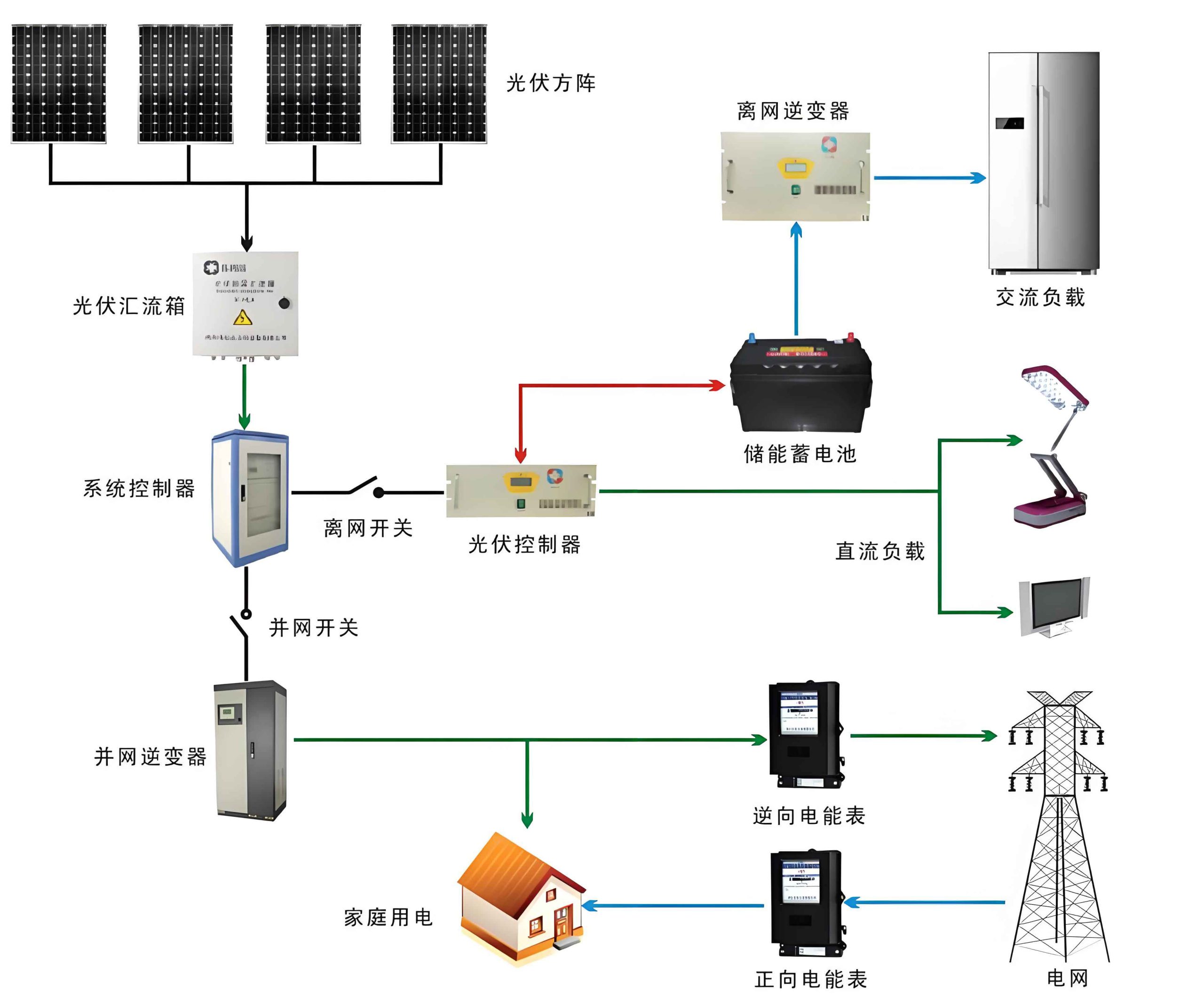
Moving on, efficient non-inverter solar systems represent true self-consumption for rooftop photovoltaics. By directly powering DC loads like LED lighting in garages, corridors, and building automation systems, they ensure that generated electricity is used immediately, with excess stored in batteries for later use. This contrasts with inverter-based systems that often feed surplus power to the grid, incurring conversion losses. In a high-rise urban context, where roof space is limited, this approach maximizes the utility of every square meter. For example, in a project involving a 120 kWp non-inverter solar system for a large underground garage, annual electricity savings exceeded 1.2 million kWh, whereas a similar-sized grid-tied inverter system would generate only about 150,000 kWh annually—an eightfold difference in effective efficiency. This highlights how tailored solar systems can achieve higher performance by aligning generation with consumption patterns.
The application areas and benefits of efficient non-inverter solar systems are extensive. They are particularly suited for building interiors, such as underground parking lots, stairwells, and security systems, where DC loads predominate. By integrating with smart building technologies, these solar systems can also support monitoring and control functions, enhancing overall energy management. The economic advantages are significant: reduced electricity bills, lower peak demand charges, and decreased reliance on grid power. To quantify this, consider the following table summarizing the benefits based on real-world implementations:
| Application | Typical Load | Annual Energy Savings (kWh) | Efficiency Gain vs. Inverter Systems |
|---|---|---|---|
| Underground Garage Lighting | LED fixtures (12V/24V) | 100,000 – 1,200,000 | Up to 8x |
| Building Corridor Lighting | DC lighting networks | 50,000 – 300,000 | 5-7x |
| Security and Surveillance | Cameras, sensors (DC) | 10,000 – 100,000 | 4-6x |
These numbers underscore the transformative potential of non-inverter solar systems in urban energy landscapes. By prioritizing direct use, they minimize waste and maximize the value of photovoltaic investments. Moreover, with the rise of smart cities, the integration of these solar systems into broader energy networks is becoming increasingly feasible, paving the way for more resilient and sustainable infrastructures.
However, several challenges must be addressed to wider adoption of efficient non-inverter solar systems. First, policy support is often lacking. Governments tend to favor inverter-based grid-tied systems through subsidies and incentives, as they align with large-scale renewable energy targets and support photovoltaic manufacturers. In contrast, non-inverter projects, being more customized and smaller in scale, rarely qualify for such benefits. For instance, a past project I was involved in received only a modest building efficiency subsidy, despite its significant energy savings. To level the playing field, policies should recognize the unique contributions of self-consumption solar systems, perhaps through tax credits or rebates for verified energy reductions rather than mere generation metrics.
Second, existing building energy design standards are misaligned with non-inverter approaches. Current regulations often emphasize the ratio of photovoltaic generation to building consumption, which can penalize systems that prioritize efficiency over output. In my view, true building energy conservation should account for the displacement of traditional power, not just the amount of solar electricity produced. Efficient non-inverter solar systems excel in this regard by directly cutting grid dependence, yet they are frequently overlooked in评分 systems. Updating standards to reflect holistic energy savings would encourage more architects and engineers to adopt these tailored solutions.
Third, the technology has not yet been incorporated into national fire safety product standards. Non-inverter solar systems, with their low-voltage DC and integrated storage, can serve as reliable emergency power sources—a critical feature for building safety. However, without official recognition, their adoption in fire-sensitive applications is hindered. I advocate for collaborative efforts between industry stakeholders and regulatory bodies to establish testing and certification protocols, ensuring that these solar systems meet safety requirements while unlocking their full potential as backup power supplies.
In conclusion, efficient non-inverter roof photovoltaic systems offer a compelling alternative to conventional approaches, especially in urban settings where space and customization are key. By leveraging low-voltage DC, tailored designs, and direct load matching, they achieve superior efficiency and practicality. As cities evolve toward smarter and more sustainable futures, integrating these solar systems into building infrastructures will be crucial. Overcoming policy, standard, and regulatory hurdles will require continued innovation and advocacy, but the benefits—reduced energy costs, enhanced safety, and greater resilience—make it a worthwhile pursuit. In my experience, the future of rooftop photovoltaics lies not in one-size-fits-all solutions, but in adaptable, efficient solar systems that harmonize with the unique demands of each building.