
In the pursuit of high-performance perovskite solar cells, achieving smooth, compact, and defect-free perovskite films is crucial for widespread application. Additive engineering has emerged as a powerful strategy to modulate crystallization kinetics and film morphology. In this study, we introduce pyridine as an additive into the perovskite precursor solution to investigate its impact on film quality, device performance, and stability. The incorporation of pyridine facilitates the formation of intermediate phase products, which effectively suppress nucleation and promote the growth of large-grained crystals. Through comprehensive characterization, including in situ optical microscopy and X-ray diffraction, we demonstrate optimized defect passivation and the presence of intermediate phases. Ultimately, pyridine-treated devices achieve a power conversion efficiency of 18.28%, along with enhanced stability, retaining 95% of their initial efficiency after 300 hours in ambient conditions.
Perovskite solar cells have garnered significant attention due to their exceptional optoelectronic properties, such as high absorption coefficients, long carrier lifetimes, and extensive diffusion lengths. These attributes position perovskite solar cells as promising candidates for addressing energy demands and environmental challenges. However, the practical deployment of perovskite solar cells is often hindered by issues related to film quality, including pinholes, small grain sizes, and high defect densities. These factors can lead to non-radiative recombination and reduced device performance. Among various optimization techniques, additive engineering stands out for its simplicity and compatibility with diverse fabrication processes. Additives can be categorized into inorganic, small organic molecules, and polymers, with Lewis base small molecules being particularly effective due to their volatility and ability to coordinate with perovskite precursors.
In this work, we focus on pyridine, a Lewis base additive, to manipulate the crystallization process of perovskite films. Pyridine’s electron-donating capability allows it to form coordination complexes with lead iodide (PbI2), leading to the formation of intermediate phases that alter nucleation and growth dynamics. This approach results in larger grain sizes, improved crystallinity, and reduced defect densities, thereby enhancing the overall performance of perovskite solar cells. The following sections detail the experimental methods, results, and discussions on the effects of pyridine additives, supported by data from morphological, structural, and optoelectronic analyses.
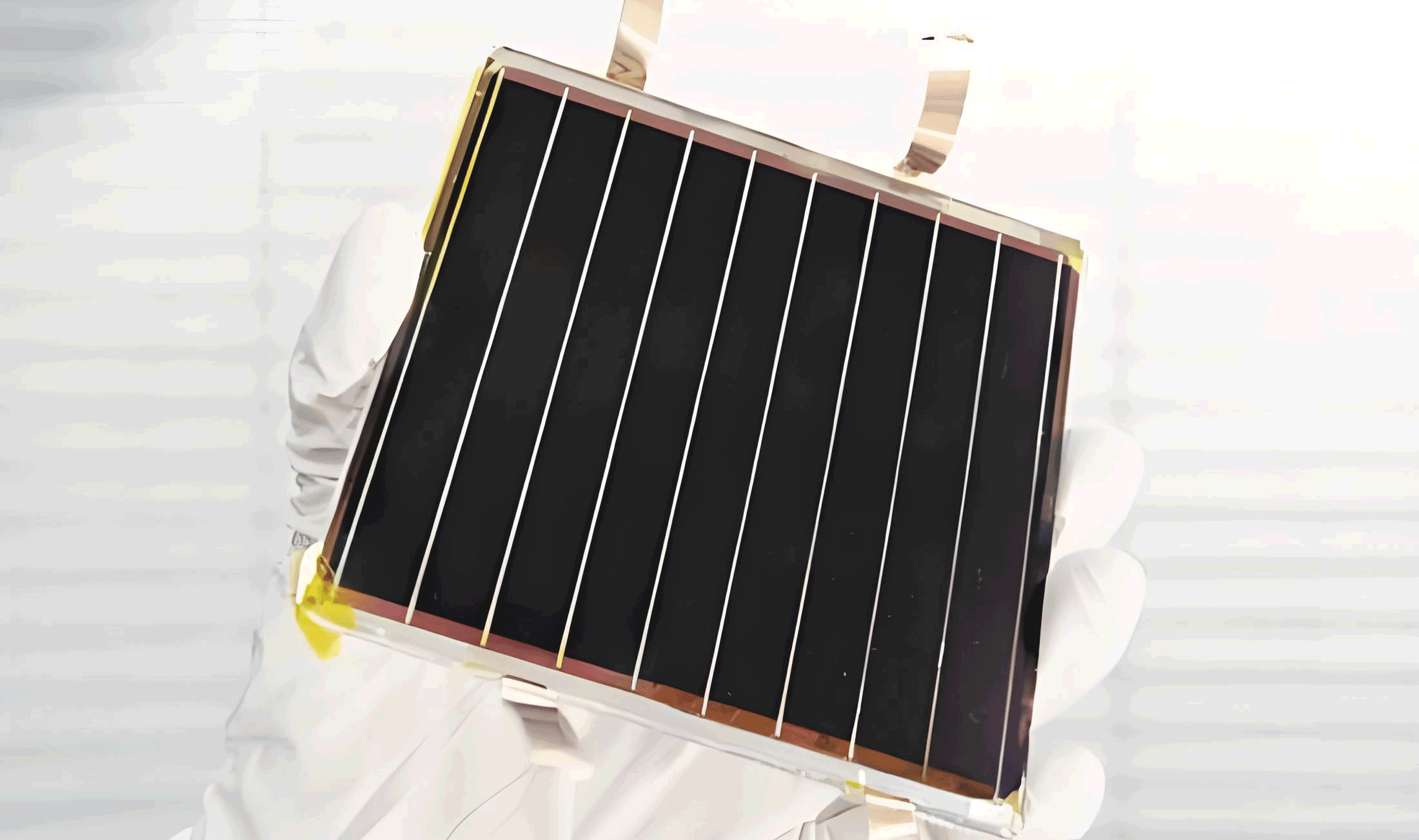
The fabrication of perovskite solar cells involves several critical steps to ensure high-quality layer deposition. Fluorine-doped tin oxide (FTO) glass substrates were cleaned sequentially with detergents, ethanol, acetone, and deionized water, followed by drying under nitrogen flow and ultraviolet-ozone treatment. A compact TiO2 electron transport layer was deposited via spray pyrolysis at 450°C using a solution of titanium diisopropoxide bis(acetylacetonate) in anhydrous isopropanol. Subsequently, a mesoporous TiO2 layer was spin-coated from a diluted commercial paste and annealed at 510°C to remove organic residues.
Two perovskite precursor solutions were prepared: Solution A without pyridine additive and Solution B with 1% pyridine additive. Both solutions contained 1.2 M PbI2 and methylammonium iodide (MAI) in a dimethyl sulfoxide (DMSO) and N,N-dimethylformamide (DMF) mixture (volume ratio 2:8), stirred at 75°C for 1 hour. The perovskite layers were deposited on the TiO2/FTO substrates using a two-step spin-coating process: 10 s at 1,000 rpm and 30 s at 5,000 rpm, with chlorobenzene anti-solvent dripping during the second step. The films were then annealed at 105°C for 30 minutes to form the perovskite layer. For the hole transport layer, a solution of spiro-OMeTAD in chlorobenzene was prepared with additives including lithium bis(trifluoromethanesulfonyl)imide (Li-TFSI), FK209 Co(III) TFSI salt, and 4-tert-butylpyridine (tBP). Finally, gold electrodes were thermally evaporated to complete the device structure.
To elucidate the influence of pyridine on film morphology, scanning electron microscopy (SEM) was employed. The SEM images reveal significant differences between the pyridine-treated and untreated films. The pyridine-modified perovskite solar cell films exhibit larger grain sizes and a more uniform, pinhole-free surface compared to the control films. This improvement is attributed to the suppressed nucleation and moderated crystal growth induced by the pyridine additive. Cross-sectional SEM further confirms the enhanced compactness and alignment of the perovskite layer in pyridine-treated devices, which is beneficial for reducing grain boundaries and minimizing charge recombination.
The crystallinity of the perovskite films was analyzed using X-ray diffraction (XRD). The XRD patterns for both films show characteristic peaks corresponding to the tetragonal perovskite structure, such as (110), (112), (211), (202), (220), (312), (224), and (330). However, the pyridine-treated films demonstrate higher peak intensities, indicating improved crystallinity and larger crystal domains. Additionally, intermediate phase peaks are observed in the unannealed films, with shifts in the pyridine-containing samples suggesting the formation of a new intermediate phase, MAI-PbI2-PY. This phase plays a critical role in controlling the crystallization process, as confirmed by in situ optical microscopy.
In situ microscopy was used to monitor the real-time growth of perovskite crystals. The pyridine-added films show delayed nucleation and fewer nucleation sites compared to the control films. As the temperature increases, the pyridine-treated films develop larger grains and achieve full coverage at 100°C, whereas the untreated films exhibit smaller grains and pinholes. This observation aligns with the proposed mechanism where pyridine forms a stable intermediate complex, slowing down the crystallization kinetics and promoting the growth of high-quality films.
The nucleation rate in perovskite crystallization can be described by the classical nucleation theory:
$$ J = A \exp\left(-\frac{\Delta G^*}{kT}\right) $$
where \( J \) is the nucleation rate, \( A \) is a pre-exponential factor, \( \Delta G^* \) is the critical Gibbs free energy for nucleation, \( k \) is the Boltzmann constant, and \( T \) is the temperature. The addition of pyridine increases \( \Delta G^* \), thereby reducing \( J \) and leading to fewer nucleation sites. This allows for the growth of larger crystals, as evidenced by the SEM and XRD results.
The device performance of perovskite solar cells was evaluated through current density-voltage (J-V) measurements and incident photon-to-current efficiency (IPCE) spectra. The J-V curves under AM 1.5G illumination show that pyridine-treated devices achieve a higher open-circuit voltage (Voc), short-circuit current density (Jsc), and fill factor (FF), resulting in an improved power conversion efficiency (PCE). The IPCE spectra exhibit enhanced quantum efficiency across the visible spectrum for pyridine-modified devices, consistent with the Jsc values. The key parameters are summarized in Table 1.
| Device | Voc (V) | Jsc (mA/cm2) | FF (%) | PCE (%) |
|---|---|---|---|---|
| Without Pyridine | 1.05 | 21.28 | 75.33 | 16.88 |
| With Pyridine | 1.08 | 22.03 | 77.09 | 18.28 |
The stability of perovskite solar cells is a critical factor for their commercial viability. We conducted aging tests under ambient conditions (25% relative humidity, 30°C) for 300 hours. The pyridine-treated devices maintained 95% of their initial PCE, while the control devices degraded rapidly, retaining only 40% of their initial efficiency after 180 hours. The enhanced stability is attributed to the hydrophobic nature of pyridine and the improved film quality, which reduce moisture ingress and defect-mediated degradation.
The power conversion efficiency of a perovskite solar cell is given by:
$$ \eta = \frac{J_{sc} \times V_{oc} \times FF}{P_{in}} $$
where \( P_{in} \) is the incident light power density (100 mW/cm2 for AM 1.5G). The improvements in \( J_{sc} \), \( V_{oc} \), and FF for pyridine-treated devices directly contribute to the higher \( \eta \). The increased \( J_{sc} \) is linked to better charge collection efficiency and reduced recombination, while the higher \( V_{oc} \) results from improved interfacial properties and defect passivation.
To further quantify the crystallographic changes, we analyzed the XRD peak positions and intensities. The intermediate phase formation in unannealed films can be represented by the shift in diffraction angles. For instance, the (002) peak of the MAI-PbI2 intermediate shifts from 6.5° to 6.3° upon pyridine addition, indicating lattice expansion due to pyridine incorporation. This shift confirms the formation of a new intermediate phase, which alters the crystallization pathway. The full width at half maximum (FWHM) of the perovskite peaks decreases in pyridine-treated films, reflecting larger crystallite sizes according to the Scherrer equation:
$$ D = \frac{K \lambda}{\beta \cos \theta} $$
where \( D \) is the crystallite size, \( K \) is the shape factor (0.9), \( \lambda \) is the X-ray wavelength (0.15406 nm), \( \beta \) is the FWHM in radians, and \( \theta \) is the Bragg angle. The calculated crystallite sizes are presented in Table 2.
| Film Type | Peak (hkl) | FWHM (°) | Crystallite Size (nm) |
|---|---|---|---|
| Without Pyridine | (110) | 0.25 | 32.5 |
| With Pyridine | (110) | 0.18 | 45.2 |
The crystallization kinetics can be modeled using the Avrami equation, which describes the phase transformation over time:
$$ X(t) = 1 – \exp(-kt^n) $$
where \( X(t) \) is the fraction of transformed material, \( k \) is the rate constant, and \( n \) is the Avrami exponent. For pyridine-treated films, the value of \( n \) increases, indicating a change in nucleation mechanism from instantaneous to progressive, which favors the growth of larger grains. This kinetic analysis supports the observed morphological improvements.
In conclusion, the introduction of pyridine as an additive in perovskite precursor solutions significantly enhances the performance and stability of perovskite solar cells. By forming intermediate complexes, pyridine modulates the nucleation and growth processes, leading to films with larger grains, higher crystallinity, and reduced defects. These improvements result in a notable increase in power conversion efficiency and long-term stability. This study underscores the potential of Lewis base additives in optimizing perovskite solar cells and provides insights for future developments in additive engineering. The strategies discussed here could be extended to other additive systems for further advancements in perovskite photovoltaics.
The degradation of perovskite solar cells often follows first-order kinetics, which can be expressed as:
$$ \frac{dPCE}{dt} = -k_d PCE $$
where \( k_d \) is the degradation rate constant. For pyridine-treated devices, \( k_d \) is lower, indicating slower degradation. The stability data over time are summarized in Table 3, highlighting the superior durability of pyridine-modified perovskite solar cells.
| Time (hours) | Without Pyridine (Normalized PCE) | With Pyridine (Normalized PCE) |
|---|---|---|
| 0 | 1.00 | 1.00 |
| 100 | 0.65 | 0.98 |
| 200 | 0.45 | 0.96 |
| 300 | 0.40 | 0.95 |
Overall, the integration of pyridine additives represents a straightforward yet effective approach to advancing perovskite solar cell technology. The demonstrated improvements in efficiency and stability pave the way for more reliable and commercially viable perovskite solar cells. Future work could explore the combination of pyridine with other functional additives to achieve synergistic effects and further enhance device performance. The continuous optimization of perovskite solar cells through additive engineering holds great promise for the renewable energy sector.