
With the rapid integration of renewable energy sources, particularly wind power, into power grids, frequency stability has become a critical concern. Traditional synchronous generators provide inherent inertia and primary frequency regulation, but inverter-based resources like wind turbines and photovoltaic systems lack these capabilities. This deficiency can lead to increased frequency deviations and rate of change of frequency (RoCoF) during disturbances, jeopardizing grid stability. To address this challenge, we propose a novel control strategy that leverages the battery energy storage system to participate in grid primary frequency regulation, considering dynamic frequency inertia characteristics. The battery energy storage system is coupled with a virtual synchronous generator (VSG) control applied to the grid-side converter, enhancing both inertial response and primary frequency control performance.
The core idea is to utilize the fast response and flexible power control of the battery energy storage system to supplement the grid’s frequency regulation needs. We design an additional active power module that incorporates virtual inertia and droop control from the battery energy storage system. These power outputs are then integrated into a variable rotor inertia control and an output feedback model predictive control strategy for the VSG, respectively. This approach ensures that the battery energy storage system not only provides short-term inertial support but also contributes to steady-state frequency restoration, effectively reducing maximum frequency deviation and RoCoF.
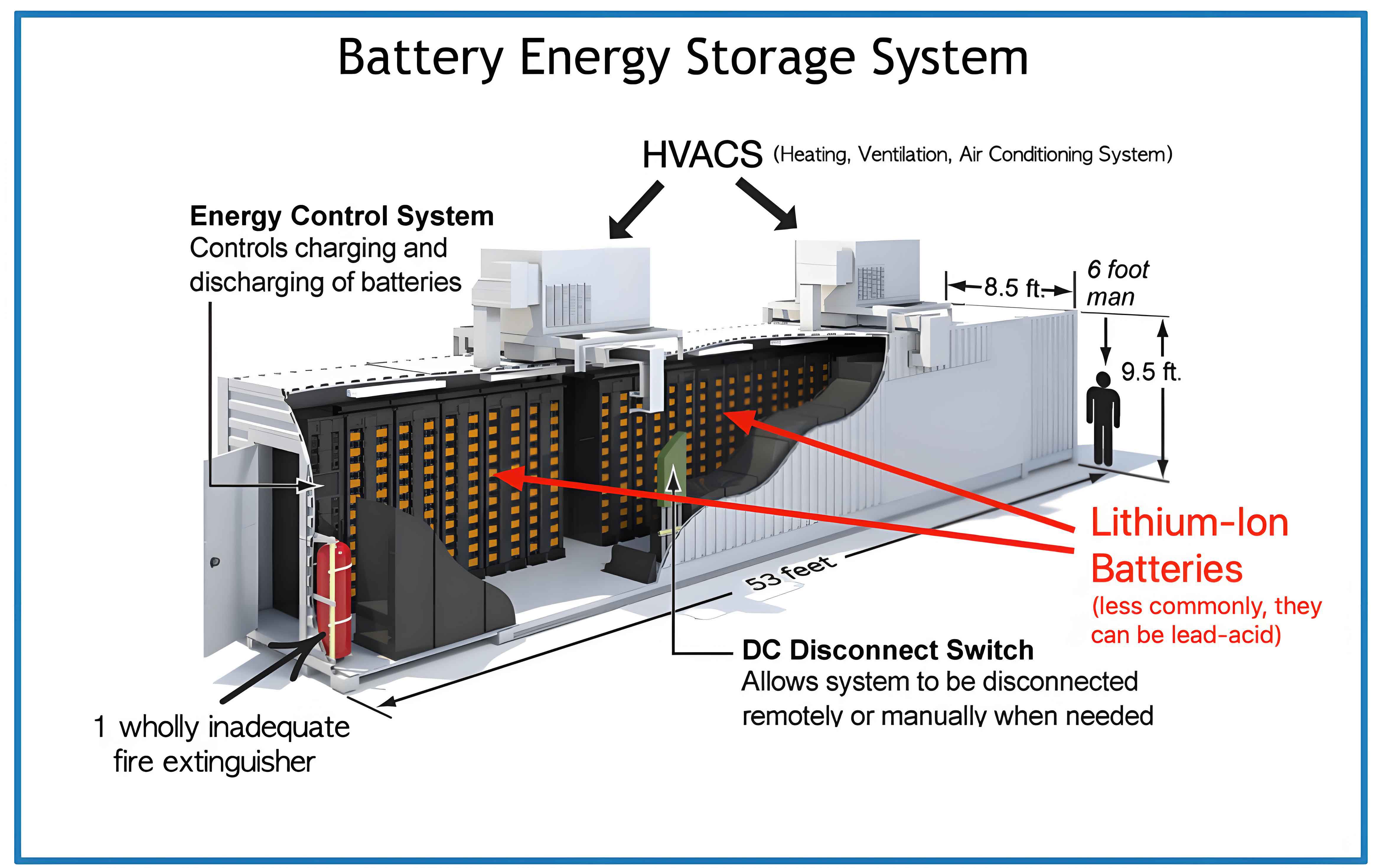
In this study, we focus on a power system configuration where a doubly-fed induction generator (DFIG)-based wind farm is equipped with a battery energy storage system on the DC link. The grid-side converter employs VSG control to emulate synchronous generator behavior. The mathematical model of the VSG is derived from the swing equation of a synchronous machine. The rotor motion equation is given by:
$$J \frac{d\omega}{dt} = T_m – T_e – D(\omega – \omega_{ref})$$
where \( J \) is the virtual rotor inertia, \( \omega \) is the rotor angular speed, \( T_m \) is the mechanical torque, \( T_e \) is the electromagnetic torque, \( D \) is the damping coefficient, and \( \omega_{ref} \) is the rated angular speed. The power angle \( \delta \) is obtained by integrating the speed deviation:
$$\delta = \int (\omega – \omega_{ref}) dt$$
To harness the battery energy storage system’s capabilities, we formulate the additional active power from the battery as follows. The droop control component is:
$$\Delta P_{dro\_1} = K_1 (f_{ref} – f)$$
and the virtual inertia control component is:
$$\Delta P_{ine\_2} = K_2 \frac{d(f_{ref} – f)}{dt}$$
Here, \( K_1 \) and \( K_2 \) are the droop coefficient and virtual inertia coefficient of the battery energy storage system, respectively, while \( f \) and \( f_{ref} \) are the measured and rated grid frequencies. These power components are used to augment the VSG control loops.
For the VSG, we propose a variable rotor inertia control strategy. The inertia is adjusted in real-time based on the product of rotor speed deviation and its derivative, enabling adaptive inertia support. The variable inertia \( J_1 \) is defined as:
$$J_1 =
\begin{cases}
J_0 + k \left| \frac{d\omega}{dt} \right|, & \text{if } \frac{d\omega}{dt} (\omega – \omega_{ref}) > 0 \\
J_0 – k \left| \frac{d\omega}{dt} \right|, & \text{if } \frac{d\omega}{dt} (\omega – \omega_{ref}) < 0
\end{cases}$$
where \( J_0 \) is the nominal inertia constant and \( k \) is a positive gain. This adjustment helps suppress frequency excursions during transients and accelerates recovery during steady-state restoration.
Additionally, we develop an output feedback model predictive control (OFMPC) for the VSG to enhance primary frequency regulation. The incremental model of the VSG is derived from the swing equation:
$$\frac{d\Delta\omega}{dt} = -\frac{D}{J} \Delta\omega + \frac{1}{J} \Delta T_m – \frac{1}{J} \Delta T_e$$
with the droop relation:
$$\Delta T = m \Delta\omega$$
where \( \Delta T \) is the torque increment corresponding to power increment \( \Delta P / \omega_{ref} \), and \( m \) is the torque droop coefficient. Discretizing this model yields the state-space form:
$$x(k+1) = A x(k) + B u(k) + D_d d(k)$$
$$y(k) = C x(k)$$
with state \( x(k) = \Delta\omega(k) \), input \( u(k) = \Delta T_m(k) \), disturbance \( d(k) = \Delta T_e(k) \), and output \( y(k) = \Delta T(k) \). The matrices are \( A = -D/J \), \( B = 1/J \), \( D_d = -1/J \), and \( C = m \).
The OFMPC aims to minimize a cost function over a prediction horizon \( N \) and control horizon \( M \):
$$\min_{\Delta U} C = (Y_{ref} – Y)^T Q (Y_{ref} – Y) + \Delta U^T R \Delta U$$
where \( Y_{ref} \) is the reference torque vector, \( Y \) is the predicted output vector, \( Q \) and \( R \) are weighting matrices, and \( \Delta U \) is the vector of input increments. The optimal solution is:
$$\Delta U = (\Phi_B^T Q \Phi_B + R)^{-1} \Phi_B^T Q (Y_{ref} – F x(k) – \Phi_D \Delta G)$$
with \( F \), \( \Phi_B \), and \( \Phi_D \) constructed from the model matrices. The first element of \( \Delta U \) is applied, creating a feedback loop that predicts and compensates frequency deviations dynamically.
The overall control structure integrates the battery energy storage system’s power with the VSG’s variable inertia and OFMPC. The additional power from the battery energy storage system’s virtual inertia control \( \Delta P_{ine\_2} \) is added to the reference for variable rotor inertia control, while the droop power \( \Delta P_{dro\_1} \) is added to the OFMPC reference. This coordinated strategy ensures that the battery energy storage system and VSG work synergistically to improve grid frequency stability.
To validate the proposed approach, we conduct simulations in a MATLAB/Simulink environment. The test system includes a regional grid with synchronous generators, a DFIG wind farm (35 turbines of 1.5 MW each), and a battery energy storage system of 2.63 MW capacity. The battery energy storage system parameters are set with state-of-charge limits between 0.1 and 0.9, initial value of 0.5, and charge/discharge efficiency of 0.9. The VSG parameters are chosen as \( D = 10 \, \text{N·s/m} \), \( J_0 = 0.2 \, \text{kg·m}^2 \), \( k = 50 \), and \( m = -0.0018 \, \text{N·s/Hz} \). The battery energy storage system coefficients are \( K_1 = 30 \) and \( K_2 = 0.3 \). We compare four control strategies: no frequency control from wind turbines, combined inertial control (virtual inertia and droop for wind turbines), battery energy storage system alone participating in frequency control, and our proposed method.
First, we apply a step load increase of 30 MW at 40 seconds. The frequency deviation and wind power output are monitored. The performance metrics include maximum frequency deviation \( \Delta f_{max} \), steady-state frequency deviation \( \Delta f_{ste} \), maximum wind power output \( \Delta P_{ge,max} \), and initial frequency dip rate \( d_{ini} \). The results are summarized in Table 1.
| Control Strategy | \(\Delta f_{max}\) (Hz) | \(\Delta f_{ste}\) (Hz) | \(\Delta P_{ge,max}\) (p.u.) | \(d_{ini}\) (Hz/s) |
|---|---|---|---|---|
| No frequency control | 0.375 | 0.075 | 0.269 | 6.314 |
| Combined inertial control | 0.288 | 0.075 | 0.373 | 5.145 |
| Battery energy storage system only | 0.224 | 0.063 | 0.382 | 4.011 |
| Proposed method | 0.208 | 0.058 | 0.398 | 3.078 |
Our proposed method shows the lowest maximum frequency deviation and steady-state error, along with the highest wind power output and slowest initial dip rate. This demonstrates the effectiveness of integrating the battery energy storage system with VSG control.
Second, we test a step wind speed increase of 0.02 p.u. at 50 seconds. The frequency deviations are positive due to excess power injection. The metrics are listed in Table 2.
| Control Strategy | \(\Delta f_{max}\) (Hz) | \(\Delta f_{ste}\) (Hz) | \(\Delta P_{ge,max}\) (p.u.) |
|---|---|---|---|
| No frequency control | 0.0204 | 0.0150 | 0.519 |
| Combined inertial control | 0.0191 | 0.0150 | 0.519 |
| Battery energy storage system only | 0.0178 | 0.0138 | 0.539 |
| Proposed method | 0.0176 | 0.0133 | 0.544 |
Again, our strategy outperforms others, minimizing frequency overshoot and improving power output. The battery energy storage system plays a crucial role in absorbing excess power and providing damping.
Third, we consider a random load disturbance over 40 seconds, as shown in a simulated profile. The metrics now include maximum frequency peak-to-valley difference \( \Delta f_{pv,max} \), maximum frequency deviation \( \Delta f_{max} \), wind power peak-to-valley difference \( \Delta P_{pv,max} \), and maximum wind power output \( \Delta P_{ge,max} \). Results are in Table 3.
| Control Strategy | \(\Delta f_{pv,max}\) (Hz) | \(\Delta f_{max}\) (Hz) | \(\Delta P_{pv,max}\) (p.u.) | \(\Delta P_{ge,max}\) (p.u.) |
|---|---|---|---|---|
| No frequency control | 0.0071 | 0.0036 | 0.0044 | 0.2702 |
| Combined inertial control | 0.0061 | 0.0034 | 0.0061 | 0.2703 |
| Battery energy storage system only | 0.0021 | 0.0011 | 0.0108 | 0.2728 |
| Proposed method | 0.0011 | 0.0006 | 0.0122 | 0.2736 |
The proposed method achieves the smallest frequency fluctuations and highest wind power utilization, highlighting its robustness under variable disturbances. The battery energy storage system effectively smoothens the power output and stabilizes frequency.
The superiority of our approach stems from the synergistic combination of the battery energy storage system and advanced VSG control. The variable rotor inertia control adapts to system dynamics, providing large inertia when needed to limit RoCoF and reducing inertia during recovery to hasten settling. The OFMPC offers predictive compensation, minimizing frequency deviations through optimal torque adjustments. Meanwhile, the battery energy storage system supplies fast power injections or absorptions, bridging gaps in inertial response and primary regulation. This integrated solution ensures that the battery energy storage system is not merely an add-on but a core component of the frequency control architecture.
In conclusion, we have presented a comprehensive control strategy for battery energy storage system participation in grid primary frequency regulation, considering dynamic frequency inertia characteristics. By embedding the battery energy storage system’s virtual inertia and droop controls into a VSG framework with variable rotor inertia and output feedback model predictive control, we significantly enhance grid stability. Simulations under step and random disturbances confirm that our method reduces maximum frequency deviation, steady-state error, and RoCoF while maximizing wind power output. The battery energy storage system proves indispensable for modern power systems with high renewable penetration, and our work provides a scalable and effective control paradigm. Future research could explore optimization of parameters for larger-scale systems and integration with other grid-forming technologies.