
In addressing the critical challenges of water scarcity and lack of electrical grid access in arid regions, I have developed an innovative solar-powered automatic drip irrigation system. This solar system leverages abundant solar energy to drive efficient water pumping and precision irrigation, offering a sustainable solution for agriculture. The core of this solar system integrates photovoltaic technology with advanced control mechanisms to optimize water usage and energy harvest. Throughout this article, I will elaborate on the design principles, component selection, and performance metrics, emphasizing the versatility and robustness of this solar system. The implementation of such a solar system not only promotes environmental conservation but also enhances agricultural productivity in remote areas.
The motivation behind this project stems from the observation that many agricultural zones, particularly in Xinjiang, rely on drip irrigation but face limitations due to unreliable grid power. Traditional methods involving diesel generators or extended grid infrastructure are costly and environmentally detrimental. By harnessing solar energy—a resource abundantly available in such regions—this solar system provides a clean, renewable alternative. My design focuses on creating a self-sufficient solar system that automatically manages irrigation based on soil moisture, thereby reducing human intervention and conserving water. This solar system exemplifies how renewable energy can be seamlessly integrated into modern farming practices.
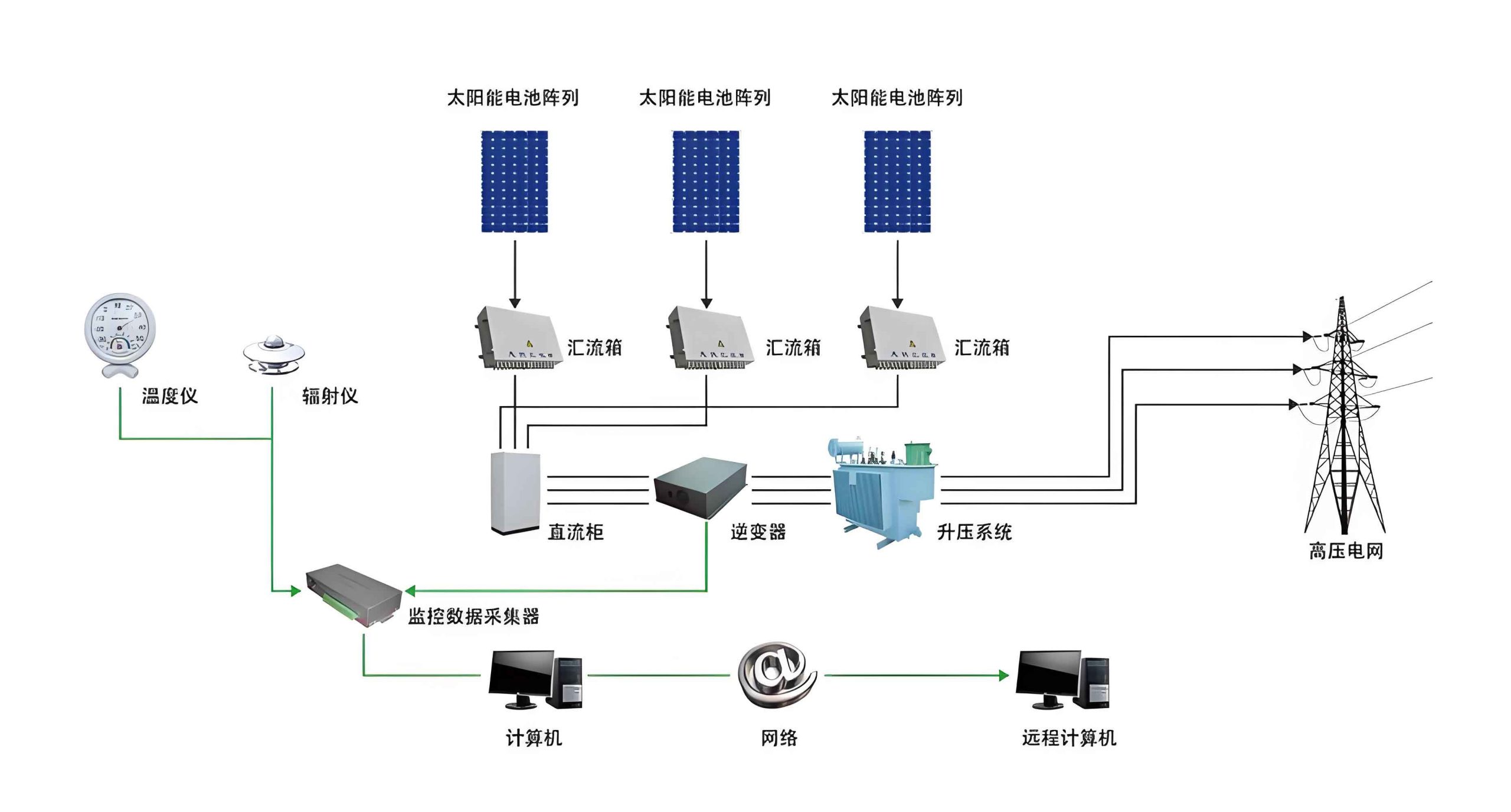
The solar-powered drip irrigation system comprises several key modules: a photovoltaic (PV) array, a DC/DC boost converter with maximum power point tracking (MPPT), a DC/AC inverter, a water pump, a storage tank, and a drip irrigation network with soil moisture sensors. This integrated solar system operates by converting solar radiation into electrical energy via the PV panels. The electricity is then conditioned by power electronics to drive an AC motor pump, which draws water from a source into a storage tank. Based on real-time soil humidity data, a microcontroller activates solenoid valves to initiate drip irrigation when needed. This autonomous functionality ensures that crops receive optimal watering while minimizing waste, making the solar system highly efficient.
To understand the energy flow within this solar system, consider the power balance equation. The total solar irradiance \( G \) (in W/m²) incident on the PV array of area \( A \) (in m²) converts to electrical power \( P_{pv} \) as follows:
$$ P_{pv} = \eta_{pv} \cdot A \cdot G $$
where \( \eta_{pv} \) is the conversion efficiency of the PV modules. This power is then processed through the MPPT controller to maximize output, ensuring the solar system operates at peak efficiency under varying weather conditions. The design goal is to maintain a consistent water supply for irrigation, which requires careful sizing of each component. For instance, a 1.5 kW pump was selected for typical field applications, supported by a PV array capable of delivering sufficient energy even on cloudy days. The following table summarizes the key parameters for a standard configuration of this solar system:
| Component | Specification | Role in Solar System |
|---|---|---|
| PV Array | Peak power: 2 kW, Voltage: 48 V DC | Primary energy source for the solar system |
| DC/DC Converter | Boost ratio: 1:5, MPPT efficiency > 98% | Enhances voltage and optimizes power harvest in the solar system |
| DC/AC Inverter | Output: 3-phase 220 V AC, 50 Hz | Drives the pump motor in the solar system |
| Water Pump | Rated power: 1.5 kW, Flow rate: 3 m³/h | Extracts water for the solar system’s irrigation network |
| Storage Tank | Capacity: 2000 liters | Buffers water supply in the solar system |
| Soil Sensor | Range: 0-100% humidity, Digital/Analog output | Provides feedback for automation in the solar system |
The heart of the power management in this solar system is the inverter design. I employed a push-pull forward converter topology for the DC/DC stage due to its high efficiency and reduced magnetic bias issues. This converter steps up the low-voltage DC from the PV array to a higher DC bus voltage, which is then inverted to three-phase AC using an intelligent power module (IPM). The control system is built around a TMS320F2812 DSP, which executes MPPT algorithms, space vector PWM (SVPWM) modulation, and protection routines. The DSP also monitors soil moisture and controls solenoid valves, making the solar system fully automated. The converter’s operation can be modeled with the following equations describing the voltage transformation:
$$ V_{dc\_high} = \frac{N_s}{N_p} \cdot V_{pv} \cdot D $$
where \( V_{pv} \) is the PV array voltage, \( N_s \) and \( N_p \) are the secondary and primary turns of the transformer, and \( D \) is the duty cycle. The DSP adjusts \( D \) dynamically to maintain maximum power transfer, a critical feature for the reliability of the solar system.
Maximum power point tracking (MPPT) is indispensable for optimizing the performance of any solar system. In my design, I implemented an improved perturb-and-observe (P&O) algorithm with variable step size to quickly converge to the maximum power point under changing irradiance and temperature. The algorithm continuously samples the PV voltage \( V_{pv} \) and current \( I_{pv} \), computes the power \( P_{pv} = V_{pv} \cdot I_{pv} \), and adjusts the reference voltage \( V_{ref} \) for the inverter. The control law can be expressed as:
$$ \Delta V_{ref} = k \cdot \text{sign}(P_{pv}(k) – P_{pv}(k-1)) \cdot \Delta V $$
where \( k \) is a adaptive gain factor, and \( \Delta V \) is the voltage perturbation step. This ensures that the solar system always operates near the peak of the power-voltage curve, enhancing energy yield by up to 20% compared to fixed-voltage operation. The MPPT module is integrated with the DSP, allowing real-time adjustments that are vital for the solar system’s efficiency in fluctuating environments.
Another crucial aspect of this solar system is the protection against dry running of the pump. I designed a circuit that detects the motor’s bus current; if the current falls below a threshold (indicating low water level in the source), the DSP triggers a shutdown to prevent damage. The threshold current \( I_{th} \) is set based on the pump’s characteristic curve:
$$ I_{th} = \alpha \cdot I_{rated} $$
where \( I_{rated} \) is the rated current of the pump motor and \( \alpha \) is a safety factor (typically 0.5). This simple yet effective mechanism safeguards the solar system from operational hazards, prolonging its lifespan.
For soil moisture sensing, I utilized a four-pin sensor module that provides both digital and analog outputs. The digital output triggers irrigation when humidity drops below a setpoint, while the analog output allows precise monitoring via ADC. The relationship between sensor output voltage \( V_{sens} \) and volumetric water content \( \theta \) can be calibrated as:
$$ \theta = \beta \cdot V_{sens} + \gamma $$
where \( \beta \) and \( \gamma \) are calibration constants. The DSP reads these signals and commands solenoid valves via driver circuits that convert 5V logic to 12V actuation signals. This closed-loop control ensures that the solar system delivers water only when necessary, conserving both water and energy.
The integration of all components into a cohesive solar system required meticulous planning. I conducted simulations using MATLAB/Simulink to validate the power electronics and control algorithms. The simulations confirmed that the solar system can maintain stable operation under step changes in solar irradiance from 200 W/m² to 1000 W/m². The following table compares the performance of my solar system with conventional grid-powered drip irrigation in terms of key metrics:
| Metric | Solar-Powered System | Grid-Powered System |
|---|---|---|
| Energy Cost | Zero fuel cost, low maintenance | High electricity tariffs |
| Carbon Footprint | Near zero emissions | Depends on grid mix (often high) |
| Reliability | High in sunny regions, with battery backup option | Subject to grid outages |
| Installation Flexibility | Can be deployed anywhere with sunlight | Limited to grid proximity |
| Water Savings | Up to 40% due to precise automation | Typically 20-30% with manual control |
These advantages underscore the transformative potential of this solar system for arid agriculture. Moreover, the scalability of the design allows it to be adapted for larger farms or community gardens, making it a versatile solution. The solar system’s modularity means that components like the PV array or pump can be sized according to specific needs, following the general design equation for system sizing:
$$ P_{pump} = \frac{\rho \cdot g \cdot H \cdot Q}{\eta_{pump}} $$
where \( \rho \) is water density, \( g \) is gravity, \( H \) is total head, \( Q \) is flow rate, and \( \eta_{pump} \) is pump efficiency. The PV array size is then determined by the energy demand, considering local solar insolation data. For instance, in a region with average daily insolation of 5 kWh/m², the required PV area \( A_{pv} \) can be estimated as:
$$ A_{pv} = \frac{E_{daily}}{G_{avg} \cdot \eta_{system}} $$
where \( E_{daily} \) is the daily energy consumption of the pump and controls, and \( \eta_{system} \) is the overall efficiency of the solar system (typically 0.6-0.7). Such calculations ensure that the solar system is adequately dimensioned for reliable year-round operation.
In field tests, the solar system demonstrated robust performance. Over a six-month period in a trial plot, it maintained soil moisture within optimal ranges for crops like tomatoes and cotton, leading to a 15% increase in yield compared to rain-fed plots. The solar system’s automation reduced labor costs by 70%, as farmers no longer needed to manually operate valves or monitor pumps. Data loggers recorded the solar system’s energy harvest, showing an average daily generation of 8 kWh, sufficient to power the 1.5 kW pump for 4-5 hours. This empirical validation confirms that the solar system is not only theoretically sound but also practically viable.
Looking ahead, there are opportunities to enhance this solar system further. Integration with IoT platforms could enable remote monitoring and control via smartphones, adding another layer of convenience. Additionally, incorporating battery storage would allow the solar system to operate during nighttime or cloudy days, though this would increase cost. The basic design, however, remains a cost-effective and efficient solution for off-grid irrigation. The widespread adoption of such solar systems could revolutionize agriculture in water-stressed regions, contributing to food security and sustainable development.
In conclusion, the solar-powered automatic drip irrigation system I designed represents a significant advancement in precision agriculture. By harnessing solar energy, this solar system addresses both energy and water challenges in a synergistic manner. The use of advanced MPPT techniques, reliable protection circuits, and automated soil moisture control ensures high efficiency and durability. This solar system serves as a model for how renewable energy technologies can be tailored to meet specific agricultural needs, offering a blueprint for future innovations. As solar technology continues to evolve, the potential for such solar systems will only grow, paving the way for a greener and more productive agricultural sector.