
In the context of global carbon neutrality and energy transition, the energy storage sector has witnessed rapid expansion, driving the demand for efficient and sustainable li ion battery technologies. As a key component in li ion battery manufacturing, N-Methyl-2-pyrrolidone (NMP) serves as an indispensable solvent for cathode slurry preparation. However, its high cost and environmental concerns necessitate effective recovery processes. In this article, I will explore and compare three prominent NMP recovery methods, emphasizing their principles, performance, and economic implications for li ion battery production. The growing adoption of li ion battery systems underscores the urgency to optimize solvent management, ensuring both profitability and compliance with stringent emission standards.
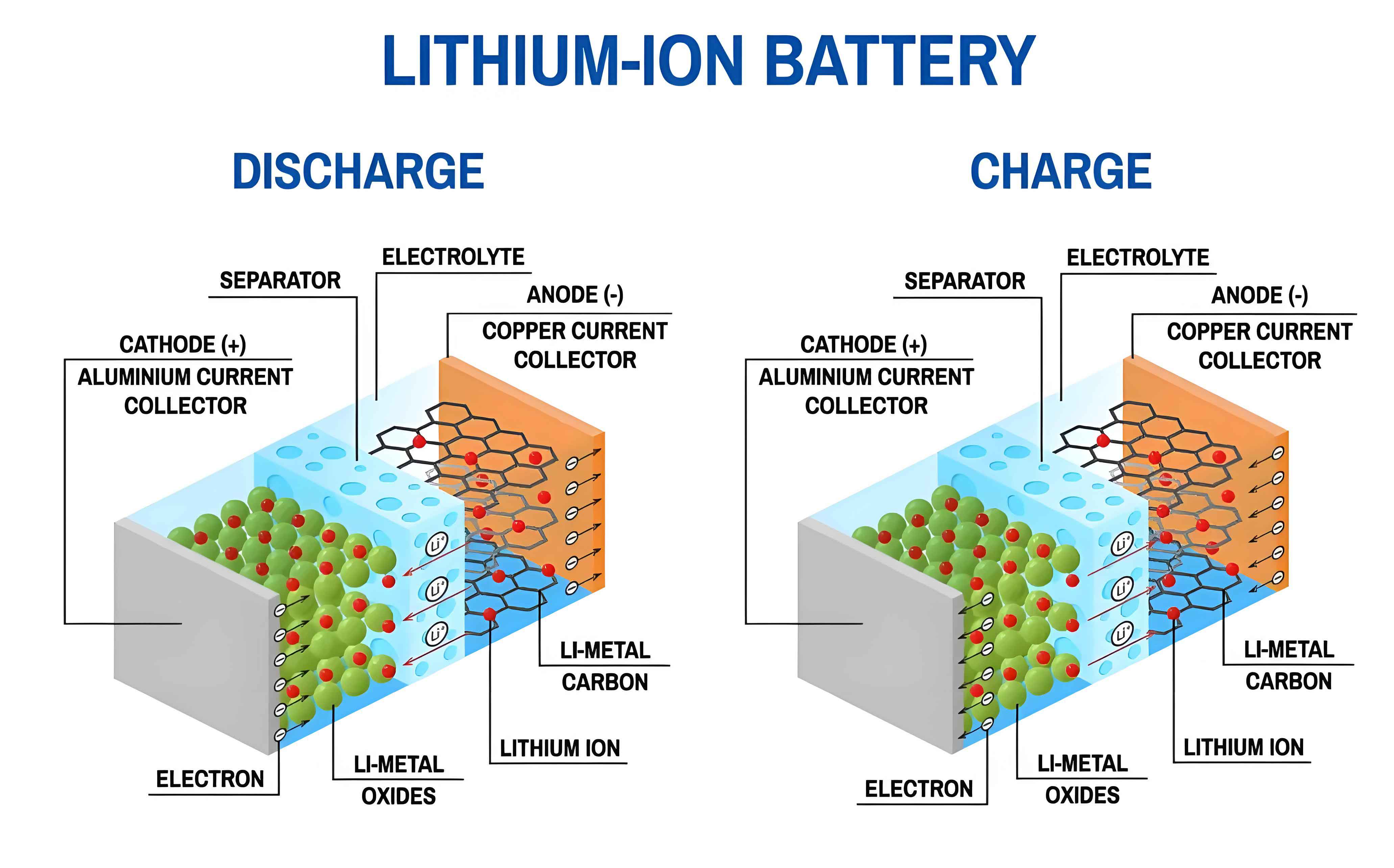
The manufacturing of li ion battery involves coating electrode slurries onto current collectors, with NMP as the primary solvent for cathode materials. During drying, NMP evaporates and is typically captured in exhaust streams. Without recovery, this leads to resource waste and environmental pollution. The li ion battery industry, therefore, seeks cost-effective and efficient NMP recovery solutions. Here, I detail three prevalent techniques: condensation with water absorption, condensation with rotary adsorption, and direct water absorption without air return. Each method has distinct advantages and drawbacks, influencing its suitability for different li ion battery production scales and regulatory environments.
NMP recovery is critical for li ion battery plants due to its substantial impact on operational costs. The solvent’s market price remains high, and its demand correlates directly with li ion battery output. By implementing recovery systems, manufacturers can reduce raw material expenses and minimize emissions. The li ion battery sector faces evolving regulations, such as limits on NMP concentration in exhaust gases, often below 50 mg/m³. This article aims to provide a comprehensive comparison, incorporating mathematical models and tabular summaries to aid decision-making for li ion battery facilities. The analysis is based on typical li ion battery production parameters, including coating machine airflows and energy consumption patterns.
Before delving into specific processes, it’s essential to understand the thermodynamic and physical principles underlying NMP recovery. The saturation vapor pressure of NMP decreases with temperature, a relationship described by the Antoine equation: $$ \log_{10} P = A – \frac{B}{T + C} $$ where \( P \) is the vapor pressure in mmHg, \( T \) is the temperature in °C, and \( A \), \( B \), and \( C \) are constants specific to NMP. For NMP, approximate values are \( A = 7.231 \), \( B = 1760 \), and \( C = 230 \). This equation helps predict condensation points in recovery systems. Additionally, the recovery efficiency \( \eta \) can be expressed as: $$ \eta = \frac{m_{\text{recovered}}}{m_{\text{total}}} \times 100\% $$ where \( m_{\text{recovered}} \) is the mass of NMP recovered and \( m_{\text{total}} \) is the total NMP mass in the exhaust. In li ion battery production, achieving high \( \eta \) is paramount for economic and environmental reasons.
The first method combines condensation freezing with water absorption and air return. This approach exploits the temperature dependence of NMP’s saturation vapor pressure. Exhaust gases from li ion battery coating dryers, at around 130°C, are cooled through heat exchangers and冷凝 units. As temperature drops, NMP condenses and is collected. Approximately 90–95% of the treated air is returned to the dryer, while the remaining 5–10% undergoes water absorption to capture residual NMP. The process involves multiple stages: initial heat recovery, condensation with cooling water, further cooling with chilled water, and final water scrubbing. The key advantage is low emission volume, but energy consumption for cooling is significant. For a typical li ion battery plant with 5 GWh capacity, this method achieves an NMP recovery efficiency of 99.8%, with exhaust concentrations below 10 mg/m³. The energy required for condensation can be estimated using: $$ Q = \dot{m} c_p \Delta T + \dot{m} \Delta h_{\text{cond}} $$ where \( Q \) is the heat removal rate, \( \dot{m} \) is the mass flow rate of exhaust, \( c_p \) is the specific heat capacity, \( \Delta T \) is the temperature change, and \( \Delta h_{\text{cond}} \) is the latent heat of condensation. This high energy demand impacts operational costs in li ion battery manufacturing.
The second method integrates condensation freezing with rotary adsorption and air return. Similar to the first, it uses condensation to recover bulk NMP, but instead of water absorption, a molecular sieve rotary adsorber treats the small exhaust fraction. The adsorbent captures NMP molecules, which are later desorbed by heating and recycled back to the condensation stage. This technique offers high-purity NMP recovery, with concentrations in the condensate exceeding 95%. However, the rotary adsorber adds complexity and energy costs. The adsorption efficiency can be modeled with the Langmuir isotherm: $$ q = \frac{q_{\text{max}} K P}{1 + K P} $$ where \( q \) is the amount adsorbed, \( q_{\text{max}} \) is the maximum capacity, \( K \) is the equilibrium constant, and \( P \) is the partial pressure of NMP. In li ion battery applications, this method achieves 99.5% recovery efficiency, but emissions can reach up to 25 mg/m³ due to adsorption limitations. The energy for desorption, often provided by steam or hot oil, contributes to higher operational expenses for li ion battery plants.
The third method employs direct water absorption without air return. Exhaust gases are cooled and then passed through a water scrubber, where NMP dissolves into water. The entire exhaust stream is discharged to the atmosphere after treatment, requiring fresh air to be supplied to the dryer. This simple process has low energy requirements but results in larger wastewater volumes and higher overall emissions. The absorption rate can be described by mass transfer equations: $$ J = k_L a (C^* – C) $$ where \( J \) is the mass transfer flux, \( k_L \) is the liquid-phase mass transfer coefficient, \( a \) is the interfacial area, \( C^* \) is the equilibrium concentration, and \( C \) is the bulk concentration. For li ion battery production, this method yields about 99% recovery efficiency, but exhaust volumes are substantial, making it less suitable for areas with strict emission caps. The wastewater generated, containing NMP-water mixtures, necessitates further treatment, adding to li ion battery plant management challenges.
To quantitatively compare these methods, I have compiled data based on a standard li ion battery production scenario: 5 GWh annual capacity, 300 operating days per year, 21 hours per day, and coating machine airflow of 160,000 m³/h. The table below summarizes key performance metrics for each NMP recovery process.
| Recovery Technology | Process Characteristics | Primary Advantages | Primary Disadvantages | Emission Level (mg/m³) | NMP Recovery Efficiency (%) | NMP Waste Liquid (10⁴ t/year) | Exhaust Emission (t/year) |
|---|---|---|---|---|---|---|---|
| Condensation Freezing with Water Absorption and Air Return | Low exhaust emission energy, moderate equipment cost | Effective emission control, high recovery rate | High condensation energy consumption | <10 | 99.8 | 3.95 | 1.92 |
| Condensation Freezing with Rotary Adsorption and Air Return | High-purity NMP recovery, good humidity control | Low waste liquid volume, clean return air | High adsorption energy cost, component replacement expenses | <25 | 99.5 | 3.42 | 4.80 |
| Direct Water Absorption without Air Return | Simple cooling and scrubbing, low operational energy | Low initial investment and running costs | Uncontrolled total emissions, high wastewater output | <10 | 99.0 | 4.23 | 19.20 |
Another aspect to consider is the economic viability for li ion battery manufacturers. The total cost \( C_{\text{total}} \) of a recovery system includes capital expenditure \( C_{\text{cap}} \) and operational expenditure \( C_{\text{op}} \), which can be expressed as: $$ C_{\text{total}} = C_{\text{cap}} + \sum_{t=1}^{n} \frac{C_{\text{op}, t}}{(1 + r)^t} $$ where \( r \) is the discount rate and \( n \) is the system lifetime. For li ion battery plants, the choice often hinges on local electricity prices, environmental regulations, and scale. The first method, while energy-intensive, may be preferred in regions with low power costs and strict emission limits. The second method suits facilities seeking high-purity NMP reuse, crucial for premium li ion battery grades. The third method is economical for small-scale or temporary li ion battery production lines where emission caps are lenient.
Energy consumption analysis further differentiates these processes. In condensation-based systems, the cooling load depends on the exhaust temperature and flow rate. Using the formula for refrigeration power: $$ W = \frac{Q}{\text{COP}} $$ where \( W \) is the electrical power input, \( Q \) is the cooling capacity, and COP is the coefficient of performance. For a typical li ion battery coating line, condensation may require several hundred kilowatts of cooling power. In contrast, water absorption systems primarily use pumps and fans, with power demands often below 100 kW. Rotary adsorption adds desorption heating, which can be quantified by: $$ Q_{\text{desorp}} = m_{\text{adsorbent}} c_p \Delta T + m_{\text{NMP}} \Delta h_{\text{desorp}} $$ This energy penalty affects the overall sustainability of li ion battery manufacturing.
Environmental impact is another critical factor. Besides NMP emissions, wastewater from absorption processes contains organic compounds, requiring treatment before discharge. The waste liquid volume \( V_{\text{waste}} \) can be estimated from the mass balance: $$ V_{\text{waste}} = \frac{m_{\text{NMP, absorbed}}}{\rho_{\text{solution}} \cdot w_{\text{NMP}}} $$ where \( \rho_{\text{solution}} \) is the density of the NMP-water mixture and \( w_{\text{NMP}} \) is the mass fraction of NMP. For li ion battery plants aiming for zero liquid discharge, additional treatment steps like distillation may be needed, increasing complexity. Emission control technologies, such as thermal oxidizers, could complement recovery systems, but they add costs. Thus, integrating recovery with overall li ion battery plant design is essential.
Technological advancements are shaping the future of NMP recovery. Emerging methods include membrane separation and hybrid systems combining multiple techniques. For instance, a membrane module could selectively permeate NMP, reducing energy use. The permeation flux \( J_m \) might follow: $$ J_m = P_m \Delta p $$ where \( P_m \) is the membrane permeability and \( \Delta p \) is the partial pressure difference. Research into such innovations is vital for the li ion battery industry to enhance efficiency and lower costs. Additionally, digital monitoring and AI-based optimization can dynamically adjust recovery parameters, adapting to varying li ion battery production schedules.
In conclusion, selecting an NMP recovery process for li ion battery manufacturing involves trade-offs among efficiency, cost, and environmental compliance. The condensation-based methods offer high recovery rates and low emissions but at elevated energy costs. The direct water absorption method is simpler and cheaper but less effective in emission control. For most large-scale li ion battery facilities, a hybrid approach, such as condensation with water absorption, may provide a balanced solution. As the li ion battery market expands, continuous improvement in solvent recovery will contribute to sustainable growth. Manufacturers should evaluate their specific conditions—including energy prices, regulatory frameworks, and production scales—to choose the optimal system. The li ion battery sector’s commitment to green manufacturing will undoubtedly drive further innovations in NMP recovery technologies.
To summarize the mathematical relationships, the overall recovery performance can be encapsulated in a unified model: $$ \eta_{\text{system}} = \eta_{\text{cond}} \cdot \eta_{\text{secondary}} $$ where \( \eta_{\text{cond}} \) is the efficiency of the condensation stage and \( \eta_{\text{secondary}} \) is the efficiency of the secondary treatment (water absorption or adsorption). For li ion battery plants, targeting \( \eta_{\text{system}} > 99.5\% \) is advisable to meet economic and environmental goals. This article has provided a detailed comparison to guide stakeholders in the li ion battery industry. The ongoing evolution of li ion battery technology will necessitate adaptable and efficient solvent management strategies, ensuring that NMP recovery remains a cornerstone of sustainable production.