
In our research on energy storage stations, we have identified that the thermal management of battery compartments plays a crucial role in overall system efficiency. Lithium‑ion batteries generate significant heat during charge and discharge cycles, and auxiliary equipment adds to the thermal load. In the northwest region, solar radiation further intensifies the heat gain, especially during summer. To maintain safe operating temperatures, cooling systems such as air conditioning or liquid cooling consume a substantial portion of the stored energy. Our field studies reveal that the combined losses from battery heat generation and cooling energy consumption account for up to 8.4 % of the total charging electricity. This directly impacts the round‑trip efficiency of the energy storage station, which typically ranges from 78 % to 85 %. To mitigate this issue, we proposed two retrofit schemes: installing reflective panels on the top of the battery compartment, and installing solar panels. Both approaches aim to reduce solar heat gain and lower the cooling demand, while solar panels additionally generate electricity to offset part of the auxiliary power consumption. In this article, we present a detailed comparative analysis of these two solutions, focusing on energy savings, economic viability, and operational benefits.
We base our analysis on a typical 2.5 MW/5 MWh battery compartment used in a photovoltaic‑coupled energy storage station located in the northwest region of China. The compartment contains 14 battery clusters, each with 25 modules, and each module consists of 16 cells, totaling 5,600 cells. The compartment operates on a daily one‑charge‑one‑discharge cycle, charging from 12:00 to 14:00 and discharging from 19:00 to 21:00, for 300 days per year. Two air‑conditioning units provide cooling, each with a rated cooling capacity of 20 kW, rated input power of 10 kW, and rated airflow of 5,700 m³/h, with a set‑point temperature of 18 °C. The following tables and equations summarize the thermal loads and cooling energy consumption we measured and calculated.
Table 1: Daily heat sources of the battery compartment (summer conditions)
| Heat source | Daily heat generation (kWh) | Peak power during charging (kW) | Remarks |
|---|---|---|---|
| Battery cells (charge & discharge) | 201.6 | 50.4 | Each cell: 9 W during charge/discharge; negligible otherwise |
| Auxiliary equipment (cables, fans, BMS, etc.) | 52.0 | 6.0 during charge/discharge; 3.0 after cycle; 1.0 other times | Includes line losses |
| Solar radiation (roof, white paint, absorption 25 %) | 58.5 | 7.3 | Average summer daily radiation 8.0 kWh/m²; midday peak 1.0 kWh/m² |
| Total | 312.1 | 63.7 | During midday charging period |
The heat balance equation for the compartment is:
$$ P_c = P_b + P_a + P_s – P_d – \frac{Q}{t} $$
where \(P_c\) is the required cooling capacity, \(P_b\) is battery heat power, \(P_a\) is auxiliary equipment heat power, \(P_s\) is solar radiation heat power, \(P_d\) is heat transfer to the environment (negligible in our case), and \(Q = c\,m\,\Delta T\) is the heat stored in the battery as sensible temperature rise. Here, \(c\) is the specific heat capacity of the battery, \(m\) is the mass, and \(\Delta T\) the temperature increase during charging.
The cooling power consumption from the air conditioners is:
$$ E_c = \frac{P_c}{\text{COP}} $$
where COP (coefficient of performance) depends on ambient temperature and the cold air set‑point. In summer midday, with high ambient temperature, COP drops to about 1.6.
Based on our measurements, the daily cooling electricity consumption in the original configuration is about 166.2 kWh, which accounts for 3.3 % of the daily charging energy (5,000 kWh). Combined with the battery and auxiliary heat loss of 253.6 kWh (5.1 %), the total energy loss reaches 8.4 %. The air‑conditioning system runs for approximately 16 hours per day under summer conditions, often operating at partial load.
Adding Reflective Panels
We investigated the installation of reflective panels on the roof of the battery compartment. These panels are made of highly reflective materials such as polished aluminum or mirrored acrylic (PMMA). When placed horizontally on the roof, they reduce the solar absorptance from 25 % to about 2 % (5 % absorptance of the panel itself, with only 2 % conducted into the compartment). Consequently, the daily solar heat gain drops from 58.5 kWh to merely 4.7 kWh, and the midday solar power gain reduces from 7.3 kW to 0.6 kW.
With this reduction, the required cooling capacity during midday charging falls from 63.7 kW to about 57.0 kW (including battery and auxiliary heat). The existing air conditioners (total rated capacity 40 kW) can now handle the load without the risk of overheating, eliminating the need to curtail charging power. Furthermore, the cooling system can be switched off for most of the day except for the 8‑hour period from 12:00 to 16:00 and 19:00 to 23:00. The daily cooling electricity consumption decreases to 130.6 kWh, representing a saving of 35.6 kWh per day. Over 300 operating days (with 100 summer‑equivalent days), the annual electricity saving is 3,560 kWh.
Table 2: Economic analysis of reflective panel installation
| Parameter | Value |
|---|---|
| Panel area (m²) | 29.28 |
| Panel mass (kg) | 69.69 |
| Panel cost (RMB/m²) | 150 |
| Total investment (RMB) | 4,392 |
| Equivalent summer days (d) | 100 |
| Annual cooling electricity saving (kWh) | 3,560 |
| Annual monetary saving (RMB) at 0.25 RMB/kWh | 890 |
| Simple payback period (years) | 4.9 |
The reflective panels also improve the reliability of the air conditioning system by reducing its runtime, and they mitigate the risk of thermal runaway. These indirect benefits further enhance the overall economic attractiveness.
Adding Solar Panels
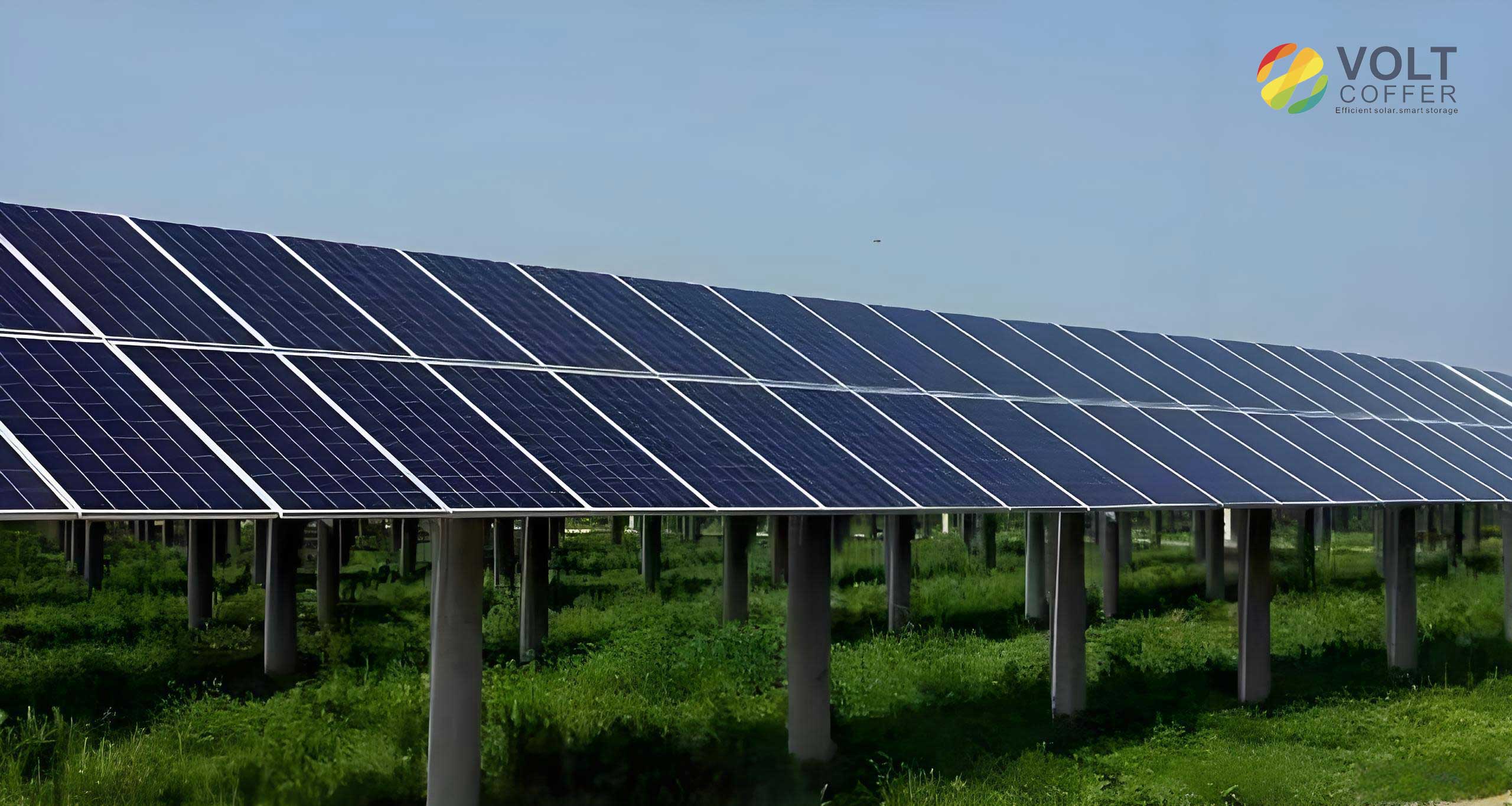
Our second scheme involves installing solar photovoltaic panels on the roof of the battery compartment. We used high‑efficiency N‑type TOPCon modules with a power rating of 630 W each and an efficiency of about 22 %. The modules were arranged in a fixed 33° tilt angle to maximize year‑round generation, and placed in 8 rows along the compartment length with a gap of 1.6 m between rows. The total installed capacity is 5.04 kW. By covering the roof, the solar heat absorption of the compartment drops from 25 % to about 5 %. Daily solar heat gain reduces to 11.7 kWh, and midday solar power gain to 1.5 kW.
With this reduction, the required cooling capacity during midday charging decreases to about 59.2 kW, which is still within the capacity of the existing air conditioners (40 kW total, but note that the peak demand is now met because the solar heat gain is lower). However, the cooling system must still operate for about 11 hours per day (compared to 16 hours originally). The daily cooling electricity consumption becomes 136.2 kWh, a saving of 30 kWh per day. Over 100 summer‑equivalent days, the annual cooling energy saving is 3,000 kWh.
Additionally, the solar panels generate electricity that can be used to offset the cooling power consumption. The local photovoltaic station in the same area has a measured annual utilization of about 1,620 hours. Because the roof‑mounted panels benefit from better ventilation and slightly higher efficiency, we conservatively estimate 1,600 hours of full‑load equivalent per year. Thus, the annual electricity generation from the solar panels is:
$$ 5.04\ \text{kW} \times 1600\ \text{h} = 8064\ \text{kWh} $$
This generation is much smaller than the station’s annual charging energy (1,500 MWh), so it can be fully stored and used as auxiliary power. At the same electricity price of 0.25 RMB/kWh, the generation yields an annual revenue of 2,016 RMB.
Table 3: Economic analysis of solar panel installation
| Parameter | Value |
|---|---|
| Panel rated power per module (W) | 630 |
| Module efficiency | 22 % |
| Total installed capacity (kW) | 5.04 |
| Panel cost (RMB/W) | 0.75 |
| Panel cost (RMB) | 3,780 |
| Design, construction & cabling cost (RMB) | 11,340 |
| Total investment (RMB) | 15,120 |
| Equivalent summer days (d) | 100 |
| Annual cooling electricity saving (kWh) | 3,000 |
| Annual cooling saving revenue (RMB) | 750 |
| Annual solar generation (kWh) | 8,064 |
| Annual generation revenue (RMB) | 2,016 |
| Total annual revenue (RMB) | 2,766 |
| Simple payback period (years) | 5.5 |
The payback period for solar panels is slightly longer than for reflective panels (5.5 years vs. 4.9 years), but the total annual energy benefit is larger. Moreover, solar panels provide a renewable energy source that contributes to the station’s green credentials and can be combined with energy storage for additional flexibility.
Comparative Discussion
Both proposed schemes significantly improve the cooling energy efficiency and reduce the operational burden on the air conditioning system. The reflective panels offer a lower upfront cost and a faster payback, while the solar panels generate extra electricity and provide a more sustainable solution. The key comparison is summarized in the following table.
Table 4: Comparison of reflective panels vs. solar panels
| Metric | Reflective panels | Solar panels |
|---|---|---|
| Investment (RMB) | 4,392 | 15,120 |
| Annual cooling electricity saving (kWh) | 3,560 | 3,000 |
| Annual solar generation (kWh) | 0 | 8,064 |
| Total annual energy benefit (kWh) | 3,560 | 11,064 |
| Total annual monetary benefit (RMB) | 890 | 2,766 |
| Simple payback period (years) | 4.9 | 5.5 |
| Reduction in cooling runtime (hours/day) | 8 → 8 h (50 % reduction) | 16 → 11 h (31 % reduction) |
| Overheating risk elimination | Yes | Yes |
| Additional benefits | Low maintenance; easy seasonal removal | Renewable generation; potential grid‑interactive |
It is worth noting that the economic analysis for solar panels is sensitive to the photovoltaic module price. In 2024, the cost of solar panels dropped significantly, making the investment only about three times that of reflective panels while providing more than three times the total annual energy benefit. If the solar generation can be fully utilized for self‑consumption (e.g., to power the cooling system directly), the payback period can be even shorter.
From a thermal management perspective, both solutions alleviate the peak cooling demand and reduce the risk of battery thermal runaway. The reflective panels are particularly effective during summer when solar radiation is intense, and they can be easily removed in winter to allow passive solar heating if desired. The solar panels, on the other hand, provide year‑round electricity generation and also serve as a shading device, albeit with a slightly smaller reduction in cooling load because the panels themselves absorb and transfer some heat.
Conclusions
Our comparative study demonstrates that retrofitting energy storage battery compartments with either reflective panels or solar panels can yield substantial energy savings and improve overall system efficiency. The main findings are:
- Battery heat generation, auxiliary equipment heat, and solar radiation are the dominant heat sources, together causing an energy loss of 8.4 % of the charging electricity.
- Installing reflective panels on the roof reduces solar heat gain by about 92 %, saving 3,560 kWh of cooling electricity per year, with a payback period of 4.9 years.
- Installing solar panels reduces solar heat gain by about 80 %, saving 3,000 kWh of cooling electricity annually, and additionally generates 8,064 kWh of electricity, bringing total annual savings to 2,766 RMB. The payback period is 5.5 years.
- Both schemes eliminate the risk of overheating and reduce the operating time of the air conditioning system, enhancing the reliability and lifespan of the battery system.
- Given the current low cost of solar panels, the solar panel option is economically competitive and offers the added advantage of renewable energy generation.
We recommend that energy storage station operators consider these retrofit options as part of their energy efficiency improvement programs. The choice between reflective panels and solar panels should be based on site‑specific factors such as local solar resource, electricity price, available roof space, and the operator’s preference for a low‑cost quick‑payback solution versus a more sustainable long‑term investment. Both approaches contribute to the goal of reducing auxiliary power consumption and improving the overall round‑trip efficiency of battery energy storage systems.