
The widespread adoption of lithium-ion batteries in electric vehicles, grid-scale energy storage, and aerospace applications is a testament to their high energy density and excellent cycle life. However, a critical bottleneck remains their performance degradation under low-temperature (LT) conditions. As someone deeply involved in energy storage research, I have observed that devices in these sectors are increasingly required to operate reliably in sub-zero environments, from frigid winters to high-altitude or space exploration. The conventional lithium-ion battery chemistry, optimized for room temperature, often fails to deliver sufficient power and capacity when the temperature drops, limiting its universal applicability. This article, from a researcher’s perspective, delves into the fundamental challenges at the material level and systematically explores the progress and strategies in developing lithium-ion battery components capable of thriving in the cold.
The performance of a lithium-ion battery is governed by the kinetics of lithium-ion (Li⁺) transport. At low temperatures, this kinetics is severely hampered by several interrelated factors. Firstly, the ionic conductivity (σ) of the liquid electrolyte plummets due to increased viscosity and reduced salt dissociation, which can be approximated by a modified Arrhenius relationship:
$$ \sigma = A \cdot \exp\left(-\frac{E_a}{k_B T}\right) $$
where \(E_a\) is the activation energy for ionic conduction, \(k_B\) is the Boltzmann constant, and \(T\) is the temperature. As \(T\) decreases, σ drops exponentially.
Secondly, the charge transfer resistance at the electrode/electrolyte interface increases dramatically. The desolvation process, where Li⁺ sheds its solvation shell before entering the Solid Electrolyte Interphase (SEI) or the electrode lattice, becomes energetically unfavorable. The associated energy barrier (\(\Delta G_{desolv}\)) rises, slowing down the reaction:
$$ k_{ct} \propto \exp\left(-\frac{\Delta G_{desolv} + \alpha F \eta}{RT}\right) $$
where \(k_{ct}\) is the charge transfer rate constant, \(\alpha\) is the charge transfer coefficient, \(F\) is Faraday’s constant, \(\eta\) is the overpotential, and \(R\) is the gas constant.
Thirdly, the solid-state diffusion of Li⁺ within the bulk electrode materials slows down. The chemical diffusion coefficient (\(D_{Li^+}\)) follows:
$$ D_{Li^+} = D_0 \cdot \exp\left(-\frac{E_a^{diff}}{RT}\right) $$
A lower \(T\) significantly reduces \(D_{Li^+}\), leading to severe concentration polarization, especially at moderate to high charge/discharge rates.
Finally, and most critically, the equilibrium potential for lithium plating on the graphite anode becomes very close to, or even above, the intercalation potential at low temperatures. This thermodynamic and kinetic shift promotes the hazardous reduction of Li⁺ to metallic lithium (plating) instead of its safe intercalation into graphite, causing rapid capacity fade and serious safety risks from dendrite formation.
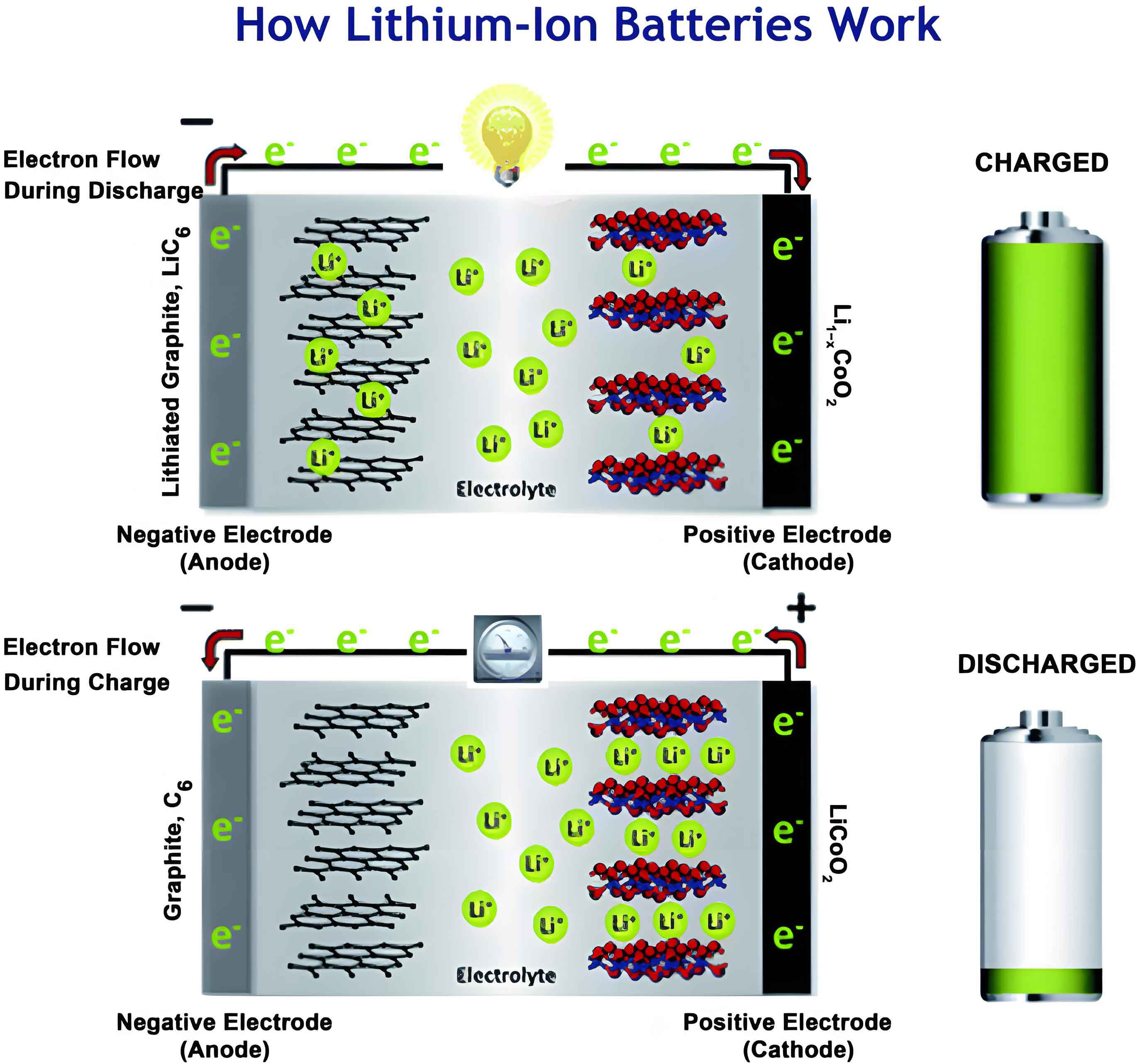
To overcome these barriers, the key materials—cathodes, anodes, and electrolytes—must be meticulously engineered. An ideal low-temperature lithium-ion battery system requires electrodes with high intrinsic electronic/ionic conductivity and robust structural stability, coupled with an electrolyte that maintains high ionic conductivity, low viscosity, and forms a stable, ionically conductive SEI/CEI even at sub-zero temperatures.
Cathode Materials: Overcoming Ionic and Electronic Transport Barriers
The cathode is often the performance-limiting electrode in LT lithium-ion battery systems due to sluggish Li⁺ diffusion and poor electronic conductivity. The main strategies involve surface engineering, particle size reduction, and structural doping.
| Cathode Type | Representative Material | Low-Temperature Challenge | Improvement Strategy | Key Performance Metric |
|---|---|---|---|---|
| Layered Oxide | LiCoO₂ (LCO), LiNixCoyMnzO₂ (NCM) | High charge-transfer resistance, surface degradation. | Amorphous Li-Zr-P-O coating, polyphenylene coating, Ti-doping. | LZPO-LCO: ~94% capacity retention after 100 cycles at -25°C. |
| Polyanion | LiFePO₄ (LFP), Li₃V₂(PO₄)₃ (LVP) | Low intrinsic electronic & ionic conductivity. | Carbon nano-coating, 3D conductive networks, binary C+YPO₄ coating. | LVP/C+YPO₄: 75.7% capacity retention at -40°C vs. room temp. |
| Spinel | LiNi₀.₅Mn₁.₅O₄ (LNMO) | High Li⁺ diffusion barrier at low T. | Cation doping (e.g., Co) to enhance conductivity. | Co-doped LNMO: 88.4% room-temperature capacity delivered at -20°C. |
The effectiveness of surface coatings can be modeled by considering the effective diffusion length. For a spherical particle of radius \(r\) with a high-resistance surface layer, the effective diffusion coefficient is greatly reduced. Coating or doping creates a more conductive surface, effectively reducing the interfacial resistance \(R_{ct}\) and modifying the apparent activation energy for charge transfer.
Anode Materials: Preventing Lithium Plating and Enhancing Kinetics
The anode presents the most severe challenge for LT operation due to the risk of lithium plating. Graphite, the dominant anode, has a lithiation potential dangerously close to that of Li/Li⁺.
The condition for lithium plating on graphite can be described when the anode’s surface potential (\(\phi_s\)) falls below 0 V vs. Li/Li⁺:
$$ \phi_s = \phi_{eq} – \eta_{ct} – \eta_{Ω} – \eta_{conc} $$
where \(\phi_{eq}\) is the equilibrium potential of graphite (a function of State of Charge, SOC), \(\eta_{ct}\) is charge-transfer overpotential, \(\eta_{Ω}\) is ohmic overpotential, and \(\eta_{conc}\) is concentration overpotential. At low \(T\), all overpotentials increase, easily driving \(\phi_s\) below 0 V and triggering plating.
Strategies to mitigate this include:
- Graphite Modification: Mild oxidation creates nano-channels for faster Li⁺ ingress. Incorporating nano-metal particles (Sn, Cu) catalyzes the lithiation reaction. Coating with Al₂O₃ provides a physical barrier.
- Alternative Anodes: Li₄Ti₅O₁₂ (LTO) operates at a safe 1.55 V vs. Li/Li⁺, eliminating plating risk. Its kinetics are improved via nano-structuring, surface fluorination, and compositing with TiO₂.
The diffusion-limited current \(i_L\) for an intercalation anode is given by:
$$ i_L = \frac{n F A D_{Li^+} C_{Li^+}^b}{δ} $$
where \(n\) is electrons transferred, \(A\) is area, \(C_{Li^+}^b\) is bulk Li⁺ concentration, and \(δ\) is diffusion layer thickness. Nano-structuring effectively reduces the actual diffusion distance, thereby increasing \(i_L\) and improving rate capability at low \(T\).
Electrolyte Design: The Heart of Low-Temperature Performance
The electrolyte is the most impactful component for enabling LT lithium-ion battery operation. The design focuses on formulating systems with low melting point, low viscosity, high ionic conductivity, and the ability to form a Li⁺-conductive, stable SEI/CEI.
1. Organic Solvents: Lowering Freezing Point and Viscosity
The quest is to move beyond standard ethylene carbonate (EC)-based formulations. While EC is excellent for SEI formation, its high melting point (36.4°C) and viscosity are detrimental. The general strategy is to blend it with low-viscosity, low-freezing-point linear carbonates (DMC, DEC, EMC) and esters.
| Solvent Type | Examples | Melting Point (°C) | Role in LT Electrolyte |
|---|---|---|---|
| Cyclic Carbonate | Ethylene Carbonate (EC) | 36.4 | Essential for graphite SEI; must be diluted for LT use. |
| Linear Carbonate | Dimethyl Carbonate (DMC), Ethyl Methyl Carbonate (EMC) | 4.6, -55 | Reduces viscosity and freezing point of EC mixtures. |
| Linear Ester | Methyl Acetate (MA), Methyl Formate (MF), Ethyl Acetate (EA) | -98, -100, -84 | Very low viscosity & freezing point; significantly boost ionic conductivity at <-30°C. |
| Other Co-solvents | 1,3-Dioxolane (DIOX), Methyl Butyrate (MB) | -95, -84 | Offers low Li⁺ desolvation energy (DIOX) or good film-forming ability (MB). |
The viscosity (η) of the electrolyte mixture critically affects ionic conductivity via the Walden’s rule approximation: \( \Lambda \eta \approx \text{constant} \), where \(\Lambda\) is the molar conductivity. Therefore, minimizing η is paramount for LT electrolytes.
2. Lithium Salts: Beyond LiPF₆
While LiPF₆ is the industry standard, its thermal instability and poor dissociation at low \(T\) drive the search for alternatives or complementary salts.
| Lithium Salt | Advantages for LT | Disadvantages | Typical Use |
|---|---|---|---|
| LiPF₆ | Good balance of conductivity & Al current collector stability. | Poor thermal/chemical stability; HF generation. | Baseline; often used in blends. |
| LiBF₄ | Lower charge-transfer resistance at low T; forms stable SEI. | Lower bulk ionic conductivity; poorer graphite passivation alone. | In blends with LiPF₆ or LiBOB. |
| LiBOB / LiDFOB | Excellent SEI/CEI forming ability; suppresses Al corrosion. | Low solubility & high viscosity in carbonates. | As additive (1-5%) or in dual-salt systems. |
| LiTFSI / LiFSI | High thermal stability, excellent ionic conductivity at low T. | Corrodes Al cathode current collector at high voltages. | In high-concentration electrolytes or with corrosion inhibitors. |
Dual-salt or multi-salt electrolytes are highly promising. For instance, a LiBF₄/LiDFOB blend combines the low \(R_{ct}\) of LiBF₄ with the superior film-forming ability of LiDFOB. The ionic conductivity of a mixed-salt electrolyte can sometimes exceed that predicted by simple mixing rules due to synergistic effects on ion-pair dissociation.
3. Functional Additives: Engineering the Interphases
Additives (< 5 wt%) are indispensable for forming stable, conductive, and low-impedance SEI/CEI layers at low temperatures.
- Film-Forming Additives: Vinylene carbonate (VC) and fluoroethylene carbonate (FEC) polymerize to form elastic, LiF-rich SEI layers that withstand electrode volume changes and remain conductive at low \(T\).
- Lithium Salt Additives: LiPO₂F₂ is remarkably effective. It decomposes to form LiF and LixPOyFz species on both anode and cathode, creating robust interphases that significantly lower interfacial impedance and suppress Li dendrite growth.
- Other Additives: Sulfur-containing compounds (e.g., dimethyl sulfite) and boron-based additives (LiDFBOP) aid in forming favorable SEI and also modify the Li⁺ solvation structure to reduce the desolvation energy barrier \(\Delta G_{desolv}\).
The role of an additive can be quantified by its effect on the apparent activation energy for charge transfer. A successful LT additive should lower \(E_a^{ct}\), as seen in the Arrhenius plot of the interfacial resistance:
$$ R_{ct} = R_0 \cdot \exp\left(\frac{E_a^{ct}}{RT}\right) $$
Effective additives shift this line downward and reduce its slope.
Summary and Future Perspectives
The development of high-performance low-temperature lithium-ion battery technology is a multi-faceted challenge requiring simultaneous breakthroughs in electrode materials, electrolyte chemistry, and interface control. From our analysis, the path forward involves integrated solutions:
- Holistic Electrolyte Engineering: The future lies in “designer electrolytes” — formulations where solvents, lithium salts, and additives are chosen not just for their individual properties but for their synergistic interactions. This includes concentrated electrolytes, localized high-concentration electrolytes (LHCE), and novel weakly-solvating solvents that inherently lower \(\Delta G_{desolv}\). The goal is an electrolyte that remains in a supercooled liquid state with high conductivity below -40°C and forms an inorganic-rich, homogeneous SEI/CEI.
- Advanced Electrode Architectures: Beyond simple doping or coating, future electrode designs will employ precise morphological control—such as vertically aligned channels, single-crystal particles with minimized grain boundaries, and 3D bicontinuous networks of active material and conductor—to ensure ultra-short and robust pathways for both electrons and Li⁺, minimizing polarization at any temperature.
- Novel Chemistries and System Integration: Exploring alternative anodes like hard carbon or composite Si-based materials with tailored interfaces, coupled with high-voltage cathodes, can push the energy density boundaries for LT applications. Furthermore, integrating materials innovation with intelligent thermal management systems at the battery pack level will be crucial for real-world applications, allowing for momentary heating to bring the cell into an optimal operating window.
In conclusion, mastering the low-temperature frontier for the lithium-ion battery is essential for its dominance in next-generation energy storage. It demands a deep understanding of the limiting physical and electrochemical processes and a creative, synergistic approach to material design. The progress summarized here provides a robust foundation, but the journey toward a lithium-ion battery that performs seamlessly from the tropics to the arctic is an ongoing and vital pursuit for the global energy transition.