
As a professional deeply involved in sustainable architecture, I have witnessed the transformative potential of integrating renewable energy into building designs. In this article, I will explore the application of solar photovoltaic technology in building integrated design, drawing from my firsthand experience in a recent commercial project. The focus is on how a well-designed solar system can enhance energy efficiency, aesthetic appeal, and economic viability. Throughout this discussion, I will emphasize the critical role of the solar system in modern construction, using tables and formulas to summarize key insights. The goal is to provide a comprehensive guide that underscores the importance of solar system integration for achieving sustainable development in the built environment.
The global shift toward renewable energy has accelerated due to growing concerns about energy shortages and environmental degradation. Solar energy, as a clean and abundant resource, offers a promising solution for reducing the carbon footprint of buildings. In my work, I have focused on integrating solar photovoltaic systems directly into building structures, a approach known as Building Integrated Photovoltaics (BIPV). This method not only generates electricity but also serves as a functional part of the building envelope. By sharing insights from a specific project, I aim to demonstrate how a thoughtfully implemented solar system can revolutionize building design. The solar system here refers to the entire photovoltaic setup, including components, installation, and performance metrics.
In this project, we developed a multi-story office building in an urban setting, designed to be a model of green architecture. The building features 20 above-ground floors and 2 basement levels, with a total floor area of approximately 25,000 square meters. Its structural framework uses reinforced concrete, complemented by a facade of glass curtain walls and aluminum panels. From the outset, our team prioritized the integration of a solar system to harness solar energy efficiently. We aimed to create a building that minimizes reliance on grid power while maintaining aesthetic integrity. This initiative aligns with national policies promoting renewable energy, and it highlights how a solar system can be seamlessly incorporated into contemporary designs. The solar system was not an afterthought but a core element of our architectural vision.
The selection of the BIPV system was based on a thorough analysis of local climate conditions and the building’s morphological characteristics. We opted for high-efficiency monocrystalline silicon photovoltaic modules, which offer a conversion efficiency of up to 19%. This choice was driven by the need to maximize energy output while minimizing the footprint of the solar system. The modules are designed to blend with the building’s外观, ensuring that the solar system enhances rather than detracts from the overall design. Below is a table summarizing the key parameters of the photovoltaic components used in our solar system:
| Parameter | Value |
|---|---|
| Dimensions (mm) | 1698 × 998 × 30 |
| Weight (kg) | 19.5 |
| Power (W) | 345 |
| Open-circuit voltage (V) | 41.7 |
| Short-circuit current (A) | 10.36 |
| Operating temperature (°C) | -40 to +85 |
We employed two main integration methods: photovoltaic tiles for the roof and photovoltaic curtain walls for the立面. The roof tiles utilize N-type TOPCon cell technology, which improves performance under high-temperature and low-light conditions. This aspect of the solar system ensures reliable energy generation throughout the year. The curtain walls use double-glass modules, providing both transparency and durability. These components are integral to the solar system, allowing natural light penetration while generating electricity. The efficiency of the solar system can be modeled using the formula: $$P = \eta \times A \times G$$ where \(P\) is the power output, \(\eta\) is the conversion efficiency, \(A\) is the surface area, and \(G\) is the solar irradiance. For our solar system, with an average irradiance of 1000 W/m², the annual energy yield is significant.
The structural design of the solar system was crucial for ensuring safety and longevity. We used embedded installation for the photovoltaic tiles, which integrate seamlessly with traditional roofing materials. This approach simplifies waterproofing and maintenance, making the solar system more robust. For the photovoltaic curtain walls, we adopted point-supported fixation, where the modules are attached to the building’s main structure at discrete points. This method reduces visual obstruction and allows for thermal expansion, enhancing the solar system’s durability. The structural integrity of the solar system is evaluated using load analysis formulas, such as: $$F = k \times \rho \times v^2 \times A$$ where \(F\) is the wind load, \(k\) is a coefficient, \(\rho\) is air density, \(v\) is wind speed, and \(A\) is the projected area. Our solar system was designed to withstand local wind and snow loads, ensuring reliable operation over its lifespan.
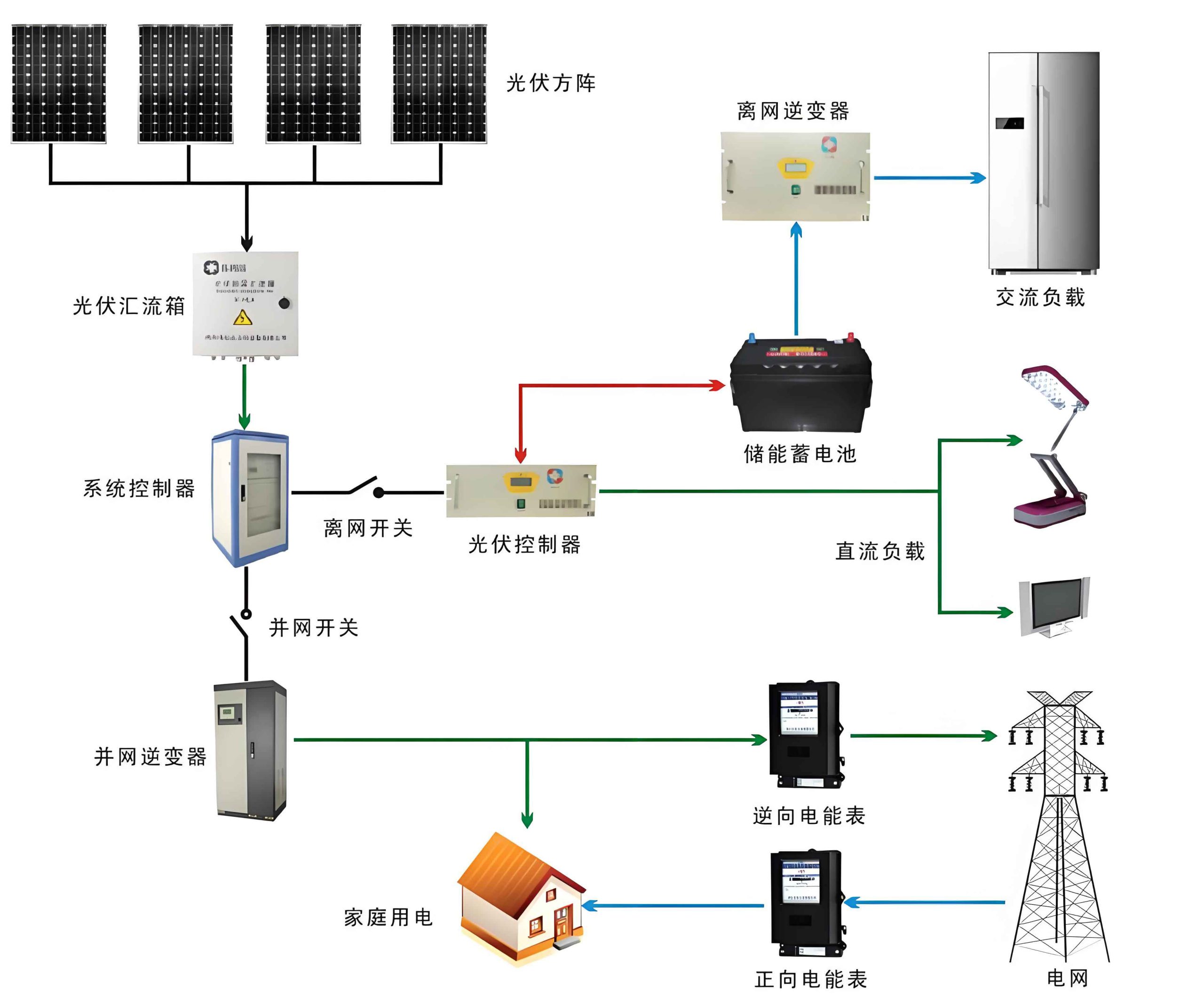
The electrical design of the solar system followed a modular configuration to optimize performance and scalability. We installed 3,600 monocrystalline silicon modules, each rated at 330 Wp, resulting in a total capacity of 1.188 MWp. The array was arranged in 18 series and 20 parallel strings, connected to 12 SMA 100 kW string inverters. This setup ensures efficient power conversion and grid integration. The solar system is connected to the municipal grid via a 380 V low-voltage connection and a 1600 kVA transformer, with a 10 kV line for distribution. Monitoring is handled by an iSolarCloud platform, which provides real-time data on the solar system’s performance. To protect against lightning, we installed four 15-meter-high lightning rods per photovoltaic array, with 8 mm galvanized steel wires as down conductors linked to the building’s grounding network. The electrical output of the solar system can be calculated using: $$E = P_{\text{total}} \times \text{PR} \times H$$ where \(E\) is the annual energy production, \(P_{\text{total}}\) is the total installed capacity, PR is the performance ratio (typically 0.75-0.85), and \(H\) is the annual peak sun hours. For our location, this yields substantial energy savings.
Analyzing the application effects, the solar system demonstrates remarkable energy utilization efficiency. The installed photovoltaic components cover 3,500 m² on the roof and south facade, with a total capacity of 500 kWp. Based on local日照 data, we estimate an annual electricity generation of 550,000 kWh. This output equates to saving 170 tons of standard coal and reducing carbon dioxide emissions by 440 tons annually. The following table breaks down the monthly发电量 for the solar system:
| Month | Daily Generation (kWh) | Monthly Generation (kWh) |
|---|---|---|
| January | 1,100 | 34,100 |
| February | 1,300 | 36,400 |
| March | 1,500 | 46,500 |
| April | 1,600 | 48,000 |
| May | 1,700 | 52,700 |
| June | 1,600 | 48,000 |
| July | 1,800 | 55,800 |
| August | 1,700 | 52,700 |
| September | 1,500 | 45,000 |
| October | 1,400 | 43,400 |
| November | 1,200 | 36,000 |
| December | 1,000 | 31,000 |
| Total Annual | — | 529,600 |
Beyond energy metrics, the solar system significantly enhances the building’s aesthetic appeal. Traditional photovoltaic modules often appear bulky and discordant, but our BIPV components are designed for harmony. The photovoltaic tiles have a purple hue that matches the roofing materials, creating a cohesive look. The photovoltaic curtain walls are semi-transparent, allowing diffused light to enter while generating power. This integration transforms the solar system into an architectural feature, adding a modern and dynamic element to the facade. The solar system thus contributes to a visually striking environment, proving that sustainability and beauty can coexist. The color and texture variations in the solar system under different lighting conditions further enrich the building’s character, making it a landmark in the urban landscape.
The economic benefits of the solar system are compelling, despite higher initial costs. From a lifecycle perspective, the solar system offers substantial returns. It replaces conventional building materials, such as exterior cladding and roofing, thereby reducing material expenses. Moreover, the solar system requires minimal maintenance, and operational costs are low. Based on our projections, the total investment for the solar system was approximately 5 million USD. With an annual electricity generation of 550,000 kWh and a feed-in tariff of 0.45 USD/kWh, the yearly revenue is around 248,000 USD. The payback period can be estimated using: $$\text{Payback Period} = \frac{\text{Initial Investment}}{\text{Annual Savings}}$$ Assuming annual savings include both direct revenue and reduced energy costs, the static payback period is about 20 years. However, as solar technology advances and electricity prices rise, this period is expected to shorten. Additionally, the solar system may qualify for government incentives and carbon credits, improving its financial attractiveness. The solar system thus represents a sound investment that aligns with long-term economic and environmental goals.
To delve deeper into the technical aspects, the solar system’s performance is influenced by factors like temperature and irradiance. The efficiency of photovoltaic modules decreases with rising temperature, which can be expressed as: $$\eta(T) = \eta_{\text{STC}} \times [1 – \beta (T – T_{\text{STC}})]$$ where \(\eta_{\text{STC}}\) is the efficiency at standard test conditions (25°C), \(\beta\) is the temperature coefficient (typically 0.004/°C for silicon cells), and \(T\) is the operating temperature. For our solar system, we selected components with low temperature coefficients to maintain high efficiency in varied climates. This consideration ensures that the solar system performs optimally throughout the year, maximizing energy harvest. Furthermore, the solar system’s design incorporates shading analysis to minimize losses, using tools like the solar angle formula: $$\theta = \arcsin(\sin \phi \sin \delta + \cos \phi \cos \delta \cos \omega)$$ where \(\theta\) is the solar altitude angle, \(\phi\) is the latitude, \(\delta\) is the solar declination, and \(\omega\) is the hour angle. By optimizing panel orientation, we enhanced the solar system’s output.
The integration of the solar system also impacts building thermodynamics. The photovoltaic modules provide shading and insulation, reducing cooling loads in summer. This effect can be quantified using the heat gain formula: $$Q = U \times A \times \Delta T$$ where \(Q\) is the heat transfer, \(U\) is the overall heat transfer coefficient, \(A\) is the area, and \(\Delta T\) is the temperature difference. By acting as a barrier, the solar system lowers the U-value of the building envelope, contributing to energy savings. In winter, the solar system allows passive solar heating, further improving thermal comfort. Thus, the solar system serves multiple functions beyond electricity generation, enhancing overall building performance. This multifunctionality is a key advantage of BIPV, making the solar system a cornerstone of sustainable design.
Looking ahead, the future of solar system integration in buildings is bright. Technological advancements are driving down costs and improving efficiencies. For instance, perovskite solar cells and bifacial modules promise higher yields for future solar systems. Moreover, smart grid technologies will enable better management of solar system output, facilitating energy storage and demand response. In my view, the solar system will become ubiquitous in construction, driven by regulatory mandates and market demand. Building codes are increasingly requiring renewable energy integration, and the solar system is at the forefront of this trend. As we move toward net-zero energy buildings, the solar system will be indispensable, providing a scalable solution for urban and rural settings alike. The solar system not only addresses energy needs but also fosters resilience against power outages and climate change.
In conclusion, the application of solar photovoltaic technology in building integrated design offers profound benefits. From my experience, a well-planned solar system can significantly boost energy efficiency, create aesthetic value, and deliver economic returns. This project exemplifies how the solar system can be harmoniously blended with architecture, supporting sustainable development. As the world transitions to cleaner energy sources, the solar system will play a pivotal role in shaping the built environment. I encourage architects, engineers, and policymakers to embrace solar system integration, leveraging its potential to create greener, smarter buildings. The solar system is more than just a power source; it is a symbol of innovation and responsibility toward our planet.