
In the context of global efforts toward carbon reduction and sustainable development, the oil and gas industry is actively seeking innovative solutions to minimize its environmental footprint while maintaining operational efficiency. One promising approach is the integration of battery energy storage systems into drilling operations, particularly in regions like Sichuan and Chongqing, where energy demands are high and grid stability can be challenging. This paper explores the application of a battery energy storage system in oil and gas drilling, focusing on its technical implementation, performance benefits, and economic viability. Drawing from a practical case study, I will analyze how such systems enhance grid capacity, improve power quality, enable peak shaving and valley filling, and provide emergency backup, ultimately contributing to cost savings and reduced carbon emissions. The battery energy storage system serves as a cornerstone for modernizing drilling power infrastructure, aligning with national green energy initiatives.
The adoption of battery energy storage systems in drilling operations is driven by the need to replace traditional diesel generators with cleaner electricity, a process known as “electricity replacing diesel.” However, in remote drilling sites, grid power often suffers from voltage drops, limited capacity, and unreliable supply due to long transmission distances. For instance, in a typical drilling site powered by a 10 kV grid line over 16 km, voltage can drop significantly under high load, hindering drilling progress. To address this, a battery energy storage system was deployed, configured as a 2,000 kW/2,752 kWh lithium iron phosphate (LiFePO4) setup. This system operates in parallel with the grid at a 600 V output, providing supplemental power during peak demands and storing energy during off-peak hours. The battery energy storage system comprises two main enclosures: a battery cabin housing the LiFePO4 cells, fire suppression, thermal management, and distribution units, and a step-up integrated cabin containing a power conversion system (PCS), transformers, and energy management systems. This design ensures robust outdoor performance with an IP54 protection rating and low noise emission below 65 dB.
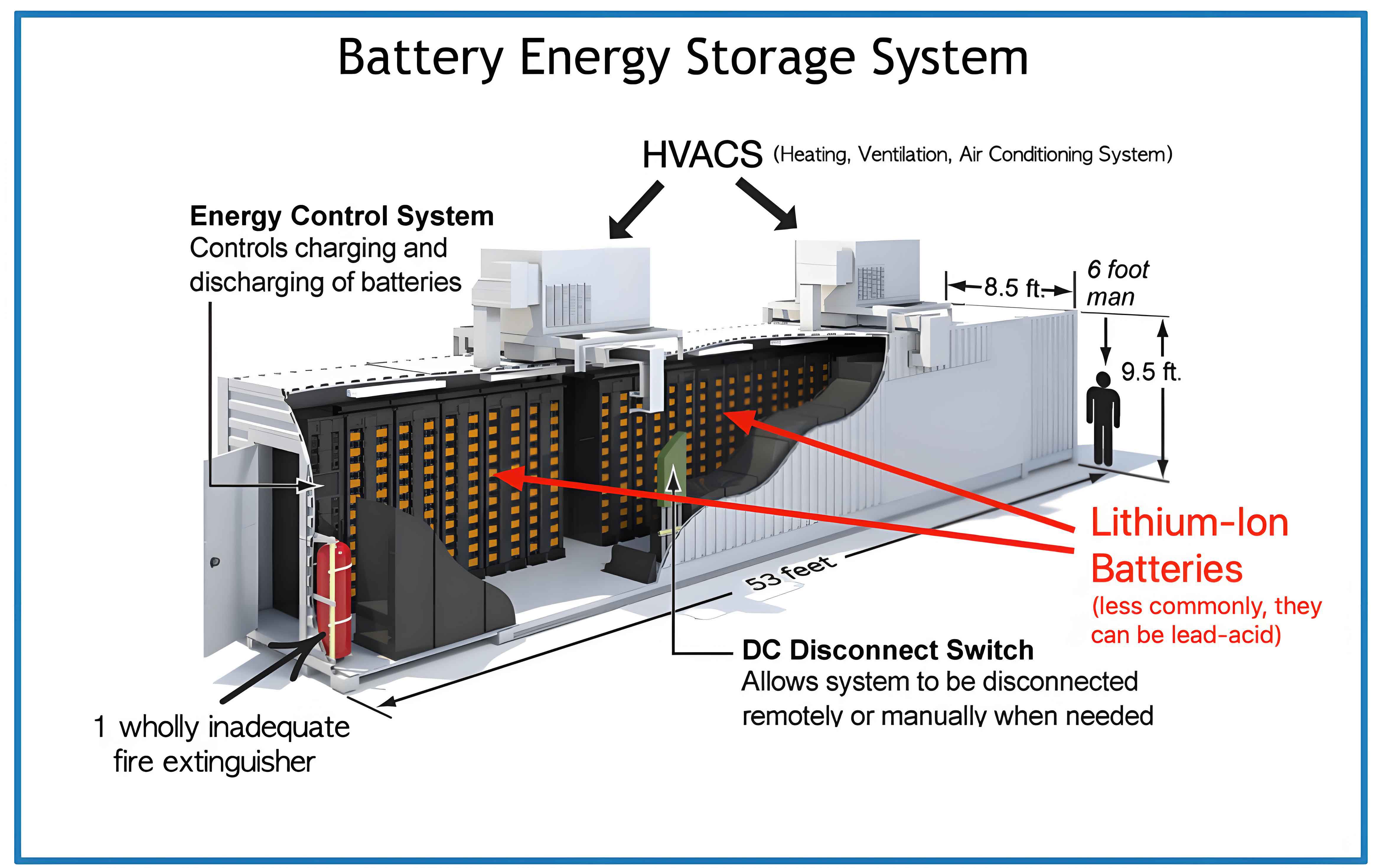
The technical specifications of the battery energy storage system are critical to its functionality. The LiFePO4 battery cells, known for their safety and longevity, have a design life of 15 years and support a “two-charge, two-discharge” daily cycle. Each cell has a nominal voltage of 3.2 V and capacity of 280 Ah, yielding an energy content of 0.896 kWh per cell. These cells are organized into modules, packs, and clusters, ultimately forming a battery stack with a total capacity of 2,752 kWh. The step-up cabin integrates a 2,000 kW PCS, a 2,000 kVA oil-immersed transformer (0.69/0.6 kV), a 100 kVA auxiliary transformer, and switchgear, enabling seamless operation in both grid-connected and islanded modes. The overall dimensions and weights are optimized for mobility, with the battery cabin measuring 5.5 m × 2.6 m × 2.85 m and weighing 35 tons, and the step-up cabin at 6.1 m × 2.6 m × 2.85 m and 16.8 tons. This compact yet powerful configuration allows the battery energy storage system to be deployed rapidly in diverse drilling environments.
The control architecture of the battery energy storage system is a sophisticated ensemble of subsystems that ensure efficient and safe operation. At its core is the Energy Management System (EMS), which acts as the brain of the setup. The EMS orchestrates energy调度, collecting data from all components and issuing control commands based on predefined strategies or real-time inputs. It incorporates algorithms for load forecasting, peak shaving, valley filling, demand management, and power quality optimization. For example, the EMS schedules charging during low-tariff night hours and discharging during high-tariff daytime peaks, maximizing economic benefits. The battery energy storage system’s EMS also handles automatic mode switching between grid-connected and islanded operations, with transition times under 100 ms, ensuring uninterrupted power supply during grid faults.
The Battery Management System (BMS) is another vital component, responsible for monitoring and protecting the LiFePO4 battery packs. It performs real-time measurements of voltage, current, and temperature at the cell, module, and cluster levels, with high precision—voltage sampling accuracy within ±5 mV and temperature within ±0.5°C. The BMS implements state-of-charge (SOC) estimation, state-of-health (SOH) tracking, thermal management, and cell balancing to extend battery life and prevent safety incidents. In the battery energy storage system, the BMS ensures that each cluster operates within safe limits, enabling reliable energy storage and release. The Power Conversion System (PCS) facilitates bidirectional energy flow between the battery and grid, supporting multiple modes: PQ (active and reactive power control), VF (voltage and frequency regulation), and SVG (static var generator) for reactive power compensation. This flexibility allows the battery energy storage system to stabilize grid voltage, improve power factor, and provide clean backup power.
Safety is paramount in a battery energy storage system, especially in hazardous drilling sites. The fire suppression system employs a multi-layer approach, with pack-level detection and pack-level spraying using perfluorohexanone, a clean and effective extinguishing agent. Smoke and heat detectors are installed throughout the cabins, triggering automatic suppression in case of thermal runaway or fire. This design minimizes risks associated with lithium-ion batteries, ensuring compliance with industry standards like GB/T 36276-2018 for lithium-ion batteries in power storage. The integration of these control and safety systems makes the battery energy storage system a reliable asset for drilling operations.
In practice, the battery energy storage system demonstrated significant benefits in drilling applications, particularly in peak shaving and valley filling. Over a period from July 2024 to February 2025, the system accumulated a total charging energy of 251,034 kWh and discharging energy of 224,940 kWh, yielding a round-trip efficiency of approximately 89.6%. This was achieved by leveraging time-of-use electricity tariffs, where the price difference between peak and off-peak hours in Sichuan is about 0.6 CNY/kWh. During off-peak night hours (e.g., 23:00 to 07:00), the battery energy storage system charged at an average power of 250 kW, and during peak daytime hours, it discharged at around 200 kW, directly reducing electricity costs. The economic gain from this arbitrage amounted to 87,770 CNY over the period. The following table summarizes the energy flow and financial savings:
| Charging Period | Total Charging Energy (kWh) | Charging Cost (CNY) | Discharging Period | Total Discharging Energy (kWh) | Discharging Revenue (CNY) | Net Savings (CNY) |
|---|---|---|---|---|---|---|
| 23:00–07:00 | 251,034 | 47,194 | 07:01–22:59 | 224,940 | 134,964 | 87,770 |
The battery energy storage system also enhanced grid capacity and power quality. At the drilling site, the grid’s effective load-bearing capacity was only about 1,000 kW due to line losses over 16 km. With the battery energy storage system supplementing power during high-demand periods, the stable supply increased to approximately 1,300 kW, effectively expanding grid capacity by 30%. Moreover, the system provided emergency backup during grid outages. For instance, on August 4, 2024, two sudden blackouts occurred—one lasting 10 minutes and another 50 minutes. In both cases, the battery energy storage system instantly switched from charging to discharging mode, maintaining continuous power to critical drilling loads and preventing potential downhole risks. Similarly, during a grid-imposed power limitation on August 23, 2024, due to high temperatures, the system supplied an additional 200 kW to sustain operations. These instances underscore the reliability of the battery energy storage system as an uninterruptible power source.
The economic evaluation of the battery energy storage system reveals compelling returns on investment. Beyond peak shaving savings, the system can replace diesel generators for backup power during operations like casing running or cementing. Diesel generation costs around 2.03 CNY/kWh, whereas the battery energy storage system delivers power at roughly 1 CNY/kWh when considering lifecycle expenses. For a typical well that requires about 58,000 kWh of backup energy, this translates to savings of approximately 60,000 CNY per well. Scaling up to a full year, assuming normal drilling activity with daily energy cycling of 2,500 kWh, the annual energy throughput reaches 750,000 kWh. With a peak-valley price difference of 0.6 CNY/kWh, the annual arbitrage revenue would be 450,000 CNY. Combined with backup fuel savings of 60,000 CNY, the total annual benefit sums to 510,000 CNY. Given an initial investment of about 4 million CNY for a 2,000 kW/2,752 kWh battery energy storage system, the payback period is estimated at 7.8 years, as shown in the formula below:
$$ \text{Payback Period} = \frac{\text{Initial Investment}}{\text{Annual Savings}} = \frac{4,000,000 \text{ CNY}}{510,000 \text{ CNY/year}} \approx 7.8 \text{ years} $$
Furthermore, the battery energy storage system contributes to environmental benefits by reducing diesel consumption and associated carbon emissions. The round-trip efficiency of the system can be expressed as:
$$ \eta = \frac{E_{\text{discharge}}}{E_{\text{charge}}} \times 100\% = \frac{224,940 \text{ kWh}}{251,034 \text{ kWh}} \times 100\% \approx 89.6\% $$
This high efficiency minimizes energy waste during storage and retrieval. Additionally, the battery energy storage system’s ability to provide reactive power support improves the overall power factor at the drilling site, reducing line losses and enhancing voltage stability. The PCS operates in SVG mode to inject or absorb reactive power as needed, which can be quantified by the formula for reactive power compensation:
$$ Q_c = P \cdot (\tan \phi_1 – \tan \phi_2) $$
where \( Q_c \) is the required compensation, \( P \) is the active power, and \( \phi_1 \) and \( \phi_2 \) are the initial and target power factor angles, respectively. By integrating such capabilities, the battery energy storage system not only saves costs but also elevates the electrical infrastructure to modern standards.
Looking ahead, the potential for battery energy storage systems in drilling operations is vast. With advancements in battery technology, such as higher energy densities and longer lifespans, future systems could offer even greater capacity and flexibility. The integration of artificial intelligence and machine learning into EMS could optimize charging and discharging strategies based on real-time weather, grid conditions, and drilling schedules. Moreover, policy support for renewable energy and carbon reduction may accelerate adoption, making battery energy storage systems a standard component in “electricity replacing diesel” microgrids for oil and gas fields. This aligns with global trends toward decarbonization and smart energy management.
In conclusion, the application of a battery energy storage system in oil and gas drilling proves to be a transformative solution for enhancing power reliability, reducing operational costs, and supporting environmental goals. The case study from Sichuan-Chongqing region demonstrates tangible benefits in peak shaving, grid augmentation, emergency backup, and economic returns. As the industry continues to evolve, the widespread deployment of battery energy storage systems will play a pivotal role in achieving sustainable and efficient drilling practices. By leveraging these systems, companies can not only cut expenses but also contribute to a greener energy landscape, paving the way for a low-carbon future in hydrocarbon extraction.