
The safety reliability and driving range of lithium ion batteries remain pivotal factors influencing consumer decisions in electric vehicles. This paper explores strategies to enhance energy density and safety through comparative analysis of liquid and solid-state lithium ion battery technologies, while outlining commercialization challenges and capacity planning.
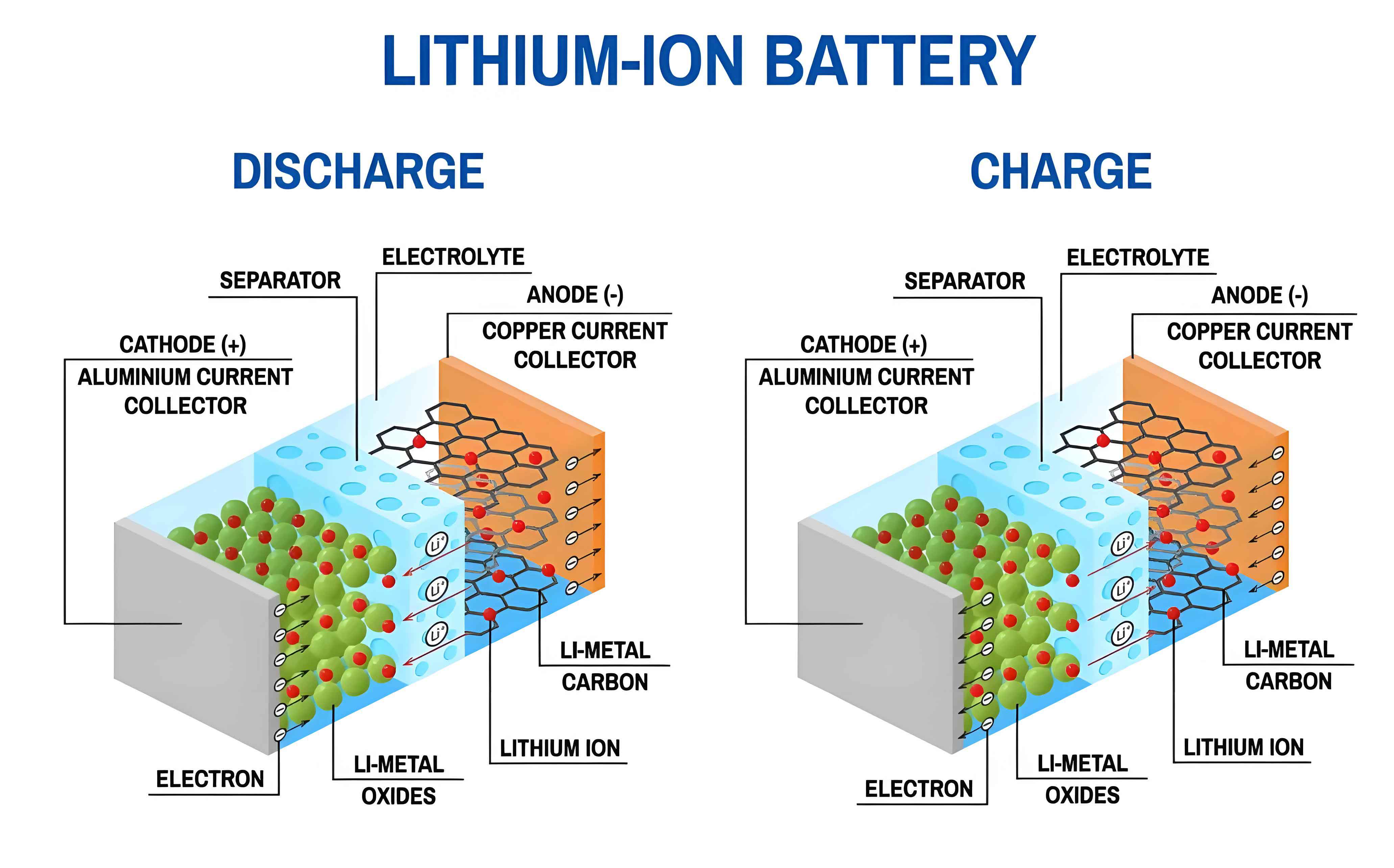
1. Classification of Lithium Ion Batteries
Conventional lithium ion batteries utilize liquid electrolytes with organic solvents (25 wt%), achieving energy densities up to 250 Wh/kg. Solid-state variants are categorized as:
| Type | Electrolyte Composition | Energy Density (Wh/kg) |
|---|---|---|
| Liquid | LiPF₆ in organic solvent | ≤250 |
| Semi-solid | 5-10% liquid in solid matrix | ≤350 |
| All-solid | Solid electrolytes only | ≥500 |
The ionic conductivity of solid electrolytes follows the Arrhenius equation:
$$ \sigma = \sigma_0 e^{-E_a/(RT)} $$
where $E_a$ represents activation energy, significantly lower in sulfide electrolytes (0.2-0.3 eV) compared to oxides (0.4-0.6 eV).
2. Technical Advantages of Solid-State Lithium Ion Batteries
Key performance parameters demonstrate superiority over conventional lithium ion batteries:
| Parameter | Liquid LIB | Solid-State LIB |
|---|---|---|
| Volumetric Energy | 700 Wh/L | 1,200 Wh/L |
| Cycle Life | 1,500 cycles | 5,000 cycles |
| Operating Temp. | -20°C~60°C | -40°C~120°C |
Sulfide-based solid electrolytes achieve exceptional conductivity:
$$ \text{Li}_{10}\text{GeP}_2\text{S}_{12}: \sigma = 1.2 \times 10^{-2} \, \text{S/cm} $$
3. Technical Pathways and Challenges
Major development routes for lithium ion battery evolution:
- Polymer electrolytes: $(\text{PEO})_n\text{-LiTFSI}$
- Sulfide ceramics: $\text{Li}_7\text{P}_3\text{S}_{11}$
- Oxide composites: $\text{Li}_{7}\text{La}_3\text{Zr}_2\text{O}_{12}$
Interfacial resistance remains critical for lithium ion transport:
$$ R_{\text{interface}} = \frac{\delta}{\sigma_{\text{contact}}} + \frac{\Delta \phi}{j_0} $$
where $\delta$ represents interfacial layer thickness and $j_0$ exchange current density.
4. Commercialization Roadmap
Global capacity planning for solid-state lithium ion batteries:
| Company | Technology | Planned Capacity (GWh) |
|---|---|---|
| Toyota | Sulfide | 20 (2027) |
| QuantumScape | Oxide | 15 (2026) |
| BYD | Hybrid | 100 (2028) |
The cost evolution follows the learning curve model:
$$ C_t = C_0 \times (Q_t/Q_0)^{-b} $$
where $b=0.28$ for lithium ion battery technologies, projecting solid-state battery costs to reach \$80/kWh by 2030.
5. Conclusion
Solid-state lithium ion batteries demonstrate transformative potential through enhanced energy density (theoretically 700 Wh/kg) and safety performance. While sulfide electrolytes currently lead in ionic conductivity ($>10^{-2}$ S/cm), hybrid solutions combining solid electrolytes with optimized liquid components will likely dominate the 2025-2030 transition period. Continuous innovation in interface engineering and manufacturing processes remains crucial for realizing the full potential of lithium ion battery technologies.