
The growing severity of atmospheric environmental issues has made air pollution prevention and control an increasingly urgent task. Significant efforts have been made in promoting the utilization of clean energy, yielding notable results. However, a considerable gap remains when compared to the pressing demands for adjusting the energy structure, improving environmental quality, and meeting the strong desire of rural populations to enhance their living conditions. To explore multiple pathways for clean heating and address current energy supply challenges, new practices in clean heating for rural areas are being implemented. Solar photovoltaic (PV) heating is a technology that collects and utilizes solar radiation, converting it into electrical energy for space heating—a quintessential clean energy solution. The region discussed is relatively rich in solar energy resources, with certain areas classified as Type II and others as Type III, providing a solid foundation for the deployment of solar heating technologies.
At its core, the “solar PV + clean heating” technology leverages the photovoltaic effect of semiconductor materials in solar cells to directly transform solar radiant energy into electricity. The overall heating system is an integrated solar system typically composed of several key components: solar PV panels, an inverter, balance-of-system (BOS) components, a control system, an auxiliary heat source, and heat distribution units (e.g., radiators, underfloor heating). Depending on the chosen auxiliary heat source, the configuration can be categorized into several models: “solar PV + electric thermal storage,” “solar PV + direct electric heater,” “solar PV + air-source heat pump,” “solar PV + ground-source heat pump,” “solar PV + biomass boiler,” and “solar PV + gas wall-hung boiler.”
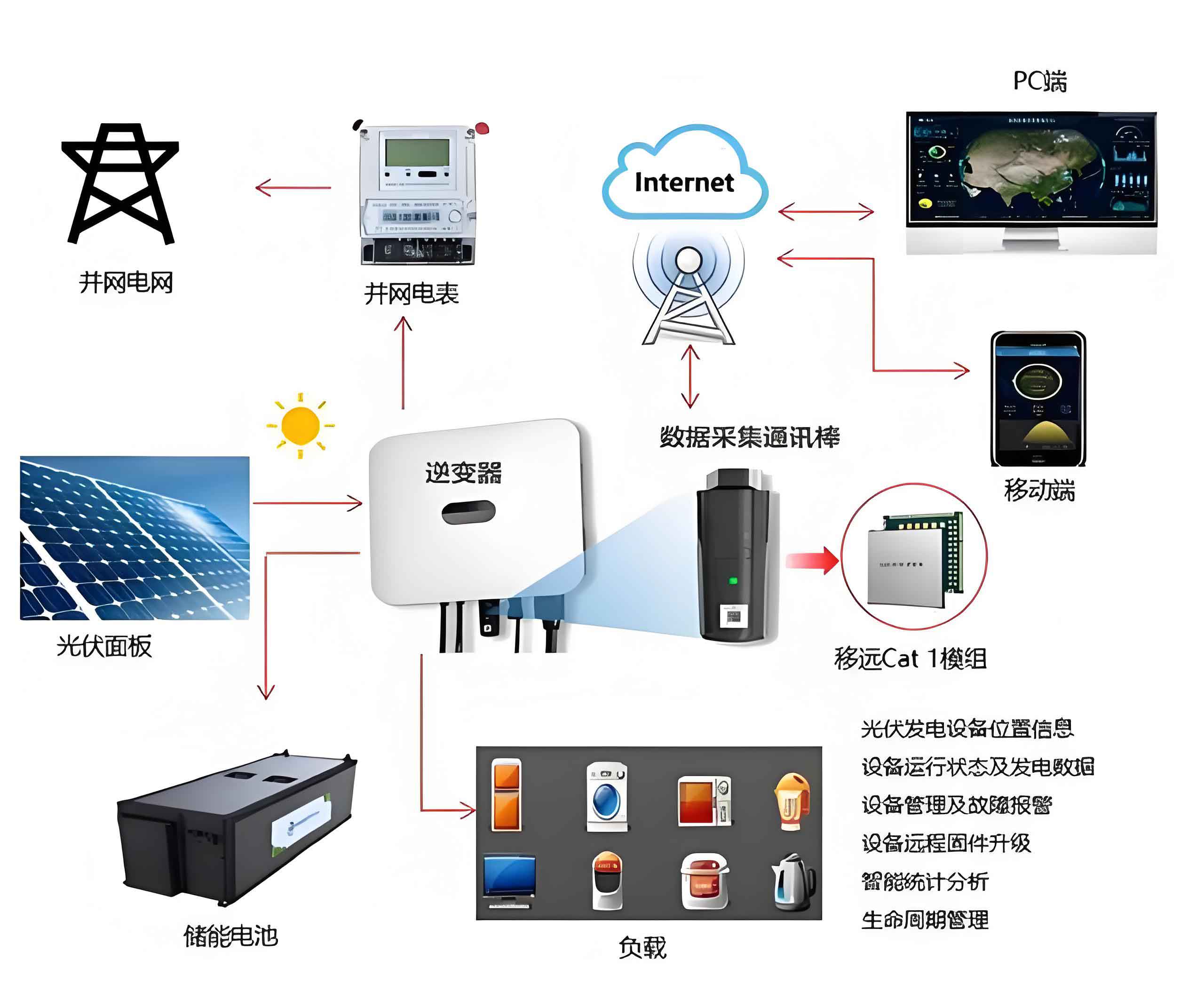
The technical operation primarily features two distinct modes, defining the economic and grid-interaction characteristics of the solar system. Mode 1 involves full feed-in of all generated electricity to the grid, while heating is supplied entirely by a separate auxiliary heat source. This mode is commonly adopted in existing projects due to favorable grid feed-in tariffs. Mode 2 utilizes the generated electricity for direct heating or to power heat pumps. This self-consumption mode often requires expensive electricity storage (e.g., batteries) and is currently less economically attractive because the cost of purchased electricity for heating is lower than the revenue from selling solar electricity to the grid. A key advantage of the “solar PV +” heating approach, particularly under Mode 1, is its potential to alleviate capacity constraints in rural power grids by generating electricity locally. For the household, this model can generate net annual income: the revenue from selling all solar electricity minus the cost of operating the auxiliary heater. Furthermore, if an electric thermal storage device is used as the auxiliary source, it can charge using low-cost off-peak (valley) electricity, benefiting from preferential tariffs, stabilizing household energy costs, and helping the broader grid by shifting load from peak to off-peak periods—a “peak shaving and valley filling” effect.
A critical analysis of the investment returns is essential for evaluating the viability of this integrated solar system. Consider a standard case: a single household with a heating area of 100 m². A 5 kW distributed PV system is installed on the roof. The annual electricity generation (E_gen) can be estimated using a simplified formula that considers local solar irradiation:
$$
E_{\text{gen}} = P_{\text{stc}} \times \text{PR} \times H_{\text{tilt}} \times 365
$$
Where \( P_{\text{stc}} \) is the installed capacity (5 kW), \( \text{PR} \) is the Performance Ratio (a system efficiency factor, typically around 0.75-0.85), and \( H_{\text{tilt}} \) is the annual solar irradiation on the tilted panels (kWh/m²/year). For this analysis, an annual yield of approximately 7,000 kWh is assumed. With a subsidized feed-in tariff (FIT) of 0.9 CNY/kWh, the annual revenue (R_solar) is:
$$
R_{\text{solar}} = E_{\text{gen}} \times \text{FIT} = 7000 \times 0.9 = 6300 \text{ CNY}
$$
The baseline for comparison is the cost of heating the same space using a direct electric heater, assuming no building insulation and a 120-day heating season to achieve comfortable indoor conditions. The estimated consumption (E_heat) is 11,500 kWh/year. At an average electricity price (P_elec) of 0.4 CNY/kWh, the heating cost (C_heat_base) would be:
$$
C_{\text{heat\_base}} = E_{\text{heat}} \times P_{\text{elec}} = 11500 \times 0.4 = 4600 \text{ CNY}
$$
Under Mode 1 operation, the household’s net financial flow is the solar revenue minus the cost of operating the chosen auxiliary heater. The “benefit” or annual net gain (B) can be expressed as:
$$
B = R_{\text{solar}} – C_{\text{aux}}
$$
Where \( C_{\text{aux}} \) is the annual operating cost of the auxiliary heating system. The total system cost involves the initial investment in both the PV system (I_PV) and the auxiliary heater (I_aux). A comprehensive comparison of different “solar PV +” configurations is presented in the table below, synthesizing key technical and economic indicators.
| Auxiliary Heat Source | PV System Investment (CNY) | Auxiliary Source Investment (CNY) | Total Initial Investment (CNY) | Solar Annual Revenue (CNY) | Heating Annual Operating Cost (CNY) | Annual Net Benefit (CNY) | Key Technical & Economic Notes |
|---|---|---|---|---|---|---|---|
| Electric Thermal Storage | 40,000 | 12,000 | 52,000 | 6,300 | 3,450 | 2,850 | Utilizes low-cost off-peak electricity. High benefit due to low operating cost. Provides grid demand-side management. |
| Direct Electric Heater | 40,000 | 3,000 | 43,000 | 6,300 | 4,600 | 1,700 | Lowest initial cost for auxiliary. Higher operating cost reduces net benefit. Simple but inefficient. |
| Air-Source Heat Pump (ASHP) | 40,000 | 16,000 | 56,000 | 6,300 | 2,000 | 4,300 | High efficiency (COP > 2.5). Lower operating cost yields highest benefit. Higher auxiliary investment. |
| Ground-Source Heat Pump (GSHP) | 40,000 | 33,000 | 73,000 | 6,300 | 1,300 | 5,000 | Highest efficiency and lowest operating cost. Very high initial investment limits ROI. Site-dependent. |
| Biomass Boiler | 40,000 | 2,000 | 45,000 | 6,300 | 3,000 | 3,300 | Low auxiliary cost. Fuel cost and availability are variable factors. Involves manual fuel handling. |
| Gas Wall-hung Boiler | 40,000 | 4,000 | 44,000 | 6,300 | 2,800 | 3,500 | Moderate initial and operating costs. Requires access to natural gas pipeline network. |
The efficiency of a heat pump-based solar system is a major driver of its operating cost. The Coefficient of Performance (COP) is defined as the ratio of useful heat output to electrical energy input:
$$
\text{COP} = \frac{Q_{\text{heat}}}{W_{\text{elec}}}
$$
For an ASHP with a COP of 3.0, the electrical energy required to deliver \( Q_{\text{heat}} \) = 11,500 kWh of heat is:
$$
W_{\text{elec, ASHP}} = \frac{Q_{\text{heat}}}{\text{COP}} = \frac{11500}{3.0} \approx 3833 \text{ kWh}
$$
The resulting operating cost at 0.4 CNY/kWh is approximately 1,533 CNY, aligning with the low costs shown in the table for high-efficiency systems. This demonstrates the profound impact of auxiliary source efficiency on the economics of the overall hybrid solar system.
Several practical project implementations offer insights into the real-world application and financing of these systems. One prevalent model involves market-oriented operation supported by bank loans. In this model, households apply for loans to cover a significant portion (e.g., 80%) of the total project cost. The subsequent revenue from selling solar electricity is then used to repay the loan, creating a self-liquidating mechanism for the user. Technical variations also exist, such as combining the PV system with a supplementary solar thermal collector (vacuum tubes) and using advanced direct electric heating technologies like high-frequency electromagnetic induction heaters, which claim to avoid scaling issues associated with traditional resistive heaters. Field data from such installations show variable daily electricity consumption for heating, heavily dependent on climate, building envelope quality, and system control, ranging from 30 to 100 kWh per day during the heating season. Another emerging pilot model for “solar PV + ASHP” systems explores a tripartite financing structure involving enterprise investment, government subsidies, and long-term (e.g., 20-year) bank loans. The ownership of the equipment and the rights to the solar feed-in revenue remain with the household, who uses the income stream to service the loan and offset the electricity costs of running the heat pump.
To further clarify the operational logic, the characteristics of the two primary modes for the integrated solar system are summarized below:
| Feature | Mode 1: Full Feed-in + Separate Auxiliary Heating | Mode 2: Self-Consumption for Heating |
|---|---|---|
| Energy Flow | All PV electricity is exported to the grid. Auxiliary heater uses grid/purchased electricity or other fuel. | PV electricity is primarily used on-site to power heaters or heat pumps. May require battery storage. |
| Current Economic Driver | High feed-in tariff > Cost of purchased energy for heating. Creates net income. | Economically challenged because value of self-consumed electricity (at retail price) < revenue from selling it (at FIT). |
| Grid Impact | Adds generation, can alleviate local capacity constraints. Thermal storage can shift grid load. | Reduces net grid demand. With storage, can increase grid independence but at high cost. |
| System Complexity & Cost | Lower complexity. No need for expensive electrical storage. | Higher complexity and cost if batteries are included for nighttime heating. |
| Suitability | Widely applicable and currently the recommended, economically viable approach. | More suitable for future scenarios with lower battery costs or different tariff structures. |
The decision for the optimal configuration in a solar system involves multi-criteria analysis. Beyond simple payback period, a more robust metric is the Net Present Value (NPV), which accounts for the time value of money over the system’s lifetime (n years, e.g., 20 years):
$$
\text{NPV} = -I_{\text{total}} + \sum_{t=1}^{n} \frac{B_t}{(1 + r)^t}
$$
Where \( I_{\text{total}} \) is the total initial investment, \( B_t \) is the annual net benefit (solar revenue minus heating cost) in year \( t \), and \( r \) is the discount rate. A positive NPV indicates a financially worthwhile project. This calculation is sensitive to the assumed degradation rate of the PV panels (typically ~0.5%/year), potential changes in feed-in tariffs, and future energy price inflation.
In conclusion, from the perspectives of initial investment, operating expenses, and comprehensive benefit analysis, certain models demonstrate stronger potential for broader adoption. The “solar PV + electric thermal storage” system offers an excellent balance of reasonable cost, significant user benefit, and valuable grid-support services. The “solar PV + air-source heat pump” configuration, while requiring a higher upfront investment for the heat pump, delivers the highest annual net benefit due to superior efficiency, making it highly attractive where initial capital is less constrained. The standard “solar PV + direct electric heater” model, with its very low barrier to entry, remains a simple, viable option, though with lower long-term financial returns. The successful scaling of these integrated solar system solutions depends on several factors: continued supportive policies for distributed PV feed-in tariffs, innovative and accessible financing mechanisms to overcome high upfront costs, public education on the long-term economic and environmental benefits, and parallel efforts to improve the thermal performance of rural buildings. The synergistic combination of solar photovoltaics with efficient, clean auxiliary heating technologies presents a pragmatic and sustainable pathway toward meeting rural heating demands while contributing to broader energy transition and environmental goals.