
The global energy transition, driven by carbon neutrality goals, has significantly increased the penetration of intermittent renewable energy sources such as wind and solar power. To maintain grid stability and ensure efficient energy utilization, the energy storage system has emerged as a critical enabler. In this study, we explore how artificial intelligence and data-driven techniques can enhance the optimal scheduling of modern energy storage systems, addressing challenges from technical performance to economic viability.
We begin by analyzing the characteristics of various energy storage system technologies. Table 1 summarizes the key properties of representative storage types, including electrochemical batteries, gravity storage, compressed air storage, and flywheels. Each technology exhibits distinct energy density, response speed, scale, and lifespan, making them suitable for different applications within the broader energy storage system framework.
| Storage Technology | Typical Representative | Energy Density | Response Speed | Scale & Lifespan | Primary Advantage | Typical Application |
|---|---|---|---|---|---|---|
| Electrochemical | Lithium-ion battery | High | Seconds/milliseconds | Medium/small; limited cycle life | Fast response, flexible deployment | Frequency regulation, smoothing fluctuations, behind-the-meter |
| Gravity | Vertical/slope tower | Medium | Minutes | Large; long life | Environmentally friendly, low cost | Peak shaving, large-scale storage |
| Compressed air | CCES (e.g., CO₂) | Medium | Minutes | Large; long life | High capacity, long duration | Grid-side peak regulation, backup |
| Flywheel | FESS | Low | Milliseconds | Medium/small; very long cycle life | Extremely high power density and response | Frequency regulation, premium power quality |
Core Technological Pathways for Energy Storage System Optimization
Artificial Intelligence and Data-Driven Empowerment
AI and data-driven methods enable accurate modeling and dynamic decision-making, mitigating the inherent uncertainties in energy storage system operation. Machine learning algorithms mine historical and real-time data to predict key parameters, such as state-of-charge and state-of-health, and to optimize scheduling. For instance, improved deep reinforcement learning algorithms (e.g., TD3-AC with self-attention) have been applied to wind-solar-compressed air energy storage system coordination, reducing operating costs by 8.3%. Similarly, multi-agent deep deterministic policy gradient (MADDPG) has been adapted for distributed energy storage system multi-objective optimization.
Digital twin technology further bridges physical systems with virtual models, enabling lifecycle optimization. However, data-driven approaches face challenges: they require massive high-quality datasets, and models often lack generalization when applied to multi-technology hybrid energy storage system configurations, such as gravity-electrochemical combinations. Future work should fuse physical mechanism models with data-driven methods.
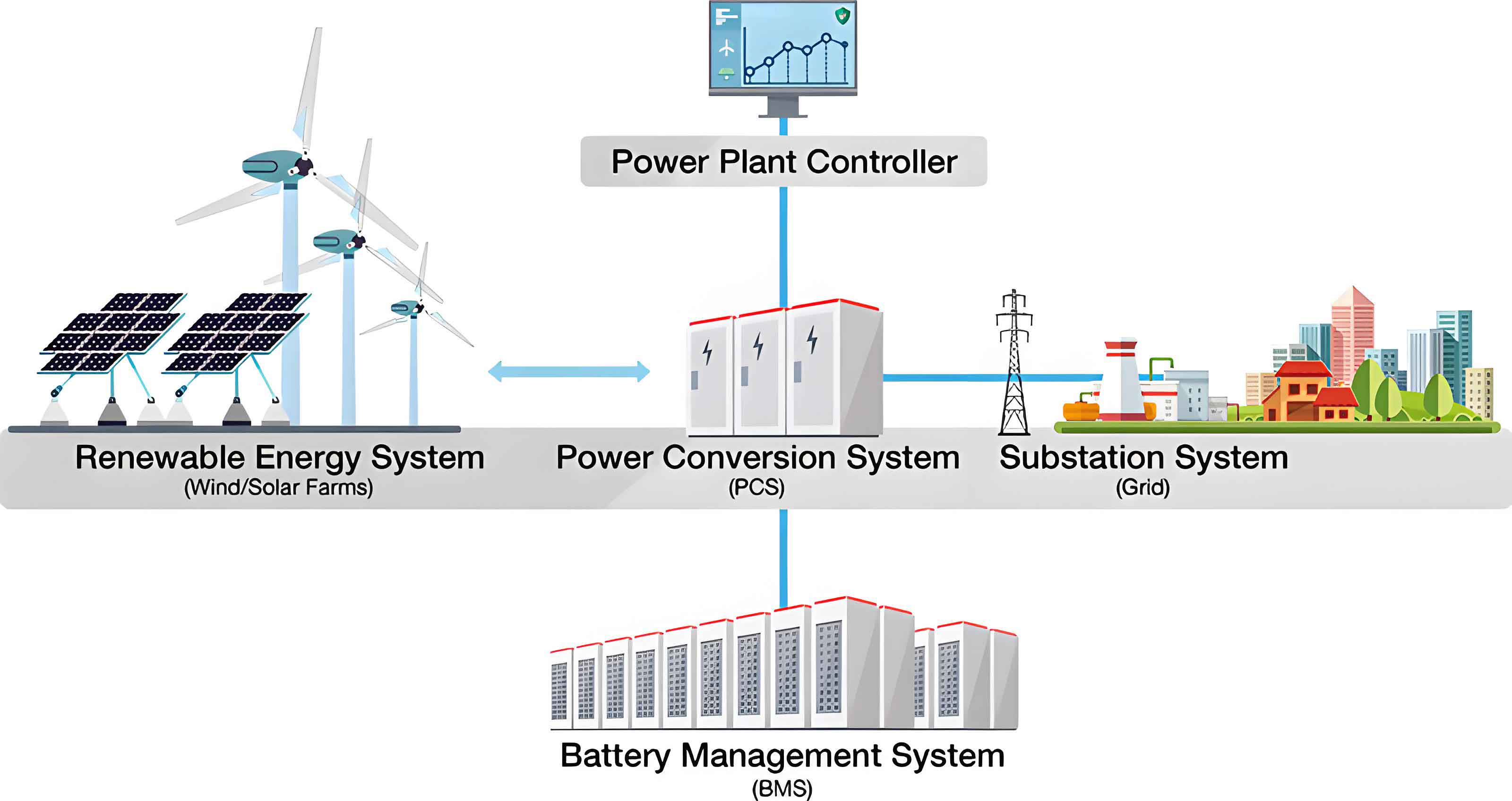
The conceptual architecture of AI applications in energy storage system management is illustrated below.
Thermal Management and Battery Management as Foundational Safeguards
Reliable thermal and battery management systems are essential for safe energy storage system operation, especially under extreme conditions. Thermal management combines active and passive cooling: heat pipe technology is used for compact portable energy storage system units, while CO₂-based thermal cycles are integrated with active cooling for large-scale installations. For battery management, the core tasks are accurate estimation of state-of-charge (SOC) and state-of-health (SOH), and balancing cell consistency. Combined model-driven and data-driven clustering algorithms provide reliable SOC/SOH estimates that support scheduling strategies. Cloud-edge collaborative monitoring further prevents thermal runaway in electric vehicle battery packs, which are themselves a type of mobile energy storage system.
Multi-Scenario Coordination Mechanisms for Energy Storage Systems
Multi-Energy Complementary System Scheduling
Multi-energy complementary systems integrate electricity, heat, and hydrogen to boost renewable energy accommodation and system flexibility. Electric-hydrogen hybrid energy storage system configurations utilize ultra-short-term wind power forecasts to reduce energy waste. Electric-thermal hybrid energy storage system using thermal decoupling alleviates constraints from combined heat and power (CHP) units; LSTM-based load prediction combined with active electric-thermal storage scheduling lowers operating costs by 3.67%–11.12%. Multi-time-scale coordination, such as day-ahead and intra-day rolling scheduling, improves dispatch accuracy and reduces costs by about 7.86% for electric-hydrogen systems.
Table 2 summarizes the key optimization models and performance improvements reported for various multi-energy configurations.
| System Configuration | Technique / Algorithm | Performance Improvement | Reference (anonymized) |
|---|---|---|---|
| Wind-solar-compressed air energy storage | Improved TD3-AC with self-attention | 8.3% reduction in operating cost | Study A |
| Wind-hydrogen storage | Ultra-short-term wind prediction + composite optimization | Reduced energy waste | Study B |
| Electric-thermal hybrid with CHP | LSTM prediction + active storage scheduling | 3.67%–11.12% cost reduction | Study C |
| Electric-hydrogen multi-time scale | Day-ahead/intra-day rolling scheduling | 7.86% operating cost reduction | Study D |
The optimization problem for a generic multi-energy energy storage system can be formulated as:
$$
\min \sum_{t \in T} \big( C_{\text{grid},t} + C_{\text{storage},t} + C_{\text{curtailment},t} \big)
$$
subject to:
$$
\begin{aligned}
&\sum_{i} P_{\text{gen},i,t} + \sum_{j} P_{\text{discharge},j,t} – \sum_{k} P_{\text{charge},k,t} = L_t, \quad \forall t \\
&0 \leq P_{\text{charge},j,t} \leq P_{\text{charge,max},j}, \quad 0 \leq P_{\text{discharge},j,t} \leq P_{\text{discharge,max},j} \\
&\text{SOC}_{j,t+1} = \text{SOC}_{j,t} + \eta_{\text{charge}} P_{\text{charge},j,t} \Delta t – \frac{P_{\text{discharge},j,t} \Delta t}{\eta_{\text{discharge}}} \\
&\text{SOC}_{\text{min},j} \leq \text{SOC}_{j,t} \leq \text{SOC}_{\text{max},j}
\end{aligned}
$$
Distributed and Gravity Energy Storage Scenario Adaptation
Distributed energy storage system architectures, based on multi-agent and spatiotemporal scheduling, offer scalability and flexibility. For example, combining distributed photovoltaics, battery storage, and dynamic electricity prices in industrial parks achieves peak shaving and 15%–20% cost savings. Particle swarm optimization and two-stage mobile storage scheduling frameworks improve task completion rates in active distribution networks.
Gravity energy storage system technologies, particularly vertical and slope designs, are suited for water-scarce regions with natural elevation differences. They provide large-scale, long-duration storage with low environmental impact. Hybrid gravity–electrochemical energy storage system configurations leverage the complementary advantages: gravity for bulk energy shifting and batteries for fast power regulation. A “source-grid-storage” coordinated model using such hybrid energy storage system has been proposed to support peak loads and integrate renewable generation.
Balancing Economics and Technical Performance in Energy Storage Scheduling
An optimal energy storage system scheduling strategy must simultaneously satisfy technical constraints (grid stability, response speed) and economic objectives (operating cost, revenue). Mixed-integer linear programming (MILP) models are deployed for charging stations participating in day-ahead and frequency regulation markets, improving efficiency and reducing peak power. Multi-objective NSGA-III algorithms optimize both grid-side load variance minimization and operation cost minimization for photovoltaic-storage charging stations.
In the context of market mechanisms, a bilevel Stackelberg game model for wind-hydrogen coupled energy storage system improves wind power competitiveness by balancing supply and demand. Multi-time-scale scheduling considering both energy and frequency regulation markets further enhances economic returns for photovoltaic-equipped storage. Dynamic carbon emission factors are incorporated into low-carbon dispatch models, balancing operational cost with environmental goals.
However, existing economic models have limitations: they often lack a comprehensive framework for multi-scenario lifecycle cost assessment, and they rarely account for capacity degradation over extended operation. Table 3 outlines the main balancing approaches and their current gaps.
| Approach | Method | Application Scenario | Identified Gap |
|---|---|---|---|
| MILP optimization | Day-ahead + frequency regulation markets | Battery charging station | Limited to single storage type |
| NSGA-III + fuzzy clustering | Multi-objective Pareto front | PV-storage charging station | No lifecycle degradation model |
| Bilevel Stackelberg game | Wind-hydrogen market bidding | Electricity market | Assumes static price signals |
| Dynamic carbon factor dispatch | Low-carbon scheduling | Power system | Does not include storage aging cost |
A unified formulation for balancing technical and economic objectives in an energy storage system can be expressed as:
$$
\max \left[ R_{\text{market}} – C_{\text{operation}} – C_{\text{degradation}} \right]
$$
subject to technical constraints including ramp rate, SOC limits, and response time requirements:
$$
\begin{aligned}
&|P_{\text{storage},t} – P_{\text{storage},t-1}| \leq \text{ramp}_{\text{max}} \\
&\text{SOC}_{\text{min}} \leq \text{SOC}_t \leq \text{SOC}_{\text{max}} \\
&\text{response\_time} \leq \tau_{\text{required}}
\end{aligned}
$$
Conclusions and Future Directions
In this study, we have provided a comprehensive review of AI-empowered optimization and scheduling strategies for energy storage systems. The research framework integrates three pillars: technology enabling (AI, data-driven modeling, thermal/battery management), scenario coordination (multi-energy complementarity, distributed and gravity storage), and economic-technical balancing. Despite significant progress, three major challenges persist:
- Data-driven modeling lacks generalization across heterogeneous energy storage system technologies (e.g., hybrid gravity–electrochemical configurations).
- There is no unified scheduling framework that fully covers all scenarios (e.g., simultaneous coordination of electric, thermal, and hydrogen storage at multiple time scales).
- Lifecycle economic models and extreme-condition safety assessments remain underdeveloped.
Future research should focus on: (i) hybrid physics-informed machine learning methods to enhance model adaptability for diverse energy storage system types; (ii) cross-energy network, multi-time-scale, multi-agent coordination frameworks leveraging game theory for balanced resource allocation; and (iii) complete lifecycle cost models integrated with market-based scheduling mechanisms, supported by policy innovation to accelerate large-scale, efficient deployment of energy storage systems.