
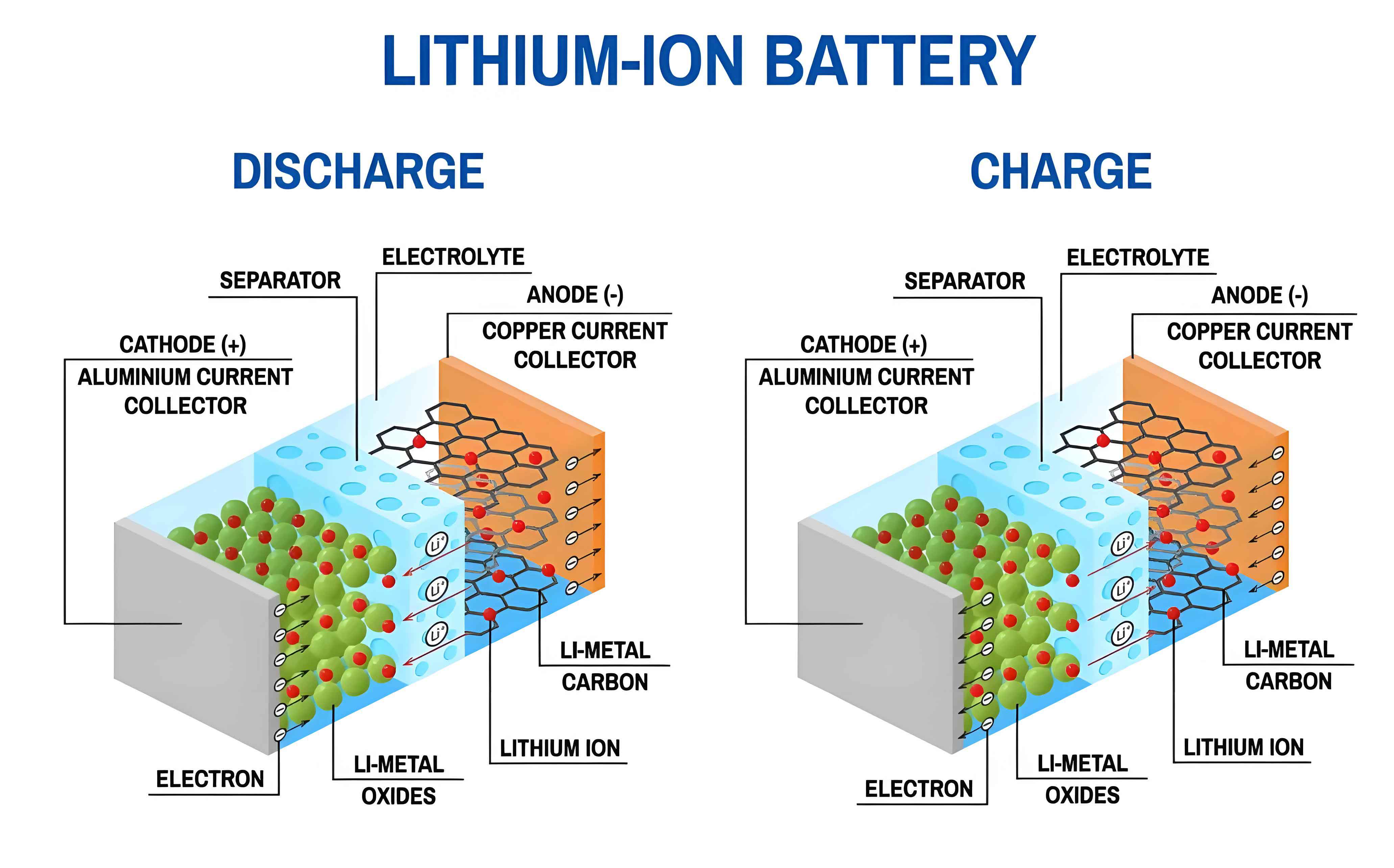
As a critical component of lithium-ion batteries, separators directly influence electrochemical performance and safety through their physical properties such as thickness, porosity, mechanical strength, and thermal stability. This review systematically examines the characterization methodologies for separator properties and evaluates emerging manufacturing technologies to address evolving demands for high-energy-density and safe lithium-ion batteries.
1. Key Physical Properties of Lithium-Ion Battery Separators
The performance metrics of separators can be quantified through fundamental equations:
Porosity ($\varepsilon$):
$$
\varepsilon = \frac{V_{\text{pores}}}{V_{\text{total}}} \times 100\%
$$
where $V_{\text{pores}}$ represents the volume of interconnected pores and $V_{\text{total}}$ the total separator volume.
Tortuosity ($\tau$):
$$
\tau = \frac{L_{\text{eff}}}{L_{\text{actual}}}
$$
quantifying the convoluted ion transport path through porous media.
Electrolyte Uptake:
$$
U = \frac{m_{\text{wet}} – m_{\text{dry}}}{m_{\text{dry}}} \times 100\%
$$
| Property | Target Range | Measurement Standards |
|---|---|---|
| Thickness | 12-25 µm | ASTM D5947 |
| Puncture Strength | >300 gf | ASTM D3763 |
| Thermal Shrinkage | <5% @90°C | IPC-TM-650 |
| Ionic Conductivity | >0.5 mS/cm | EIS Analysis |
2. Manufacturing Processes for Lithium-Ion Battery Separators
Current industrial production predominantly employs polyolefin-based membranes through dry/wet processes:
2.1 Dry Process
The crystallinity evolution during dry stretching follows:
$$
X_c = \frac{\Delta H_m}{\Delta H_m^0} \times 100\%
$$
where $X_c$ is crystallinity degree, $\Delta H_m$ measured melting enthalpy, and $\Delta H_m^0$ theoretical value for 100% crystalline polymer.
| Parameter | Uniaxial Stretching | Biaxial Stretching |
|---|---|---|
| Orientation | Machine direction | MD + Transverse |
| Pore Shape | Elliptical | Spherical |
| Through-plane Strength | 15-25 MPa | 30-45 MPa |
2.2 Wet Process
The phase separation kinetics can be modeled by:
$$
\frac{\partial \phi}{\partial t} = \nabla \cdot [M(\phi)\nabla(\frac{\delta F}{\delta \phi})]
$$
where $\phi$ is polymer concentration, $M$ mobility coefficient, and $F$ free energy functional.
3. Emerging Manufacturing Technologies
3.1 Electrospinning
The Taylor cone formation in electrospinning follows:
$$
\frac{\epsilon_0 E^2}{2\gamma} = \frac{1}{R} – \frac{1}{H}
$$
where $E$ is electric field, $\gamma$ surface tension, $R$ jet radius, and $H$ nozzle-to-collector distance.
| Material | Fiber Diameter (nm) | Porosity (%) | Conductivity (mS/cm) |
|---|---|---|---|
| PVDF-HFP | 250 ± 40 | 78 | 1.2 |
| PI/PAN | 180 ± 30 | 82 | 1.8 |
| SiO₂/PVDF | 350 ± 50 | 65 | 0.9 |
3.2 Phase Inversion Methods
The solvent-nonsolvent exchange rate ($k$) governs membrane morphology:
$$
k = D_s \frac{C_s^{\text{surface}} – C_s^{\text{bulk}}}{\delta}
$$
where $D_s$ is diffusion coefficient, $C_s$ solvent concentration, and $\delta$ boundary layer thickness.
4. Performance Enhancement Strategies
Advanced coating technologies improve separator functionality:
4.1 Ceramic Coatings
The adhesion strength of Al₂O₃ coatings follows:
$$
\sigma_{\text{adh}} = \frac{E_{\text{coat}}}{1-\nu_{\text{coat}}} \cdot \frac{h_{\text{coat}}^2}{R_{\text{particle}}}
$$
where $E$ is Young’s modulus, $\nu$ Poisson’s ratio, $h$ coating thickness, and $R$ particle radius.
| Coating Material | Thermal Shrinkage @120°C | Electrolyte Uptake | Cycle Retention |
|---|---|---|---|
| Al₂O₃ | 3.2% | 220% | 92% (500 cycles) |
| ZrO₂ | 2.8% | 245% | 94% |
| TiO₂ | 4.1% | 195% | 89% |
5. Future Perspectives
The lithium-ion battery industry demands separators with multidimensional performance:
$$
\text{Figure of Merit} = \frac{\sigma_{\text{ionic}} \cdot \sigma_{\text{mech}} \cdot T_{\text{shutdown}}}{\rho_{\text{sep}} \cdot \text{Cost}}
$$
where $\sigma_{\text{ionic}}$ = ionic conductivity, $\sigma_{\text{mech}}$ = mechanical strength, $T_{\text{shutdown}}$ = thermal shutdown temperature, and $\rho_{\text{sep}}$ = separator density.
Emerging trends include:
- Hybrid manufacturing combining dry-process mechanical strength with wet-process porosity control
- Machine learning-guided optimization of pore architecture
- Sustainable separator production using bio-based polymers
This comprehensive analysis demonstrates that advancements in separator technology remain crucial for developing next-generation lithium-ion batteries with enhanced safety and energy density. Continuous innovation in manufacturing processes and material engineering will address existing limitations while meeting evolving market requirements.