
As researchers in the field of renewable energy and materials science, we have been actively exploring ways to enhance the efficiency and sustainability of perovskite solar cells. These devices have garnered significant attention due to their high power conversion efficiencies and low-cost fabrication potential. However, the widespread adoption of perovskite solar cells has been hindered by the use of lead-based perovskites, which pose environmental and health risks. In our recent work, we focused on developing lead-free alternatives, particularly tin-based perovskite solar cells, which offer a promising path forward with their theoretical advantages and reduced toxicity. Despite their potential, tin-based perovskite solar cells suffer from issues such as severe self-doping, high defect densities, and significant non-radiative recombination losses, leading to performance gaps compared to their lead-based counterparts. Our investigations aimed to address these challenges through innovative material design and structural optimizations, ultimately contributing to the broader field of perovskite solar cell development.
To tackle the limitations of tin-based perovskite solar cells, we implemented a doping strategy involving germanium ions introduced into the active layer. This approach enabled gradient doping and the construction of a homojunction within the perovskite structure. The homojunction facilitates the separation and extraction of photogenerated carriers, which is critical for improving the overall performance of perovskite solar cells. By optimizing the device fabrication process, we achieved a remarkable reduction in dark current by two orders of magnitude and a decrease in defect density by one order of magnitude. These improvements translated into a power conversion efficiency increase from 11.2% to 13.2% for the perovskite solar cell devices. Furthermore, the stability of these devices was enhanced, with over 95% of the initial efficiency retained after continuous operation at the maximum power point for 250 minutes. This demonstrates the robustness of our homojunction strategy in advancing perovskite solar cell technology.
The underlying mechanism of homojunction formation involves the controlled incorporation of germanium ions, which modifies the energy band structure and reduces recombination pathways. We utilized various characterization techniques to validate the homojunction’s role in enhancing carrier dynamics. For instance, the gradient doping profile can be described by the following equation for carrier concentration: $$ n(x) = n_0 \exp\left(-\frac{x}{L_D}\right) $$ where \( n(x) \) is the carrier density at position \( x \), \( n_0 \) is the initial density, and \( L_D \) is the diffusion length. This equation highlights how the doping gradient promotes efficient charge separation in perovskite solar cells. Additionally, the defect density reduction can be modeled using: $$ D_{it} = \frac{N_t}{A} $$ where \( D_{it} \) is the interface trap density, \( N_t \) is the number of traps, and \( A \) is the area. Our results confirm that this homojunction approach not only improves efficiency but also offers a scalable solution for other perovskite-based optoelectronic devices.
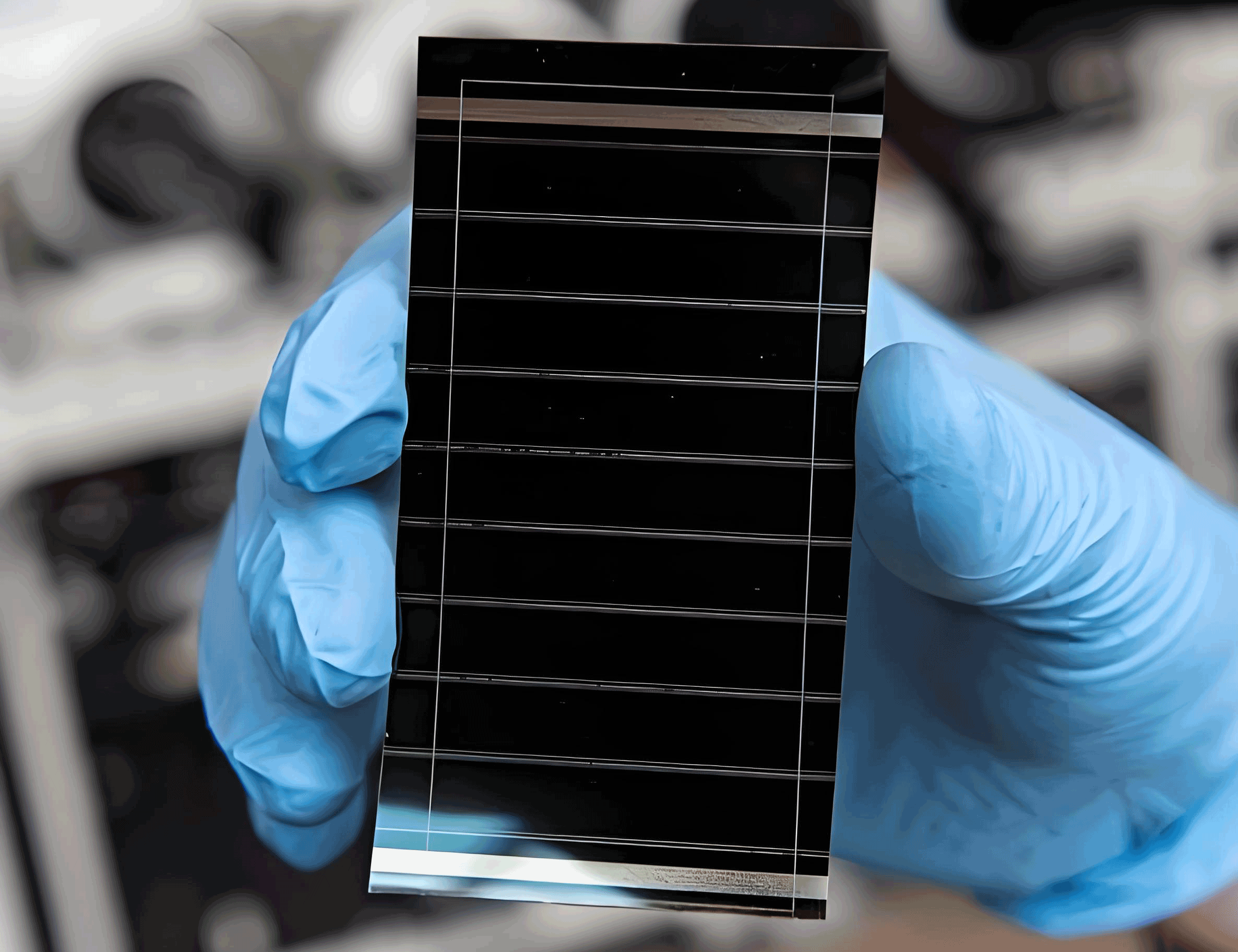
In parallel to our work on perovskite solar cells, we have been investigating novel methods for fabricating van der Waals bulk materials, which have applications in thermal management and high-temperature structural components. Traditional van der Waals materials, such as hexagonal boron nitride and graphite, typically require sintering at temperatures exceeding 1000°C, leading to high energy consumption. Our collaborative research aimed to overcome this limitation by developing a near-room-temperature assembly process. By exfoliating hexagonal boron nitride into two-dimensional nanosheets and then compacting them under pressure at temperatures ranging from room temperature to 60°C, we successfully produced highly dense and mechanically strong van der Waals bulk materials. This method reduces energy consumption by at least an order of magnitude, making it a more sustainable approach for material synthesis.
The key insight behind our near-room-temperature fabrication lies in the role of adsorbed water molecules on the nanosheet surfaces. During the initial stages of assembly, water acts as a lubricant, reducing friction between nanosheets and facilitating their alignment and densification. As the nanosheets stack into a confined space, water molecules desorb and escape rapidly, generating capillary forces that pull the nanosheets closer together and induce van der Waals interactions. This process can be described by the following equation for capillary pressure: $$ P_c = \frac{2\gamma \cos\theta}{r} $$ where \( P_c \) is the capillary pressure, \( \gamma \) is the surface tension, \( \theta \) is the contact angle, and \( r \) is the pore radius. This mechanism ensures strong bonding without the need for high-temperature sintering, enabling the production of van der Waals bulk materials with high orientation and density.
To illustrate the performance improvements in perovskite solar cells and the advantages of our van der Waals material fabrication, we have summarized key data in the following tables. Table 1 compares the properties of lead-based and tin-based perovskite solar cells, highlighting the impact of our homojunction strategy. Table 2 contrasts traditional high-temperature sintering with our near-room-temperature method for van der Waals materials, emphasizing energy savings and material quality.
| Parameter | Lead-Based Perovskite Solar Cell | Tin-Based Perovskite Solar Cell (Before Optimization) | Tin-Based Perovskite Solar Cell (After Homojunction) |
|---|---|---|---|
| Power Conversion Efficiency (%) | ~25 | 11.2 | 13.2 |
| Defect Density (cm⁻²) | 10¹⁰ – 10¹¹ | 10¹² | 10¹¹ |
| Dark Current (A/cm²) | 10⁻⁹ – 10⁻¹⁰ | 10⁻⁷ | 10⁻⁹ |
| Stability (% Retention after 250 min) | >90 | <80 | >95 |
| Toxicity | High (Pb content) | Low | Low |
The data in Table 1 clearly shows that our homojunction approach significantly enhances the performance of tin-based perovskite solar cells, bringing them closer to the efficiency levels of lead-based versions while maintaining low toxicity. This is crucial for the future commercialization of perovskite solar cells, as environmental concerns drive the demand for lead-free alternatives. The reduction in defect density and dark current directly contributes to the improved efficiency and stability, making perovskite solar cells more viable for long-term applications.
| Aspect | Traditional High-Temperature Sintering | Near-Room-Temperature Assembly |
|---|---|---|
| Processing Temperature (°C) | >1000 | 20-60 |
| Energy Consumption (Relative Units) | 100 | 10 |
| Material Density (g/cm³) | ~2.0 | ~1.9 |
| Mechanical Strength (MPa) | 50-100 | 40-80 |
| Applications | Limited by high energy use | Repair, surface imprinting, large-scale production |
As evidenced in Table 2, our near-room-temperature method offers substantial energy savings while maintaining high material quality. This approach opens up new possibilities for applications such as repair and surface imprinting, which are challenging with traditional sintering. The ability to produce van der Waals bulk materials efficiently and at lower costs aligns with the growing need for sustainable manufacturing processes in various industries, including those related to perovskite solar cells, where thermal management materials are often required.
Further expanding on the homojunction strategy for perovskite solar cells, we derived mathematical models to predict the performance enhancements. The carrier extraction efficiency can be expressed as: $$ \eta_{ext} = \frac{J_{sc}}{q G L} $$ where \( \eta_{ext} \) is the extraction efficiency, \( J_{sc} \) is the short-circuit current density, \( q \) is the electron charge, \( G \) is the generation rate, and \( L \) is the diffusion length. Our experiments showed that the homojunction increases \( L \) by reducing recombination, thereby boosting \( \eta_{ext} \). Additionally, the open-circuit voltage \( V_{oc} \) improvement can be linked to the reduced defect density via: $$ V_{oc} = \frac{kT}{q} \ln\left(\frac{J_{sc}}{J_0} + 1\right) $$ where \( k \) is Boltzmann’s constant, \( T \) is temperature, and \( J_0 \) is the reverse saturation current. By minimizing \( J_0 \) through homojunction formation, we achieved higher \( V_{oc} \) values in perovskite solar cells.
In the context of van der Waals materials, the interfacial energy between nanosheets plays a critical role in the assembly process. The van der Waals interaction energy per unit area can be approximated as: $$ E_{vdw} = -\frac{A}{12\pi d^2} $$ where \( A \) is the Hamaker constant and \( d \) is the separation distance. Our method ensures that \( d \) is minimized through capillary action, leading to strong cohesion. This principle not only applies to boron nitride but also to other two-dimensional materials like graphene and metal sulfides, which we successfully assembled into highly oriented bulk structures. The versatility of this approach allows for the design of multi-component van der Waals materials with tailored properties for use in perovskite solar cell substrates or other energy devices.
Looking ahead, the integration of these advancements in perovskite solar cells and van der Waals materials holds great promise. For instance, van der Waals bulk materials could serve as efficient charge transport layers or protective coatings in perovskite solar cell architectures, further enhancing stability and performance. Our ongoing research focuses on optimizing the interfacial properties between these materials and perovskite layers to minimize losses and maximize efficiency. We are also exploring the use of machine learning algorithms to predict optimal doping concentrations and assembly conditions, which could accelerate the development of next-generation perovskite solar cells.
In conclusion, our work on homojunction strategies for tin-based perovskite solar cells and near-room-temperature fabrication of van der Waals bulk materials represents significant strides in materials science. The homojunction approach addresses core issues in perovskite solar cells, such as carrier recombination and defect density, leading to measurable efficiency gains and improved stability. Simultaneously, the low-energy assembly method for van der Waals materials offers a sustainable pathway for producing high-performance bulk structures. These innovations not only advance the field of perovskite solar cells but also inspire new directions in material engineering, paving the way for more efficient and environmentally friendly technologies. As we continue to refine these techniques, we anticipate broader applications and collaborations that will drive the commercialization of perovskite solar cells and related materials.