
In recent years, the rapid adoption of lithium-ion batteries in energy storage systems has been driven by their high energy density, environmental benefits, and long cycle life. However, safety incidents related to thermal runaway and mechanical degradation have raised critical concerns about the reliability and stability of these li ion battery systems. As a researcher in this field, I have observed that effective monitoring of internal parameters, such as temperature and strain, is essential for predicting battery health, preventing failures, and optimizing performance. Traditional sensors, like thermocouples and resistance strain gauges, face limitations in size, electromagnetic interference, and integration within li ion battery cells. This has spurred interest in advanced sensing technologies, particularly Fiber Bragg Gratings (FBGs), which offer unique advantages for in-situ and operando monitoring. In this article, I will delve into the research progress on FBG-based temperature and strain monitoring for li ion battery applications, highlighting principles, methodologies, comparative analyses, and future directions. The goal is to provide a detailed overview that underscores the transformative potential of FBG sensors in enhancing the safety and efficiency of energy storage systems.
The core principle of FBG sensing revolves around the modulation of light within an optical fiber. An FBG is created by periodically altering the refractive index in the fiber core, typically through UV laser exposure, forming a grating structure. When broadband light is transmitted through the fiber, a specific wavelength, known as the Bragg wavelength, is reflected based on the phase-matching condition. This wavelength, denoted as λ_B, is governed by the equation: $$λ_B = 2n_{eff}Λ$$ where \(n_{eff}\) is the effective refractive index of the fiber core and \(Λ\) is the grating period. External perturbations, such as temperature changes or mechanical strain, alter \(n_{eff}\) and \(Λ\), causing a shift in λ_B. By measuring this shift, we can quantify the environmental parameters affecting the li ion battery. The sensitivity of FBGs to both temperature and strain makes them ideal for multi-parameter monitoring, but this also introduces cross-sensitivity challenges that require careful calibration and compensation techniques, which I will discuss later.
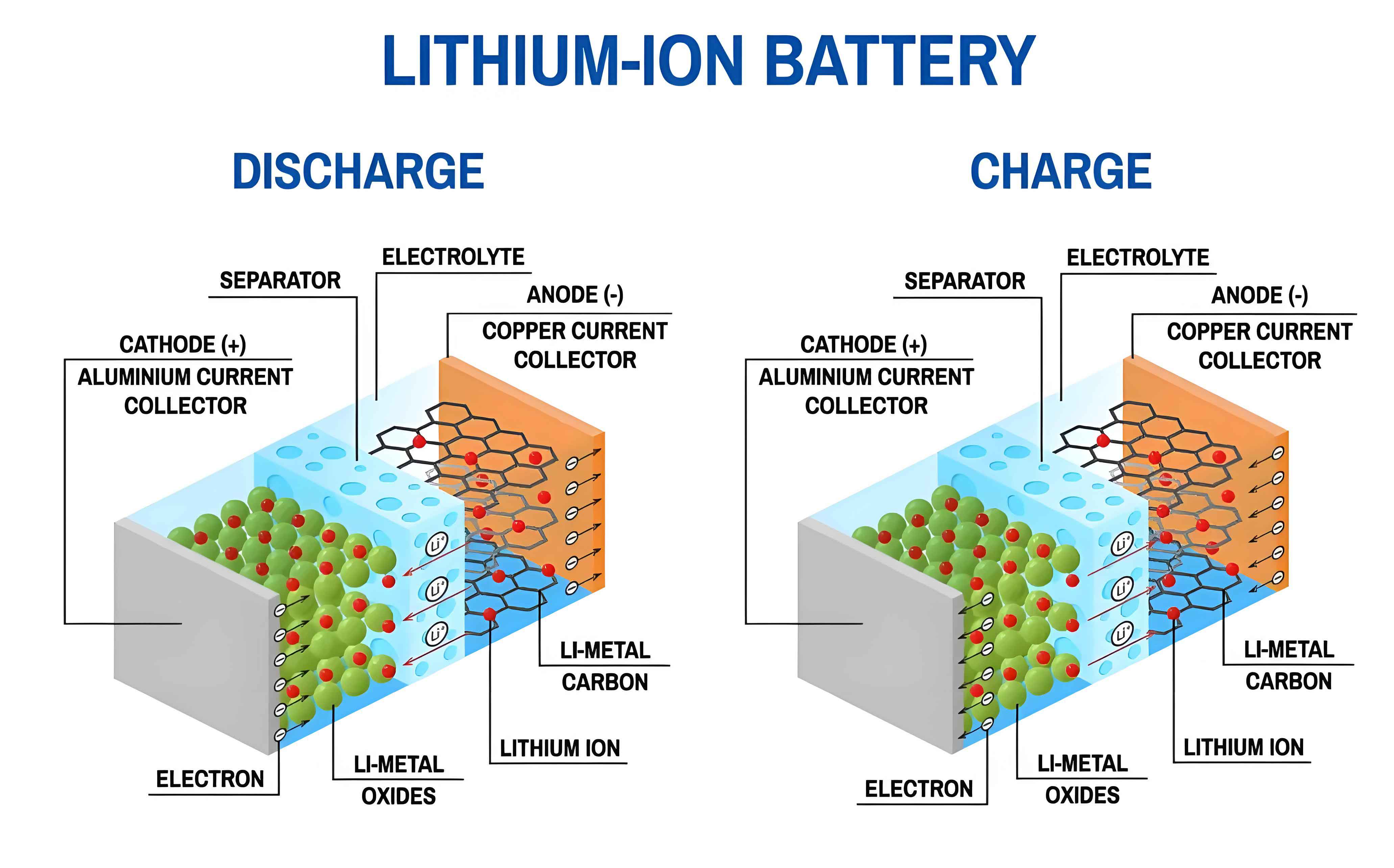
Temperature monitoring in li ion battery is critical because excessive heat accelerates aging, reduces capacity, and can trigger thermal runaway. Conventional methods, such as thermocouples and negative temperature coefficient (NTC) thermistors, are widely used but have drawbacks. Thermocouples, for instance, provide point measurements and may not capture spatial temperature gradients within a li ion battery cell. NTC sensors, while sensitive, can be affected by electromagnetic interference and require complex integration. In contrast, FBG sensors offer distributed or multi-point temperature sensing along a single fiber, enabling comprehensive thermal mapping. For example, by embedding FBGs at different locations—such as near electrodes, separators, or casing—we can monitor hot spots and thermal dynamics during charging and discharging cycles. The temperature sensitivity of an FBG is typically around 10 pm/°C for silica fibers, and it can be enhanced using specialized coatings or materials. In my experience, FBGs have demonstrated faster response times compared to thermocouples, with studies showing up to 28.2% lower rise time, making them superior for real-time monitoring in abusive conditions. Moreover, FBGs are immune to electromagnetic interference, which is crucial in high-current li ion battery environments where electrical noise can corrupt sensor signals.
To quantify the advantages, let me present a comparative table of temperature sensing technologies for li ion battery applications:
| Sensor Type | Key Features | Advantages for Li Ion Battery | Limitations |
|---|---|---|---|
| Thermocouple | Point measurement, wide temperature range | Low cost, established technology | Limited spatial resolution, prone to EMI |
| NTC Thermistor | High sensitivity, compact size | Good accuracy for surface temps | Slow response, calibration drift |
| FBG Sensor | Multiplexed, distributed sensing | EMI immunity, fast response, embeddable | Cross-sensitivity with strain, higher cost |
In practice, researchers have successfully deployed FBG networks on li ion battery surfaces and interiors. For instance, a network of five FBGs placed at strategic points—top, middle, bottom—can capture temperature distributions during different C-rate discharges. The data reveal that internal temperatures can exceed surface temperatures by up to 6°C, highlighting the need for embedded sensing. The calibration of FBGs involves determining the temperature coefficient \(k_T\), which relates wavelength shift Δλ to temperature change ΔT: $$Δλ = k_T ΔT$$ For standard FBGs, \(k_T\) is approximately 10 pm/°C, but it can vary with fiber type and coating. By integrating FBGs into li ion battery cells during manufacturing, we enable continuous health monitoring without compromising performance. This approach has been validated in cycling tests, where FBG-instrumented li ion battery cells showed comparable cycle life to non-instrumented ones, proving the non-invasive nature of the technology.
Strain monitoring is equally vital for li ion battery systems, as mechanical stresses from volume changes during lithiation/delithiation can lead to electrode cracking, separator deformation, and capacity fade. Traditional strain gauges, based on resistive principles, are sensitive but suffer from temperature compensation issues and EMI. FBG sensors, however, can measure strain directly through wavelength shifts, with typical strain sensitivity around 1.2 pm/με. The strain-induced shift Δλ_s is given by: $$Δλ_s = k_ε Δε$$ where \(k_ε\) is the strain coefficient and Δε is the applied strain. When combined with temperature effects, the total shift is: $$Δλ_{total} = k_T ΔT + k_ε Δε$$ To decouple these, dual-FBG configurations are used: one FBG bonded to the li ion battery surface for combined sensitivity, and another loosely attached as a temperature reference. By subtracting the reference signal, we isolate strain contributions. This method has been applied to monitor volume expansion in pouch cells, where FBGs detected strain variations during cycling that correlated with state-of-charge (SOC) and degradation. For example, during charging, anode materials like graphite expand, inducing compressive strains that FBGs can capture with high resolution. This real-time strain data aids in predicting mechanical failures and optimizing battery management systems (BMS) for li ion battery packs.
Embedding FBGs inside li ion battery cells offers even more accurate strain monitoring. By placing sensors between electrode layers or near current collectors, we gain insights into internal stress dynamics. A key challenge is ensuring the FBG survives the harsh electrochemical environment. Protective coatings, such as polyimide or fluorinated polymers, have been developed to shield fibers from electrolyte corrosion. Studies show that embedded FBGs can endure hundreds of cycles without performance loss, providing valuable data on ion diffusion processes. The strain profiles obtained reveal both fast elastic responses and slow viscoelastic creep, which are critical for understanding li ion battery mechanics. To illustrate, here’s a table summarizing strain monitoring techniques for li ion battery:
| Technique | Measurement Type | Sensitivity | Suitability for Li Ion Battery |
|---|---|---|---|
| Resistance Strain Gauge | Surface strain, point-based | High but temperature-sensitive | Limited due to EMI and size |
| FBG (Surface) | Surface strain, multipoint | ~1.2 pm/με, EMI immune | Excellent for external monitoring |
| FBG (Embedded) | Internal strain, distributed | Similar to surface, plus thermal data | Ideal for core mechanics analysis |
The integration of temperature and strain sensing using FBGs enables comprehensive state estimation for li ion battery systems. In BMS, FBG data can feed into algorithms for SOC and state-of-health (SOH) estimation, improving safety margins. For instance, abnormal temperature rises coupled with strain spikes might indicate internal short circuits or lithium plating, allowing for preemptive shutdowns. Multiplexing multiple FBGs on a single fiber reduces cabling complexity, making it feasible to monitor large li ion battery packs with dozens of cells. A notable application is in electric vehicles, where FBG networks with over 90 sensors have been deployed to track thermal and mechanical behavior under dynamic loads. The scalability of FBG systems, combined with their durability, positions them as a cornerstone for next-generation smart li ion battery management.
Despite the progress, challenges remain in FBG-based monitoring for li ion battery. Cross-sensitivity between temperature and strain requires sophisticated compensation models, often involving additional sensors or advanced signal processing. The cost of FBG interrogation systems, though decreasing, is still higher than conventional electronics, which may hinder widespread adoption in consumer-grade li ion battery products. Furthermore, standardization of embedding protocols is needed to ensure consistent performance across different li ion battery chemistries and form factors. Future research should focus on developing FBG sensors with enhanced sensitivities through novel materials, such as polymer fibers or metallic coatings, and integrating them with wireless readout systems for IoT-enabled li ion battery packs. Additionally, machine learning techniques could be leveraged to analyze FBG data streams for predictive maintenance, further bolstering the reliability of energy storage systems.
In conclusion, FBG technology represents a transformative approach to monitoring li ion battery systems, offering unparalleled advantages in temperature and strain sensing. Through multiplexing, EMI immunity, and embeddability, FBGs provide detailed insights into internal states that are inaccessible with traditional sensors. As the demand for safer and more efficient li ion battery solutions grows, the adoption of FBG-based monitoring is poised to accelerate, driving innovations in BMS and energy storage design. I believe that continued interdisciplinary efforts—combining optics, materials science, and electrochemistry—will unlock new frontiers in li ion battery health management, ultimately contributing to a sustainable energy future. The journey from lab-scale demonstrations to commercial deployment is underway, and FBG sensors are set to play a pivotal role in ensuring that every li ion battery operates within its optimal window of performance and safety.