
In recent years, the rapid development of new energy vehicles, driven by global policy initiatives, has placed lithium-ion batteries at the forefront of energy storage research. As a researcher in this field, I have witnessed firsthand the growing demand for high-performance lithium-ion batteries, with installation capacities increasing annually. However, the core component—the cathode material—faces intrinsic challenges such as harmful phase transitions, micro-crack formation, and interfacial side reactions, which severely limit the capacity and cycle life of lithium-ion batteries. Consequently, various modification strategies have been developed to enhance cathode materials, leading to significant improvements in electrochemical performance. In this article, I will delve into the classification, charge-discharge mechanisms, and failure modes of cathode materials for lithium-ion batteries, with a focus on two primary modification techniques: element doping and surface coating. Throughout, I will incorporate tables and formulas to summarize key points, aiming to provide a comprehensive overview of the progress in this critical area of lithium-ion battery technology.
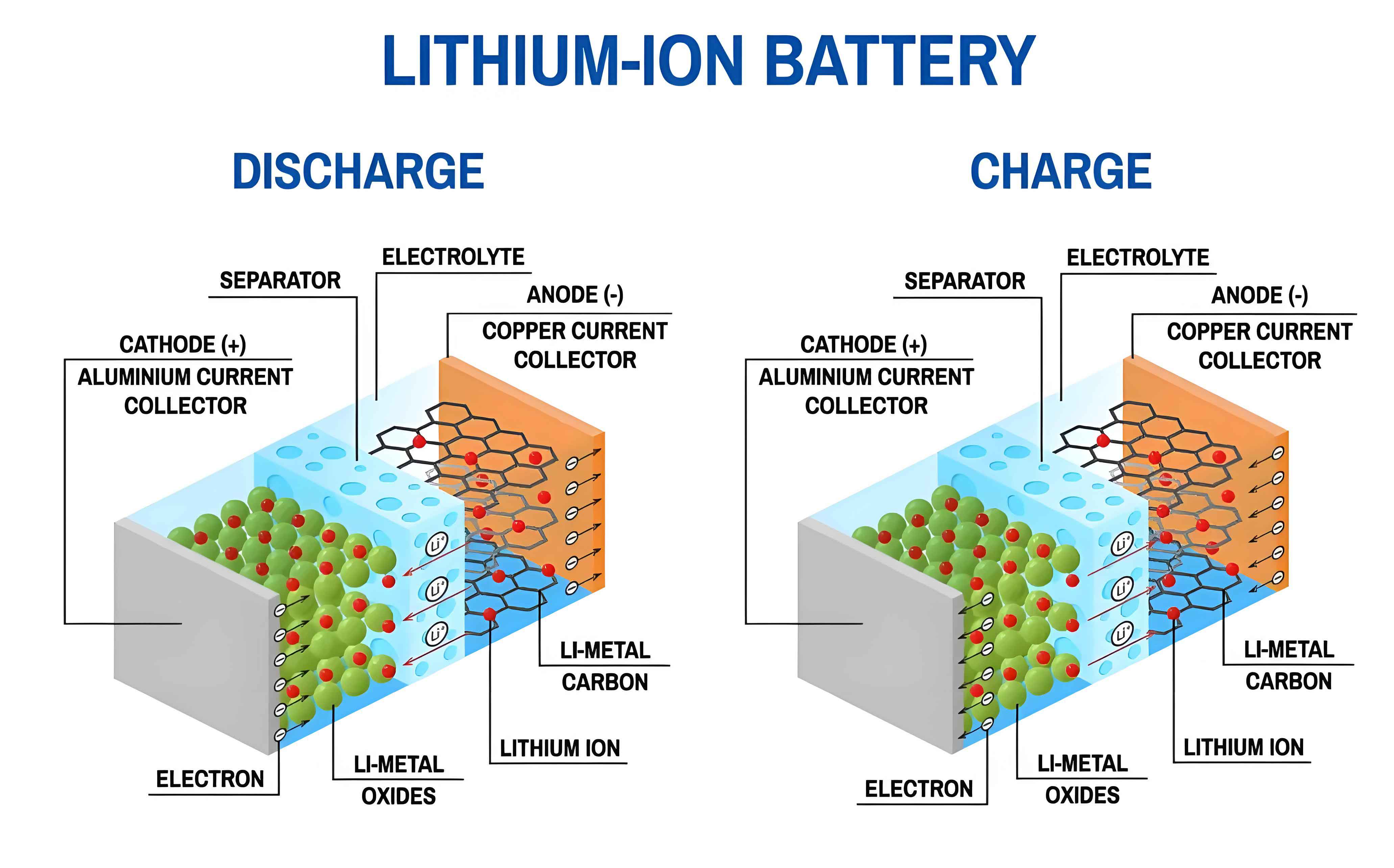
The lithium-ion battery operates on the principle of lithium-ion intercalation and deintercalation during charge and discharge cycles. For a typical ternary lithium-ion battery, the reactions can be represented as follows. At the cathode: $$ \text{LiMO}_2 \rightarrow \text{Li}_{1-x}\text{MO}_2 + x\text{Li}^+ + x e^- $$ where M represents transition metals like Ni, Co, and Mn. At the anode: $$ n\text{C} + x\text{Li}^+ + x e^- \rightarrow \text{Li}_x\text{C}_n $$ The overall cell reaction is: $$ \text{LiMO}_2 + n\text{C} \rightarrow \text{Li}_{1-x}\text{MO}_2 + \text{Li}_x\text{C}_n $$ This reversible process is fundamental to the operation of lithium-ion batteries, but in practice, capacity fading occurs due to irreversible changes in the cathode structure and interface. The failure mechanisms in cathode materials for lithium-ion batteries are multifaceted, involving crystal structure degradation and parasitic reactions. For instance, cation mixing between Li+ and Ni2+ ions, due to their similar radii, reduces active lithium sites and increases impedance. Phase transitions, such as the H2 to H3 transition in nickel-rich NCM materials, cause abrupt contraction along the c-axis, leading to layer instability and formation of rock-salt phases like NiO. Micro-cracks develop in secondary particles due to anisotropic stress during cycling, exposing fresh surfaces to electrolyte and accelerating degradation. Interfacial side reactions, often initiated by HF from LiPF6 decomposition, dissolve transition metal ions and promote solid electrolyte interphase (SEI) growth, further impeding lithium-ion transport in lithium-ion batteries.
To understand the diversity of cathode materials in lithium-ion batteries, I have summarized common types in Table 1. Each material offers distinct advantages and limitations, influencing their suitability for applications such as electric vehicles, energy storage systems, and consumer electronics. The quest for higher energy density and longer cycle life in lithium-ion batteries has driven extensive research into modifying these cathode materials.
| Cathode Material | Theoretical Specific Capacity (mAh/g) | Voltage Plateau (V) | Cost | Advantages | Disadvantages | Primary Applications |
|---|---|---|---|---|---|---|
| LiNixCoyMnzO2 (NCM) | 273–285 | 3.6 | High | Tunable composition, balanced performance | Complex synthesis, high cost | EVs, energy storage |
| LiFePO4 (LFP) | 170 | 3.4 | Low | High safety, long lifespan, low cost | Low energy density | EVs, grid storage |
| LiMn2O4 (LMO) | 148 | 3.8 | Low | High thermal stability | Poor cycle life | Power tools, medical devices |
| LiCoO2 (LCO) | 274 | 3.7 | High | High energy density | Short lifespan, thermal instability | Consumer electronics |
| xLi2MnO3·(1-x)LiTMO2 (LMR) | >250 | — | Moderate | Very high capacity | Requires high voltage, commercialization challenges | Next-gen high-capacity batteries |
Modification of cathode materials for lithium-ion batteries is essential to mitigate failure mechanisms. I will now explore two predominant approaches: element doping and surface coating. Element doping involves incorporating foreign atoms into the crystal lattice to stabilize the structure, suppress phase transitions, and enhance ionic conductivity. The effectiveness of doping depends on the element’s ionic radius, bonding energy with oxygen, and site occupancy. Based on the periodic table, I categorize doping elements into s-block, d-block, p-block, and f-block metals, each with unique impacts on lithium-ion battery performance.
For s-block elements, such as Na, K, Mg, and Ca, doping often occurs at lithium sites. These ions, with larger radii than Li+, expand the interlayer spacing, facilitating faster lithium-ion diffusion and reducing structural strain during cycling. For example, Na doping can decrease cation mixing and act as a pillar to prevent layer collapse. However, excessive doping may reduce the number of active lithium sites, slightly lowering initial capacity. The trade-offs are summarized in Table 2. In contrast, d-block transition metals like Ti, Zr, V, and Zn are commonly used due to their strong metal-oxygen bonds. They typically occupy transition metal sites, reinforcing the lattice and inhibiting oxygen release. For instance, Zr doping enhances structural stability by forming robust Zr–O bonds, while V doping improves lithium-ion diffusion coefficients. The versatility of d-block elements makes them popular for modifying high-nickel NCM cathodes in lithium-ion batteries. p-block elements, including Al, B, and F, offer cost-effective doping options. Al doping is particularly notable for improving thermal stability and cycle life in lithium-ion batteries, as Al3+ ions strengthen the framework. Halogen doping, such as with F or Cl, can expand ion channels and enhance electronic conductivity. f-block rare-earth elements, like Yb and La, exhibit high oxygen affinity, effectively suppressing oxygen evolution and cation disorder in lithium-rich cathodes for lithium-ion batteries.
| Element Block | Doping Elements | Primary Effects | Advantages | Disadvantages |
|---|---|---|---|---|
| s-block | Na, K, Mg, Ca, Rb, Cs, Ba | Expand interlayer spacing, reduce cation mixing, pillar effect | Enhance Li+ diffusion, structural stability | May reduce initial capacity, some elements costly |
| d-block | Ti, Zr, V, Cr, Zn, Cu, Fe, Nb, Mo, W | Strengthen metal-oxygen bonds, suppress phase transitions, improve conductivity | High effectiveness, wide availability | Some metals expensive, may introduce impurities |
| p-block | Al, B, Si, P, S, F, Cl, Br | Stabilize structure, enhance ion/electron transport, cost-effective | Low cost, versatile | Over-doping can harm performance |
| f-block | La, Ce, Yb, Lu | High oxygen affinity, inhibit oxygen loss, reduce cation disorder | Excellent stability enhancement | High cost, limited availability |
The benefits of element doping can be quantified using formulas that describe lattice parameter changes or diffusion enhancements. For example, the expansion of the c-lattice parameter due to doping with an element E can be approximated by: $$ \Delta c = k \cdot r_E $$ where \( k \) is a material-specific constant and \( r_E \) is the ionic radius of the dopant. This expansion facilitates lithium-ion movement in lithium-ion batteries. Additionally, doping can reduce the activation energy for lithium-ion diffusion, as modeled by the Arrhenius equation: $$ D = D_0 \exp\left(-\frac{E_a}{RT}\right) $$ where \( D \) is the diffusion coefficient, \( D_0 \) is the pre-exponential factor, \( E_a \) is the activation energy, \( R \) is the gas constant, and \( T \) is temperature. Effective doping lowers \( E_a \), improving rate capability in lithium-ion batteries.
Surface coating is another critical modification strategy for cathode materials in lithium-ion batteries. It involves applying a thin layer on particle surfaces to isolate active material from the electrolyte, thereby mitigating side reactions and preserving structural integrity. Coatings are classified into electrochemically inert and active materials. Inert coatings, such as Al2O3, SiO2, and ZrO2, act as physical barriers. For instance, Al2O3 coating on NCM811 cathodes suppresses HF attack and reduces transition metal dissolution, extending cycle life in lithium-ion batteries. However, inert coatings may increase interfacial resistance slightly. The optimal coating thickness is crucial; too thick a layer impedes lithium-ion transport, while too thin may be ineffective. A balance is achieved by controlling coating parameters during synthesis.
Electrochemically active coatings, including lithium-ion conductors like Li3PO4 or conductive polymers, not only protect but also enhance ion/electron transport. For example, a Li3InCl6 coating on NCM523 improves lithium-ion conductivity and reduces residual lithium content, boosting performance in lithium-ion batteries. Conductive carbon coatings, derived from organic precursors, enhance electronic conductivity and stabilize the interface. The synergy between coating and doping is often exploited; for example, Mg/Ta co-doping combined with CeO2 coating on LiNi0.9Al0.1O2 yields superior cycle stability and high-voltage tolerance in lithium-ion batteries. I summarize common coating materials and their functions in Table 3.
| Coating Type | Examples | Key Functions | Impact on Lithium-Ion Battery Performance |
|---|---|---|---|
| Inert Coatings | Al2O3, SiO2, ZrO2, TiO2, fluorides (e.g., AlF3) | Barrier against electrolyte, suppress HF attack, reduce TM dissolution | Improved cycle life, thermal stability; may slightly increase resistance |
| Active Ion Conductors | Li3PO4, Li2SiO3, Li3InCl6, solid electrolytes (e.g., LLZO) | Facilitate Li+ transport, stabilize interface, reduce residual lithium | Enhanced rate capability, lower impedance, longer lifespan |
| Conductive Coatings | Carbon, conductive polymers (e.g., PEDOT), graphene | Improve electronic conductivity, protect surface, inhibit side reactions | Higher capacity retention, better rate performance |
| Composite Coatings | Al2O3-carbon hybrid, polymer-inorganic blends | Combine barrier and conductive properties, multifunctional protection | Superior overall electrochemical stability |
Beyond doping and coating, other innovative modifications are emerging for cathode materials in lithium-ion batteries. Single-crystal synthesis eliminates grain boundaries, reducing micro-crack formation. For example, single-crystal NCM with Ce doping exhibits minimal phase transitions and enhanced conductivity. Concentration-gradient core-shell structures, where nickel content decreases from core to surface, mitigate surface degradation and improve thermal stability. Heterostructured designs, such as titanium-induced core-shell NCM, effectively suppress parasitic reactions. These approaches highlight the ongoing innovation in lithium-ion battery technology to address failure mechanisms.
The electrochemical performance of modified cathode materials can be evaluated using formulas that relate capacity retention to cycle number. For instance, the capacity fading in lithium-ion batteries often follows a power-law model: $$ C_n = C_0 \cdot n^{-\alpha} $$ where \( C_n \) is the capacity at cycle \( n \), \( C_0 \) is the initial capacity, and \( \alpha \) is the fading rate. Effective modification reduces \( \alpha \), indicating slower degradation. Similarly, the charge transfer resistance \( R_{ct} \) in electrochemical impedance spectroscopy (EIS) can be modeled with a Randles circuit: $$ Z = R_s + \frac{1}{j\omega C_{dl} + \frac{1}{R_{ct}}} $$ where \( R_s \) is solution resistance, \( C_{dl} \) is double-layer capacitance, and \( \omega \) is angular frequency. Coatings and doping often lower \( R_{ct} \), facilitating faster kinetics in lithium-ion batteries.
In conclusion, the advancement of cathode materials for lithium-ion batteries hinges on understanding and mitigating failure mechanisms through modification. Element doping stabilizes crystal structures, while surface coating protects interfaces, collectively enhancing cycle life and safety. However, challenges remain, such as balancing initial capacity loss with long-term stability, reducing costs for widespread adoption, and optimizing modification parameters for industrial scale-up. Future research should focus on developing low-cost, multifunctional dopants and coatings, leveraging advanced characterization to elucidate structure-property relationships, and integrating modification strategies with sustainable recycling processes for spent lithium-ion batteries. As the demand for high-performance energy storage grows, continued innovation in cathode materials will be pivotal to the evolution of lithium-ion batteries, enabling longer-range electric vehicles and more reliable grid storage solutions. I believe that interdisciplinary efforts combining materials science, electrochemistry, and engineering will drive the next breakthroughs in lithium-ion battery technology.