
The ever-growing demand for high-energy-density storage systems, driven by the rapid proliferation of electric vehicles and portable electronics, has placed immense pressure on the development of next-generation electrode materials for lithium-ion batteries. Conventional inorganic electrodes, while commercially dominant, face significant hurdles including resource scarcity, high cost, environmental concerns, and inherent limitations in their theoretical specific capacity. These challenges have catalyzed a paradigm shift towards exploring sustainable and versatile organic materials as promising alternatives. Organic molecules, with their designable structures, abundant elemental resources, and high theoretical capacities, offer a compelling avenue. However, their practical deployment in lithium-ion batteries is severely hampered by intrinsic drawbacks such as high solubility in liquid electrolytes, poor electronic conductivity, and inadequate cycling stability, leading to rapid capacity fade.
This work focuses on strategically combining two distinct organic molecules to overcome these limitations. On one hand, contorted hexabenzocoronene (HBC), a non-planar polycyclic aromatic hydrocarbon, possesses a rigid, stable conjugated framework that offers exceptional structural integrity and limited solubility, making it a candidate for stable cycling. On the other hand, 1,4-benzoquinone (BQ), a representative carbonyl compound, is renowned for its high theoretical specific capacity and fast redox kinetics but suffers from severe dissolution issues. The core hypothesis is that a composite material integrating HBC and BQ could synergistically combine the stability of the former with the high capacity of the latter. We systematically investigate the electrochemical performance, particularly the cycling stability, of HBC-BQ composites as anode materials in lithium-ion batteries, comparing them with their pristine counterparts.
The synthesis of the HBC molecule was carried out following established multi-step organic procedures, involving condensation, bromination, Suzuki coupling, and oxidative cyclodehydrogenation steps. The final product was characterized to confirm its structure. The organic small molecule BQ was obtained commercially. Composite materials, denoted as HBC@BQ(x:y), were prepared by physically mixing HBC and BQ in specific molar ratios (1:1 and 1:6) in a common solvent, followed by thorough solvent evaporation and drying to yield a homogeneous solid mixture. Electrodes were fabricated by coating a slurry of the active material (70 wt%), conductive carbon black (20 wt%), and polyvinylidene fluoride binder (10 wt%) in N-methyl-2-pyrrolidone onto a copper foil current collector. After drying under vacuum, CR2032 coin cells were assembled in an argon-filled glovebox using lithium metal as the counter/reference electrode, a porous polypropylene separator, and a standard electrolyte solution (e.g., 1 M LiPF6 in a mixture of ethylene carbonate and dimethyl carbonate). The electrochemical performance of these cells was evaluated using galvanostatic charge-discharge cycling, cyclic voltammetry (CV), and electrochemical impedance spectroscopy (EIS).
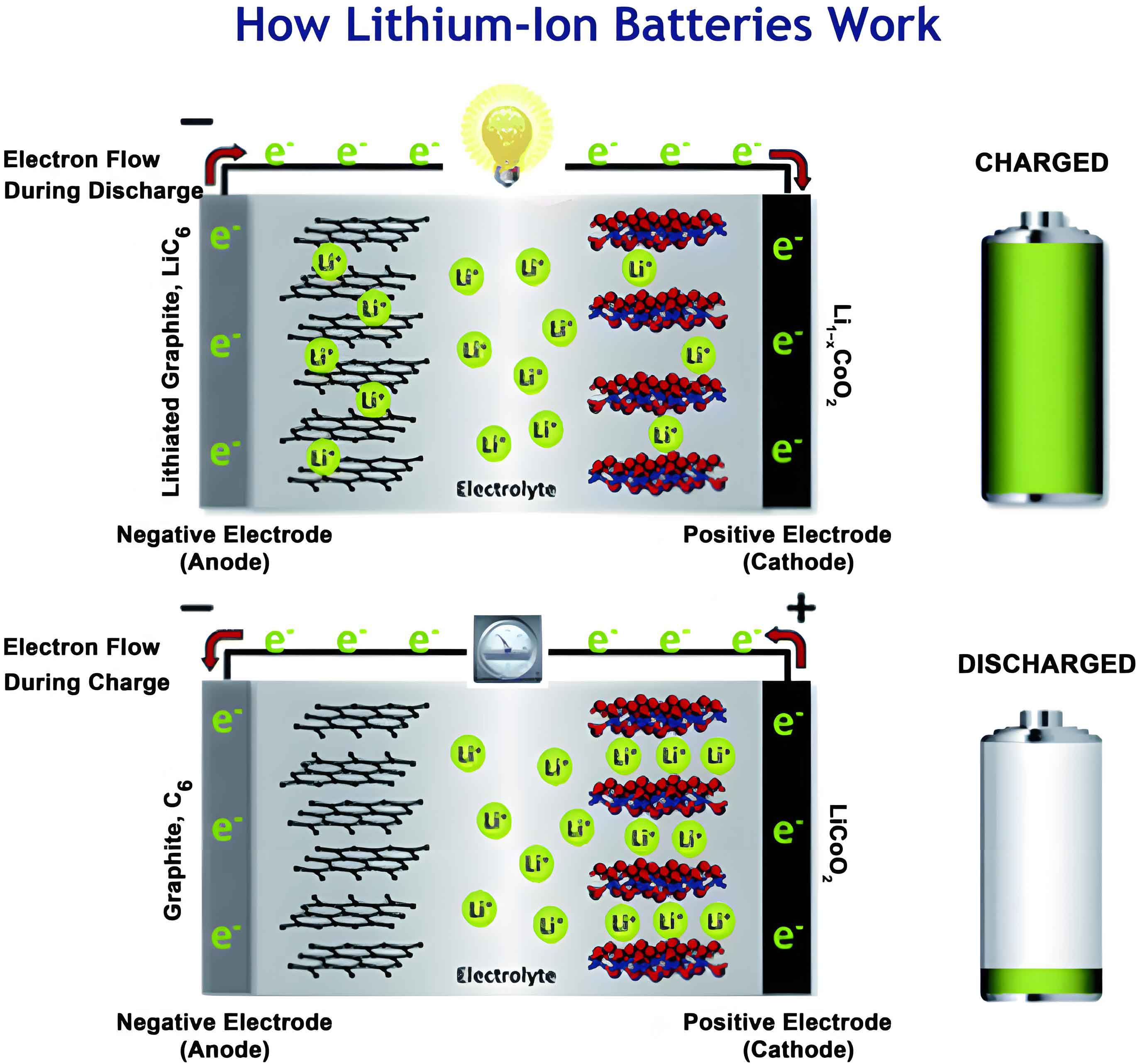
The fundamental charge storage mechanism in such organic materials often involves multi-electron redox reactions. For a carbonyl-based compound like BQ, the lithiation/delithiation can be represented as:
$$ \text{Q} + 2\text{Li}^+ + 2e^- \rightleftharpoons \text{QLi}_2 $$
where Q represents the quinone moiety. The theoretical specific capacity ($C_{th}$) can be calculated using the formula:
$$ C_{th} = \frac{nF}{3.6 \times M} $$
where $n$ is the number of electrons transferred per formula unit, $F$ is Faraday’s constant (96485 C mol-1), and $M$ is the molecular weight (g mol-1). For BQ ($\text{C}_6\text{H}_4\text{O}_2$, $M$ = 108.09 g mol-1}$) with $n=2$, $C_{th}$ is approximately 496 mAh g-1. For HBC ($\text{C}_{42}\text{H}_{18}$, $M$ = 522.58 g mol-1}$), the capacity likely stems from lithium ion insertion/intercalation into its layered molecular stacks, and its theoretical value is lower but offers superior stability.
Initial electrochemical characterization provided critical insights. The EIS spectra, measured over a frequency range from 100 kHz to 0.01 Hz, revealed the interfacial charge transfer resistance ($R_{ct}$) of the different electrodes. The data is summarized in Table 1. The semicircle in the high-to-medium frequency region corresponds to $R_{ct}$, a key parameter influencing rate capability.
| Anode Material | Charge Transfer Resistance, $R_{ct}$ (Ω) | Notes |
|---|---|---|
| HBC | 854 | High stability but significant resistance |
| BQ | 1820 | High capacity but very high resistance due to dissolution/passivation |
| HBC@BQ (1:1) | 580 | Reduced resistance compared to individual components |
| HBC@BQ (1:6) | 220 | Lowest resistance, indicating optimized composite interface |
The composite materials, especially HBC@BQ (1:6), exhibited a substantially lower $R_{ct}$ compared to the pristine materials. This suggests that the combination facilitates better charge transfer kinetics at the electrode-electrolyte interface, which is crucial for high-performance lithium-ion battery operation. The likely reason is that the HBC framework acts as a conductive, insoluble scaffold that prevents the agglomeration and dissolution of BQ molecules, maintaining a more stable and accessible surface for redox reactions.
Cyclic voltammetry scans at 0.5 mV s-1 between 0.1 and 3.0 V vs. Li/Li+ further elucidated the redox behavior. All materials showed reduction (lithiation) peaks near 0 V and oxidation (delithiation) peaks in the range of 0.3-0.6 V, confirming their activity as anode materials. However, the composites displayed sharper and more intense oxidation peaks with larger integrated areas compared to HBC or BQ alone. The peak current ($i_p$) in CV relates to the kinetics and can be expressed for a reversible system by the Randles-Sevcik equation:
$$ i_p = (2.69 \times 10^5) \cdot n^{3/2} \cdot A \cdot D^{1/2} \cdot C \cdot \nu^{1/2} $$
where $A$ is the electrode area, $D$ is the diffusion coefficient, $C$ is the concentration, and $\nu$ is the scan rate. The enhanced peak current and definition in composites imply improved lithium-ion diffusion kinetics and a higher number of accessible active sites, contributing to higher capacity.
The galvanostatic charge-discharge cycling performance is the most critical metric for evaluating lithium-ion battery anode materials. Testing was conducted at a current density of 200 mA g-1. The long-term cycling stability data for 300 cycles is compiled in Table 2. The specific capacity retention and Coulombic efficiency are vital indicators of practical viability.
| Material | Initial Discharge Capacity (mAh g-1) | Capacity after 300 cycles (mAh g-1) | Capacity Retention (%) | Average Coulombic Efficiency over 300 cycles (%) |
|---|---|---|---|---|
| HBC | ~125 | ~118 | ~94.4 | 99.2 |
| BQ | ~410 | ~85 | ~20.7 | 97.8 |
| HBC@BQ (1:1) | ~280 | ~245 | ~87.5 | 99.3 |
| HBC@BQ (1:6) | ~380 | ~330.9 | ~87.1 | 99.51 |
The data unequivocally demonstrates the success of the composite strategy. While pristine BQ delivers a high initial capacity, it suffers a catastrophic fade, retaining only about 21% after 300 cycles, which is attributed to its dissolution and shuttling effect in the electrolyte. Pristine HBC shows excellent capacity retention (>94%) but offers a modest specific capacity. The composites, however, strike an optimal balance. HBC@BQ (1:6) delivers a high initial capacity close to that of BQ and maintains 330.9 mAh g-1 after 300 cycles with an outstanding Coulombic efficiency of 99.51%. This represents a significant advancement in organic anode performance for lithium-ion batteries. The capacity increase during the initial cycles, observed for all samples, is typical of organic electrodes and can be attributed to a gradual activation process and electrochemical milling that increases the accessible surface area.
The rate capability, which assesses the performance under varying current densities, is another crucial factor for lithium-ion batteries intended for high-power applications. The materials were subjected to charge-discharge cycles at progressively increasing current densities from 0.1 A g-1 to 5 A g-1, and then back to 0.1 A g-1. The delivered capacities at each stage are presented in Table 3. The capacity recovery upon returning to a low current density indicates the reversibility and robustness of the electrode structure.
| Current Density (A g-1) | HBC Capacity (mAh g-1) | BQ Capacity (mAh g-1) | HBC@BQ (1:1) Capacity (mAh g-1) | HBC@BQ (1:6) Capacity (mAh g-1) |
|---|---|---|---|---|
| 0.1 | 115 | 178 | 171 | 228 |
| 0.2 | 76 | 114 | 122 | 218 |
| 0.5 | 66 | 106 | 102 | 204 |
| 1.0 | 43 | 88 | 70 | 180 |
| 2.0 | 34 | 67 | 48 | 150 |
| 3.0 | 32 | 60 | 40 | 132 |
| 5.0 | 28 | 43 | 36 | 75 |
| 0.1 (Return) | 122 | 189 | 182 | 264 |
HBC@BQ (1:6) consistently outperforms the other materials across all current densities, showcasing superior rate capability. Even at a very high current density of 5 A g-1, it retains a measurable capacity, whereas the others fade more significantly. Importantly, when the current density is restored to 0.1 A g-1, HBC@BQ (1:6) not only recovers but exceeds its initial capacity at that rate, indicating excellent structural resilience and minimal degradation during high-rate cycling. This behavior is paramount for a reliable lithium-ion battery anode. The enhanced rate performance can be linked to the reduced $R_{ct}$ and potentially improved lithium-ion diffusion coefficient ($D_{Li+}$) within the composite, which can be estimated from galvanostatic intermittent titration technique (GITT) or low-frequency EIS data using the formula:
$$ D_{Li^+} = \frac{4}{\pi} \left( \frac{V_m}{A \cdot F \cdot S} \right)^2 \left( \frac{\Delta E_s}{\Delta E_\tau} \right)^2 $$
where $V_m$ is molar volume, $A$ is area, $F$ is Faraday’s constant, $S$ is the slope of the potential vs. time1/2 plot, $\Delta E_s$ is the steady-state potential change, and $\Delta E_\tau$ is the potential change during constant current pulse.
The charge-discharge voltage profiles offer further insight into the redox processes. While HBC shows a distinct plateau around 0.3 V corresponding to its lithiation/delithiation, BQ exhibits sloping profiles without clear plateaus, indicative of a less defined phase transition. The composite materials, particularly HBC@BQ (1:6), display well-defined and flat discharge plateaus in the 0.3-0.6 V region. This signifies a more stable and cooperative redox process, likely where the HBC matrix provides a stable hosting environment that modulates the electrochemical reaction of BQ, leading to a two-phase-like behavior beneficial for a stable output voltage in a lithium-ion battery.
The proposed mechanism for the enhanced performance in the HBC-BQ composite anodes for lithium-ion batteries involves several synergistic effects. Firstly, the rigid, contorted structure of HBC molecules tends to form layered stacks with inherent voids. During composite formation, BQ molecules likely occupy or interact with these interstitial spaces. This integration has dual benefits: (1) it physically confines the BQ molecules, dramatically reducing their dissolution into the electrolyte and thus mitigating capacity fade; (2) it potentially expands the interlayer spacing of HBC aggregates, creating more accessible pathways and sites for lithium-ion insertion and diffusion. Secondly, the electron-donating character of the HBC core and the electron-accepting nature of the BQ moiety might facilitate beneficial electronic interactions, improving the overall electronic conductivity of the composite material. This is consistent with the observed lower impedance. The optimal molar ratio of 1:6 (HBC:BQ) suggests that a sufficient amount of HBC is needed to form a percolating, stable network that effectively encapsulates and stabilizes the majority BQ active material, while an excess of HBC would dilute the capacity, and an excess of BQ would overwhelm the stabilizing framework.
To quantitatively assess the cycling stability, the capacity fade can often be modeled using a power-law relationship:
$$ C_N = C_0 \cdot N^{-\lambda} $$
where $C_N$ is the capacity at cycle $N$, $C_0$ is the initial capacity, and $\lambda$ is the fade rate constant. For a high-stability lithium-ion battery anode, $\lambda$ should be as close to zero as possible. Fitting the cycling data for HBC@BQ (1:6) yields a very small $\lambda$ value, confirming its exceptional stability compared to pristine BQ which has a much larger $\lambda$.
In conclusion, this comprehensive study demonstrates a highly effective strategy for designing high-performance organic anode materials for lithium-ion batteries. By forming a composite between the stable, conductive scaffold of contorted hexabenzocoronene (HBC) and the high-capacity active molecule 1,4-benzoquinone (BQ), we have successfully created an anode material that synergistically combines the advantages of both components. The HBC@BQ (1:6) composite exhibits a high specific capacity, outstanding long-term cycling stability with minimal fade over 300 cycles, remarkable rate capability, and a stable charge-discharge profile. Its performance metrics, including a retained capacity of 330.9 mAh g-1 and a Coulombic efficiency exceeding 99.5%, represent significant progress in the field of organic electrodes for lithium-ion batteries. The underlying mechanism is attributed to the physical confinement of BQ, expansion of lithium-ion diffusion pathways, and improved interfacial charge transfer. This work provides a novel and promising design principle—the marriage of a stabilizing molecular framework with a high-capacity redox-active unit—that can be extended to other organic material combinations, paving the way for the development of sustainable, high-energy-density, and durable lithium-ion batteries for future energy storage applications.