
The evolution of portable and stationary energy storage is inextricably linked to the development of battery technology. Among the various energy storage systems, the li ion battery has emerged as the dominant technology, powering everything from consumer electronics to electric vehicles and grid-scale storage solutions. Its superior energy density, long cycle life, and relatively low self-discharge rate are the key attributes behind this widespread adoption. The performance of a li ion battery is fundamentally governed by the electrochemical properties of its electrode materials. Consequently, relentless research focuses on discovering and engineering new materials to push the boundaries of capacity, power, safety, and longevity. This article delves into the material framework of li ion battery electrodes, with a particular emphasis on the synthesis, characterization, and performance advantages of graphene-based composite materials for the anode.
1. A Framework of Li Ion Battery Electrode Materials
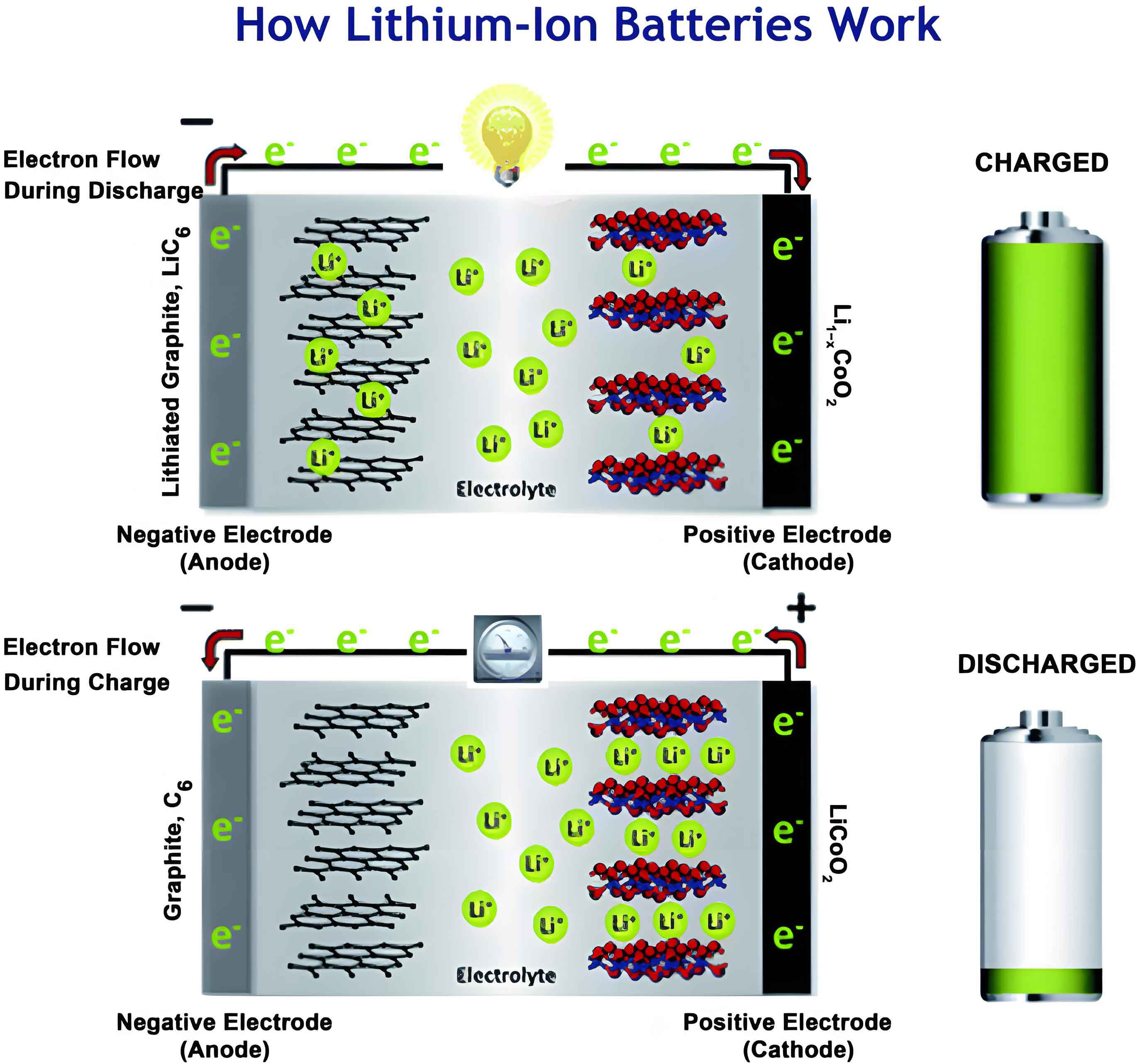
The operation of a li ion battery hinges on the reversible shuttling of lithium ions between a cathode and an anode during charge and discharge cycles. The selection and design of these electrode materials are therefore paramount.
1.1 Cathode Materials: The Source of Lithium Ions
The cathode, or positive electrode, serves as the source of lithium ions in a conventional li ion battery. It is typically a composite structure consisting of an active material, a conductive additive (like carbon black), and a polymeric binder on a current collector (aluminum foil). Ideal cathode materials must satisfy several stringent criteria to be viable for high-performance li ion battery applications.
| Property | Requirement & Rationale |
|---|---|
| High Operating Voltage | The redox potential of the active material should be high (typically >3.5 V vs. Li/Li+) to maximize the cell voltage and, consequently, the energy density ($E \approx V \times C$). |
| High Specific Capacity | The material must allow for the reversible insertion/extraction of a large number of Li+ ions per formula unit, contributing directly to the battery’s capacity. |
| Structural Stability | The crystal structure must remain stable during repeated Li+ (de)intercalation to ensure long cycle life. Phase transitions should be minimal and reversible. |
| Fast Ionic & Electronic Transport | High Li+ diffusion coefficients and electronic conductivity are essential for good rate capability (fast charging/discharging). |
| Chemical/Electrochemical Stability | The material must be stable in the electrolyte environment across the operating voltage window to prevent side reactions and degradation. |
| Cost, Safety, and Environmental Impact | Practical applications demand low cost, thermal/abuse tolerance, and use of abundant, non-toxic elements. |
Major families of cathode materials developed over the years include:
- Layered Oxides: LiCoO2 (LCO), LiNixMnyCozO2 (NMC), LiNi0.8Co0.15Al0.05O2 (NCA). The general reaction is: $$ \text{LiMO}_2 \rightleftharpoons \text{Li}_{1-x}\text{MO}_2 + x\text{Li}^+ + xe^- $$ where M is a transition metal or combination thereof.
- Spinel Oxides: LiMn2O4 (LMO). Offers good power but moderate capacity.
- Polyanion Compounds: LiFePO4 (LFP), LiMnPO4. Feature strong P-O bonds that enhance thermal and structural stability, improving safety.
1.2 Anode Materials: The Host for Lithium Ions
The anode, or negative electrode, accepts and stores lithium ions during charging. The quest for the ideal anode material is driven by the following desired properties:
| Property | Requirement & Rationale |
|---|---|
| Low and Flat Working Potential | A potential close to that of Li/Li+ is desired to maximize output voltage, but it must be slightly higher to prevent lithium plating (for safety). |
| High Gravimetric/Volumetric Capacity | The material should host a large number of Li atoms per mass or volume unit. |
| Excellent Cycle Life | Minimal volume change and maintained structural integrity during cycling are crucial. |
| Good Electronic Conductivity & Ionic Diffusivity | Essential for high power density and rate performance. |
| Formation of Stable Solid Electrolyte Interphase (SEI) | A stable, ionically conductive but electronically insulating SEI layer on the anode surface is vital for long-term cyclability. |
Traditional and emerging anode materials include:
- Graphitic Carbon: The commercial standard (theoretical capacity: 372 mAh g-1). Works via intercalation: $$ \text{C}_6 + x\text{Li}^+ + xe^- \rightleftharpoons \text{Li}_x\text{C}_6 $$
- Alloying Materials: Si (theoretical: ~3579 mAh g-1), Sn, Ge. They undergo alloying/dealloying reactions, e.g., $$ \text{Si} + x\text{Li}^+ + xe^- \rightleftharpoons \text{Li}_x\text{Si} $$ Suffer from massive volume expansion (>300% for Si).
- Conversion Materials: Transition metal oxides (Fe3O4, Co3O4), sulfides, phosphides. They undergo a conversion reaction: $$ \text{M}_a\text{X}_b + (b \cdot n)\text{Li}^+ + (b \cdot n)e^- \rightleftharpoons a\text{M} + b\text{Li}_n\text{X} $$ (where X = O, S, P; M = metal). They offer high capacities but often have large voltage hysteresis and volume changes.
- Lithium Metal: The “holy grail” due to its ultra-high capacity (3860 mAh g-1) and lowest potential. However, challenges like dendrite growth and instability persist.
2. Graphene and Its Composites: A Paradigm Shift for Anodes
Graphene, a single layer of sp2-hybridized carbon atoms arranged in a hexagonal lattice, has attracted immense attention since its isolation. Its extraordinary properties—high specific surface area (~2630 m2 g-1), exceptional electrical and thermal conductivity, mechanical strength, and chemical stability—make it an ideal candidate for enhancing li ion battery electrodes, particularly anodes.
2.1 Rationale for Graphene-Based Composite Anodes
While pristine graphene can store Li via adsorption on both sides and at edges (theoretical capacity ~744 mAh g-1), it often suffers from restacking due to strong π-π interactions, reducing active surface area and Li+ diffusion kinetics. Its true potential is unlocked in composite structures, where it acts as a multifunctional matrix or scaffold for other active materials (Si, Sn, metal oxides like Fe3O4, etc.). The composite approach addresses critical shortcomings:
- Buffering Volume Changes: The flexible and robust graphene sheets can accommodate the strain from the expansion/contraction of alloying or conversion materials, preventing pulverization.
- Enhancing Electrical Conductivity: Graphene forms a percolating conductive network throughout the electrode, facilitating electron transport to and from the active nanoparticles.
- Preventing Agglomeration: By confining active nanoparticles between or on graphene sheets, their aggregation during cycling is inhibited, maintaining a high electrochemically active surface area.
- Providing Short Diffusion Paths: The 2D structure and the composite’s porous architecture shorten the diffusion length for both Li+ ions and electrons.
The core electrochemical principle involves the synergistic storage of lithium. The graphene component stores Li via adsorption and possibly intercalation at defects, while the partnered active material (e.g., Fe3O4) stores Li via its intrinsic mechanism (conversion reaction). The overall capacity is a contribution from both.
3. Synthesis and Performance of Graphene Composite Anodes: Case Studies
The performance of a graphene composite in a li ion battery is profoundly influenced by its synthesis method, which dictates morphology, particle size, dispersion, and interfacial bonding. Below, we explore two representative synthesis strategies and their electrochemical outcomes.
3.1 Two-Dimensional (2D) Fe3O4/Graphene Nanosheet Composites
Synthesis Strategy (Modified Hummers’ Method & Hydrothermal Assembly):
This common approach involves anchoring Fe3O4 nanoparticles onto the surfaces of graphene oxide (GO) or reduced graphene oxide (rGO) sheets.
- GO Synthesis: Graphite is oxidized using Hummers’ method (KMnO4, NaNO3, concentrated H2SO4) to produce GO, which is hydrophilic due to oxygen functional groups (-OH, -COOH, epoxides).
- Composite Formation: Fe3+/Fe2+ salts (e.g., FeCl3 and FeSO4) are mixed with the GO dispersion. Under basic conditions (e.g., with NH3·H2O) and hydrothermal treatment, Fe3O4 nanoparticles nucleate and grow on the GO sheets. Simultaneously, the hydrothermal process reduces GO to rGO, improving conductivity.
The reaction can be summarized as: $$ \text{Fe}^{2+} + 2\text{Fe}^{3+} + 8\text{OH}^- \rightarrow \text{Fe}_3\text{O}_4 \downarrow + 4\text{H}_2\text{O} $$ - Post-treatment: The product is washed, dried, and sometimes annealed in an inert atmosphere to further enhance crystallinity and conductivity.
Structure and Electrochemical Performance:
The resulting material features Fe3O4 nanoparticles (5-50 nm) uniformly dispersed on 2D rGO sheets. This structure offers distinct advantages in a li ion battery:
- High Reversible Capacity: The composite leverages the high theoretical capacity of Fe3O4 (~924 mAh g-1) via the conversion reaction: $$ \text{Fe}_3\text{O}_4 + 8\text{Li}^+ + 8e^- \rightleftharpoons 3\text{Fe}^0 + 4\text{Li}_2\text{O} $$ The rGO contributes additional capacity through surface storage mechanisms.
- Enhanced Rate Capability: The rGO network provides rapid electron transport pathways, reducing polarization. The capacitive contribution (surface-controlled storage) can be significant, often quantified via Dunn’s method from cyclic voltammetry data: $$ i(V) = k_1 v + k_2 v^{1/2} $$ where $i$ is current, $v$ is scan rate, $k_1 v$ represents the capacitive contribution, and $k_2 v^{1/2}$ represents the diffusion-controlled contribution. For these composites, the $k_1$ term is substantial.
- Improved Cycling vs. Bare Fe3O4: The graphene sheets buffer the volume change of Fe3O4 during cycling, leading to better capacity retention. However, capacity fading can still occur over hundreds of cycles due to gradual aggregation of nanoparticles and possible detachment from the graphene substrate.
3.2 Three-Dimensional (3D) Graphene Network Fe3O4/G Composites
Synthesis Strategy (Template-Assisted & Self-Assembly):
This advanced approach aims to construct an interconnected 3D macroporous graphene scaffold, overcoming the restacking issue of 2D sheets.
- 3D Graphene Framework Preparation: Methods include:
- Template-Directed CVD: Using a nickel foam as a template for graphene growth via Chemical Vapor Deposition (CVD), followed by etching away the template.
- Hydrothermal Self-Assembly & Freeze-Drying: A concentrated GO dispersion is subjected to hydrothermal treatment, causing the sheets to cross-link into a 3D hydrogel. Subsequent freeze-drying (lyophilization) preserves the porous 3D architecture, yielding a graphene aerogel.
- Template Assembly: Using sacrificial templates like SiO2 or polystyrene spheres around which GO coats, followed by template removal.
- Incorporation of Active Material: Fe3O4 can be introduced via:
- In-situ growth: Impregnating the 3D graphene network with Fe salt precursors, followed by precipitation/hydrothermal treatment to form Fe3O4 nanoparticles within the pores.
- Ex-situ deposition: Pre-formed Fe3O4 nanoparticles are loaded into the porous network.
Structure and Electrochemical Performance:
The 3D composite features a bicontinuous structure: a continuous, highly conductive graphene network forming interconnected pores that are infiltrated with Fe3O4 nanoparticles. This architecture is transformative for li ion battery performance:
- Ultra-Stable Cycling Performance: The 3D graphene cage provides superior mechanical confinement for the active material, effectively accommodating volume changes. Electron transport is optimized through the 3D conductive highway. This often results in remarkably slow capacity decay, with capacity retention exceeding 90% over many hundreds of cycles.
- Exceptional Rate Performance and Low Polarization: The porous network ensures excellent electrolyte penetration and provides very short, multidirectional ion diffusion paths. The continuous graphene backbone offers minimal resistance to electron flow. This is reflected in a small voltage gap between charge and discharge plateaus and high capacity retention even at very high current rates. The effective electronic conductivity ($\sigma_{eff}$) of such a percolated network can be described by percolation theory.
- High Active Material Loading: The 3D framework can support a higher mass loading of active material without sacrificing electrical connectivity, which is crucial for achieving high areal capacity in practical li ion battery electrodes.
| Feature | 2D Sheet-Based Composite | 3D Network-Based Composite |
|---|---|---|
| Morphology | Nanoparticles on/between sheets; potential restacking. | Nanoparticles embedded in a macroporous, interconnected scaffold. |
| Electronic Conductivity Path | 2D in-plane conduction; inter-sheet contact resistance. | 3D percolating network; continuous pathways. |
| Ion Transport | Mainly through inter-sheet channels; can be hindered. | Through open, interconnected pores; facilitated transport. |
| Volume Change Buffering | Good (flexible sheets), but limited by 2D geometry. | Excellent (3D elastic cage); provides multidirectional stress relief. |
| Typical Cycle Life Stability | Good improvement over bare material, but fading occurs. | Outstanding; very slow capacity decay due to structural integrity. |
| Rate Capability | Good, limited by ion diffusion between layers. | Exceptional, due to short diffusion lengths and fast e– transport. |
| Synthesis Complexity | Relatively simple (solution-based). | More complex, often involving templates or special drying. |
4. Beyond Fe3O4: Other Promising Graphene Composites for Li Ion Battery Anodes
The graphene composite strategy is universal. Other high-capacity materials benefit immensely from integration with graphene:
- Silicon/Graphene: This is perhaps the most sought-after composite for next-generation li ion battery anodes. Silicon offers the highest theoretical capacity but suffers from >300% volume expansion. Graphene can be used to create flexible cages, sandwich structures, or porous scaffolds to contain Si nanoparticles/nanowires, dramatically improving cyclability.
- Tin/Graphene: Similar to Si, Sn alloys with Li. Graphene composites mitigate its pulverization issue.
- Other Metal Oxides/Sulfides: Materials like SnO2, MoS2, and Co3O4 have been successfully combined with graphene, showing enhanced performance over their pure forms.
- Lithium Titanate (LTO)/Graphene: While LTO has excellent cycle life and safety (zero strain material), its conductivity is low. Graphene additives significantly boost its rate capability.
5. Conclusions and Future Perspectives
The integration of graphene into composite structures represents a powerful materials engineering strategy to overcome the intrinsic limitations of high-capacity anode materials for li ion battery technology. As detailed, transitioning from simple 2D mixing to architecting 3D interconnected networks can yield transformative improvements in cycle life, rate capability, and overall electrode robustness.
The future development of graphene-based anodes for li ion battery applications will likely focus on:
- Precise Morphology Control: Developing more scalable and reproducible methods to tailor pore size, graphene sheet orientation, and nanoparticle distribution in 3D scaffolds.
- Understanding Interfacial Chemistry: In-depth study of the chemical bonding and charge transfer at the graphene/active-material interface to further optimize electrochemical kinetics and SEI stability.
- Scalable and Sustainable Synthesis: Reducing cost and environmental impact by improving synthetic routes, potentially using biomass-derived graphene precursors.
- Integration with Emerging Battery Chemistries: Exploring graphene composites for sodium-ion, potassium-ion, and lithium-sulfur batteries.
In conclusion, graphene and its composites have firmly established themselves as a cornerstone material platform for advancing anode technology. Their continued development holds significant promise for realizing the next leap in energy density, power, and longevity for the ubiquitous li ion battery, thereby accelerating the transition to a more electrified and sustainable energy future.