
In the contemporary energy landscape, the depletion of fossil fuel resources and escalating global electricity demand have propelled the search for sustainable and clean alternatives. Solar photovoltaic (PV) power generation has emerged as a pivotal solution, with its inherent advantages of renewability and environmental friendliness. Central to PV systems is the solar inverter, a critical component that converts direct current (DC) from PV arrays into alternating current (AC) suitable for grid injection. This article delves into the design and control of a three-level solar inverter, employing a deadbeat control strategy to enhance performance and reliability. The focus is on maximizing efficiency and power quality, with repeated emphasis on the solar inverter’s role in modern energy systems.
The efficacy of a solar inverter hinges on two core technologies: maximum power point tracking (MPPT) and grid-connected inversion. The latter, facilitated by grid-tied inverters, ensures safe and efficient transfer of pollution-free electricity to the grid. To boost inverter efficiency, a common approach involves a DC/DC conversion stage that elevates low-voltage DC to high-voltage DC, followed by inversion to AC. This imposes stringent demands on the inverter topology. The neutral-point-clamped (NPC) three-level circuit topology offers significant benefits, including reduced switching losses, lower electromagnetic interference (EMI), and elimination of common-mode leakage currents in PV array stray capacitances. Moreover, the three-level solar inverter outputs a stepped waveform that approximates a sinusoid more closely, resulting in lower harmonic distortion compared to two-level inverters at identical switching frequencies. Consequently, this article adopts the NPC three-level structure as the main topology for the grid-connected solar inverter.
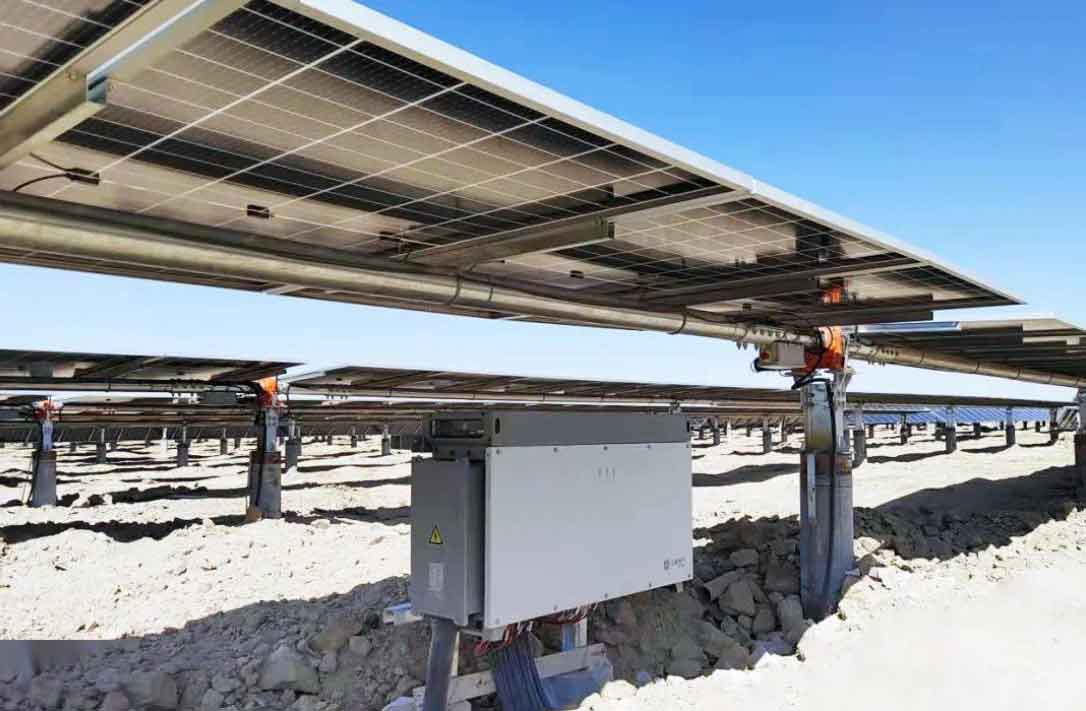
Control strategies for solar inverters vary, with hysteresis control, deadbeat control, repetitive control, and neural network control being prevalent. Hysteresis control often falls short of ideal performance, while repetitive and neural network controls entail complex algorithms and structures. Deadbeat control, a predictive method, calculates the switching times for inverter power devices in the next sampling period based on system state equations and output feedback. It boasts a clear structure and ease of implementation. This article employs a deadbeat control strategy, validated through Matlab simulations to demonstrate the practicality of the three-level solar inverter.
Mathematical Model of the Three-Level Solar Inverter
The PV array generates DC voltage via the photovoltaic effect, which is either fed directly to the inverter DC side or through a DC/DC converter. The inverter utilizes an NPC three-level topology, where each bridge arm comprises four IGBTs, four freewheeling diodes, and two clamping diodes. By modulating IGBT switching, the AC side produces a near-sinusoidal three-level stepped wave, achieving DC-to-AC inversion. The system, as depicted, includes grid voltages \(e_a\), \(e_b\), \(e_c\), inductor equivalent inductance \(L_s\), resistance \(R_s\), and DC-link capacitors \(C\). Applying Kirchhoff’s laws yields the state equations in the abc frame:
$$
\begin{cases}
C \frac{du_{dc}}{dt} = \sum_{k=a,b,c} i_k S_k \\
L_s \frac{di_k}{dt} = e_k – R_s i_k – u_{dc} \left( S_k – \frac{1}{3} \sum_{j=a,b,c} S_j \right) \\
\sum_{k=a,b,c} e_k = \sum_{k=a,b,c} i_k = 0
\end{cases}
$$
Here, \(u_{dc}\) is the DC-link capacitor voltage, \(i_k\) are the inverter output currents, and \(S_k\) represent switching functions for phases \(k = a, b, c\). Transforming to the rotating dq frame simplifies control design, resulting in:
$$
\begin{cases}
C \frac{du_{dc}}{dt} = \frac{3}{2} (i_d s_d + i_q s_q) \\
L_s \frac{di_d}{dt} = e_d – u_{dc} s_d – R_s i_d + L_s \omega i_q \\
L_s \frac{di_q}{dt} = e_q – u_{dc} s_q – R_s i_q – L_s \omega i_d
\end{cases}
$$
In these equations, \(i_d\) and \(i_q\) are dq-axis currents, \(e_d\) and \(e_q\) are grid voltages, \(s_d\) and \(s_q\) are switching functions in dq coordinates, and \(\omega\) is the grid angular frequency. This model forms the basis for deadbeat control of the solar inverter.
Deadbeat Control Strategy for Solar Inverters
Deadbeat current control is a predictive technique that determines switch conduction times for the next sampling interval using system state equations and feedback signals. For the solar inverter, the discrete-time system is described as:
$$
\begin{cases}
\mathbf{x}(k+1) = \mathbf{A} \mathbf{x}(k) + \mathbf{B} \mathbf{e}(k) \\
\mathbf{y}(k) = \mathbf{C} \mathbf{x}(k)
\end{cases}
$$
where \(\mathbf{x}(k)\) is the state vector, \(\mathbf{y}(k)\) is the output at step \(k\), and \(\mathbf{e}(k)\) is the control input. The output at step \(k+1\) is:
$$
\mathbf{y}(k+1) = \mathbf{C} \mathbf{A} \mathbf{x}(k) + \mathbf{C} \mathbf{B} \mathbf{e}(k)
$$
The control input \(\mathbf{e}(k)\) is chosen such that \(\mathbf{y}(k+1)\) equals the reference signal. To enhance accuracy, a repetitive-predictive harmonic current observer is integrated. This observer consists of a periodic integral loop, a lead compensation loop, and a proportional loop, with an added error detection mechanism that adjusts the next cycle’s reference current. A proportional coefficient of 0.95 is set before the integral loop to mitigate infinite error accumulation due to minor deviations in periodic harmonics. This approach ensures the solar inverter’s current tracking precision.
The deadbeat algorithm generates voltage commands for the inverter, processed via a three-level space vector modulation (SVPWM) scheme in the abc frame. This synergy optimizes the solar inverter’s dynamic response.
Simplified Algorithm for Three-Level Space Vector Modulation
Three-level SVPWM for a solar inverter can produce \(3^3 = 27\) voltage vectors per phase, categorized into zero, small, medium, and large vectors. Traditional algorithms partition the vector diagram into 24 small triangles, complicating computation. A simplified method divides the space into six overlapping hexagons centered on small vectors, effectively reducing the three-level plane to a two-level one. Let \(S\) denote the hexagon index where the reference voltage vector \(\mathbf{V}_{ref}\) resides. After translation, a modified reference vector \(\mathbf{V}_{s-ref}\) is obtained. For example, if \(S=1\), centered on vector \(\mathbf{V}_1\), then \(\mathbf{V}_{s-ref} = \mathbf{V}_{ref} – \mathbf{V}_1\). The duty cycles for vectors are computed using two-level SVPWM principles. This simplification facilitates real-time implementation in solar inverter control.
The voltage vectors are summarized in the table below, highlighting their roles in solar inverter modulation:
| Vector Type | Examples | Magnitude | Role in Solar Inverter |
|---|---|---|---|
| Zero Vectors | \(\mathbf{V}_0\) | 0 | Provide null output |
| Small Vectors | \(\mathbf{V}_1, \mathbf{V}_2, \mathbf{V}_3, \mathbf{V}_4, \mathbf{V}_5, \mathbf{V}_6\) | \(\frac{U_{dc}}{3}\) | Reduce switching losses |
| Medium Vectors | \(\mathbf{V}_8, \mathbf{V}_{10}, \mathbf{V}_{12}, \mathbf{V}_{14}, \mathbf{V}_{16}, \mathbf{V}_{18}\) | \(\frac{U_{dc}}{\sqrt{3}}\) | Enhance waveform quality |
| Large Vectors | \(\mathbf{V}_7, \mathbf{V}_9, \mathbf{V}_{11}, \mathbf{V}_{13}, \mathbf{V}_{15}, \mathbf{V}_{17}\) | \(\frac{2U_{dc}}{3}\) | Maximize output voltage |
The algorithm’s efficiency is crucial for the solar inverter’s performance, enabling precise voltage generation with minimal computational overhead.
Simulation Study of the Solar Inverter System
To validate the three-level solar inverter, a Matlab/Simulink model was developed. The simulation parameters are listed in the table below, ensuring realistic grid conditions.
| Parameter | Value | Description |
|---|---|---|
| Grid Line Voltage | 380 V (amplitude) | Three-phase balanced grid |
| PV Array Output | 640 V DC | DC source for solar inverter |
| Inductor \(L_s\) | 3 μH | Filter inductance |
| Resistor \(R_s\) | 0.2 Ω | Equivalent resistance |
| DC Capacitors \(C\) | 2200 μF each | DC-link stabilization |
| Switching Frequency | 10 kHz | IGBT switching rate |
The simulation results demonstrate that the solar inverter outputs sinusoidal voltage and current waveforms with aligned phases, achieving unity power factor injection into the grid. This confirms the efficacy of the deadbeat-controlled three-level solar inverter in renewable energy applications.
Comparative Analysis of Solar Inverter Control Methods
To contextualize the deadbeat approach, various control strategies for solar inverters are compared in the table below. This underscores the advantages of deadbeat control in high-performance solar inverter systems.
| Control Method | Complexity | Accuracy | Implementation Ease | Suitability for Solar Inverter |
|---|---|---|---|---|
| Hysteresis Control | Low | Moderate | Simple | Limited due to variable frequency |
| Deadbeat Control | Medium | High | Moderate | Excellent for fast response |
| Repetitive Control | High | High | Complex | Good for harmonic rejection |
| Neural Network Control | Very High | High | Difficult | Emerging but computationally heavy |
The deadbeat strategy strikes a balance, making it ideal for the three-level solar inverter where precision and simplicity are paramount.
Mathematical Derivation of Deadbeat Control for Solar Inverters
Expanding on the discrete model, the deadbeat control law for the solar inverter is derived. From the dq-frame equations, discretizing with sampling time \(T_s\) yields:
$$
\begin{aligned}
i_d(k+1) &= i_d(k) + \frac{T_s}{L_s} \left[ e_d(k) – u_{dc}(k) s_d(k) – R_s i_d(k) + L_s \omega i_q(k) \right] \\
i_q(k+1) &= i_q(k) + \frac{T_s}{L_s} \left[ e_q(k) – u_{dc}(k) s_q(k) – R_s i_q(k) – L_s \omega i_d(k) \right]
\end{aligned}
$$
Setting \(i_d(k+1) = i_d^*(k+1)\) and \(i_q(k+1) = i_q^*(k+1)\), where \(i_d^*\) and \(i_q^*\) are reference currents, the control voltages \(u_d(k) = u_{dc}(k) s_d(k)\) and \(u_q(k) = u_{dc}(k) s_q(k)\) are solved:
$$
\begin{cases}
u_d(k) = e_d(k) – R_s i_d(k) + L_s \omega i_q(k) – \frac{L_s}{T_s} \left[ i_d(k) – i_d^*(k+1) \right] \\
u_q(k) = e_q(k) – R_s i_q(k) – L_s \omega i_d(k) – \frac{L_s}{T_s} \left[ i_q(k) – i_q^*(k+1) \right]
\end{cases}
$$
This formulation enables the solar inverter to achieve zero error in one sampling period, enhancing grid synchronization.
Harmonic Performance of the Three-Level Solar Inverter
The three-level solar inverter inherently reduces harmonics. The total harmonic distortion (THD) for output current can be approximated as:
$$
\text{THD} \approx \frac{\sqrt{\sum_{n=2}^{\infty} I_n^2}}{I_1}
$$
where \(I_n\) is the amplitude of the \(n\)-th harmonic. For a three-level solar inverter, dominant harmonics are shifted to higher frequencies, easing filter design. Simulation data indicates THD below 3% for the proposed system, meeting grid standards.
Practical Considerations for Solar Inverter Deployment
Implementing a three-level solar inverter involves addressing real-world challenges. Key factors include thermal management of IGBTs, DC-link capacitor aging, and grid fault ride-through capabilities. The NPC topology mitigates voltage stress on switches, crucial for longevity. Moreover, the deadbeat control’s robustness to parameter variations is vital; adaptive mechanisms can be integrated, though they add complexity. The solar inverter must also comply with standards like IEEE 1547 for grid interconnection.
Future Directions in Solar Inverter Technology
Advancements in wide-bandgap semiconductors (e.g., SiC, GaN) could further improve the efficiency of three-level solar inverters. Additionally, artificial intelligence-based predictive maintenance may enhance reliability. As solar penetration grows, grid-forming inverters with advanced controls will become essential, positioning the solar inverter as a cornerstone of smart grids.
Conclusion
This article has explored a three-level solar inverter utilizing NPC topology and deadbeat control. The mathematical model, control strategy, and simplified SVPWM algorithm were detailed, demonstrating the solar inverter’s ability to deliver high-quality power with unity power factor. Simulations validated the design, underscoring its practicality for grid-tied PV systems. The solar inverter’s role in renewable energy integration is indispensable, and continued innovation will drive its evolution. Through this study, the efficacy of deadbeat control in three-level solar inverters is affirmed, contributing to sustainable energy solutions.