
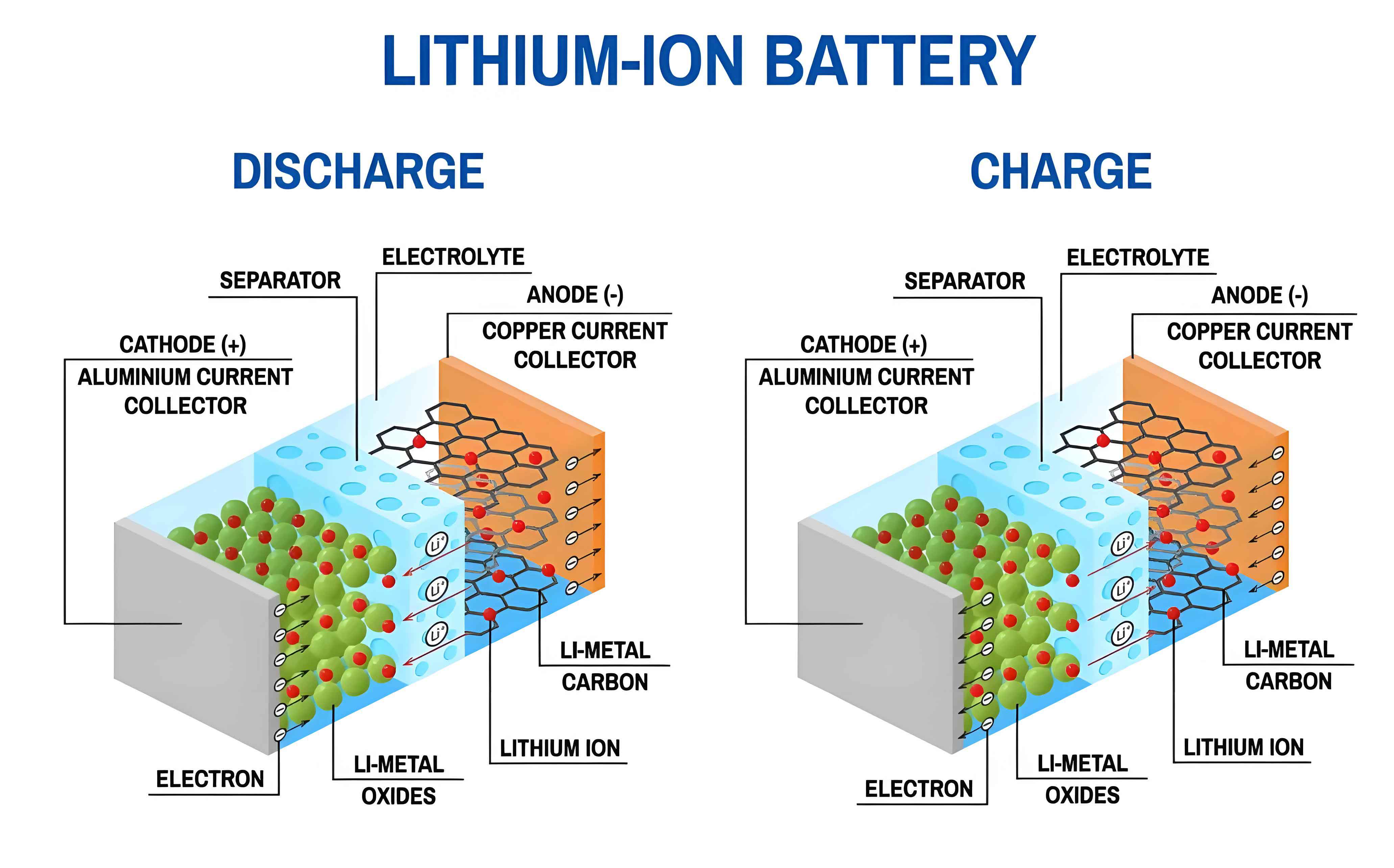
The pursuit of advanced electrode materials is central to the evolution of lithium-ion battery technology, which underpins modern portable electronics, electric vehicles, and grid-scale energy storage. Among various candidates, vanadium-based compounds have garnered significant interest due to their rich redox chemistry, multi-valent states, and potential for high specific capacity, offering a promising avenue to transcend the limitations of conventional electrode materials like LiFePO4 or graphite. However, the vast chemical and structural space of possible vanadium compounds makes the experimental discovery of optimal materials a slow and resource-intensive process. In this work, I establish a high-throughput screening pipeline that synergistically combines data-driven machine learning (ML) with precise first-principles calculations to efficiently identify novel vanadium-based electrodes with high theoretical capacity and suitable operational voltage for lithium-ion battery applications. This integrated approach not only accelerates the discovery cycle but also provides fundamental insights into the structure-property relationships governing electrochemical performance.
Computational Methodology and Workflow
The core of this study is a two-stage screening and validation protocol. The first stage employs machine learning to rapidly predict the maximum theoretical specific capacity across a large database of vanadium-containing materials. The second stage uses density functional theory (DFT) calculations to validate the top candidates from the ML stage, assessing their structural stability, electronic properties, lithium-ion adsorption energetics, and open-circuit voltage.
1. Data Curation and Feature Engineering for Machine Learning
The initial dataset was constructed by querying the Materials Project (MP) database for all stable, vanadium-containing inorganic crystalline materials. This resulted in a preliminary set of 4,694 unique compounds. For each material, the maximum theoretical specific capacity (Qtheo), serving as the target property for ML models, was computed using the `pymatgen` software package. This calculation is based on the grand potential phase diagram analysis, which considers all possible lithiation/delithiation reactions to find the phase yielding the highest capacity in mAh/g.
To enable the ML models to learn the underlying patterns, a set of 20 descriptive features was calculated or extracted for each compound. These features comprehensively describe the material’s intrinsic properties across several domains, as summarized in Table 1.
| Feature Category | Feature Name | Description |
|---|---|---|
| Structural & Compositional | Density | Theoretical density (g/cm³) from the crystal structure. |
| nsites | Number of atoms in the unit cell. | |
| nelements | Number of unique chemical elements. | |
| Volume | Unit cell volume (ų). | |
| Formation Energy per Atom | Energy of formation normalized per atom (eV/atom). | |
| Electronic Structure | Band Gap | Electronic band gap (eV). |
| Fermi Energy | Energy of the Fermi level (eV). | |
| e_above_hull | Energy above the convex hull (meV/atom), indicating stability. | |
| Total Magnetization | Magnetic moment per formula unit (µB). | |
| Highest Occupied Band Energy | Energy of the top of the valence band (eV). | |
| Lowest Unoccupied Band Energy | Energy of the bottom of the conduction band (eV). | |
| Elemental Properties (Averages) | Atomic Radius | Average atomic radius of constituent elements. |
| Electronegativity | Average Pauling electronegativity. | |
| Mendeleev Number | Average Mendeleev number. | |
| Atomic Weight | Average atomic mass. | |
| Thermodynamic & Bonding | Energy per Atom | Total energy per atom (eV/atom). |
| Cohesive Energy per Atom | Cohesive energy per atom (eV/atom). | |
| Total Energy | Total DFT energy of the unit cell (eV). | |
| Number of Bonds | Estimated number of bonds in the unit cell. | |
| Bond Length Mean | Mean bond length (Å). |
Prior to model training, a rigorous feature engineering pipeline was applied. Missing values were negligible due to the source database. All feature values were normalized to a [0, 1] range using min-max scaling to ensure equal weighting during model training:
$$ X_{\text{norm}} = \frac{X – X_{\text{min}}}{X_{\text{max}} – X_{\text{min}}} $$
Subsequently, correlation analysis was performed. Features showing negligible linear correlation (Pearson’s |r| < 0.05) and low mutual information with the target capacity were considered redundant and removed to prevent overfitting and improve model interpretability.
2. Machine Learning Model Development and Optimization
Three distinct regression algorithms were implemented and compared for predicting Qtheo: Deep Neural Network (DNN), Random Forest (RF), and Support Vector Regression (SVR). The dataset was split into training (80%) and testing (20%) sets, preserving the distribution of Qtheo. Model hyperparameters were optimized using a Genetic Algorithm (GA) with a population size of 50 over 50 generations, employing a tournament selection strategy with crossover and mutation probabilities of 0.5 and 0.2, respectively. The fitness function for the GA was the coefficient of determination (R²) obtained from a 5-fold cross-validation on the training set. The final model performance was evaluated on the held-out test set using R² and Mean Absolute Error (MAE).
The key hyperparameter spaces explored were:
- DNN: Number of layers (2-5), neurons per layer (16-128), learning rate (1e-5 to 1e-2), dropout rate (0-0.5), and activation functions (ReLU, tanh).
- RF: Number of estimators (50-200), maximum tree depth (5-20), and minimum samples per leaf (1-5).
- SVR: Regularization parameter C (0.1-10), epsilon-tube (0.01-0.5), and kernel coefficient γ for the Radial Basis Function (RBF) kernel (0.001-0.1).
Model interpretability was achieved using SHapley Additive exPlanations (SHAP) analysis on the best-performing model to quantify the contribution of each feature to individual predictions.
3. First-Principles Validation
The most promising candidates identified by the ML screening underwent validation via plane-wave DFT calculations as implemented in the Vienna Ab initio Simulation Package (VASP). The exchange-correlation functional was treated within the generalized gradient approximation using the Perdew-Burke-Ernzerhof (PBE) formulation. Projector-augmented wave (PAW) pseudopotentials were used to describe core-electron interactions. A kinetic energy cutoff of 520 eV was used for the plane-wave basis set. Brillouin zone integration was performed using Monkhorst-Pack k-point meshes with a density of at least 30 points per Å⁻¹. All atomic positions and lattice vectors were fully relaxed until the forces on each atom were less than 0.01 eV/Å.
For the top candidates, the following properties were calculated:
- Electronic Structure: Band structure and density of states (DOS) were computed to assess electrical conductivity (metallic vs. insulating behavior).
- Lithium Adsorption Energy: A single Li atom was placed at various symmetric sites on the candidate material’s surface (modeled via a suitable slab or within a bulk intercalation site). The adsorption energy (Eads) was calculated as:
$$ E_{\text{ads}} = E_{\text{total}}( \text{M + Li} ) – E_{\text{total}}(\text{M}) – E_{\text{total}}(\text{Li}_{\text{bulk}}) $$
where M is the host material and Etotal(Libulk) is the energy per atom of bulk bcc lithium. More negative Eads indicates stronger binding. - Average Open-Circuit Voltage (OCV): For intercalation-type electrodes, the average voltage for the reaction M + xLi → LixM was estimated using the formalism:
$$ V_{\text{avg}} \approx -\frac{[E(\text{Li}_x\text{M}) – E(\text{M}) – x E(\text{Li}_{\text{bulk}})]}{x e} $$
where e is the elementary charge, and E(LixM) and E(M) are the total energies of the lithiated and unlithiated phases, respectively. Several intermediate lithiation levels (x) were modeled using supercells to approximate the voltage profile.
Results and Discussion
1. Data-Driven Insights and Model Performance
The distribution of the calculated maximum theoretical capacity for the 4,694 vanadium-based materials reveals a bimodal characteristic, with significant populations around 200-300 mAh/g and 500-600 mAh/g. This immediately highlights the potential of vanadium compounds to exceed the capacity of many commercial lithium-ion battery cathode materials.
The correlation analysis pinpointed material density as the most influential feature, exhibiting the highest Pearson correlation coefficient (r ≈ 0.57) with Qtheo. This aligns with physical intuition: for intercalation-type electrodes in a lithium-ion battery, a higher density often correlates with a more compact crystal structure that can accommodate more lithium ions per unit mass or volume, thereby increasing the gravimetric and volumetric capacity. Other features related to electronic structure, such as the lowest unoccupied band energy and Fermi energy, showed moderate negative correlations.
After feature selection and GA optimization, the performance of the three ML models on the independent test set is summarized in Table 2.
| Model | Optimized Hyperparameters | Test R² | Test MAE (mAh/g) |
|---|---|---|---|
| Deep Neural Network (DNN) | Layers: [62, 34, 43, 42]; Learning Rate: 1e-5; Activation: ReLU | 0.771 | 78.2 |
| Random Forest (RF) | n_estimators: 75; max_depth: 5; min_samples_leaf: 2 | 0.702 | 85.6 |
| Support Vector Regression (SVR) | C: 0.5; ε: 0.5; γ: 0.02; Kernel: RBF | 0.659 | 91.3 |
The DNN model achieved superior predictive accuracy, capturing the complex, non-linear relationships between the material descriptors and the theoretical capacity. The SHAP analysis of the DNN model further confirmed the paramount importance of density, followed by compositional features like `nsites` and `nelements`. This underscores that for a high-capacity lithium-ion battery electrode, a dense, multi-element crystal structure that provides abundant and diverse sites for lithium accommodation is a key design principle.
Leveraging the predictive power of the DNN model, the entire dataset was screened. Materials predicted to have a very high theoretical capacity (> 650 mAh/g) were shortlisted. From this list, candidates were prioritized based on high density (top 0.5%) and thermodynamic stability (low energy above hull). This process yielded 26 promising vanadium-based compounds.
2. First-Principles Validation of Top Candidates
Three materials from the shortlist—V6O13, MgV5O12, and V2MoO8—were selected for detailed DFT validation due to their exceptionally high predicted capacities and structural diversity.
2.1 Electronic Structure and Conductivity
The calculated band structures and density of states are crucial for assessing intrinsic electronic conductivity, a vital property for minimizing polarization in a lithium-ion battery electrode.
- V6O13: Exhibits a clear metallic character with several bands crossing the Fermi level. The DOS at the Fermi level is high, primarily contributed by V-3d orbitals, indicating excellent electronic conductivity.
- MgV5O12: Also shows metallic behavior. The states near the Fermi level are dominated by the V-3d orbitals from the vanadium oxide framework, suggesting good conductivity.
- V2MoO8: Displays a semi-metallic or very narrow bandgap semiconductor character. While not as conductive as the other two, its modest bandgap may still permit sufficient electronic transport, especially upon lithiation.
The metallic/semi-metallic nature of all three candidates is highly advantageous for their use as electrodes, potentially eliminating the need for conductive carbon additives and improving rate capability.
2.2 Lithium Adsorption and Intercalation Energetics
The adsorption energy of a single Li atom was calculated to probe the initial interaction strength. V6O13 showed the most negative Eads (-3.30 eV), indicating very strong initial Li binding, likely at the abundant oxygen sites within its layered structure. MgV5O12 and V2MoO8 had adsorption energies of -1.96 eV and -1.54 eV, respectively, which are still favorable for lithiation.
To evaluate the full intercalation potential, the average open-circuit voltage was computed for the reaction from the pristine material to a lithiated phase LixM. Supercell models were constructed for different lithium concentrations (x). The calculated voltages are presented in Table 3.
| Material (M) | Space Group | Predicted Qtheo (mAh/g) | DFT-Calculated Average OCV vs. Li/Li⁺ (V) | Proposed Electrode Type |
|---|---|---|---|---|
| V6O13 | C2/m | 755 | 2.56 | Cathode |
| MgV5O12 | P1̄ | 699 | 0.64 | Anode |
| V2MoO8 | C2/m | 678 | 0.49 | Anode |
The OCV calculations provide critical application guidance. V6O13 has an average voltage of 2.56 V, which falls within the desirable range for a lithium-ion battery cathode material, offering a balance between energy density and electrolyte stability. In contrast, both MgV5O12 and V2MoO8 exhibit low average voltages (0.64 V and 0.49 V, respectively), positioning them as potential high-capacity anode materials to replace graphite (∼0.1 V) with significantly higher capacity. Their higher operating voltage compared to graphite could also mitigate lithium plating safety concerns.
Conclusion
In this study, I have successfully demonstrated an efficient and robust computational pipeline for discovering high-performance vanadium-based electrode materials for lithium-ion batteries. By integrating a machine learning model trained on a large materials database with targeted first-principles validation, I rapidly screened thousands of compounds and identified several promising candidates. The pipeline highlights the critical role of material density as a primary descriptor for high theoretical capacity. Subsequent DFT calculations on the top candidates, V6O13, MgV5O12, and V2MoO8, confirmed their high predicted capacities, favorable electronic conductivity, and suitable open-circuit voltages for application as cathode and anode materials, respectively. This work underscores the transformative potential of combined data-driven and physics-based methods in accelerating the design and discovery of next-generation energy storage materials. The established framework is generalizable and can be readily adapted to explore other material systems for lithium-ion batteries and beyond, such as sodium-ion or magnesium-ion battery electrodes.