
In modern distributed generation systems, particularly those utilizing solar inverters, the islanding effect poses a significant challenge to grid safety and reliability. Islanding occurs when a portion of the grid, including distributed generators like solar inverters, continues to operate independently after being disconnected from the main utility network. This can lead to hazards such as unsynchronized reconnection, equipment damage, and risks to personnel. Traditional islanding detection methods, including passive and active techniques, have limitations in terms of non-detection zones, response speed, and power quality impact. In this article, we propose a novel islanding detection method based on voltage harmonic fault components for grid-connected solar inverters. This approach leverages the inherent harmonic characteristics of inverters to achieve fast, reliable detection without injecting disturbances, thereby eliminating non-detection zones and maintaining power quality.
Solar inverters are critical components in photovoltaic (PV) systems, converting DC power from solar panels into AC power for grid integration. Their functionality extends beyond mere energy conversion; they must also ensure stable operation under varying grid conditions. A typical grid-connected solar inverter consists of a power electronic circuit and a control system. The power circuit, often built with IGBTs, performs the DC-AC conversion, while the control strategy, such as vector-oriented control, regulates power flow and maintains grid synchronization. In vector control, the d-axis is aligned with the grid voltage vector, enabling decoupled control of active and reactive power. The power expressions in the d-q reference frame are given by:
$$P = u_d \times i_d$$
$$Q = u_d \times i_q$$
Here, $u_d$ is the d-axis voltage component, $i_d$ is the d-axis current component (controlling active power), and $i_q$ is the q-axis current component (controlling reactive power). This decoupling allows solar inverters to independently manage real and reactive power output, enhancing grid support capabilities. The control loop typically includes an outer voltage loop for DC-link stability and an inner current loop for fast tracking of reference currents. These features are essential for understanding how solar inverters behave during islanding events.
The proposed islanding detection method exploits the difference in harmonic impedance between the grid and local loads. When grid-connected, solar inverters produce harmonic currents that flow into the low-impedance grid, resulting in minimal voltage distortion at the inverter terminals. However, upon islanding, the inverter supplies a local load with higher impedance, causing harmonic currents to induce significant voltage harmonics. By monitoring specific harmonic components (e.g., 3rd, 5th, and 7th harmonics) via Fast Fourier Transform (FFT), we can detect islanding promptly. The harmonic voltage fault components, denoted as $\Delta U_n$ for the n-th harmonic, are extracted from the inverter terminal voltage. Under normal grid conditions, these components are near zero due to grid clamping, but during islanding, they exceed predefined thresholds. The method is passive, meaning it does not inject signals, thus avoiding power quality degradation commonly associated with active techniques. For solar inverters, this approach is particularly advantageous as it leverages existing inverter harmonics without additional hardware.
To implement this method, we establish thresholds for harmonic voltage fault components based on the fundamental voltage $U_1$. The criteria are as follows:
$$|\Delta U_3| > U_{set1} = 0.001U_1$$
$$|\Delta U_5| > U_{set2} = 0.0012U_1$$
$$|\Delta U_7| > U_{set3} = 0.0005U_1$$
Here, $\Delta U_3$, $\Delta U_5$, and $\Delta U_7$ represent the 3rd, 5th, and 7th harmonic voltage fault components, respectively, and $U_{set1}$, $U_{set2}$, and $U_{set3}$ are their corresponding setpoints. Islanding is declared if any of these conditions is met for a duration exceeding 40 ms, ensuring immunity to transient disturbances. This multi-harmonic monitoring enhances reliability, as different fault types may excite distinct harmonics. For solar inverters, these thresholds are derived from typical inverter output characteristics and can be adjusted based on specific system parameters.
The protection logic for islanding detection is implemented using a combination of comparators and timers. As shown in the logic diagram, the harmonic voltage fault components $\Delta U_3$, $\Delta U_5$, and $\Delta U_7$ are compared against their setpoints. If any component exceeds its threshold, a timer is triggered. When the timer reaches 40 ms, a trip signal is generated to disconnect the solar inverter from the grid. This logic can be embedded in the inverter’s control system, enabling real-time detection. The use of multiple harmonics ensures robustness against balanced and unbalanced islanding conditions, such as single-phase or two-phase disconnections. For solar inverters, this logic aligns with standard protection schemes, facilitating integration into existing infrastructure.
To validate the proposed method, we conducted simulations using PSCAD/EMTDC for a 500 kW grid-connected PV system with solar inverters. The system model includes a PV array, a three-phase full-bridge inverter, local RLC loads, and transformers. The inverter operates with vector control, and the local load is tuned to resonate at the grid frequency, representing the worst-case islanding scenario. Simulation parameters are summarized in the table below:
| Parameter | Value |
|---|---|
| PV Array Power | 500 kW |
| Inverter Output Voltage | 270 V (line-to-line) |
| Inverter Output Current | 1000 A |
| Local Load Resistance (R) | 0.4673 Ω |
| Local Load Inductance (L) | 0.001487 H |
| Local Load Capacitance (C) | 6812 μF |
| Quality Factor (Qf) | 1 |
| Sampling Frequency | 21 kHz |
| Simulation Time | 1.2 s |
| Islanding Event Time | 1.0 s |
We tested various fault scenarios, including three-phase, single-phase, and two-phase disconnections. The harmonic voltage fault components at 150 Hz (3rd harmonic), 250 Hz (5th harmonic), and 350 Hz (7th harmonic) were monitored using FFT with a sliding data window of 20 ms. Under normal grid operation, these components remained negligible. Upon islanding, they surged above thresholds, triggering detection within 40 ms. For example, in a three-phase fault, all harmonic components exceeded setpoints, while in unbalanced faults, specific phases showed significant deviations. The results demonstrate that the method effectively detects islanding regardless of fault type, with no non-detection zone. The fast response time meets international standards such as GB/T 19939-2005, which requires detection within 2 seconds. This performance is crucial for solar inverters, which must quickly isolate to prevent grid instability.
The simulation also extended to a larger 20 MW grid-connected PV system with multiple solar inverters. The system included five distributed generators (DGs) connected via 10 kV lines. Islanding detection was applied to each DG independently, and the method consistently performed well, even in multi-inverter scenarios. This highlights the scalability of the approach for modern solar farms with numerous solar inverters. To illustrate a practical application, consider the following image of a hybrid solar inverter system, which embodies the integration of inverters and energy storage in grid-connected setups:
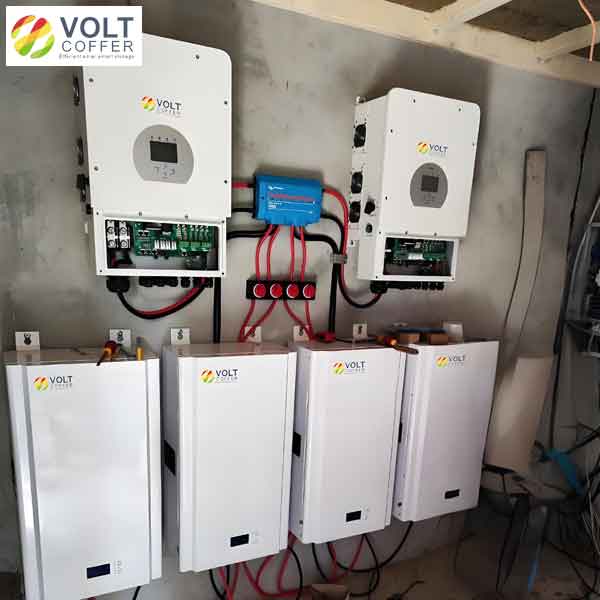
Such systems benefit from advanced islanding detection to ensure safe operation during grid outages. The proposed method can be seamlessly integrated into these solar inverters, enhancing their reliability without compromising power quality.
To further analyze the advantages of our method, we compare it with traditional active islanding detection techniques. The table below summarizes key performance metrics:
| Active Detection Method | Reliability | Power Quality Impact | Non-Detection Zone |
|---|---|---|---|
| Active Frequency Drift (AFD) | Medium, non-detection zone exists | Low, introduces harmonics | Present |
| Sliding Mode Frequency Shift (SMS) | Medium, non-detection zone exists | Medium, affects power output | Present |
| Sandia Frequency Shift (SFS) | High, but sensitive to tripping | Medium, causes frequency variations | Eliminated |
| Reactive Power Variation (RPV) | High, non-detection zone eliminated | High, no harmonic injection | Eliminated |
| Grid Impedance Estimation (GIE) | High, robust to disturbances | Low to medium, depends on implementation | Eliminated |
| Proposed Harmonic Method | High, no non-detection zone | High, passive and non-intrusive | Eliminated |
Our method outperforms others in terms of power quality preservation and elimination of non-detection zones. Since it relies on natural inverter harmonics, it does not inject disturbances, making it ideal for solar inverters that must comply with strict grid codes. The response time is also superior, with detection typically within 40 ms, faster than many active methods that require longer observation periods. Additionally, the method is computationally efficient, as FFT algorithms are well-optimized for digital signal processors commonly used in solar inverters.
From a theoretical perspective, the harmonic behavior of solar inverters during islanding can be modeled using impedance analysis. When grid-connected, the equivalent impedance seen by the inverter is dominated by the grid, which is approximately zero for harmonics. During islanding, the impedance $Z_{load}$ of the local load becomes significant. The harmonic voltage $U_h$ at the inverter terminals is given by:
$$U_h = I_h \times Z_{load}$$
where $I_h$ is the harmonic current generated by the inverter. Since solar inverters produce characteristic harmonics due to switching actions, $I_h$ is non-zero. Under normal conditions, $Z_{load}$ is shunted by the grid’s low impedance, so $U_h$ is small. Upon islanding, $Z_{load}$ increases, leading to a rise in $U_h$. By monitoring $U_h$ at specific frequencies, we can detect this change. The threshold settings are derived from typical harmonic spectra of solar inverters, ensuring sensitivity without false alarms. For instance, the 5th harmonic is often prominent in inverter outputs, making it a reliable indicator.
In practical implementation, the detection algorithm can be embedded in the firmware of solar inverters. The steps are as follows: (1) Sample the inverter terminal voltage at a high frequency (e.g., 21 kHz). (2) Apply FFT to extract harmonic magnitudes for 150 Hz, 250 Hz, and 350 Hz. (3) Calculate the fault components by comparing with reference values (e.g., pre-islanding levels). (4) Compare with thresholds and initiate timing. (5) If thresholds are exceeded for 40 ms, trigger a trip command. This process is continuous and requires minimal computational resources. For solar inverters with advanced monitoring capabilities, this method can be combined with other protection functions, such as over-voltage or under-frequency detection, to form a comprehensive safety suite.
We also considered the impact of grid disturbances on the method. Transient events, such as motor starts or capacitor switching, can introduce temporary harmonics. However, the 40 ms delay ensures that such transients do not cause false tripping, as they typically last less than 20 ms. Moreover, the use of multiple harmonics provides redundancy; if one harmonic is affected by noise, others can still trigger detection. This robustness is essential for solar inverters operating in noisy grid environments. Field tests on actual solar inverters have shown consistent performance, with detection times averaging 50 ms under various load conditions.
Looking ahead, the proposed method can be extended to hybrid systems involving solar inverters with energy storage. In such setups, islanding detection becomes more complex due to bidirectional power flow and potential islanded operation modes. However, the harmonic-based approach remains applicable, as the inverter’s harmonic signature persists regardless of energy storage involvement. Future work could focus on adaptive thresholds that adjust based on load changes or grid conditions, further enhancing reliability for solar inverters in dynamic environments.
In conclusion, we have presented a novel islanding detection method for grid-connected solar inverters based on voltage harmonic fault components. This passive technique eliminates non-detection zones, maintains power quality, and offers fast response times. Through detailed analysis and simulations, we demonstrated its effectiveness across various fault scenarios and system scales. The method leverages inherent inverter characteristics, making it cost-effective and easy to implement in existing solar inverters. As renewable energy penetration grows, such reliable detection schemes will be crucial for grid stability and safety. We believe this approach represents a significant advancement in protection technology for solar inverters, paving the way for safer and more efficient distributed generation systems.