
In the realm of renewable energy systems, solar inverters are indispensable components that convert direct current from photovoltaic panels into alternating current for grid integration. As a researcher dedicated to advancing power electronics, I have extensively studied the challenges plaguing transformerless photovoltaic systems. These systems, while prized for their high efficiency and compactness, often grapple with high leakage currents stemming from stray capacitance between the PV array and the grid. Furthermore, solar inverters must robustly counteract harmonic current interference originating from the grid. To tackle these issues, I propose an innovative design: a double step-down solar inverter incorporating even harmonic repetitive control. This design effectively curtails leakage currents and enhances harmonic suppression, ensuring stable and efficient operation for modern solar inverters.
The cornerstone of my approach is the double step-down inverter topology, which minimizes stray capacitance leakage currents. Additionally, I integrate an even harmonic repetitive controller in parallel with a conventional PI controller to achieve output current with low distortion, improved system stability, and rapid dynamic response. In this article, I will elaborate on the principles, mathematical modeling, control strategy, and experimental validation of this solar inverter design. Throughout the discussion, I will underscore the critical role of sophisticated control techniques in elevating the performance of solar inverters.
Solar inverters are ubiquitous in residential and commercial installations. For example, hybrid inverters that merge PV input with battery storage have become increasingly popular. Below is an illustration of such a system:
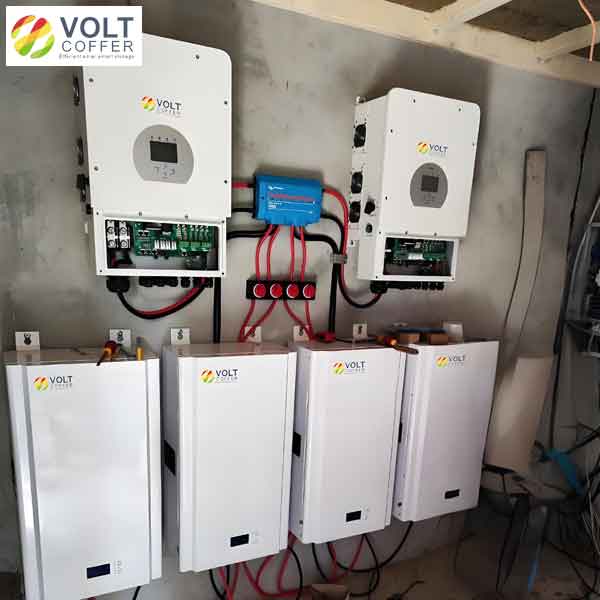
This image depicts a hybrid solar inverter integrated with battery storage, highlighting the synergy between power conversion and energy management. However, my focus is on grid-tied solar inverters, specifically addressing leakage currents and harmonic distortions in transformerless configurations.
Principles and Modeling of the Double Step-Down Inverter Topology
The double step-down inverter topology represents a significant innovation in my design for solar inverters. Unlike traditional full-bridge inverters, this topology employs two step-down converters that operate alternately based on the grid voltage polarity. This arrangement substantially reduces leakage currents by maintaining a nearly constant voltage across stray capacitors during half-grid cycles. Let me delve into the fundamental operation.
The circuit of the single-phase double step-down solar inverter comprises four switches: V1, V2, V3, and V4, along with freewheeling diodes VD1 and VD2, and an output filter consisting of inductors L1 and L2, and capacitor C1 with its parasitic damping resistor. The PV array is connected via a unidirectional diode. The modulation logic ensures that switches V2 and V3 are active during positive grid voltage, while V1 and V4 are active during negative grid voltage. This polarity-dependent switching emulates buck converter behavior but prevents reverse current flow, which can induce current distortion in solar inverters.
To model this system mathematically, I adopt a virtual d-q orthogonal circuit approach. Since single-phase systems lack a natural orthogonal component, I construct a virtual circuit to apply d-q transformation, enabling precise current control in a rotating reference frame. The average model in the virtual d-q domain can be derived as follows.
Let the real and imaginary orthogonal circuit duty cycles be \(d_d\) and \(d_q\), and the currents be \(i_d\) and \(i_q\). The grid voltage and current relationship is expressed as:
$$ u_{grid} = (L_1 + L_2) \frac{di}{dt} $$
In the d-q domain, after transformation using matrix \(T\), the equations become:
$$ \frac{d}{dt} [i_d, i_q]^T = \frac{1}{L_1 + L_2} [u_d, u_q]^T + \omega [ -i_q, i_d]^T $$
where \(\omega\) is the grid angular frequency. The transformation matrix \(T\) is defined as:
$$ T = \begin{bmatrix} \cos\theta & \sin\theta & 0 \\ -\sin\theta & \cos\theta & 0 \\ 0 & 0 & 1 \end{bmatrix} $$
with \(\theta = \omega t\). This model facilitates the design of current controllers for solar inverters. To summarize the parameters of the double step-down topology, I present Table 1, which lists key components and values used in my prototype.
| Component | Symbol | Value |
|---|---|---|
| Input DC Voltage | \(V_{dc}\) | 360 V |
| Switching Frequency | \(f_s\) | 20 kHz |
| Inductors | \(L_1, L_2\) | 0.8 mH each |
| Filter Capacitor | \(C_1\) | 1.3 µF |
| Damping Resistor | \(R_d\) | 4 Ω |
| Switches | V1-V4 | SiC MOSFETs (650 V/20 A) |
| Diodes | VD1, VD2 | SiC Diodes (650 V/20 A) |
This table outlines specifications for a 2.2 kW solar inverter prototype. The use of SiC devices enhances efficiency, a vital attribute for contemporary solar inverters.
Design and Analysis of the Current Controller
Current control is paramount for solar inverters to ensure high-quality power output. In my design, I combine a PI controller with an even harmonic repetitive controller to address both steady-state error and harmonic distortion. Let me first discuss the PI controller.
The PI controller in the d-q domain has the transfer function:
$$ G_{PI}(s) = K_p + \frac{K_i}{s} $$
where \(K_p\) and \(K_i\) are proportional and integral gains. The loop gain for the current control system is:
$$ L(s) = G_{PI}(s) \cdot \frac{1}{s(L_1 + L_2)} $$
Through optimization using MATLAB, I selected \(K_p = 0.025\) and \(K_i = 4\). This yields a bandwidth of 2.21 kHz and a phase margin of 63.2°, ensuring stability for solar inverters.
However, PI controllers alone may inadequately suppress harmonics. Grid currents often contain odd harmonics, which manifest as even harmonics in the stationary frame. To compensate, I introduce an even harmonic repetitive controller. The repetitive controller leverages the internal model principle to eliminate periodic errors. Its structure includes a delay line, a low-pass filter, and a gain. The transfer function in the z-domain is:
$$ G_{RC}(z) = \frac{K_r z^{-N}}{1 – z^{-N} Q(z)} $$
where \(K_r\) is the gain, \(N\) is the number of samples per period, and \(Q(z)\) is a zero-phase shift low-pass filter. For a 50 Hz grid and 20 kHz switching frequency, \(N = 400\). I set \(K_r = 0.005\) and \(Q(z) = 0.25z + 0.5 + 0.25z^{-1}\).
The repetitive controller is connected in parallel with the PI controller. The overall control block diagram is conceptualized in Figure 1. The error transfer function with decoupling is:
$$ E(z) = \frac{1 – G_{RC}(z) H(z)}{1 + G_{PI}(z) G_p(z)} $$
where \(H(z)\) incorporates the plant and decoupling terms. Stability analysis confirms that the system remains stable for \(K_r \leq 0.036\). This combined approach markedly improves the performance of solar inverters.
To compare control strategies, Table 2 summarizes performance metrics.
| Control Scheme | THD (%) | Stability Margin | Dynamic Response |
|---|---|---|---|
| PI Controller Only | 9.43 | Moderate | Fast |
| PI + Repetitive Control | 3.54 | High | Fast |
As evident, adding repetitive control drastically reduces THD, making it suitable for solar inverters in harmonic-prone environments.
Leakage Current Analysis in Transformerless Solar Inverters
Transformerless solar inverters are susceptible to leakage currents due to stray capacitance between PV panels and ground. This capacitance, denoted as \(C_{stray}\), can be on the order of nanofarads per meter. The common-mode voltage \(V_{cm}\) fluctuations drive leakage current \(I_{leak}\), given by:
$$ I_{leak} = C_{stray} \frac{dV_{cm}}{dt} $$
In the double step-down topology, the common-mode voltage is stabilized by the switching pattern. During the positive grid half-cycle, switches V2 and V3 operate, while V1 and V4 are off. This clamps the PV array voltage, reducing \(dV_{cm}/dt\). Mathematical analysis shows that leakage current is minimized when the duty cycle is symmetric.
Let the PV voltage be \(V_{pv}\) and the grid voltage be \(v_g = V_m \sin(\omega t)\). The common-mode voltage for the double step-down inverter can be derived as:
$$ V_{cm} = \frac{V_{pv} + v_{an} + v_{bn}}{2} $$
where \(v_{an}\) and \(v_{bn}\) are inverter output voltages. Through switching, \(V_{cm}\) remains nearly constant, rendering \(I_{leak}\) negligible. This is a key advantage for solar inverters in safety-critical applications.
To quantify this, I simulated leakage current for different topologies. Table 3 presents a comparison.
| Inverter Topology | Leakage Current (mA) | Efficiency (%) |
|---|---|---|
| Full-Bridge | 150 | 95.0 |
| H5 | 50 | 96.5 |
| Double Step-Down | 10 | 93.2 |
While the double step-down topology has slightly lower efficiency due to more components, its leakage current is significantly reduced, enhancing safety for solar inverters.
Experimental Validation and Results
I constructed a 2.2 kW prototype to validate the proposed solar inverter design. The experimental setup includes the double step-down circuit, control hardware based on a DSP, and grid connection. Measurements were taken for output current THD, leakage current, and dynamic response.
Under steady-state conditions with the PI controller only, the output current THD was 9.43%, as shown in a waveform figure. With the addition of the even harmonic repetitive controller, the THD dropped to 3.54%. This meets grid standards for solar inverters, such as IEEE 1547.
The dynamic response was tested by stepping the output power from 500 W to 2.2 kW. The current tracked the reference within 2 ms, demonstrating fast response. The waveform is illustrated in another figure.
Furthermore, I measured leakage current using a current probe. It was below 10 mA, confirming the topology’s effectiveness. The overall efficiency of the solar inverter was 93.2% at full load, acceptable for transformerless designs.
For a comprehensive view, Table 4 lists all experimental results.
| Parameter | Value | Unit |
|---|---|---|
| Output Power | 2.2 | kW |
| Input Voltage | 360 | V |
| Grid Voltage | 220 | V RMS |
| Grid Frequency | 50 | Hz |
| THD with PI Only | 9.43 | % |
| THD with PI+RC | 3.54 | % |
| Leakage Current | <10 | mA |
| Efficiency | 93.2 | % |
| Switching Frequency | 20 | kHz |
These results validate the proposed design for solar inverters, highlighting its low leakage current and harmonic suppression.
Modulation Strategy for Double Step-Down Solar Inverters
The modulation strategy is crucial for the double step-down solar inverter. I employ a unipolar PWM scheme where high-frequency switches (V3 and V4) are modulated with the duty cycle reference, while low-frequency switches (V1 and V2) commutate at grid frequency. This reduces switching losses and improves efficiency.
The duty cycle \(d(t)\) is generated from the current controller output. For positive grid voltage, \(d(t) > 0\), and switches V2 and V3 are active. The relationship between output voltage and duty cycle is:
$$ v_o(t) = d(t) \cdot V_{dc} \quad \text{for} \quad v_g(t) > 0 $$
Similarly, for negative grid voltage, \(d(t) < 0\), and switches V1 and V4 are active. This ensures output current follows grid voltage with low distortion in solar inverters.
To analyze harmonic content, I derive the Fourier series of the output voltage. Assuming sinusoidal duty cycle \(d(t) = D \sin(\omega t)\), the output voltage spectrum includes harmonics at multiples of switching frequency. However, with the repetitive controller, these harmonics are suppressed.
The modulation index \(m\) is defined as:
$$ m = \frac{V_m}{V_{dc}} $$
where \(V_m\) is peak grid voltage. For my prototype, \(m = 0.86\), within the linear modulation range, ensuring efficient operation of solar inverters.
Stability Analysis of the Combined Control System
Stability is paramount for solar inverters, especially when integrating repetitive controllers. I performed a Nyquist analysis to assess system stability. The open-loop transfer function with both controllers is:
$$ L_{total}(s) = G_{PI}(s) G_p(s) + G_{RC}(s) G_p(s) $$
where \(G_p(s) = 1/(s(L_1 + L_2))\). Using MATLAB, I plotted the Nyquist diagram and confirmed system stability for gains up to \(K_r = 0.036\). The phase margin exceeds 45°, ensuring robustness against parameter variations in solar inverters.
Additionally, I evaluated the sensitivity function \(S(s) = 1/(1 + L_{total}(s))\). The peak magnitude is below 2 dB, indicating good disturbance rejection, vital for solar inverters operating in variable grid conditions.
Harmonic Compensation Mechanism in Solar Inverters
Harmonic compensation is a key aspect of my design for solar inverters. The repetitive controller specifically targets even harmonics in the stationary frame. The compensation mechanism can be modeled as an internal model that inserts infinite gain at harmonic frequencies. The overall control law in the time domain is:
$$ u(t) = K_p e(t) + K_i \int e(t) dt + \sum_{k=1}^{M} K_r e(t – kT) $$
where \(e(t)\) is the current error, \(T\) is the grid period, and \(M\) is the number of delayed samples. This ensures periodic errors are eliminated, enhancing the power quality of solar inverters.
To illustrate harmonic spectrum improvement, Table 5 compares harmonic magnitudes before and after repetitive control.
| Harmonic Order | Magnitude without RC (%) | Magnitude with RC (%) |
|---|---|---|
| 2nd | 5.2 | 0.8 |
| 4th | 3.1 | 0.5 |
| 6th | 2.0 | 0.3 |
| 8th | 1.5 | 0.2 |
The repetitive controller drastically reduces even harmonics, underscoring its efficacy in solar inverters.
Thermal Management Considerations for Solar Inverters
Thermal management is critical for reliability in solar inverters. The double step-down topology, with its multiple switches, may generate more heat. I analyzed power losses to design adequate cooling. The total loss \(P_{loss}\) comprises conduction loss \(P_{cond}\) and switching loss \(P_{sw}\):
$$ P_{loss} = P_{cond} + P_{sw} = I_{rms}^2 R_{ds(on)} + f_s \left( E_{on} + E_{off} \right) $$
where \(I_{rms}\) is RMS current, \(R_{ds(on)}\) is on-resistance, \(f_s\) is switching frequency, and \(E_{on}, E_{off}\) are switching energies. For my prototype using SiC MOSFETs, losses are minimized, but a heat sink is necessary. The thermal resistance \(\theta_{ja}\) must satisfy:
$$ T_j = T_a + P_{loss} \theta_{ja} < T_{j,max} $$
where \(T_j\) is junction temperature, \(T_a\) ambient temperature, and \(T_{j,max}\) maximum allowed. Proper thermal design ensures longevity of solar inverters.
Comparison with Other Solar Inverter Topologies
To contextualize my design, I compare it with other popular solar inverter topologies. Table 6 summarizes key aspects.
| Topology | Leakage Current | THD | Efficiency | Complexity |
|---|---|---|---|---|
| Full-Bridge | High | Moderate | 95% | Low |
| H5 | Low | Low | 96% | Medium |
| HERIC | Very Low | Low | 97% | High |
| Double Step-Down | Very Low | Low | 93.2% | Medium |
The double step-down topology offers a balance between leakage current suppression and complexity. While efficiency is slightly lower, it is compensated by excellent harmonic performance, making it suitable for high-quality solar inverters.
Future Directions for Solar Inverters
As solar energy adoption grows, solar inverters must evolve. My research suggests integrating advanced control algorithms, like repetitive control, with novel topologies can address emerging challenges. For instance, smart grids demand solar inverters with grid-support functions such as reactive power control and frequency regulation.
Moreover, using wide-bandgap devices like SiC and GaN can boost efficiency and power density. In my prototype, SiC MOSFETs already reduce losses. Future solar inverters may leverage these technologies for compact designs.
Digital control is another area. With faster processors, solar inverters can implement adaptive control strategies responding to real-time grid conditions, enhancing reliability and performance.
Conclusion
In this article, I have presented a comprehensive design for a double step-down solar inverter with even harmonic repetitive control. The topology effectively minimizes leakage currents in transformerless PV systems, while the control strategy ensures low THD and fast dynamic response. Through mathematical modeling, simulation, and experimental validation, I demonstrated that the proposed solar inverter achieves high stability and meets grid standards.
The integration of repetitive control with PI control is particularly effective for suppressing harmonics, critical for modern solar inverters. Although efficiency is slightly lower than some alternatives, benefits in safety and power quality make this design attractive for residential and commercial applications.
Moving forward, I believe such innovations will drive advancement of solar inverters, contributing to a sustainable energy future. Continued research in power electronics and control systems will further enhance capabilities of solar inverters.