
In recent years, the global shift toward renewable energy sources has accelerated, with solar photovoltaic (PV) power generation standing out as a key technology due to its cleanliness, safety, and distributed nature. Governments worldwide, including in my country, have prioritized solar energy development in national strategies, such as the “14th Five-Year Plan,” which emphasizes the expansion of solar PV capacity. However, traditional solar PV systems often suffer from inefficiencies and reliability issues, limiting their widespread adoption. As a researcher in electrical automation, I aim to address these challenges by proposing a comprehensive design for a solar photovoltaic power generation system integrated with advanced electrical automation technologies. This design leverages intelligent control algorithms and optimized system architecture to enhance power generation efficiency and stability. In this article, I will detail the principles, design, and validation of this automated solar system, emphasizing its flexibility in both grid-connected and off-grid modes. The goal is to contribute to the high-quality development of the solar industry by showcasing how automation can transform solar energy systems into more robust and efficient solutions.
The fundamental principle behind solar photovoltaic power generation is the photovoltaic effect, where solar radiation is directly converted into electrical energy. When photons with energy greater than the bandgap of semiconductor materials, such as silicon (approximately 1.12 eV), strike a PV cell, they are absorbed, exciting electrons from the valence band to the conduction band and creating electron-hole pairs. These carriers are separated by the built-in electric field of a PN junction, generating a current in an external circuit. The core parameters of a PV cell include open-circuit voltage, short-circuit current, fill factor, and photoelectric conversion efficiency, with efficiency being the critical metric for performance evaluation. To improve this efficiency, researchers focus on optimizing cell materials and structures—for instance, adopting advanced technologies like back-contact, N-type TOPCon, or heterojunction designs. Additionally, maximizing light utilization through multi-junction tandem structures or photon management techniques can broaden the absorption spectrum. From a cost perspective, reducing the levelized cost of electricity involves enhancing manufacturing processes, such as using larger silicon wafers (e.g., M12 or G12), finer front grid lines (below 30 μm), and loss-free cutting and interconnection methods. These advancements aim to minimize material waste while maintaining high conversion rates, thereby accelerating the industrialization of solar photovoltaic technology. In my design, I incorporate these principles to ensure the solar system operates at peak performance, leveraging automation to adapt to varying conditions.
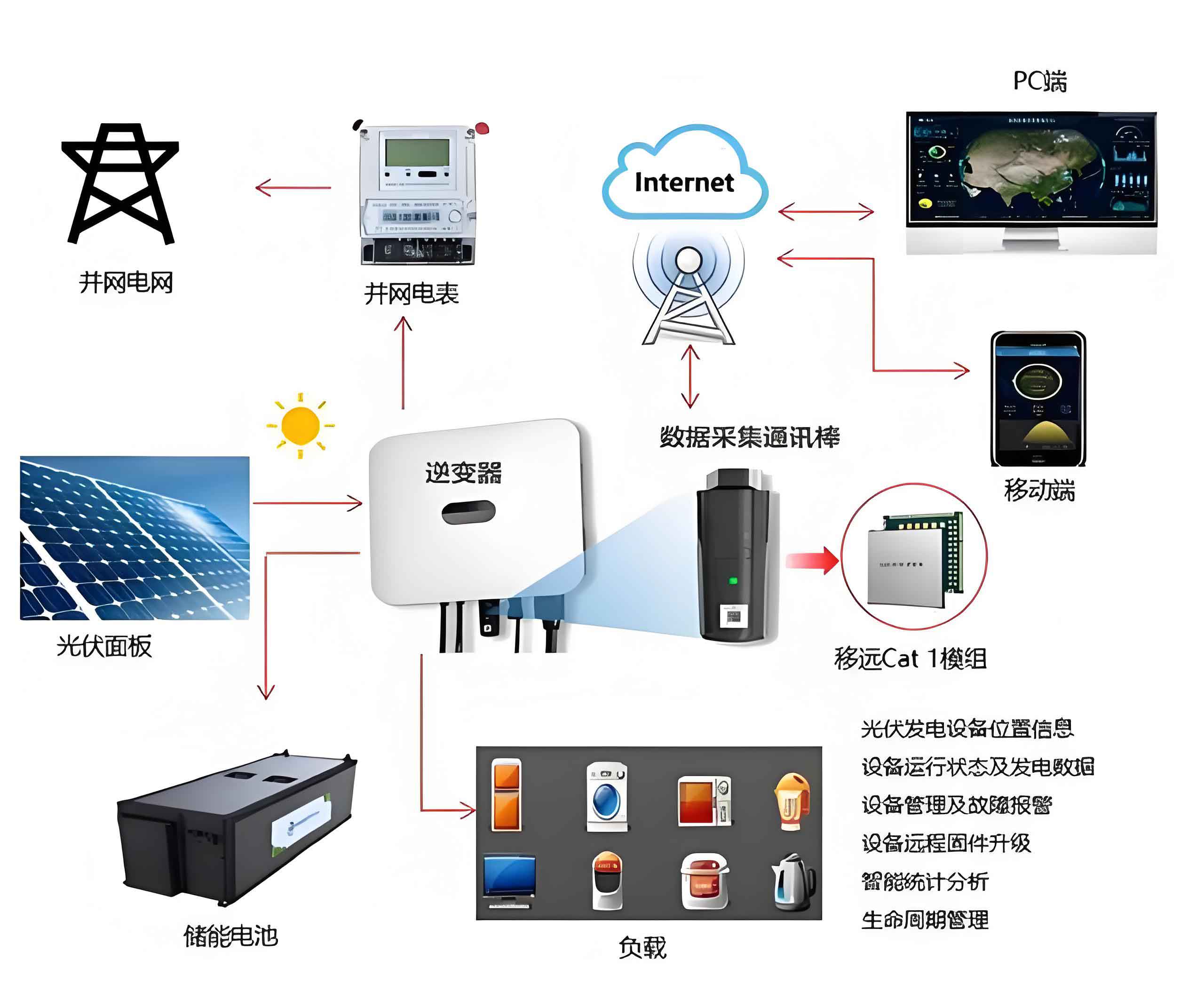
The overall design of the automated solar photovoltaic power generation system centers on a modular architecture that seamlessly integrates PV components, inverters, control systems, and energy storage devices. This solar system converts sunlight into direct current (DC) via PV modules, which is then transformed into alternating current (AC) by inverters for residential or industrial use. Excess power is stored in batteries for later use or fed back into the grid. The control system monitors and adjusts operations in real-time, ensuring efficient energy utilization and safe distribution. By employing automation technologies, the solar system achieves unmanned operation, reducing operational costs and enhancing energy efficiency. The design emphasizes scalability, allowing the solar system to be deployed in diverse settings, from small households to large industrial parks. In the following sections, I will break down the system into hierarchical layers—energy capture, energy conversion, energy management, and automation/interaction—each contributing to the robustness of the overall solar system.
The energy capture layer forms the foundation of the solar system, consisting primarily of PV modules. These modules are typically composed of multiple monocrystalline silicon cells (e.g., 156 mm × 156 mm or 210 mm × 210 mm) connected in series and parallel, encapsulated using a glass-EVA-cell-EVA-backsheet lamination process to enhance mechanical strength and environmental resilience. For optimal energy capture, the PV modules are mounted on fixed supports or single/dual-axis solar tracking systems at an optimal tilt angle, usually equal to the local latitude, to maximize solar irradiance reception. To further improve performance, I implement an intelligent Maximum Power Point Tracking (MPPT) algorithm. This algorithm continuously monitors the output voltage and current of the PV modules, calculating the output power as follows:
$$P_{pv} = V_{pv} \times I_{pv}$$
By adjusting the operating voltage of the PV modules, the MPPT algorithm ensures they operate at the maximum power point, where the derivative of power with respect to voltage is zero (i.e., dP/dV = 0). This optimizes photoelectric conversion efficiency. The algorithm employs methods such as perturb-and-observe, incremental conductance, or fuzzy logic control to determine the search direction and step size. A controller then regulates the duty cycle of a DC/DC converter based on MPPT commands, altering the equivalent load on the PV modules to achieve maximum power output. This approach is critical for maintaining high efficiency in the solar system under varying solar conditions.
The energy conversion layer is responsible for converting the DC power generated by the PV modules into AC power compliant with grid standards. The core device here is the inverter, which typically uses a voltage-source topology, such as two-level or multi-level structures. The inverter operates with a DC voltage range of 200 V to 1500 V, an AC rated voltage of 230 V/400 V, and a frequency of 50 Hz/60 Hz, achieving maximum efficiencies over 98.5%. Auxiliary equipment includes LC/LCL filters, isolation transformers, and grid synchronization devices. To ensure high-quality output current, I adopt a space vector pulse width modulation (SVPWM) algorithm based on current decoupling control. This algorithm first computes the reference output current using grid voltage and phase-locked loop (PLL) signals:
$$I_{ref} = I_d \cos(\omega t) + I_q \sin(\omega t)$$
where ω is the grid angular frequency, and Id and Iq are the setpoints for active and reactive currents, respectively. The controller compares the measured output current Iinv with Iref to determine the current error ΔI, which is fed into a PI regulator to produce the voltage reference signal Vref for SVPWM modulation. The modulator then calculates the conduction times and switching sequences for the inverter bridge arms based on Vref’s magnitude and phase, generating appropriate IGBT drive signals. This method enhances the inverter’s performance, contributing to the stability of the solar system.
The energy management layer optimizes energy utilization and ensures power supply reliability. It comprises controllers (e.g., PLCs, DSPs), human-machine interfaces (HMIs), communication modules (e.g., RS485, CAN), and various sensors (e.g., for voltage, current, temperature), deployed in a hierarchical distributed manner for comprehensive monitoring. The software platform often uses real-time multi-tasking operating systems like VxWorks or RTX, supporting application development under the IEC 61131-3 standard. At the heart of this layer, I develop an efficient energy scheduling strategy based on model predictive control (MPC). In each control cycle Δt, the strategy solves an optimization problem using real-time data from the PV modules, energy storage, and loads, along with predicted power values for N future cycles (the prediction horizon). The problem is formulated as:
$$\min \sum_{k=1}^{N} \left( \alpha |P_{pv}(k) – P_{load}(k)| + \beta P_{ess}^2(k) \right)$$
subject to:
$$SOC_{min} \leq SOC(k) \leq SOC_{max}$$
$$P_{ess\_min} \leq P_{ess}(k) \leq P_{ess\_max}$$
Here, Ppv, Pess, and Pload represent the power of the PV modules, energy storage system, and load, respectively; SOC is the state of charge of the storage; and α and β are weighting coefficients. The objective is to minimize PV curtailment and storage charge-discharge losses while satisfying SOC and power constraints. The solution yields the optimal charge-discharge power Pess*(k) for the storage system over the prediction horizon. The controller implements Pess*(1) as the current cycle’s storage power command and repeats the optimization process, enabling continuous rolling energy调度. Results are transmitted via Modbus-TCP protocol to guide subsystem coordination. This approach significantly enhances the flexibility and efficiency of the solar system.
The automation and interaction layer enables unmanned operation and human-computer interaction. Hardware includes data acquisition and monitoring units (e.g., SCADA systems), remote communication units (e.g., GPRS/4G/5G modules), and actuators (e.g., electric valves, circuit breakers). The software platform centers on SCADA software with a B/S architecture web server. The automation layer executes control commands automatically, such as system startup/shutdown and fault isolation, while reporting real-time status and fault information. The interaction layer supports remote access via web-based HMIs for visual monitoring and parameter configuration. In my design, I implement an adaptive operation mode switching strategy for this solar system. Defining the imbalance ε between PV generation, storage power, and load power, I set thresholds ε1 and ε2 for “grid-connected” and “off-grid” modes. The mechanism works as follows: if in grid-connected mode and ε > ε1 persists for time t1, the system requests a switch to off-grid mode from the grid dispatcher; if in off-grid mode and ε > ε2 persists for time t2, it reverts to grid-connected operation. This allows the solar system to adapt to PV volatility and load changes, ensuring reliability while maximizing renewable energy utilization and smoothing load curves. Switching commands are sent remotely via the IEC 60870-5-104 protocol to the microgrid controller. Additionally, the interaction layer incorporates demand-response mechanisms for users, such as dynamic pricing and load control, to improve the solar system’s regulatory flexibility.
To validate the feasibility and performance of this automated solar photovoltaic power generation system, I conducted experiments in an industrial park in Nanjing, Jiangsu Province, China. This location has an annual average sunshine duration of 2213 hours, offering rich solar resources. The experimental setup includes a 120 kWp PV array with 400 monocrystalline silicon PV modules (330 Wp each). The inverter is a three-phase grid-tied type (rated 50 kW) with an MPPT voltage range of 200–1000 V. The energy storage system uses lithium iron phosphate batteries (total capacity 200 kWh, 0.5C rate). The control system is built on Siemens S7-1200 PLC and WinCC SCADA software. Experiments were performed in both grid-connected and off-grid modes, each running continuously for 72 hours. Evaluation metrics include system total efficiency ηsys, inverter efficiency ηinv, MPPT efficiency ηMPPT, energy storage charge-discharge efficiency ηESS, grid interaction power Pgrid, and storage state of charge SOC. During testing, load power (10–100 kW) and irradiance (200–1000 W/m²) were varied to simulate different conditions. Data was collected at 1-minute intervals via RS485 bus for real-time monitoring and storage.
The results are summarized in Table 1, which compares system performance indicators under grid-connected and off-grid modes across various irradiance and load power levels. This table provides a comprehensive view of how the solar system behaves under diverse operational scenarios.
| Irradiance (W/m²) | Load Power (kW) | Operation Mode | ηsys (%) | ηinv (%) | ηMPPT (%) | ηESS (%) | Pgrid (kW) | SOC (%) |
|---|---|---|---|---|---|---|---|---|
| 1000 | 100 | Grid-connected | 85.7 | 98.2 | 99.5 | 95.3 | -18.5 | – |
| Off-grid | 84.3 | 97.9 | 99.4 | 94.8 | – | 78.5 | ||
| 800 | 80 | Grid-connected | 84.9 | 97.8 | 99.3 | 94.8 | -12.7 | – |
| Off-grid | 83.5 | 97.5 | 99.2 | 94.3 | – | 72.1 | ||
| 600 | 60 | Grid-connected | 83.6 | 97.5 | 99.1 | 94.2 | -6.9 | – |
| Off-grid | 82.1 | 97.1 | 98.9 | 93.7 | – | 65.8 | ||
| 400 | 40 | Grid-connected | 81.8 | 96.9 | 98.8 | 93.5 | -1.2 | – |
| Off-grid | 80.4 | 96.5 | 98.5 | 92.9 | – | 59.3 | ||
| 200 | 20 | Grid-connected | 78.5 | 95.7 | 98.2 | 92.1 | +3.8 | – |
| Off-grid | 77.2 | 95.3 | 97.8 | 91.5 | – | 52.7 |
From Table 1, it is evident that under identical irradiance and load power conditions, the grid-connected mode exhibits slightly higher system total efficiency ηsys than the off-grid mode. The maximum difference occurs at 1000 W/m² irradiance and 100 kW load, reaching 1.4 percentage points. This is primarily due to the additional energy conversion stages introduced by the storage system in off-grid mode. Nonetheless, even under the least favorable conditions (200 W/m² irradiance, 20 kW load), the off-grid solar system maintains a total efficiency above 77%, demonstrating good adaptability. The MPPT efficiency ηMPPT is excellent in both modes, consistently staying above 97.8% across all scenarios, indicating that the designed MPPT algorithm has superior dynamic tracking performance. The inverter efficiency ηinv increases with load rate, achieving around 98% at 80–100 kW loads, benefiting from the advanced SVPWM modulation technique. The energy storage charge-discharge efficiency ηESS fluctuates between 91.5% and 95.3%, slightly lower than expected, possibly due to imprecise battery temperature control. I recommend optimizing the thermal management system in future iterations.
In grid-connected mode, when irradiance drops below 400 W/m², the solar system shifts from feeding power to the grid to absorbing power from it, as shown by Pgrid turning from negative to positive. This highlights the system’s ability to flexibly adjust power exchange with the grid based on generation and consumption patterns, aiding in peak shaving and valley filling. In off-grid mode, the SOC data reveals that the storage system effectively mitigates PV power fluctuations, ensuring continuous load supply. However, under high load and low irradiance conditions, SOC declines rapidly, from 78.5% to 52.7%, which could impact long-term reliability. To address this, I suggest further refining the energy management strategy, such as incorporating deep reinforcement learning-based load prediction algorithms to better balance generation, storage, and consumption. Overall, the experimental results validate the feasibility and superiority of the designed solar system. It demonstrates high energy conversion efficiency and flexible regulation across various operational conditions and modes, providing strong support for the large-scale application of solar photovoltaic power generation. Future research will focus on improving storage efficiency and temperature control precision to enhance the solar system’s long-term reliability and cost-effectiveness.
In conclusion, through optimized system design and the integration of intelligent control strategies, I have successfully enhanced the power generation efficiency and stability of an automated solar photovoltaic power generation system. The experiments confirm the system’s superior performance under different conditions, showcasing its flexibility in both grid-connected and off-grid modes. This solar system represents a significant step forward in harnessing solar energy more effectively. Moving forward, research will concentrate on advancing storage efficiency and temperature control accuracy to bolster the system’s long-term reliability and economic viability. By continuing to innovate, we can drive broader adoption of solar technology, contributing to a sustainable energy future. The automated solar system, with its robust architecture and adaptive controls, stands as a testament to the potential of electrical automation in revolutionizing renewable energy solutions.