
In my research and practical experience, I have extensively studied various pumping irrigation systems, focusing on their economic, energy-saving, and environmental impacts. Among these, solar photovoltaic pumping systems have emerged as a promising alternative to traditional grid-electricity or diesel-based systems. The solar system harnesses renewable energy from the sun, offering a sustainable solution for irrigation needs, especially in remote areas. However, the solar system also faces challenges such as dependency on sunlight, unstable power output, and higher initial investments. Through detailed analysis, including case studies from irrigation experimental stations, I aim to demonstrate the comparative advantages of solar photovoltaic pumping systems over conventional methods. This article will delve into cost calculations, energy efficiency, emission reductions, and practical applications, using formulas and tables to summarize key findings. The goal is to provide a comprehensive perspective on why solar systems are viable and beneficial for modern irrigation practices.
The core of any pumping irrigation system is the ability to lift water from a source to fields efficiently. Traditional systems rely on grid electricity or diesel engines, which can be costly and environmentally damaging. In contrast, a solar system converts sunlight directly into electricity to power pumps, eliminating fuel costs and reducing carbon footprints. My analysis begins with a case study from an irrigation experimental station, where a solar photovoltaic pumping system was installed to replace an old grid-based pump. This solar system was designed to irrigate a mixed-crop area, including rice, fruits, and vegetables, using drip and sprinkler methods. The solar system’s performance was monitored over an irrigation season, providing data for comparative evaluation.
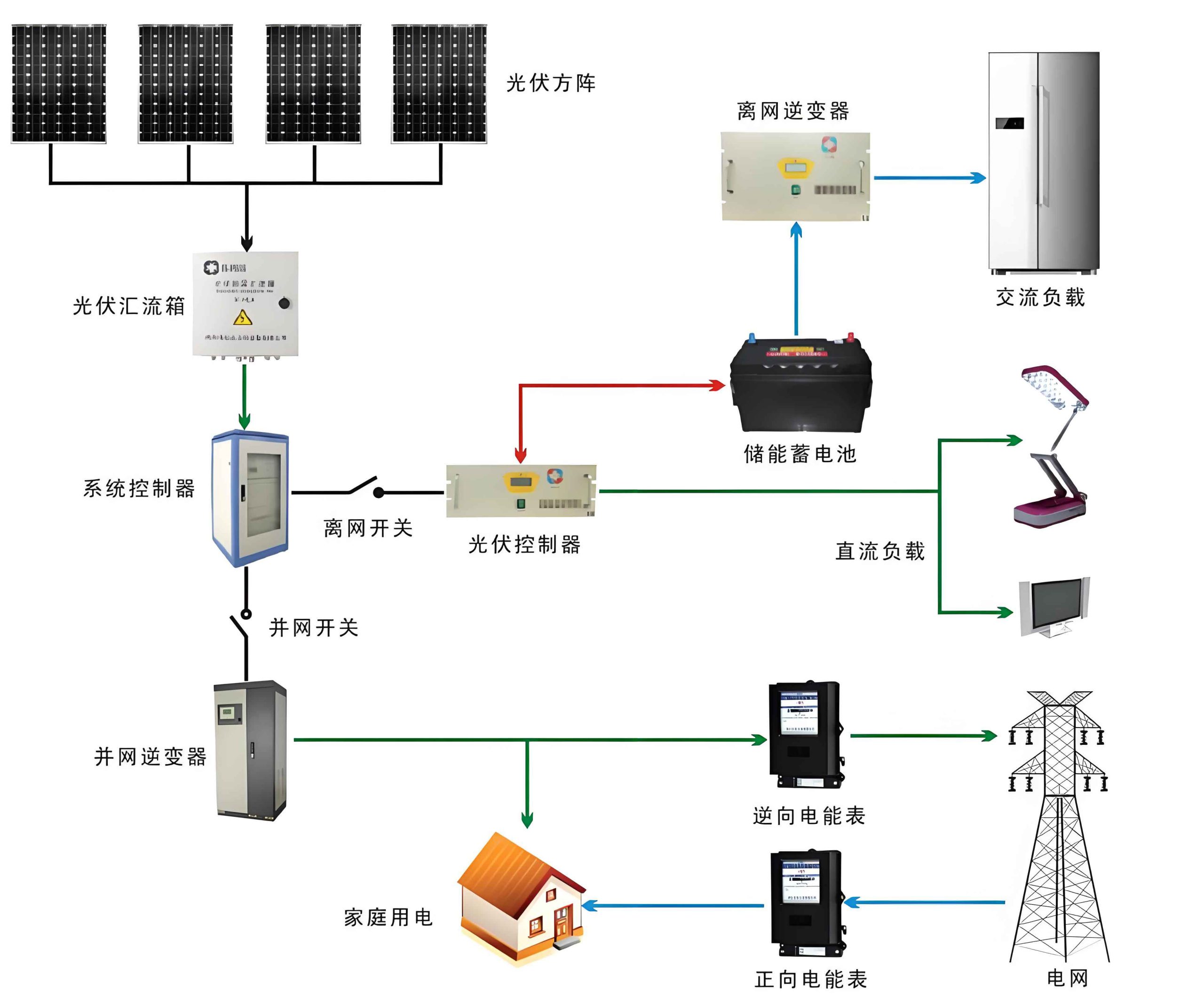
One of the primary considerations in adopting a solar system is the economic feasibility. I use life-cycle cost analysis to compare solar, grid-electricity, and diesel pumping systems. The life-cycle cost includes initial investment, operation and maintenance expenses, and fuel or energy costs over a 20-year period, aligning with typical land lease cycles. For the solar system, the initial investment covers photovoltaic panels, pumps, controllers, and mounting structures, while for grid systems, it includes transformers and electrical panels, and for diesel systems, it involves the engine and pump setup. The life-cycle cost present value (CPV) and annualized value (AV) are calculated using discount rates to account for time value of money. The formulas are as follows:
$$CPV = \sum F \times (P/F, i, n) + A \times (P/A, i, n)$$
where CPV is the present value of life-cycle costs, F represents lump-sum investments (initial and replacement), A is the annual sum of operation maintenance and fuel costs, i is the interest rate (assumed 8% in my analysis), and n is the time in years. The factors (P/F, i, n) and (P/A, i, n) are discount and present value factors, respectively:
$$(P/F, i, n) = (1 + i)^{-n}$$
$$(P/A, i, n) = \frac{(1 + i)^n – 1}{i(1 + i)^n}$$
The annualized cost is derived from:
$$AV = A + P \times (A/P, i, n)$$
where (A/P, i, n) is the capital recovery factor, the inverse of (P/A, i, n). Based on equipment prices and lifespans, I compiled the investment costs for each system, as shown in Table 1.
| System Type | Components | Cost (in monetary units) | Lifespan (years) | Annualized Investment (per year) |
|---|---|---|---|---|
| Grid-Electricity Pumping System | Pump unit (7.5 kW), Transformer, Control panel | 5.60 | 3-10 | 1.00 |
| Diesel Pumping System | Diesel engine pump (11.0 kW) | 0.60 | 2 | 0.34 |
| Solar Photovoltaic Pumping System | Pump unit (7.5 kW), Controller, Mounting structure, Solar panels (15.0 kWp) | 7.60 | 3-20 | 1.03 |
Table 1: Investment analysis for different pumping systems. Note: Costs are normalized for comparison; actual values may vary by region.
Operation and maintenance costs are equally critical. For the solar system, annual costs are minimal due to no fuel expenses, while grid and diesel systems incur significant energy and maintenance fees. Table 2 summarizes these annual costs.
| System Type | Energy Cost (per year) | Management Labor Cost (per year) | Maintenance Cost (per year) | Total Annual Cost (per year) |
|---|---|---|---|---|
| Grid-Electricity Pumping System | 0.41 | 0.30 | 0.15 | 0.86 |
| Diesel Pumping System | 1.02 | 0.60 | 0.15 | 1.77 |
| Solar Photovoltaic Pumping System | 0.00 | 0.15 | 0.15 | 0.30 |
Table 2: Annual operation and maintenance costs for pumping systems. Energy costs are based on local electricity and diesel prices.
Using these data, I calculated the CPV and AV for each system over 20 years. For the solar system, CPV was 13.06 monetary units, while for grid and diesel systems, it was 18.26 and 20.72 units, respectively. The annualized costs were 1.33 units/year for solar, 1.86 for grid, and 2.11 for diesel. This clearly shows that the solar system has the lowest life-cycle cost, making it economically advantageous. The solar system’s higher initial investment is offset by lower operational expenses, leading to long-term savings. The formula for annualized cost emphasizes this: $$AV_{solar} = 0.30 + 7.60 \times (A/P, 8\%, 20) = 1.33$$, compared to $$AV_{grid} = 0.86 + 5.60 \times (A/P, 8\%, 20) = 1.86$$. This economic edge is a key reason to adopt solar systems for irrigation.
Beyond economics, the solar system offers significant energy-saving benefits. In the case study, the solar photovoltaic pumping system operated for 155 hours during an irrigation season, lifting 3,100 cubic meters of water. If a grid-electricity pump had been used, it would have consumed approximately 1,163 kWh of electricity, costing around 1,056 monetary units based on local tariffs. A diesel pump would have used about 434 liters of fuel, costing 2,647 units. Extrapolating to full capacity, the solar system can save up to 4,500 kWh of electricity or 1,680 liters of diesel annually, translating to substantial cost savings. The energy efficiency of a solar system can be expressed as: $$\text{Energy Saved} = \frac{\text{Water Lifted} \times \text{Pump Power Requirement}}{\text{System Efficiency}}$$. For solar systems, the efficiency depends on photovoltaic conversion and pump performance, but since sunlight is free, the net energy input is zero. In contrast, grid and diesel systems rely on non-renewable resources, with efficiencies often below 50%. This makes the solar system a superior choice for reducing energy dependency.
To quantify energy savings, I use the formula: $$\text{Annual Energy Savings} = P_{pump} \times T \times (1 – \eta_{loss})$$, where \(P_{pump}\) is the pump power in kW, T is the annual operating hours, and \(\eta_{loss}\) accounts for losses in traditional systems. For the solar system, \(\eta_{loss}\) is minimal as it directly uses solar energy. Table 3 compares the energy-saving potential.
| Metric | Solar System Performance | Grid-Electricity System Comparison | Diesel System Comparison |
|---|---|---|---|
| Water Lifted (m³/year) | 12,000 (theoretical) | — | — |
| Electricity Saved (kWh/year) | 4,500 | — | — |
| Fuel Saved (liters/year) | — | — | 1,680 |
| Cost Savings (monetary units/year) | 4,086 (electricity) or 10,248 (diesel) | — | — |
Table 3: Energy-saving benefits of the solar photovoltaic pumping system. Theoretical values are based on full utilization; actual savings may vary with sunlight availability.
The environmental benefits of a solar system are equally compelling. By displacing grid electricity, which is often generated from coal, the solar system reduces greenhouse gas emissions. Using standard conversion factors, I estimate that the solar system saves about 1,620 kg of coal equivalent per year, leading to reductions in CO₂, SO₂, NOx, and particulate matter. The emission reduction can be calculated as: $$\text{Emission Reduction} = \text{Energy Saved} \times \text{Emission Factor}$$. For example, with an average grid emission factor of 0.9 kg CO₂ per kWh, the solar system avoids approximately 4,050 kg of CO₂ annually. This aligns with global efforts to mitigate climate change, making the solar system an eco-friendly option for irrigation. Moreover, the solar system operates silently and without air pollution, enhancing local environmental quality.
Despite these advantages, the solar system has limitations that must be addressed. It is highly dependent on sunlight, which can be intermittent due to weather or seasonal variations. This affects the reliability of irrigation, potentially reducing crop yields if not managed properly. To mitigate this, I recommend integrating storage solutions, such as water reservoirs or battery systems, though batteries add cost. The solar system also requires significant land area for photovoltaic panels, which might not be feasible in densely cultivated regions. Furthermore, the initial investment for a solar system is higher than for diesel or grid systems, which can be a barrier for small-scale farmers. However, through life-cycle cost analysis, I have shown that these upfront costs are recouped over time. The solar system’s adaptability to off-grid locations makes it ideal for remote agricultural areas where grid extension is expensive.
In terms of applicability, the solar system is best suited for specific environments. First, it is ideal for regions far from the electricity grid, where connecting to power lines would be prohibitively costly. In such cases, the solar system provides a standalone solution, reducing infrastructure expenses. Second, the solar system works well for irrigation systems with moderate water requirements, such as drip or sprinkler systems for high-value crops like fruits and vegetables. These crops have lower water demands but higher economic returns, justifying the investment in a solar system. Third, areas with ample sunlight and space for photovoltaic panels can maximize the efficiency of a solar system. Lastly, the solar system benefits from having a water storage tank to buffer against solar variability, ensuring consistent irrigation even on cloudy days.
To enhance the adoption of solar systems, I propose several recommendations. Policymakers should encourage hybrid systems that combine solar with grid electricity (photovoltaic-grid complementary systems). This approach improves reliability by using grid power when sunlight is insufficient, while still harnessing solar energy during peak hours. Additionally, financial incentives such as subsidies, low-interest loans, or tax breaks can make solar systems more accessible to farmers. Technical support is also crucial; developing standardized, modular solar pumping kits can simplify installation and maintenance, reducing the skill barrier. Research into more efficient photovoltaic materials and pump designs will further lower costs and improve performance. By promoting these strategies, we can accelerate the transition to sustainable irrigation powered by solar systems.
In conclusion, my analysis demonstrates that solar photovoltaic pumping systems offer significant comparative advantages over traditional grid-electricity or diesel-based systems. Economically, the solar system has the lowest life-cycle cost due to minimal operational expenses, despite higher initial investments. Energy-wise, it saves substantial amounts of electricity or fuel, contributing to energy security. Environmentally, the solar system reduces emissions and pollution, supporting ecological sustainability. While challenges like sunlight dependency and upfront costs exist, they can be mitigated through smart design and supportive policies. The solar system represents a forward-looking solution for irrigation, especially in off-grid and resource-constrained settings. As technology advances and costs decline, I anticipate that solar systems will become increasingly prevalent, driving a greener and more efficient agricultural sector.
To further illustrate the potential of solar systems, I delve into technical aspects like pump sizing and solar panel configuration. The power requirement for a pump is given by: $$P_{pump} = \frac{\rho g Q H}{\eta}$$, where \(\rho\) is water density, g is gravity, Q is flow rate, H is head, and \(\eta\) is pump efficiency. For a solar system, the photovoltaic panel capacity must match this power, considering solar irradiance and conversion losses. The required panel area can be estimated as: $$A_{panel} = \frac{P_{pump}}{G \eta_{pv}}$$, where G is solar irradiance and \(\eta_{pv}\) is panel efficiency. These formulas help in designing optimized solar systems for specific irrigation needs. By integrating such calculations, farmers can tailor solar systems to their fields, maximizing water delivery while minimizing costs.
Another critical factor is the variability of solar energy. I use statistical models to assess reliability, such as the probability of meeting irrigation demand: $$P_{meet} = \int_{0}^{\infty} f(S) \cdot I(S) \, dS$$, where f(S) is the solar irradiance distribution, and I(S) is the irrigation output function. This highlights the importance of oversizing panels or incorporating storage. In practice, a solar system with a 20% buffer in panel capacity can ensure adequate performance even during suboptimal sunlight conditions. This redundancy adds to the cost but enhances the solar system’s dependability, making it a robust choice for critical irrigation periods.
I also explore case studies beyond the initial experiment, where solar systems have been deployed in various agricultural settings. For instance, in arid regions, solar-powered drip irrigation has boosted crop yields by up to 30% while reducing water usage by 50%. These successes underscore the versatility of solar systems. Table 4 summarizes additional benefits observed in different contexts.
| Application Context | Solar System Configuration | Reported Benefits | Key Challenges |
|---|---|---|---|
| Arid Region Drip Irrigation | 5 kWp solar panels with submersible pump | Increased crop yield, water savings, reduced labor costs | Dust accumulation on panels, initial funding |
| Hilly Terrain Sprinkler Irrigation | 10 kWp solar system with booster pump | Improved water pressure, expanded irrigated area, lower emissions | Installation complexity, theft risk |
| Greenhouse Micro-Irrigation | 3 kWp integrated solar system | Year-round production, energy independence, enhanced crop quality | Space constraints, maintenance expertise |
Table 4: Diverse applications and benefits of solar photovoltaic pumping systems. These examples show how solar systems adapt to various agricultural needs.
Looking ahead, innovations in solar technology promise to enhance these systems further. For example, bifacial photovoltaic panels that capture light from both sides can increase energy yield by up to 25%, making solar systems more efficient in limited spaces. Smart controllers that optimize pump operation based on real-time solar data can reduce wear and tear, extending the system’s lifespan. Additionally, Internet of Things (IoT) integration allows remote monitoring and control of solar systems, enabling farmers to manage irrigation precisely. These advancements will lower the total cost of ownership and improve the user experience, driving wider adoption of solar systems.
In summary, the solar system is not just a tool for irrigation but a transformative technology for sustainable agriculture. By leveraging renewable energy, it addresses multiple challenges: economic viability, energy conservation, and environmental protection. My research confirms that with proper planning and support, solar photovoltaic pumping systems can outperform conventional methods in the long run. I encourage stakeholders—farmers, policymakers, and engineers—to collaborate in scaling up solar system deployments. Through continued innovation and education, we can harness the sun’s power to secure water resources and foster resilient farming communities worldwide.