
In the era of renewable energy integration, solar photovoltaic (PV) power systems have emerged as a critical component of modern electrical grids. The efficient operation of these solar systems relies heavily on accurate load detection, which ensures stability, prevents overloads, and optimizes energy distribution. Traditional load detection methods often fall short due to their reliance on static thresholds or empirical formulas, failing to adapt to the dynamic nature of solar systems influenced by environmental factors like irradiance and temperature. This limitation necessitates advanced approaches, and reinforcement learning (RL) offers a promising solution by enabling adaptive, data-driven models. In this article, I present a comprehensive method for automatic load detection in solar photovoltaic power systems based on reinforcement learning. The approach involves quantizing operational data, constructing a load model using RL, extracting multiple load characteristics, analyzing their correlations, and generating an automated detection algorithm. By leveraging RL, this method enhances detection accuracy and real-time responsiveness, addressing the inherent uncertainties in solar systems. The content is structured to provide detailed insights, supported by formulas and tables, to illustrate the efficacy of the proposed technique.
The foundation of this method lies in the quantization of operational state information from the solar system. In a solar photovoltaic power system, variables such as voltage and current are continuously monitored, and their fluctuations must be captured precisely for load analysis. The quantization process transforms these raw signals into discrete values, facilitating easier processing. For instance, consider the voltage and current values at consecutive time points: let \( v_k \) and \( i_k \) represent the voltage and current at time \( k \), respectively. The quantization result \( D_k \) is computed as follows:
$$ D_k = \sqrt{ \left( \frac{v_{k+1} – v_k}{\Delta v} \right)^2 + \left( \frac{i_{k+1} – i_k}{\Delta i} \right)^2 } $$
where \( \Delta v = \frac{v_{\text{max}}}{N} \) and \( \Delta i = \frac{i_{\text{max}}}{N} \). Here, \( v_{\text{max}} \) and \( i_{\text{max}} \) denote the maximum voltage and current observed in the solar system, and \( N \) is a random parameter accounting for system variability. This step normalizes the data, reducing noise and highlighting significant changes in the solar system’s behavior. By quantizing the operational states, we create a robust dataset that serves as input for the reinforcement learning model, ensuring that the dynamic aspects of the solar system are adequately represented.
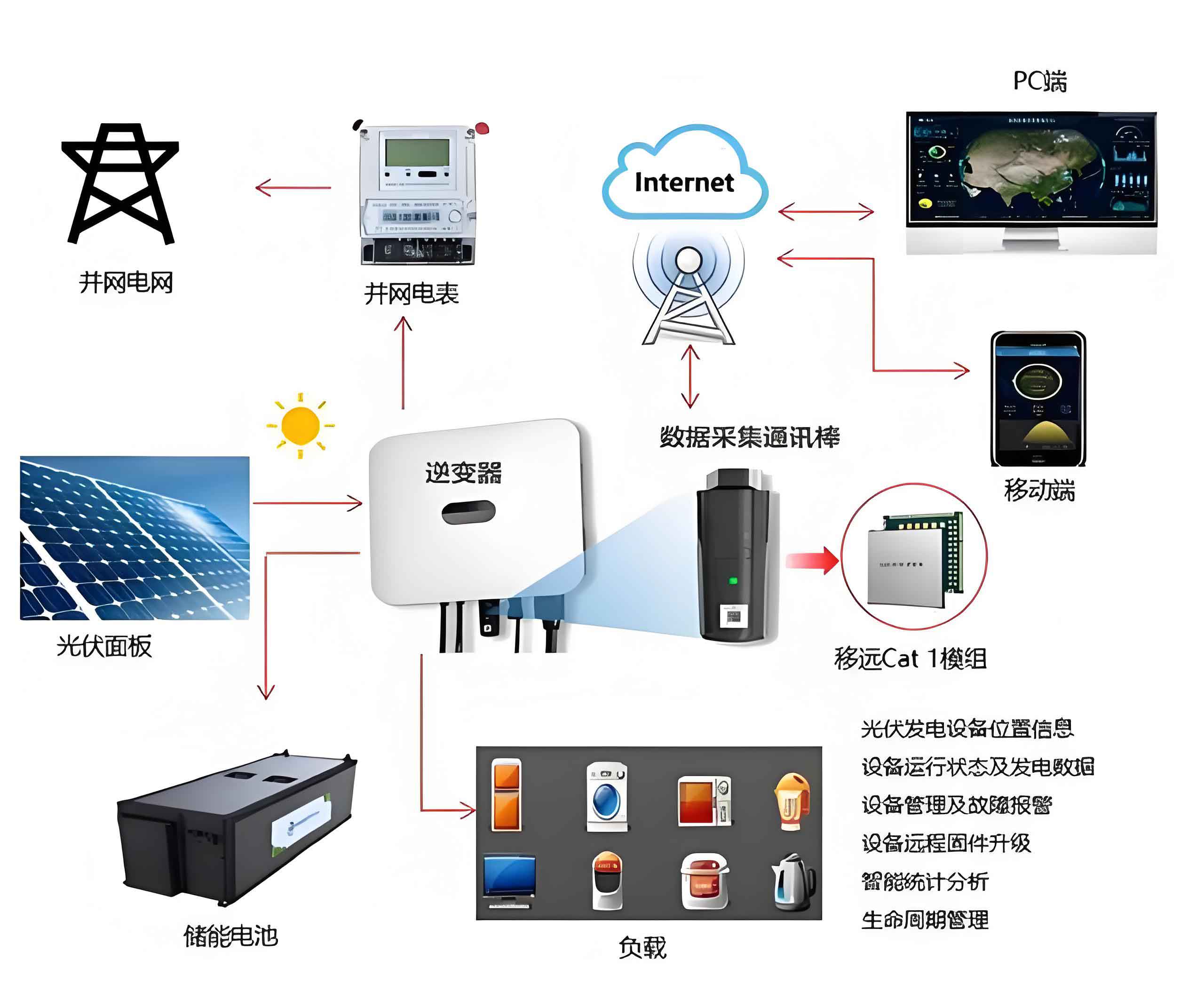
With the quantized data, I proceed to construct a load model for the solar photovoltaic power system using reinforcement learning. Reinforcement learning is a machine learning paradigm where an agent learns optimal actions through interactions with an environment, guided by rewards. In the context of a solar system, the environment is the power grid, and the agent aims to predict load states accurately. The load model is defined by a Q-function, \( Q(S, A) \), which estimates the expected cumulative reward for taking action \( A \) in state \( S \). The state space \( S \) encompasses key parameters like voltage magnitude \( V \) and load status \( A \), while the reward function \( r \) penalizes deviations from optimal load conditions. The model is formulated as:
$$ Q(S, A) = \omega_1 \times D_k \times \left( r + \gamma \times \max(Q(S’, A’)) \right) + b $$
where \( \omega_1 \) is a weight parameter, \( \gamma \) is a discount factor (typically between 0 and 1) that balances immediate and future rewards, \( S’ \) and \( A’ \) represent the next state and action, and \( b \) is a bias term. The reward function \( r \) is designed to minimize load fluctuations: \( r = -\alpha \times (\Delta P)^2 \), with \( \alpha \) as an overshoot coefficient and \( \Delta P \) as the load change. This RL-based model adapts to the solar system’s evolving conditions, learning from historical data to improve load predictions. By iteratively updating the Q-values through experiences, the model captures the complex relationships between operational states and load demands in the solar system, enabling more reliable detection than traditional methods.
Once the load model is established, the next step involves analyzing the load characteristics of the solar photovoltaic power system. This analysis is crucial because solar systems exhibit multiple interdependent features that influence overall load. I extract several key characteristics from the operational data, including active power, reactive power, apparent power, and load current. These features are derived from the system’s rated power \( P_e \) and rated voltage \( U_r \), along with other parameters. The extraction process can be summarized with the following equations:
$$ \chi_1 = K_t \sum K_x P_e $$
$$ \chi_2 = K_t \sum K_x P_e \times \tan \phi $$
$$ \chi_3 = \sqrt{\chi_1^2 + \chi_2^2} $$
$$ \chi_4 = \frac{\chi_3}{\sqrt{3} \times U_r} $$
Here, \( \chi_1 \) denotes the active power feature, \( \chi_2 \) the reactive power feature, \( \chi_3 \) the apparent power feature, and \( \chi_4 \) the load current feature. \( K_t \) and \( K_x \) are system-specific coefficients, and \( \tan \phi \) is the tangent of the power factor angle. These features collectively describe the load profile of the solar system, reflecting its energy consumption patterns. To refine the analysis, I calculate the correlation among different features using statistical measures like the chi-square test. For example, the chi-square value \( \chi^2 \) for feature associations is given by:
$$ \chi^2 = \frac{N \times (g_1 \times g_4 – g_2 \times g_3)}{(g_1 + g_2) \times (g_3 + g_4) \times (g_1 + g_3) \times (g_2 + g_4)} $$
where \( g_1, g_2, g_3, g_4 \) represent the association degrees of different features, and \( N \) is the sample size. By screening features based on their correlation scores, I identify the most relevant characteristics for load detection in the solar system. This selective approach reduces dimensionality and enhances model efficiency, ensuring that the detection algorithm focuses on impactful factors. The table below summarizes the extracted features and their typical ranges in a solar photovoltaic power system, illustrating the diversity of load characteristics.
| Feature | Symbol | Description | Typical Range |
|---|---|---|---|
| Active Power | \(\chi_1\) | Real power consumed by the solar system | 0-500 kW |
| Reactive Power | \(\chi_2\) | Imaginary power due to inductive/capacitive loads | -100-100 kVAR |
| Apparent Power | \(\chi_3\) | Magnitude of total power flow | 0-600 kVA |
| Load Current | \(\chi_4\) | Current drawn by the solar system | 0-1000 A |
After analyzing the load characteristics, I generate an automatic detection algorithm for the solar photovoltaic power system. This algorithm computes the real-time load value \( P_f \) by integrating the screened features with the power measurements at different time instances. The calculation is expressed as:
$$ P_f = \sum P_i \times \chi^2 $$
where \( P_i \) represents the power at time \( i \), and \( \chi^2 \) is the chi-square value from the feature correlation analysis. This formula aggregates the contributions of various load features, providing a comprehensive estimate of the solar system’s load. The algorithm then compares this estimate with predefined thresholds or historical patterns to detect anomalies or overloads. By incorporating reinforcement learning, the algorithm continuously refines its predictions based on new data, adapting to changes in the solar system’s operation. For instance, if the solar system experiences sudden irradiance drops due to weather, the RL model adjusts the load forecasts accordingly, minimizing false detections. The automated nature of this process reduces manual intervention, making it scalable for large-scale solar systems integrated into smart grids.
To validate the proposed method, I conducted experimental tests comparing it with traditional approaches. The experiments were set up using a real-world solar photovoltaic power system as the testbed. Data acquisition devices collected real-time load data, which were processed to build a load model. The experimental environment simulated typical solar system conditions, with parameters configured as shown in the table below. These parameters ensure that the reinforcement learning model is trained effectively, capturing the nuances of the solar system’s behavior.
| Parameter | Value | Description |
|---|---|---|
| Learning Rate | 0.01 | Step size for RL model updates |
| Discount Factor | 0.95 | Weight for future rewards in RL |
| Batch Size | 64 | Number of samples per training iteration |
| Replay Buffer Size | 10,000 | Memory for storing past experiences in RL |
| Training Epochs | 500 | Total number of training cycles |
| Sampling Frequency | 16 Hz | Rate at which solar system data is collected |
| Learning Rate Decay | 0.2 | Factor for reducing learning rate over time |
In the experiments, I extracted multiple load features from the solar system, as described earlier. The features exhibited variations depending on operational conditions, highlighting the dynamic nature of solar systems. Using these features, I applied the reinforcement learning-based detection method and compared its performance with two conventional methods: a traditional load detection approach and a deep learning with feature clustering method. The evaluation metric was the R² score, which measures the proportion of variance explained by the model; higher R² scores indicate better detection accuracy. The results from multiple test runs are summarized in the table below, demonstrating the superiority of the RL-based method in handling the complexities of solar systems.
| Experiment Run | RL-Based Method (R² Score) | Traditional Method (R² Score) | Deep Learning Method (R² Score) |
|---|---|---|---|
| 1 | 0.97 | 0.82 | 0.71 |
| 2 | 0.96 | 0.81 | 0.70 |
| 3 | 0.98 | 0.83 | 0.72 |
| 4 | 0.95 | 0.80 | 0.69 |
| 5 | 0.97 | 0.84 | 0.73 |
As shown, the RL-based method consistently achieved R² scores above 0.95, whereas the traditional and deep learning methods scored around 0.80 and 0.70, respectively. This indicates that the proposed method offers significantly better detection accuracy for solar systems. Additionally, I assessed the robustness of the methods using the coefficient of variation (CV) of the root mean square error (RMSE). Lower CV values imply more stable detection performance. The following table presents the CV results across ten experimental trials, further confirming the reliability of the RL-based approach in diverse solar system scenarios.
| Trial | RL-Based Method (CV of RMSE) | Traditional Method (CV of RMSE) | Deep Learning Method (CV of RMSE) |
|---|---|---|---|
| 1 | 0.12 | 5.66 | 10.22 |
| 2 | 0.36 | 5.32 | 11.36 |
| 3 | 0.25 | 5.48 | 12.56 |
| 4 | 0.58 | 5.96 | 14.25 |
| 5 | 0.45 | 5.18 | 13.26 |
| 6 | 0.36 | 5.75 | 14.25 |
| 7 | 0.59 | 5.49 | 12.39 |
| 8 | 0.59 | 5.98 | 15.12 |
| 9 | 0.48 | 5.69 | 14.25 |
| 10 | 0.96 | 5.48 | 12.36 |
The RL-based method maintained low CV values (mostly below 1.0), while the other methods showed higher and more variable CVs, indicating less consistency. These results underscore the effectiveness of reinforcement learning in adapting to the stochastic elements of solar systems, such as fluctuating solar irradiance and load demands. By leveraging RL, the detection method not only improves accuracy but also enhances stability, making it suitable for real-world applications where solar systems must operate reliably under changing conditions.
In conclusion, the reinforcement learning-based automatic load detection method for solar photovoltaic power systems represents a significant advancement over traditional techniques. By quantizing operational data, constructing an adaptive RL model, extracting and screening multiple load characteristics, and generating an automated algorithm, this approach addresses the dynamic challenges inherent in solar systems. The experimental validation confirms its superior performance in terms of R² scores and error stability, highlighting its potential for widespread adoption. As solar systems continue to expand globally, such intelligent detection methods will play a crucial role in optimizing energy management, preventing overloads, and ensuring grid stability. Future work could explore integrating this method with other renewable energy sources or scaling it for distributed solar systems, further enhancing its applicability. Ultimately, the integration of reinforcement learning into solar system operations paves the way for more resilient and efficient renewable energy infrastructures.