
As I delve into the evolving landscape of energy storage, it becomes increasingly clear that the solid-state battery represents a paradigm shift in electrochemical power sources. Unlike conventional lithium-ion batteries that employ liquid or gel electrolytes, a solid-state battery utilizes solid electrodes and a solid electrolyte, fundamentally enhancing safety, energy density, and longevity. The transition to solid-state battery technology is not merely an incremental improvement; it is a revolutionary leap that promises to redefine electric vehicles, portable electronics, and grid storage. In this comprehensive analysis, I will explore the technical foundations, global development efforts, and future prospects of solid-state battery systems, employing tables and formulas to elucidate key concepts.
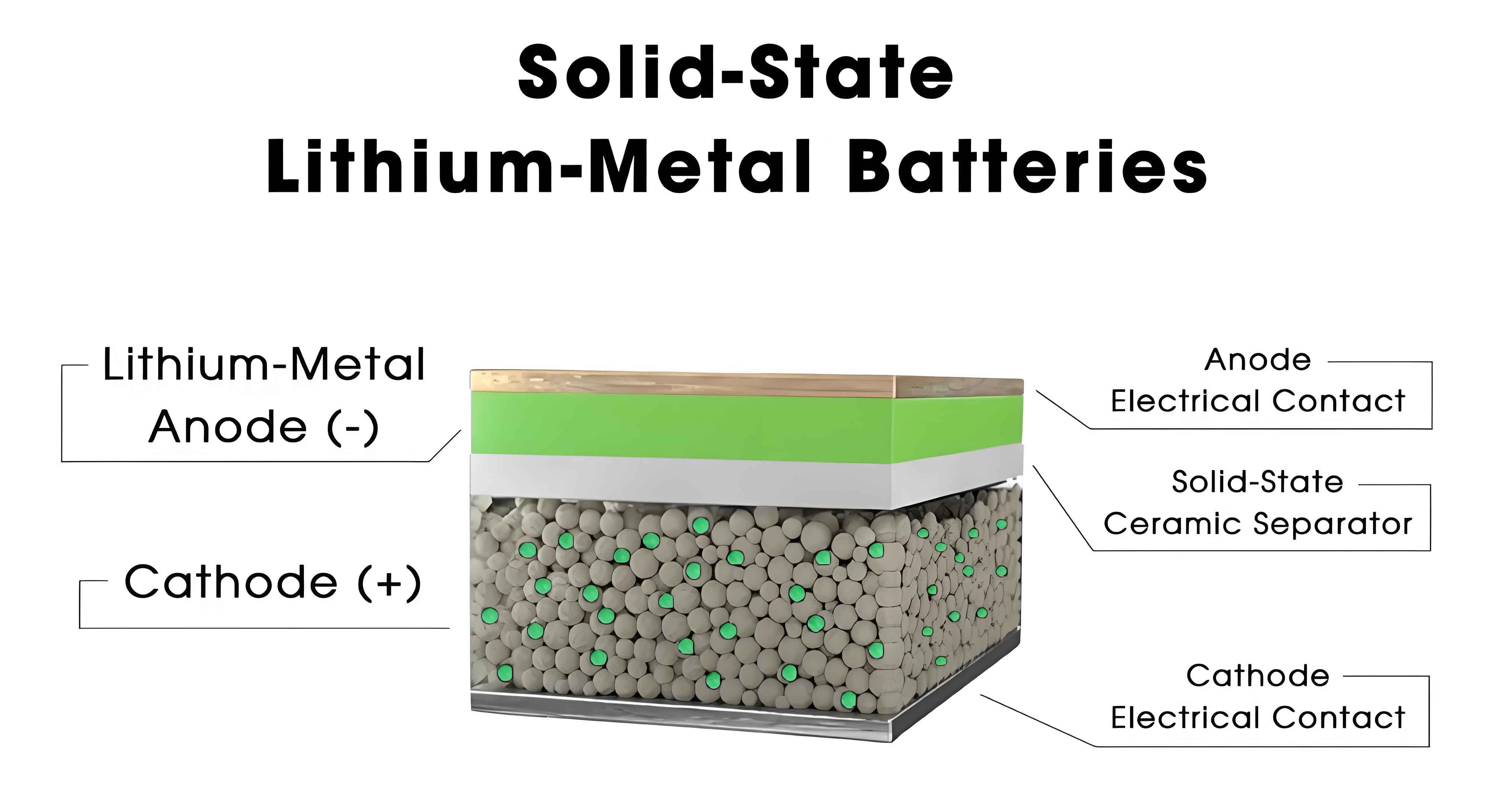
The core principle of a solid-state battery hinges on the replacement of flammable liquid electrolytes with solid materials, such as polymers, ceramics, or composites. This configuration mitigates risks of leakage, thermal runaway, and combustion, thereby addressing a critical safety concern inherent in traditional batteries. The fundamental components include a cathode (positive electrode), an anode (negative electrode), and a solid electrolyte. The energy density (E_d) of a solid-state battery can be expressed as a function of specific capacity (C) and voltage (V):
$$E_d = \frac{C \times V}{m}$$
where m represents the mass. Solid-state batteries typically exhibit higher energy densities due to the enablement of high-capacity anode materials like lithium metal. For instance, theoretical energy densities can exceed 500 Wh/kg, compared to approximately 250 Wh/kg for state-of-the-art liquid lithium-ion batteries. The power density (P_d), related to charge/discharge rates, is influenced by ionic conductivity (σ_i) of the solid electrolyte and interfacial resistance (R_int):
$$P_d \propto \frac{1}{R_{int} + \frac{d}{\sigma_i}}$$
where d denotes the thickness of the electrolyte layer. One major challenge in solid-state battery development is minimizing R_int, which often hampers power performance.
The global competition to commercialize solid-state battery technology is intense, with nations and corporations investing heavily in research and development. Below is a table summarizing key initiatives and milestones across different regions, highlighting the strategic focus on solid-state battery advancements.
| Region/Entity | Key Focus | Target Energy Density | Projected Timeline | Notable Achievements |
|---|---|---|---|---|
| East Asia (Collective Efforts) | High-energy cathodes, solid electrolyte synthesis | 300-500 Wh/kg | 2025-2030 | Prototypes achieving >300 Wh/kg; deep-sea application tests |
| North America (Startups & Automakers) | Hybrid solid-liquid systems, lithium metal anodes | 400-600 Wh/kg | 2024-2027 | Semi-solid batteries for drones; partnerships with OEMs |
| European Union (Automotive Industry) | Full solid-state integration, scalable manufacturing | 350-450 Wh/kg | 2025-2030 | Substantial investments in solid-state battery firms; pilot lines |
| Global Academia & Research Institutes | Fundamental material science, interface engineering | Theoretical models >700 Wh/kg | Ongoing | Novel electrolytes (e.g., sulfide, oxide); ultra-fast charging prototypes |
From my perspective, the progress in solid-state battery technology is accelerating. In East Asia, significant strides have been made in developing “rigid-yet-flexible” solid-state battery designs that combine mechanical robustness with high ionic conductivity. For example, research teams have demonstrated solid-state battery units with energy densities exceeding 300 Wh/kg and cycle lives over 1,000 charges, successfully deployed in extreme environments such as deep-sea exploration. This underscores the reliability potential of solid-state battery systems. Meanwhile, in North America, innovative approaches like semi-solid batteries—which blend solid electrolytes with minimal liquid components—are gaining traction. These semi-solid batteries aim to balance energy density enhancements with practical cycle life, addressing a common trade-off in pure solid-state battery designs.
The electrochemical kinetics in a solid-state battery are governed by the Butler-Volmer equation, modified for solid-solid interfaces. The current density (i) at the electrode-electrolyte interface can be described as:
$$i = i_0 \left[ \exp\left(\frac{\alpha n F \eta}{RT}\right) – \exp\left(-\frac{(1-\alpha) n F \eta}{RT}\right) \right]$$
where i_0 is the exchange current density, α is the charge transfer coefficient, n is the number of electrons, F is Faraday’s constant, η is the overpotential, R is the gas constant, and T is temperature. In solid-state battery systems, i_0 is often lower due to poor interfacial contact, leading to higher polarization and reduced power. Research focuses on engineering interfaces to boost i_0, thereby improving rate capability.
Another critical aspect is the ionic conductivity of solid electrolytes. Various classes exist, each with distinct properties. The table below compares common solid electrolyte materials used in solid-state battery research.
| Electrolyte Type | Material Examples | Ionic Conductivity (S/cm) at 25°C | Advantages | Challenges |
|---|---|---|---|---|
| Oxide-based | LLZO (Garnet), LATP | 10^{-4} to 10^{-3} | High stability, wide voltage window | Brittleness, high interfacial resistance |
| Sulfide-based | LPS, LGPS | 10^{-3} to 10^{-2} | High conductivity, soft texture | Moisture sensitivity, toxicity concerns |
| Polymer-based | PEO with lithium salts | 10^{-5} to 10^{-4} | Flexibility, ease of processing | Low conductivity at room temperature |
| Composite/Hybrid | Ceramic-polymer blends | 10^{-4} to 10^{-3} | Balanced properties, improved interface | Complex fabrication, cost |
The evolution of solid-state battery technology is not without hurdles. As I analyze the challenges, interfacial degradation remains a primary obstacle. During cycling, volume changes in electrodes can cause mechanical stress at solid-solid junctions, leading to delamination and increased resistance. This phenomenon can be modeled using strain energy (U) accumulation:
$$U = \frac{1}{2} \int_V \sigma_{ij} \epsilon_{ij} dV$$
where σ_ij and ε_ij are stress and strain tensors, respectively. Mitigating this requires adaptive interfaces or compliant interlayers. Additionally, dendrite formation—a notorious issue in lithium metal anodes—persists in some solid-state battery configurations. The growth rate of dendrites (v_d) can be approximated by:
$$v_d \propto \frac{i_{local}}{\rho_{Li}}$$
where i_local is the local current density and ρ_Li is the resistivity of lithium. Solid electrolytes with high shear modulus can suppress dendrites, but not entirely eliminate them in prolonged cycling.
Looking at commercialization timelines, major automotive players have announced ambitious plans for solid-state battery deployment. For instance, several European automakers aim to integrate solid-state battery packs into electric vehicles by 2025, projecting a doubling of driving range compared to current lithium-ion counterparts. In the Asia-Pacific region, consortiums involving battery manufacturers and universities are targeting full-scale production of all-solid-state batteries within the next five years, focusing on cost reduction through scalable processes like roll-to-roll manufacturing. The investment flows into solid-state battery ventures underscore the technology’s perceived strategic value; billions of dollars are being allocated globally to accelerate R&D.
From an application standpoint, the solid-state battery holds promise beyond electric vehicles. In aerospace, the high specific energy and safety profile make solid-state battery systems ideal for unmanned aerial vehicles (UAVs) and satellites. For example, tests have shown that UAVs equipped with prototype solid-state batteries can achieve flight durations over 40 minutes, a significant improvement from the 20-minute baseline with conventional batteries. In consumer electronics, the solid-state battery could enable thinner devices with longer battery life, while in grid storage, its non-flammability enhances safety for large-scale installations.
The economic implications are profound. The cost per kilowatt-hour (kWh) for a solid-state battery is currently high due to expensive materials and complex fabrication. However, learning curve models suggest that costs could decline rapidly with scale. The experience curve formula often applied is:
$$C(N) = C_0 \times N^{-b}$$
where C(N) is the cost after N cumulative units produced, C_0 is the initial cost, and b is the learning rate (typically 0.1-0.3 for batteries). For solid-state battery mass production, b may be steeper due to process innovations. The table below projects cost trends based on different adoption scenarios.
| Year | Conservative Scenario ($/kWh) | Aggressive Scenario ($/kWh) | Driving Factors |
|---|---|---|---|
| 2023 | 500-700 | 400-600 | Pilot lines, material sourcing |
| 2025 | 300-450 | 200-350 | Scale-up, electrolyte synthesis optimization |
| 2030 | 150-250 | 100-180 | Automated manufacturing, recycling loops |
Environmental sustainability is another dimension where solid-state battery technology can excel. By eliminating liquid electrolytes, the use of toxic solvents is avoided, simplifying recycling and reducing hazardous waste. The life-cycle assessment (LCA) of a solid-state battery typically shows lower environmental impact per kWh stored, especially when paired with renewable energy sources for production. The net energy balance can be expressed as:
$$E_{net} = E_{output} – (E_{manufacturing} + E_{EOL})$$
where E_output is the total energy delivered over the battery’s life, E_manufacturing is the embodied energy, and E_EOL is end-of-life processing energy. Solid-state battery designs with longer cycle lives improve E_net substantially.
In my assessment, the future of solid-state battery development will hinge on interdisciplinary collaboration. Material scientists, electrochemists, and engineers must work together to overcome interfacial challenges, enhance ionic conductivities, and devise cost-effective production methods. Promising research directions include nanostructured electrodes to shorten ion diffusion paths, artificial interface layers to stabilize contacts, and novel solid electrolyte compositions discovered via high-throughput computational screening. The solid-state battery community is also exploring beyond-lithium chemistries, such as sodium-ion or magnesium-ion solid-state batteries, which could offer resource advantages.
To summarize, the global race for solid-state battery supremacy is reshaping the energy storage landscape. With its superior safety, high energy density, and potential for long cycle life, the solid-state battery stands as a cornerstone technology for a sustainable energy future. While technical hurdles remain, the concerted efforts across academia, industry, and governments are driving rapid progress. As we move forward, the solid-state battery will likely transition from laboratory prototypes to mainstream applications, powering everything from electric cars to grid storage systems. The journey toward widespread adoption of solid-state battery technology is complex, but the rewards—in terms of performance, safety, and environmental benefit—are immense, heralding a new era in electrochemical energy storage.