
In the rapidly evolving landscape of electric vehicles, solid-state battery technology has emerged as a pivotal innovation, promising to redefine energy storage solutions. As an observer deeply immersed in this field, I believe that solid-state batteries are not merely an incremental improvement but a transformative leap that could address the core limitations of conventional lithium-ion batteries. The global push towards electrification hinges on developing safer, more efficient, and higher-capacity batteries, and solid-state batteries stand at the forefront of this endeavor. By replacing flammable liquid electrolytes with solid alternatives, this technology offers enhanced stability and performance, making it a critical focus for researchers and industries worldwide. In this article, I will delve into the advantages, challenges, international progress, and strategic imperatives surrounding solid-state batteries, employing tables and formulas to elucidate key points and underscore the significance of this breakthrough.
The advantages of solid-state batteries are multifaceted, spanning safety, energy density, and integration with smart technologies. From my perspective, the shift from liquid to solid electrolytes is the most defining characteristic, as it fundamentally alters the battery’s risk profile and operational efficiency. Below, I present a table summarizing the core benefits of solid-state batteries compared to traditional lithium-ion batteries:
| Feature | Traditional Lithium-Ion Battery | Solid-State Battery |
|---|---|---|
| Electrolyte State | Liquid (flammable) | Solid (non-flammable) |
| Energy Density | ~250-300 Wh/kg (current max) | Potential for >500 Wh/kg |
| Safety | Prone to thermal runaway and fire | High resistance to overheating and combustion |
| Cycle Life | ~1000-1500 cycles | Expected to exceed 2000 cycles |
| Operating Temperature Range | Limited by liquid electrolyte stability | Wider range due to solid electrolyte resilience |
One of the most compelling advantages is the enhanced energy density. Studies suggest that solid-state batteries can store up to 80% more energy per unit weight than their liquid counterparts. This can be expressed mathematically as: $$ E_{ss} = E_{li} \times (1 + \delta) $$ where \( E_{ss} \) is the energy density of a solid-state battery, \( E_{li} \) is that of a lithium-ion battery, and \( \delta \) represents the improvement factor, often estimated at 0.8 based on prototype data. This boost stems from the ability to use high-capacity electrodes like lithium metal, which replaces graphite anodes, reducing weight and volume. For instance, if a conventional battery offers 250 Wh/kg, a solid-state battery could achieve: $$ E_{ss} = 250 \times 1.8 = 450 \text{ Wh/kg} $$ Such an increase directly translates to longer driving ranges for electric vehicles, alleviating range anxiety—a major barrier to EV adoption.
Safety is another paramount advantage. In my analysis, the absence of volatile liquids eliminates risks associated with leakage and combustion. Solid electrolytes are inherently stable, even under high temperatures, significantly lowering the probability of fires. This can be modeled using thermal dynamics formulas, such as the Arrhenius equation for reaction rates: $$ k = A e^{-E_a/(RT)} $$ where \( k \) is the rate of thermal runaway, \( E_a \) is activation energy, \( R \) is the gas constant, and \( T \) is temperature. For solid-state batteries, \( E_a \) is higher due to the solid electrolyte’s inertness, making \( k \) exponentially smaller. Moreover, smart battery management systems (BMS) integrated with vehicle networks can monitor parameters like voltage, current, and temperature in real-time, preempting failures. A BMS can adjust charging protocols to maintain state-of-charge (SOC) between 30% and 70% during storage, prolonging battery life. This synergy between solid-state batteries and intelligent connectivity enhances reliability, as shown in the formula for SOC management: $$ \text{SOC}(t) = \text{SOC}_0 – \int_0^t I(\tau) \, d\tau / C $$ where \( I \) is current and \( C \) is capacity, with the BMS optimizing this integral to prevent degradation.
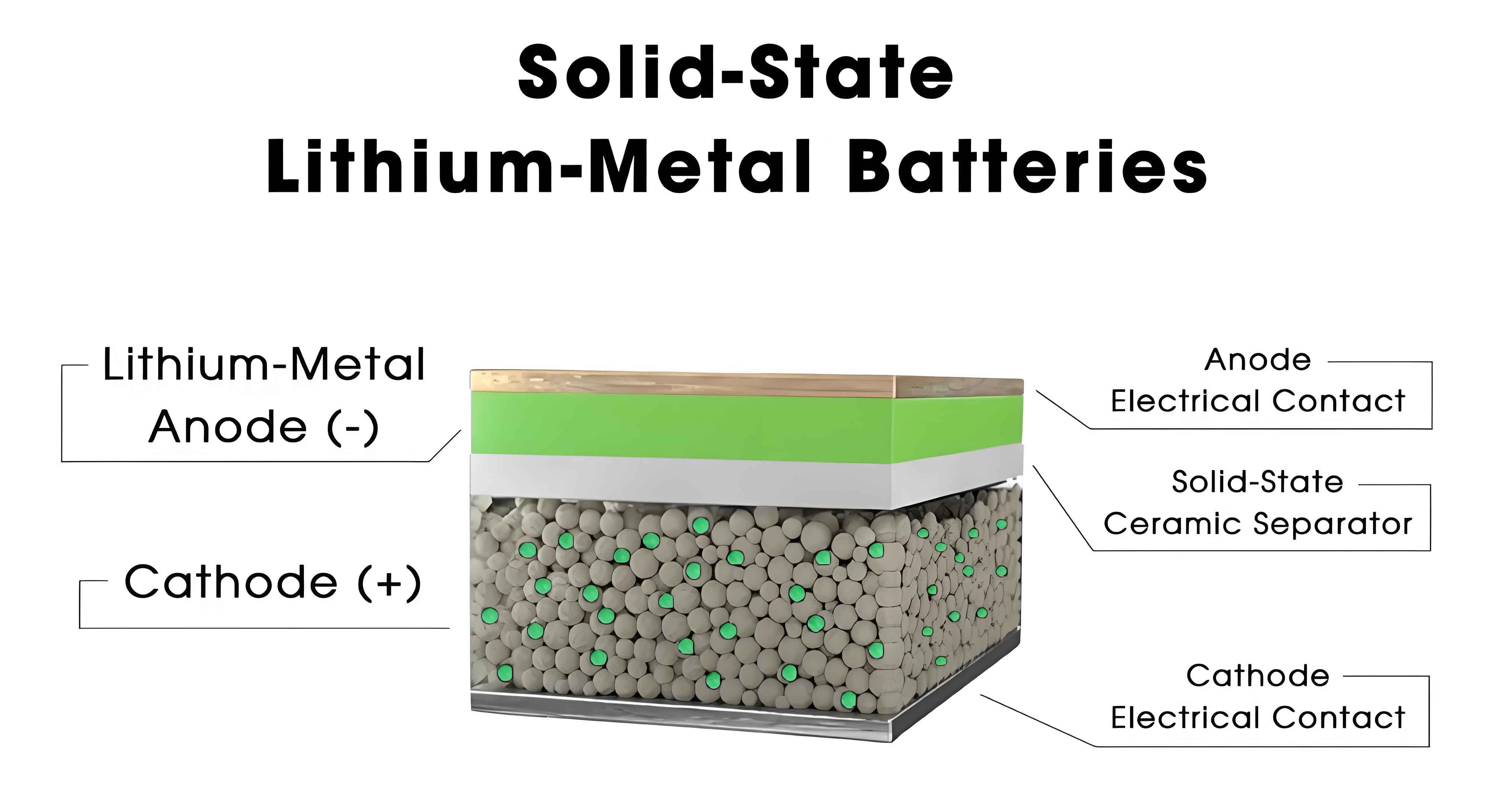
However, the development of solid-state batteries is fraught with challenges that must be overcome for commercialization. From a technical standpoint, the transition from liquid to solid electrolytes introduces interface and conductivity issues. Different solid electrolyte materials—oxides, polymers, and sulfides—each have drawbacks, as summarized in this table:
| Electrolyte Type | Advantages | Challenges | Conductivity (S/cm) |
|---|---|---|---|
| Oxide | High stability | Poor interface contact, high impedance | ~10^{-3} to 10^{-4} |
| Polymer | Flexibility | Low conductivity (~10^{-5} S/cm) | ~10^{-5} |
| Sulfide | High conductivity | Air-sensitive, expensive, hard to scale | ~10^{-2} to 10^{-3} |
The conductivity gap is particularly stark; polymer electrolytes are 4-5 orders of magnitude less conductive than liquid electrolytes, hindering ion transport. This can be described by the Nernst-Einstein relation: $$ \sigma = \frac{n q^2 D}{k_B T} $$ where \( \sigma \) is conductivity, \( n \) is ion concentration, \( q \) is charge, \( D \) is diffusion coefficient, \( k_B \) is Boltzmann’s constant, and \( T \) is temperature. For solid-state batteries, \( D \) is often lower due to solid-state diffusion barriers, reducing \( \sigma \). Additionally, pairing solid electrolytes with high-energy electrodes like nickel-rich cathodes or silicon anodes exacerbates volume expansion problems during cycling, leading to mechanical stress. The strain \( \epsilon \) can be approximated as: $$ \epsilon = \frac{\Delta V}{V_0} $$ where \( \Delta V \) is volume change and \( V_0 \) is initial volume, necessitating robust electrode designs to prevent fatigue.
Manufacturing hurdles also loom large. In my assessment, scaling up from lab prototypes to mass production is a daunting task. Current solid-state battery prototypes cost around $100,000 per unit, far from economical for EVs. The cost equation for production includes material expenses, processing fees, and yield rates: $$ C_{total} = C_{material} + C_{processing} + C_{overhead} $$ where \( C_{material} \) dominates due to expensive raw materials like sulfides or lithium metal. To achieve economies of scale, production volumes must increase dramatically, but existing techniques like thin-film deposition are slow and costly. Moreover, quality control is critical; defects per million (DPM) must be minimized to ensure safety. If we target a cost of $100/kWh for competitiveness, current costs need to drop by a factor of 1000, requiring innovations in both chemistry and engineering.
Market timing presents another challenge. While solid-state batteries offer long-term potential, liquid lithium-ion batteries are continuously improving, with energy densities nearing 300 Wh/kg. This narrows the window for solid-state batteries to gain a foothold. The adoption curve can be modeled using the technology S-curve: $$ M(t) = \frac{M_{max}}{1 + e^{-k(t-t_0)}} $$ where \( M(t) \) is market share, \( M_{max} \) is maximum potential, \( k \) is growth rate, and \( t_0 \) is inflection point. For solid-state batteries, \( t_0 \) may be delayed if liquid batteries saturate demand first, emphasizing the need for accelerated development.
Internationally, efforts to advance solid-state battery technology are intensifying. From my observation, Japan has taken a lead, with companies like Toyota spearheading research. Toyota holds over 200 patents in this area and aims to commercialize solid-state batteries by 2025, leveraging collaborations with universities and material firms. The Japanese government invests heavily, allocating 50-100 billion yen annually to support R&D. In the United States, startups like QuantumScape claim breakthroughs, reporting energy densities above 1000 Wh/L and over 1100 cycles with 80% capacity retention. Their partnership with Volkswagen targets a 1 GWh pilot line by 2024. South Korea’s approach involves conglomerates like Samsung SDI, LG Chem, and SK Innovation, which formed a joint fund to develop next-gen battery tech, including solid-state batteries. LG plans to commercialize all-solid-state batteries between 2025 and 2027. These initiatives highlight a global race where innovation is driven by both public and private sectors.
To capitalize on this momentum, strategic actions are essential. In my view, a multi-pronged strategy focusing on policy, industry, technology, and commerce is crucial for any region aiming to lead in solid-state battery development. Below, I outline key recommendations in a table format:
| Strategy Area | Actions | Expected Outcomes |
|---|---|---|
| Policy Guidance | Fund R&D projects via national programs; incentivize private investment; set safety and performance standards. | Accelerated innovation, reduced time-to-market, and enhanced competitiveness. |
| Industrial Collaboration | Establish supply chains for key materials (e.g., solid electrolytes); foster partnerships between academia and industry. | Lower production costs, improved scalability, and robust ecosystem. |
| Technical Support | Create national testing platforms for diagnostics; support core research teams in materials science. | High-quality prototypes, reliable data, and global influence in the field. |
| Commercial Pathway | Adopt a hybrid solid-liquid approach initially; gradually transition to all-solid-state batteries as technology matures. | Faster market entry, reduced risk, and sustained relevance in the evolving battery landscape. |
Policy-wise, governments should prioritize funding for basic research and applied projects. This can be quantified by allocating resources based on projected returns, using a formula like: $$ I_{opt} = \arg\max_I \left[ \sum_{t=1}^T \frac{R_t(I) – C_t(I)}{(1+r)^t} \right] $$ where \( I \) is investment, \( R_t \) is revenue at time \( t \), \( C_t \) is cost, and \( r \) is discount rate. For solid-state batteries, early-stage investments in materials discovery—such as sulfide or oxide electrolytes—can yield high long-term benefits. Industry must concurrently address supply chain bottlenecks, especially for lithium metal and solid electrolyte precursors. The cost of raw materials can be modeled with time-series analysis: $$ P_{material}(t) = P_0 e^{\alpha t} $$ where \( P_0 \) is initial price and \( \alpha \) is growth rate, underscoring the need for sustainable sourcing to curb inflation.
Technologically, advancing diagnostic tools is vital. I propose establishing open-access platforms for testing solid-state battery performance under varied conditions. Key metrics like ionic conductivity \( \sigma_{ion} \) and interfacial resistance \( R_{int} \) should be standardized, with formulas for evaluation: $$ R_{int} = \frac{V}{I} – R_{bulk} $$ where \( V \) is voltage, \( I \) is current, and \( R_{bulk} \) is bulk resistance. Such platforms can foster collaboration and speed up iteration cycles. Additionally, research should explore novel electrode materials to complement solid electrolytes, using computational models like density functional theory (DFT) to predict properties: $$ E_{total} = \min_{\psi} \left\langle \psi | H | \psi \right\rangle $$ where \( E_{total} \) is total energy of a material system, \( H \) is Hamiltonian, and \( \psi \) is wavefunction, aiding in the design of high-performance components.
Commercially, a phased approach is prudent. Hybrid batteries combining solid and liquid electrolytes can serve as an intermediate step, offering improved safety without the full cost of all-solid-state versions. The market penetration of solid-state batteries can be estimated with a diffusion model: $$ \frac{dS}{dt} = p \cdot (M – S) + q \cdot S \cdot (M – S) $$ where \( S \) is adopters, \( M \) is total market size, \( p \) is innovation coefficient, and \( q \) is imitation coefficient. Starting with niche applications like premium EVs or grid storage can build credibility before mass adoption. Furthermore, integrating solid-state batteries with smart grids via vehicle-to-grid (V2G) technology can enhance value, as expressed in the power balance equation: $$ P_{grid}(t) = P_{demand}(t) – \sum_i P_{battery,i}(t) $$ where \( P_{battery,i} \) is power from EV batteries, enabling peak shaving and emergency response.
In conclusion, solid-state batteries represent a transformative leap for energy storage, with the potential to redefine electric mobility and beyond. From my vantage point, their advantages in safety, energy density, and integration with smart systems are undeniable, yet challenges in materials, manufacturing, and market timing require concerted efforts. The global race is on, with nations and corporations vying for dominance through innovation and collaboration. By adopting a holistic strategy—encompassing policy support, industrial synergy, technical rigor, and commercial pragmatism—we can accelerate the development of solid-state batteries and unlock their full potential. As we stand on the cusp of this technological revolution, it is imperative to invest relentlessly in research and foster an ecosystem that embraces change, ensuring that solid-state batteries become the cornerstone of a sustainable, electrified future.