
As a researcher deeply immersed in the field of energy storage, I have witnessed the rapid evolution of battery technologies, particularly the rise of solid-state batteries as a promising successor to conventional liquid electrolyte systems. The demand for fast charging capabilities in electric vehicles and portable electronics has never been higher, driving intense focus on overcoming the limitations of current lithium-ion batteries. In this article, I will explore the application of fast charging technology in solid-state batteries, delving into the challenges, optimization strategies, and future prospects. Solid-state batteries offer inherent advantages such as higher energy density, improved safety, and potential for rapid charging, but their commercialization hinges on addressing key technical hurdles. Throughout this discussion, I will emphasize the critical role of solid-state battery components and incorporate tables and formulas to summarize key points, aiming to provide a thorough understanding of this transformative technology.
The transition to solid-state batteries represents a paradigm shift in energy storage. Unlike traditional liquid electrolyte batteries, solid-state batteries employ solid electrolytes, which can be ceramics, polymers, or composites. This design eliminates flammable organic solvents, reducing safety risks while enabling the use of high-capacity electrodes like lithium metal. However, achieving fast charging in solid-state batteries is not straightforward; it requires overcoming ionic transport limitations, interfacial resistances, and mechanical stability issues. In my analysis, I will break down these aspects and propose solutions based on recent advancements. The term “solid-state battery” will be frequently mentioned to underscore its centrality, as it is the core technology under discussion.
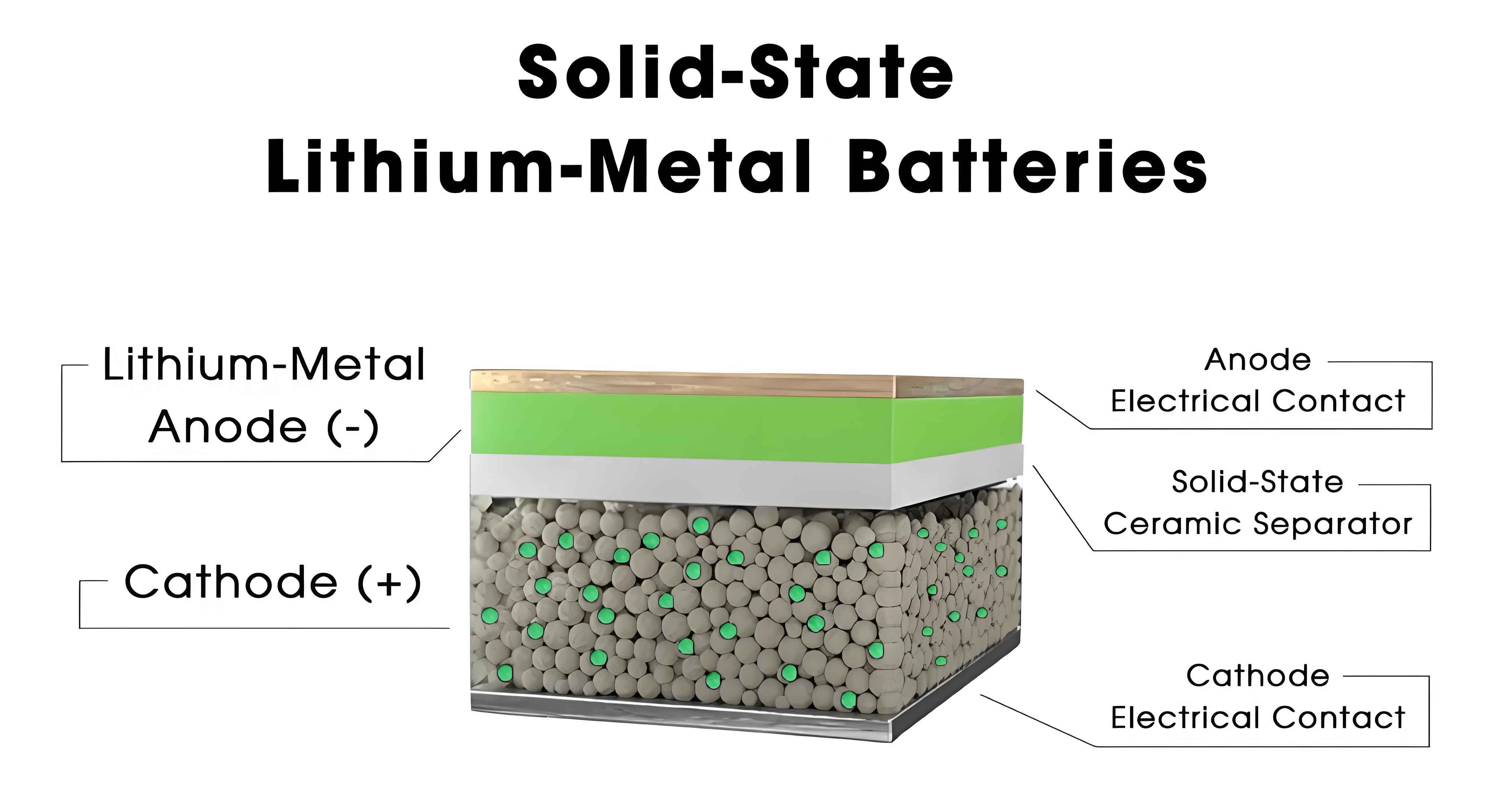
To begin, let’s consider the fundamental advantages of solid-state batteries that make them suitable for fast charging. The solid electrolyte in a solid-state battery typically has a high lithium-ion transference number, often close to unity, which minimizes concentration polarization during high-current operation. This is a key factor for fast charging, as it allows ions to move efficiently without the depletion gradients common in liquid systems. The ionic conductivity $\sigma_{ion}$ of a solid electrolyte is given by the Nernst-Einstein relation: $$\sigma_{ion} = \frac{n q^2 D}{k_B T}$$ where $n$ is the charge carrier concentration, $q$ is the charge, $D$ is the diffusion coefficient, $k_B$ is Boltzmann’s constant, and $T$ is the temperature. For fast charging, we need $\sigma_{ion}$ to be as high as possible, ideally exceeding 1 mS/cm at room temperature. Many solid-state electrolytes, such as sulfides and oxides, have achieved this benchmark, but further improvements are necessary for practical applications. Below is a table comparing different types of solid electrolytes used in solid-state batteries:
| Electrolyte Type | Example Materials | Ionic Conductivity (mS/cm, 25°C) | Advantages for Fast Charging | Challenges |
|---|---|---|---|---|
| Sulfide | Li10GeP2S12, Li7P3S11 | 10-25 | High conductivity, good mechanical flexibility | Air sensitivity, interfacial reactions |
| Oxide | Li7La3Zr2O12 (LLZO), Li1.3Al0.3Ti1.7(PO4)3 (LATP) | 0.1-1 | High stability, wide electrochemical window | Brittleness, high sintering temperatures |
| Polymer | PEO-LiTFSI, PAN-based composites | 0.01-0.1 | Flexibility, ease of processing | Low conductivity at room temperature |
| Composite | Sulfide-polymer blends | 1-10 | Balanced properties, improved interface | Complex fabrication, stability issues |
Despite these promising materials, fast charging in solid-state batteries faces significant challenges. One major issue is the high interfacial resistance between solid components. In a solid-state battery, the electrode-electrolyte interface is a solid-solid contact, which often leads to poor adhesion and limited active sites for charge transfer. This resistance $R_{interface}$ can be modeled as: $$R_{interface} = \frac{\delta}{\sigma_{eff}} + R_{ct}$$ where $\delta$ is the interfacial layer thickness, $\sigma_{eff}$ is the effective conductivity, and $R_{ct}$ is the charge transfer resistance. During fast charging, high currents exacerbate this resistance, causing voltage polarization and capacity fade. Another challenge is lithium dendrite formation at the anode, especially when using lithium metal. The critical current density $J_{crit}$ for dendrite suppression in solid-state batteries is given by: $$J_{crit} = \frac{\sigma_{ion} \Delta \phi}{L}$$ where $\Delta \phi$ is the overpotential and $L$ is the electrolyte thickness. Exceeding $J_{crit}$ during fast charging can lead to short circuits and safety hazards. Therefore, optimizing $J_{crit}$ is crucial for enabling fast charging in solid-state batteries.
To address these challenges, I propose several optimization strategies focused on cathode design, electrolyte selection, and anode modification. Starting with cathode structure, the composite cathode in a solid-state battery must facilitate rapid ion and electron transport. Homogeneous mixing of active materials, conductive additives, and solid electrolyte particles is essential to reduce tortuosity and enhance percolation pathways. The effective ionic conductivity $\sigma_{cathode}$ of a composite cathode can be expressed using the Bruggeman equation: $$\sigma_{cathode} = \sigma_{ion} \phi^{1.5}$$ where $\phi$ is the volume fraction of the solid electrolyte. For fast charging, we aim to maximize $\phi$ while maintaining mechanical integrity. Recent approaches include nanostructuring active materials to shorten diffusion paths and applying conductive coatings to improve electronic conductivity. For instance, lithium iron phosphate (LFP) and high-nickel oxides (NCM) have been modified with carbon coatings to achieve high-rate capabilities. Below is a table summarizing cathode optimization techniques for fast charging in solid-state batteries:
| Optimization Technique | Description | Impact on Fast Charging | Example Materials |
|---|---|---|---|
| Nanostructuring | Reducing particle size to nanoscale | Shortens Li+ diffusion paths, increases surface area | Nano-LFP, NCM811 |
| Surface Coating | Applying conductive or protective layers | Enhances electron transport, reduces side reactions | Carbon-coated oxides, Li2O-ZrO2 coatings |
| Homogeneous Composites | Uniform mixing of components | Improves ionic percolation, lowers interfacial resistance | Li1.75Ti2(Ge0.25P0.75S3.8Se0.2)3-based cathodes |
| Porosity Control | Engineering pore structure for infiltration | Facilitates electrolyte penetration, enhances kinetics | 3D-printed cathode architectures |
Moving to solid electrolyte selection, the choice of electrolyte profoundly affects fast charging performance. Sulfide-based solid electrolytes, such as Li7Si2S7I, have gained attention due to their high ionic conductivity, often exceeding 10 mS/cm. This conductivity $\sigma$ can be approximated by the Arrhenius equation: $$\sigma = \sigma_0 \exp\left(-\frac{E_a}{k_B T}\right)$$ where $\sigma_0$ is the pre-exponential factor and $E_a$ is the activation energy. For fast charging, we seek electrolytes with low $E_a$ to maintain high conductivity across temperature ranges. However, sulfides suffer from air instability, releasing H2S upon exposure to moisture. Strategies to mitigate this include oxygen substitution or polymer blending. Oxide electrolytes like LLZO offer better stability but require high-temperature processing, which can degrade interfaces. Polymer electrolytes provide flexibility but need plasticizers or fillers to boost conductivity. In my view, composite electrolytes that combine sulfides with polymers or oxides represent a promising avenue for fast-charging solid-state batteries, as they balance conductivity, stability, and processability.
Anode optimization is equally critical for fast charging in solid-state batteries. Traditional graphite anodes have limited rate capability due to slow lithium intercalation kinetics. Silicon anodes offer high capacity but suffer from large volume changes, leading to mechanical failure. Lithium metal anodes are ideal for high energy density but prone to dendrite growth. To enable fast charging, we must enhance lithium diffusion and stabilize the anode-electrolyte interface. The diffusion coefficient $D_{Li}$ in anode materials can be estimated using Fick’s law: $$J = -D_{Li} \frac{\partial C}{\partial x}$$ where $J$ is the flux and $C$ is the concentration. For fast charging, $D_{Li}$ should be high to accommodate rapid lithium plating/stripping. Modifications like introducing porous structures, using alloy composites, or applying interfacial layers can improve performance. For example, nitrogen-doped carbon materials (e.g., C3N3) have shown promise as fast-charging anodes due to their high conductivity and stability. The capacity $Q$ of an anode material is given by: $$Q = n F \frac{\Delta x}{M}$$ where $n$ is the number of electrons, $F$ is Faraday’s constant, $\Delta x$ is the lithium uptake, and $M$ is the molar mass. Optimizing these parameters is key for solid-state battery anodes. Below is a table comparing anode materials for fast charging in solid-state batteries:
| Anode Material | Theoretical Capacity (mAh/g) | Advantages for Fast Charging | Challenges in Solid-State Batteries |
|---|---|---|---|
| Graphite | 372 | Stable, low cost | Slow kinetics, lithium plating risk |
| Silicon | 4200 | High capacity, abundant | Large volume expansion, poor cycling |
| Lithium Metal | 3860 | Highest capacity, low potential | Dendrite formation, interfacial reactions |
| Nitrided Carbon | 2800 (e.g., C3N3) | Fast diffusion, good stability | Synthesis complexity, scalability |
| Titanium-based | 175 (Li4Ti5O12) | Zero strain, long cycle life | Low energy density |
In addition to material-level optimizations, cell engineering plays a vital role in enabling fast charging for solid-state batteries. Reducing the electrolyte thickness $L$ is crucial, as it lowers ionic resistance $R_{ion}$ according to: $$R_{ion} = \frac{L}{\sigma_{ion} A}$$ where $A$ is the cross-sectional area. Thin-film solid electrolytes, often below 50 μm, can significantly enhance rate capability. Moreover, improving interfacial wetting through techniques like thermal pressing or interface coatings can reduce $R_{interface}$. For instance, applying a thin layer of lithium phosphorus oxynitride (LiPON) or polymer buffers between electrodes and electrolyte has shown to stabilize interfaces during fast charging. Another aspect is thermal management; fast charging generates heat $Q_{gen}$ due to Joule heating: $$Q_{gen} = I^2 R_{total} t$$ where $I$ is the current, $R_{total}$ is the total resistance, and $t$ is time. Solid-state batteries, with their lower flammability, may better handle thermal rise, but efficient heat dissipation remains important to prevent degradation.
Looking ahead, the future of fast charging in solid-state batteries hinges on interdisciplinary research. From my perspective, advances in computational modeling will accelerate material discovery. For example, machine learning algorithms can predict ionic conductivities or interface stabilities, guiding experimental work. Furthermore, scaling up production processes like roll-to-roll manufacturing or 3D printing could make solid-state batteries more cost-effective. The integration of fast charging protocols, such as pulse charging or adaptive current control, may also optimize performance based on real-time conditions. In the context of electric vehicles, solid-state batteries with fast charging capabilities could reduce charging times to minutes, rivaling refueling of conventional cars. This would require charging stations with high-power infrastructure, but the safety benefits of solid-state batteries might ease regulatory hurdles.
To quantify the progress, let’s consider some key performance metrics for fast-charging solid-state batteries. The energy density $E$ of a battery is given by: $$E = \frac{1}{2} C V^2$$ where $C$ is the capacitance and $V$ is the voltage. For solid-state batteries, $E$ can exceed 500 Wh/kg, enabling longer ranges. The power density $P$ for fast charging is: $$P = \frac{V^2}{4 R_{internal}}$$ where $R_{internal}$ is the internal resistance. Minimizing $R_{internal}$ through material and design optimizations is essential for high $P$. Recent prototypes have demonstrated charging rates up to 3C-5C (i.e., full charge in 12-20 minutes) in solid-state batteries, but achieving this consistently across cycles remains a challenge. Below is a table summarizing target metrics for fast-charging solid-state batteries:
| Metric | Current State | Target for Fast Charging | Key Influencing Factors |
|---|---|---|---|
| Ionic Conductivity (mS/cm) | 1-25 (sulfides) | >10 at 25°C | Material composition, defects |
| Interfacial Resistance (Ω cm²) | 100-1000 | <50 | Coating quality, contact pressure |
| Critical Current Density (mA/cm²) | 1-10 | >20 | Electrolyte mechanical properties |
| Cycle Life at Fast Charge | 100-500 cycles | >1000 cycles | Anode stability, interface evolution |
| Energy Density (Wh/kg) | 300-400 | >500 | Electrode materials, cell design |
In conclusion, the application of fast charging technology in solid-state batteries holds immense potential to revolutionize energy storage. As I have discussed, solid-state batteries offer inherent advantages like safety and high energy density, but realizing fast charging requires overcoming ionic transport barriers, interfacial issues, and anode instability. Through optimized cathode structures, advanced solid electrolytes, and innovative anode materials, we can push the boundaries. The journey involves continuous material innovation, precise engineering, and holistic system integration. Solid-state batteries are not just an incremental improvement; they represent a foundational shift. With sustained research and development, I believe solid-state batteries will soon enable electric vehicles that charge as quickly as filling a gas tank, powering a sustainable future. The keyword “solid-state battery” encapsulates this vision, and its repeated mention here underscores the focus on this transformative technology. As we advance, collaboration across academia and industry will be key to turning these prospects into reality, making fast-charging solid-state batteries a cornerstone of next-generation energy solutions.