
The relentless pursuit of sustainable energy solutions has positioned the lithium ion battery as a cornerstone technology, particularly for electric vehicles and grid storage. However, the performance ceiling of conventional electrode materials like graphite and lithium transition metal oxides, coupled with cost and safety concerns, necessitates the exploration of novel material paradigms. Metal-Organic Frameworks (MOFs), a class of crystalline porous materials constructed from metal ions or clusters coordinated to organic linkers, have emerged as a highly versatile platform in this endeavor. Their exceptional attributes—ultrahigh surface area, tunable pore chemistry, structural diversity, and designable functionality—offer unique opportunities to address critical challenges across all major components of a lithium ion battery. This article provides a comprehensive overview of the application of MOFs and their derivatives as active and functional materials for cathodes, anodes, electrolytes, and separators, highlighting the mechanisms through which they enhance performance.
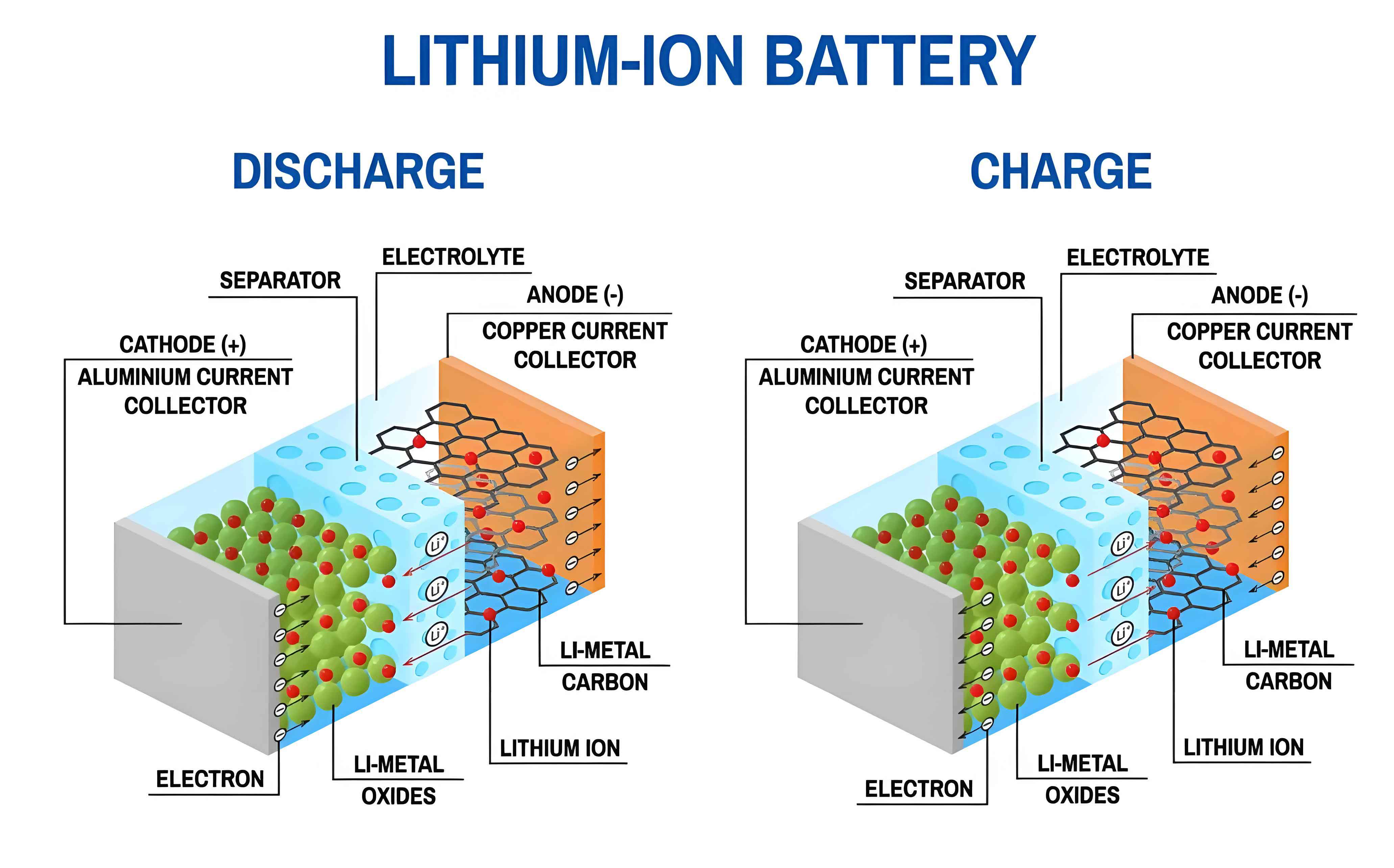
The fundamental appeal of MOFs for electrochemical energy storage lies in their structural precision and chemical versatility. Unlike traditional materials, the properties of a MOF can be meticulously engineered by selecting specific metal nodes and organic ligands. This allows for the creation of materials with predefined pore sizes for ion sieving, open metal sites for catalytic activity, or redox-active organic units for charge storage. When integrated into a lithium ion battery, MOFs can facilitate faster ion transport, provide abundant active sites, accommodate volume changes during cycling, and improve interfacial stability. The following sections dissect their roles component-by-component.
MOF-Based Cathode Materials: Harnessing Redox Activity
In the cathode of a lithium ion battery, MOFs can serve as the primary active material by utilizing redox reactions at either the metal clusters or the organic linkers. This approach moves beyond conventional intercalation chemistry. For instance, ferrocene-based MOFs leverage the reversible Fe2+/Fe3+ couple within the organic strut, delivering high operating voltages and impressive cycling stability. Conductive MOFs, such as those based on hexahydroxytriphenylene linkers coordinated to copper, offer both porosity and intrinsic electronic conductivity, enabling efficient electron transfer during lithiation/delithiation without the need for excessive conductive carbon additives. The capacity of a MOF cathode can be approximated by considering the number of accessible redox centers per formula unit:
$$ \text{Theoretical Capacity (C)} = \frac{n \times F}{3.6 \times M} $$
where \( n \) is the number of electrons transferred per formula unit, \( F \) is Faraday’s constant (96485 C/mol), and \( M \) is the molar mass (g/mol) of the MOF. The factor 3.6 converts Coulombs to mAh. Mixed-metal MOFs (e.g., Li-Co-MOF, Ce-doped NiCo-MOF) further enhance performance by synergizing the electrochemical properties of different metals, often leading to improved structural stability and higher capacity. The table below summarizes key examples of MOF-based cathodes.
| MOF Material | Key Feature | Capacity (mAh/g) | Cycling Performance |
|---|---|---|---|
| Fe2(DFc)3 | Redox-active ferrocene linker | ~172 at 50 mA/g | 70 mAh/g after 10,000 cycles at 2 A/g |
| Cu3(HHTP)2 | Intrinsically conductive 2D framework | ~95 (near theoretical) | ~8% decay over 100 cycles at 1C |
| Ce-doped NiCo-MOF | Mixed metals with enhanced stability | 280 at 2C | 92% capacity retention after 1,000 cycles |
MOF-Derived Anode Materials: Engineering Porosity and Composites
While pristine MOFs have been explored as anodes, their often poor electronic conductivity and structural instability during lithium insertion have led to the widespread use of MOFs as “self-sacrificial templates” or precursors. Pyrolysis of MOFs under controlled atmospheres yields sophisticated nanostructures, including porous metal oxides, sulfides, or carbon composites. These derivatives inherit the high surface area and porosity of the parent MOF, which are critical for a high-performance lithium ion battery anode. The pores provide short diffusion paths for lithium ions and buffer the massive volume expansion associated with alloying or conversion reactions. For example, pyrolysis of ZnCo-based ZIFs yields spinel ZnCo2O4 embedded in a conductive carbon matrix. The conversion reaction can be represented as:
$$ \text{ZnCo}_2\text{O}_4 + 8\text{Li}^+ + 8e^- \rightleftharpoons \text{Zn} + 2\text{Co} + 4\text{Li}_2\text{O} $$
The in-situ formed carbon network prevents nanoparticle aggregation and maintains electrical connectivity. Similarly, MOFs can be grown directly on active materials like silicon to create core-shell buffers. The enhanced performance stems from multiple factors: high active site density, robust mechanical stability, and facilitated electrolyte infiltration. The ionic diffusion within such a porous electrode often follows a shortened path, which can be conceptually linked to enhanced kinetics.
| Precursor MOF / Strategy | Derived Anode Material | Key Advantage | Performance Highlight |
|---|---|---|---|
| Co-BTC MOF (pyrolysis) | Porous Co3O4 nanoparticles | Nanoporous structure buffers volume change | 924 mAh/g after 100 cycles at 200 mA/g |
| ZIF-67 on Si@CNT | Si@CNT@porous carbon composite | Carbon shell from MOF accommodates Si expansion | 732 mAh/g initial capacity at 2 A/g |
| Electrospun PAN/ZIF-67 | ZnCo2O4/C composite nanofibers | 3D conductive network with MOF-derived porosity | >2000 mAh/g after 200 cycles |
MOFs in Solid-State Electrolytes: Structuring Ion Transport Pathways
The development of solid-state electrolytes is crucial for building safer, higher-energy-density lithium ion battery systems. MOFs contribute to this field in two primary ways: as active fillers in polymer composites and as the primary ion-conducting matrix. As fillers, MOF nanoparticles (e.g., Al-MOF, ZIF-67) dispersed in polymers like PEO serve multiple functions. They disrupt polymer crystallinity, increasing the amorphous region for ion hopping, as described by the Vogel–Fulcher–Tammann relation for ionic conductivity in polymers:
$$ \sigma(T) = \sigma_0 \exp\left[\frac{-B}{T – T_0}\right] $$
where \( \sigma_0 \), \( B \), and \( T_0 \) are fitting parameters. The MOF’s Lewis acidic metal sites can also interact with anions from lithium salts (e.g., TFSI–), effectively immobilizing them and increasing the lithium-ion transference number (\( t_{\text{Li}^+} \)), a critical metric for mitigating concentration polarization. When MOFs themselves form the electrolyte matrix, lithium ions are introduced via post-synthetic infusion of lithium salts or ionic liquids into the pores, or by grafting lithium-ion conducting groups onto the framework. The ordered, nano-sized channels can facilitate selective and rapid Li+ transport while suppressing dendrite growth. The ionic conductivity (\( \sigma \)) in such a confined system depends on the concentration (\( c \)), charge (\( z \)), and mobility (\( \mu \)) of the charge carriers: \( \sigma = \sum c_i z_i \mu_i \).
| MOF Role / Material | Electrolyte System | Ionic Conductivity | Li+ Transference Number (tLi+) |
|---|---|---|---|
| Filler (5 wt% Al-MOF) | PEO-LiTFSI composite | 7.11 × 10⁻⁴ S/cm at 60°C | 0.46 |
| Host for Ionic Liquid | MIL-121 + EMIM-TFSI | 5 × 10⁻² S/m at 30°C | — |
| Ion-Conducting Matrix | Zr-MA-Li+ framework | High | 0.63 |
MOF-Functionalized Separators: Enabling Smart Interfacial Engineering
The separator in a lithium ion battery is more than a passive barrier; its properties directly influence ion flux, thermal stability, and cycle life. MOFs are ingeniously used to transform conventional polyolefin separators. Coating separators with a layer of MOF particles (e.g., ZIF-8, Ti-MOF) or embedding MOFs into nanofiber mats (e.g., PAN/HKUST-1) creates multifunctional interfaces. The hydrophilic and porous MOF layer significantly improves electrolyte wettability and uptake, which lowers interfacial resistance. More importantly, MOFs can be designed to regulate ion transport. Frameworks with negatively charged or Lewis acidic pores can attract and trap anions, creating a uniform Li+ flux toward the anode, which is described by a modified Nernst-Planck equation considering surface interactions:
$$ J_i = -D_i \nabla c_i – \frac{z_i F}{RT} D_i c_i \nabla \phi + c_i v + J_i^{\text{surface}} $$
where \( J_i^{\text{surface}} \) represents the flux contribution from specific MOF-ion interactions. This homogenized flux is critical for suppressing lithium dendrite formation. Furthermore, the thermal stability of the MOF layer can reduce thermal shrinkage of the separator, enhancing the safety profile of the lithium ion battery. The improved electrochemical performance is a direct result of these synergistic effects: better electrolyte retention, uniform current distribution, and enhanced mechanical/thermal robustness.
| Functionalization Method | MOF Used | Key Separator Enhancement | Battery Performance Benefit |
|---|---|---|---|
| Surface Coating | ZIF-67, Ti-MOF | Enhanced wettability, anion trapping | High capacity retention (>98% after 50 cycles at 2C) |
| Electrospinning | HKUST-1 into PAN | High porosity, uniform MOF distribution, mechanical strength | 83.1% capacity retention after 200 cycles at 0.1C |
| Surface Coating | MOF-808 | Improved thermal stability | Stable high-rate cycling |
Conclusion and Future Perspectives
The integration of Metal-Organic Frameworks represents a paradigm shift in the material design for lithium ion battery technology. From serving as redox-active centers and nanostructured templates to becoming ion-conducting media and smart interfacial modifiers, MOFs offer solutions across the entire device architecture. Their inherent tunability allows researchers to tailor properties—such as pore size, chemical functionality, and electrical conductivity—to meet specific electrochemical demands, pushing the boundaries of energy density, power density, safety, and longevity for the next-generation lithium ion battery.
However, the path to commercialization faces hurdles. The typically low intrinsic electronic conductivity of most MOFs limits their direct use as electrodes. Cost-effective, scalable synthesis using less expensive ligands and metals is necessary. Long-term chemical/electrochemical stability in harsh battery environments requires further investigation. Future research will likely focus on: 1) Rational design of conductive MOFs with built-in charge transport pathways; 2) Development of advanced MOF composites that synergize the strengths of MOFs with conductive polymers, graphene, or other active materials; and 3) Engineering of low-cost, stable MOF formulations specifically for large-scale lithium ion battery manufacturing. By addressing these challenges, MOF-based materials hold immense promise for creating safer, more powerful, and longer-lasting energy storage systems, ultimately accelerating the global transition to sustainable electrification.