
The widespread adoption of electric vehicles (EVs) is pivotal for mitigating fossil fuel dependence and reducing urban air pollution. Central to the performance and safety of these vehicles is the lithium-ion battery, the primary source of propulsion energy. However, the operational safety of lithium-ion battery packs remains a critical concern, with thermal runaway incidents posing significant risks. Thermal runaway is a positive feedback loop where excessive heat triggers exothermic chemical reactions within the cell, leading to rapid temperature escalation, potential fire, or explosion. This catastrophic failure can be initiated by various abuse conditions such as overcharging, internal short circuits, mechanical damage, or exposure to high ambient temperatures. Fundamentally, regardless of the initiating factor, the final pathway involves the cell’s internal temperature surpassing a critical threshold, activating a series of irreversible exothermic decomposition reactions. Therefore, investigating the characteristics and propagation mechanisms of thermal runaway, particularly under high-temperature environmental conditions, is essential for designing safer battery systems and effective thermal management strategies.
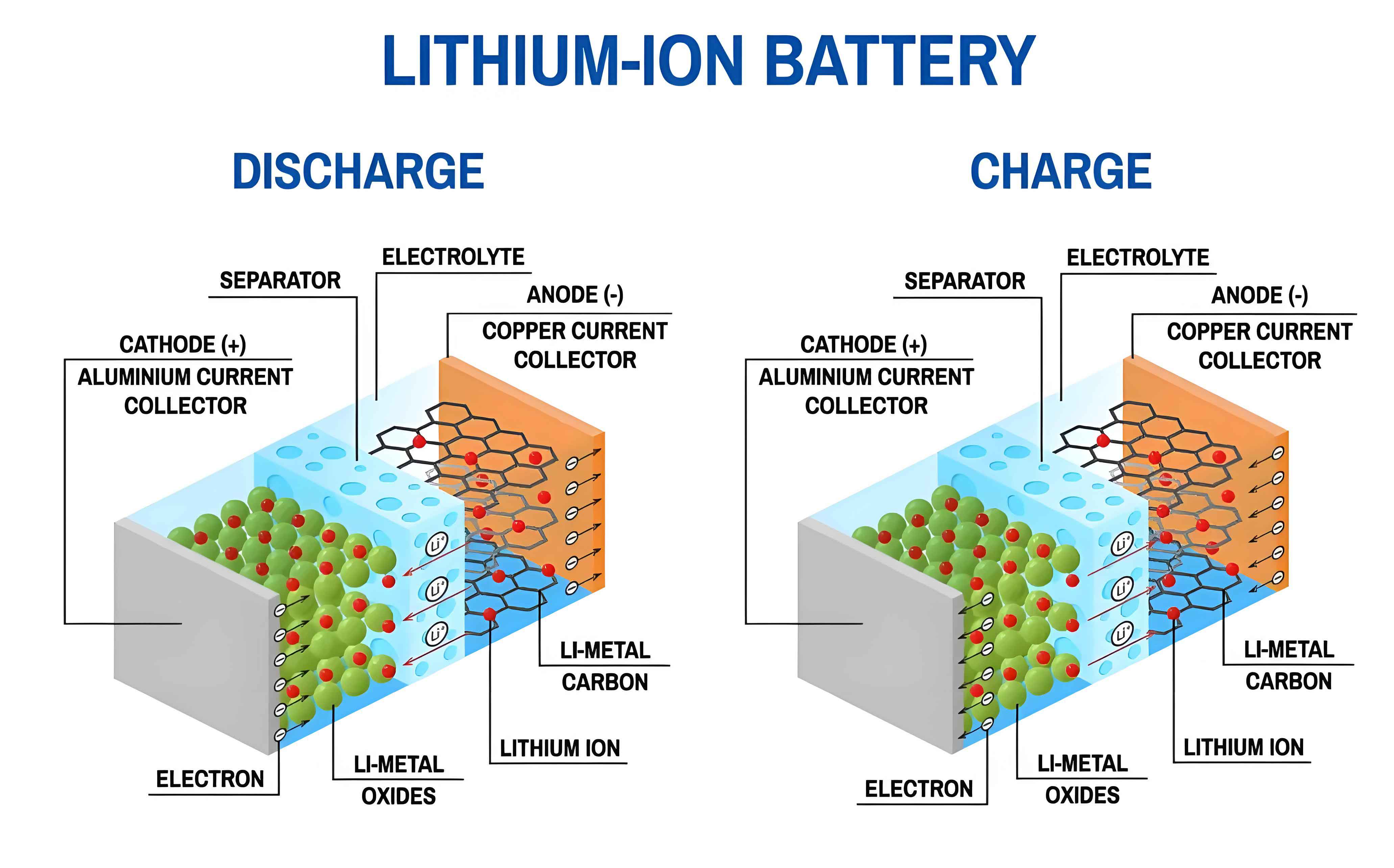
This study focuses on simulating the thermal runaway behavior of a module comprising multiple prismatic lithium-ion battery cells subjected to high external temperatures. The objective is to develop a three-dimensional numerical model capable of predicting the internal temperature distribution, heat transfer dynamics, and the progression of exothermic side reactions that culminate in thermal runaway. By analyzing the influence of key parameters such as ambient temperature, convective heat transfer coefficient, and initial cell temperature, this work aims to provide insights for inhibiting thermal runaway propagation in practical lithium-ion battery pack applications.
Theoretical Framework and Mathematical Model
To accurately simulate the thermal behavior of a lithium-ion battery module under thermal abuse, a coupled electrochemical-thermal model is established. The model geometry consists of a module with four prismatic lithium-ion battery cells arranged in parallel. Critical safety components are integrated into the design: phase change material (PCM) encapsulating the module to absorb heat during initial warming, and thin thermal insulation barriers placed between individual cells to delay heat transfer and propagation. The properties of the cell components, PCM, and insulation material are summarized in the tables below.
| Parameter | Value |
|---|---|
| Nominal Capacity | 60 Ah |
| Cell Dimensions (L×W×H) | 130 × 36 × 108 mm |
| Nominal Voltage | 3.6 V |
| Cathode Material | LiNi0.5Co0.2Mn0.3O2 (NCM523) |
| Anode Material | Graphite |
| Separator | Polyolefin Microporous Film |
| Average Density (ρ) | ~2100 kg/m³ |
| Specific Heat Capacity (cp) | ~1600 J/(kg·K) |
| Parameter | Value |
|---|---|
| Material Type | Nano-fiber based |
| Thickness | 2 mm |
| Thermal Conductivity (λ) | 0.03 W/(m·K) |
| Density (ρ) | 2400 kg/m³ |
| Specific Heat Capacity (cp) | 794.2 J/(kg·K) |
| Parameter | Value |
|---|---|
| Melting Point | 42 °C |
| Melt Range | 3 °C |
| Thermal Conductivity (λ) | 3.90 W/(m·K) |
| Density (ρ) | 800 kg/m³ |
| Specific Heat Capacity (cp) | 2100 J/(kg·K) |
| Thickness | 3 mm |
Governing Energy Conservation Equation
The thermal response of the lithium-ion battery module is governed by the principle of energy conservation. The transient temperature field is described by the following equation, accounting for heat conduction, internal heat generation from side reactions, and convective boundary losses:
$$
\frac{\partial (\rho c_p T)}{\partial t} = \nabla \cdot (\lambda \nabla T) + Q_{\text{total}}
$$
where \( \rho \) is the density, \( c_p \) is the specific heat capacity, \( T \) is the temperature, \( \lambda \) is the thermal conductivity, and \( t \) is time. The total volumetric heat generation rate \( Q_{\text{total}} \) is the sum of heat from several key exothermic side reactions that occur when the lithium-ion battery temperature rises:
$$
Q_{\text{total}} = Q_{\text{SEI}} + Q_{\text{neg}} + Q_{\text{pos}} + Q_{\text{elec}}
$$
Here, \( Q_{\text{SEI}} \), \( Q_{\text{neg}} \), \( Q_{\text{pos}} \), and \( Q_{\text{elec}} \) represent the heat generation rates due to the decomposition of the Solid Electrolyte Interphase (SEI), the reaction between the lithiated anode and the electrolyte, the decomposition of the cathode active material, and the decomposition of the electrolyte itself, respectively.
Kinetic Models for Exothermic Side Reactions
The heat generation from each side reaction is modeled using Arrhenius-type kinetics, where the reaction rate depends exponentially on temperature. The general form for the heat generation rate of a reaction \( i \) is:
$$
Q_i = -W_i H_i \frac{dc_i}{dt}
$$
where \( W_i \) is the mass content of the active material involved in the reaction (kg/m³), \( H_i \) is the reaction enthalpy (J/kg), and \( c_i \) is a dimensionless concentration representing the state of the reactant (1 for fully available, 0 for fully consumed). The rate of change \( dc_i/dt \) is given by:
$$
\frac{dc_i}{dt} = -A_i \exp\left(-\frac{E_{a,i}}{RT}\right) f(c_i)
$$
where \( A_i \) is the pre-exponential factor (s⁻¹), \( E_{a,i} \) is the activation energy (J/mol), \( R \) is the universal gas constant (8.314 J/(mol·K)), and \( f(c_i) \) describes the reaction order.
The specific kinetic equations for each critical reaction in a lithium-ion battery are detailed below:
1. SEI Layer Decomposition: This is typically the first exothermic reaction to initiate at moderate temperatures (~90-120°C).
$$
\frac{dc_{\text{SEI}}}{dt} = -A_{\text{SEI}} c_{\text{SEI}} \exp\left(-\frac{E_{a,\text{SEI}}}{RT}\right), \quad \text{with } A_{\text{SEI}}=7 \times 10^{15} \text{ s}^{-1}, \ E_{a,\text{SEI}}=1.4 \times 10^5 \text{ J/mol}
$$
2. Reaction between Lithiated Anode (Graphite) and Electrolyte: This highly exothermic reaction begins after significant SEI breakdown.
$$
\frac{dc_{\text{neg}}}{dt} = -A_{\text{neg}} c_{\text{neg}} \exp\left(-\frac{E_{a,\text{neg}}}{RT}\right) \exp\left(-\frac{c_{\text{SEI}}}{c_{\text{SEI,ref}}}\right), \quad \text{with } A_{\text{neg}}=2.5 \times 10^{13} \text{ s}^{-1}
$$
3. Cathode Active Material Decomposition: The decomposition of the NCM oxide releases oxygen and generates significant heat.
$$
\frac{dc_{\text{pos}}}{dt} = -A_{\text{pos}} \alpha_c (1 – \alpha_c) \exp\left(-\frac{E_{a,\text{pos}}}{RT}\right), \quad \text{with } A_{\text{pos}}=6.7 \times 10^{13} \text{ s}^{-1}
$$
4. Electrolyte Decomposition: This reaction can proceed independently at high temperatures.
$$
\frac{dc_{\text{elec}}}{dt} = -A_{\text{elec}} c_{\text{elec}} \exp\left(-\frac{E_{a,\text{elec}}}{RT}\right), \quad \text{with } A_{\text{elec}}=5.14 \times 10^{25} \text{ s}^{-1}
$$
Boundary Condition: Convective Heat Transfer
The lithium-ion battery module is assumed to be exposed to a high-temperature environment. The heat flux at the external boundaries due to convection is modeled as:
$$
q_{\text{conv}} = h (T_{\text{amb}} – T_{\text{surf}})
$$
where \( h \) is the convective heat transfer coefficient (W/(m²·K)), \( T_{\text{amb}} \) is the ambient temperature, and \( T_{\text{surf}} \) is the surface temperature of the module. This boundary condition drives the initial heating of the lithium-ion battery module from the outside in.
Simulation Setup and Model Validation
A three-dimensional finite element model of the lithium-ion battery module was constructed, incorporating the geometry of the four cells, the inter-cell insulation, and the PCM jacket. The mesh consisted of tetrahedral and triangular elements, with careful attention paid to the thin insulation layers to ensure numerical accuracy. The coupled system of partial differential equations for energy conservation and chemical kinetics was solved transiently.
The numerical model was validated by comparing its predictions against experimental data for thermal runaway under two different ambient temperatures: 140°C and 170°C. The simulated temperature evolution curves showed excellent agreement with the experimental measurements in terms of the onset time of thermal runaway, the peak temperature reached, and the overall temperature trend. This close correspondence confirms the model’s capability to capture the fundamental physics of thermal runaway in a lithium-ion battery module and provides a reliable basis for further parametric studies.
Results and Analysis: Parametric Study on Thermal Runaway
Effect of Ambient Temperature (Tamb)
The ambient temperature is a primary external driver for triggering thermal runaway in a lithium-ion battery. Simulations were conducted at four ambient temperatures: 70°C, 125°C, 140°C, and 170°C, with a constant heat transfer coefficient and initial temperature.
The results reveal a critical threshold between 125°C and 140°C. At 70°C and 125°C, the temperature of the lithium-ion battery module rises slowly and eventually stabilizes without triggering a catastrophic runaway. The PCM and insulation effectively manage the heat input. However, at 140°C and 170°C, a distinct thermal runaway occurs. After a gradual heating period, the module’s maximum temperature reaches approximately 167°C, at which point exothermic side reactions accelerate dramatically, leading to a sharp, uncontrollable temperature rise.
| Ambient Temperature, Tamb (°C) | Runaway Onset Time (s) | Runaway Onset Temp. (°C) | Peak Temperature (°C) | Peak Time (s) |
|---|---|---|---|---|
| 140 | ~16,200 | 167.3 | ~359.1 | ~16,700 |
| 170 | ~9,200 | 167.3 | ~374.7 | ~9,400 |
The analysis of the individual reaction heats provides deeper insight. At 140°C and 170°C, the heat generation from the SEI decomposition, anode-electrolyte reaction, cathode decomposition, and electrolyte decomposition all increased by orders of magnitude in a sequential and coupled manner. At 125°C, only the SEI decomposition showed noticeable activity, but its generated heat was insufficient to trigger the subsequent, more energetic reactions. This identifies the temperature range of 125-140°C as a critical threshold for the thermal runaway of this specific lithium-ion battery configuration. To prevent thermal runaway, maintaining the environment below 125°C is crucial.
Effect of Convective Heat Transfer Coefficient (h)
The convective heat transfer coefficient \( h \) governs the rate at which environmental heat is transferred to the lithium-ion battery module surface. Simulations were performed with different \( h \) values (5, 10, 15, 25 W/(m²·K)) at the critical ambient temperatures of 140°C and 170°C.
| Tamb (°C) | h (W/(m²·K)) | Runaway Onset Time (s) | Peak Temperature (°C) | Observation |
|---|---|---|---|---|
| 140 | 5 | No Runaway | – | Stabilized |
| 10 | ~16,500 | ~362.2 | Runaway occurred | |
| 15 | ~12,900 | ~356.6 | Runaway occurred | |
| 25 | ~10,000 | ~346.7 | Runaway occurred | |
| 170 | 5 | ~16,200 | ~375.1 | Runaway occurred |
| 10 | ~9,200 | ~374.7 | Runaway occurred | |
| 15 | ~6,700 | ~375.0 | Runaway occurred | |
| 25 | ~4,600 | ~374.1 | Runaway occurred |
The results demonstrate that a higher \( h \) value accelerates the heating of the lithium-ion battery module, significantly shortening the time to thermal runaway. At 140°C, a coefficient as low as 5 W/(m²·K) was sufficient to prevent runaway, while values of 10 and above triggered it. At the more severe 170°C condition, even the lowest \( h \) of 5 W/(m²·K) eventually led to runaway, albeit after a much longer period (~4.5 hours). Notably, while \( h \) greatly influences the onset time, it has a relatively minor effect on the final peak runaway temperature, which is primarily determined by the total chemical energy released from the lithium-ion battery materials.
Effect of Initial Battery Temperature (Tinit)
The initial temperature of the lithium-ion battery module at the moment it is exposed to the high-temperature environment is another key parameter. Simulations were run with initial temperatures of 20°C, 40°C, 60°C, and 100°C under various ambient conditions.
At an ambient temperature of 127°C, a module with an initial temperature of 100°C underwent thermal runaway after ~18,100 seconds, whereas modules starting at lower temperatures did not. This highlights that the combined thermal energy (ambient + initial) must exceed a critical level. At ambient temperatures of 140°C and 170°C, thermal runaway occurred for all initial temperatures, but the time to onset was dramatically reduced with higher Tinit.
| Tamb (°C) | Tinit (°C) | Runaway Onset Time (s) | Peak Temperature (°C) |
|---|---|---|---|
| 140 | 20 | ~16,300 | ~359.1 |
| 40 | ~14,900 | ~360.1 | |
| 60 | ~13,000 | ~366.4 | |
| 100 | ~7,700 | ~365.0 | |
| 170 | 20 | ~9,280 | ~379.6 |
| 40 | ~8,260 | ~379.3 | |
| 60 | ~7,020 | ~377.4 | |
| 100 | ~3,980 | ~384.4 |
A higher initial temperature means the lithium-ion battery cell is already closer to the activation threshold for its internal exothermic reactions. Therefore, it requires less additional energy from the environment to initiate the chain reaction leading to thermal runaway. Similar to the effect of \( h \), the initial temperature primarily affects the timing of the event rather than its ultimate severity in terms of peak temperature.
Discussion and Implications for Battery Safety Design
This numerical investigation elucidates the complex interplay between external thermal abuse conditions and the internal failure mechanisms of a lithium-ion battery module. The onset of thermal runaway is not dictated by a single parameter but by a combination that drives the core temperature of the cell toward the kinetic activation zone of its constituent materials. The identified threshold ambient temperature of 125-140°C serves as a critical design limit for safety systems. Battery compartments must be shielded or cooled to remain below this limit during extreme operating scenarios or in the event of a nearby fire.
The study underscores the dual role of heat transfer in lithium-ion battery safety. A high convective heat transfer coefficient is typically desirable for cooling during normal operation. However, under external fire or high-temperature exposure, this same property becomes a liability, rapidly channeling heat into the module and precipitating earlier thermal runaway. This paradox highlights the need for adaptive or intelligent thermal management systems that can alter their function based on the operational context—promoting cooling during normal use but switching to isolation or insulation modes under abuse conditions.
The beneficial effect of a low heat transfer coefficient (h=5 W/(m²·K)) in delaying or preventing runaway at 140°C suggests that incorporating passive thermal barriers around the battery pack can be an effective safety strategy. Furthermore, the significant delay offered by starting with a cooler battery temperature emphasizes the importance of effective operational thermal management to keep the lithium-ion battery as cool as possible during use, thereby increasing its margin of safety against thermal runaway if an abuse condition arises.
Conclusion
In this work, a comprehensive three-dimensional coupled electrochemical-thermal model was developed and validated to simulate thermal runaway propagation in a lithium-ion battery module under high-temperature environmental exposure. The model successfully captures the temperature evolution and the chain of exothermic side reactions leading to catastrophic failure. The parametric analysis leads to the following key conclusions:
- Critical Ambient Temperature Threshold: For the studied lithium-ion battery configuration, the critical ambient temperature range for triggering thermal runaway lies between 125°C and 140°C. Maintaining the operating environment below 125°C is essential for preventing this failure mode.
- Accelerating Effect of Heat Transfer and Initial State: Both a higher convective heat transfer coefficient (h) and a higher initial battery temperature (Tinit) significantly shorten the time to thermal runaway onset. A higher \( h \) increases the rate of external heat influx, while a higher \( T_{init} \) reduces the internal energy required to reach reaction activation thresholds.
- Limited Influence on Peak Severity: While ambient temperature, heat transfer coefficient, and initial temperature affect the timing of thermal runaway, they have a relatively minor impact on the final peak temperature, which is predominantly governed by the total chemical energy stored in the lithium-ion battery materials.
- Safety Design Guidelines: To enhance the safety of lithium-ion battery packs against external thermal threats, design strategies should focus on: (a) Implementing thermal insulation or barriers to reduce the effective heat transfer coefficient during abuse scenarios; (b) Ensuring robust operational cooling to maintain a low average and initial cell temperature; and (c) Designing battery enclosures to withstand or delay exposure to ambient temperatures exceeding 125°C.
This simulation-based study provides valuable insights and quantitative data for designing safer lithium-ion battery systems and developing effective thermal runaway mitigation strategies, contributing to the overall safety and reliability of electric vehicles and large-scale energy storage applications.