
In my extensive research on energy storage systems, I have focused on understanding the critical factors that limit the performance of lithium ion batteries under extreme conditions, particularly at low temperatures. The lithium ion battery, as a cornerstone of modern portable electronics, electric vehicles, and grid storage, exhibits significant degradation in energy and power density when operated below -20°C, with severe capacity loss at -40°C. This deterioration stems from multiple intertwined mechanisms: reduced electrolyte ionic conductivity, hindered lithium ion kinetics across the solid electrolyte interphase (SEI), and sluggish solid-state diffusion within electrode materials. In this article, I delve into the material-centric aspects that govern these processes, specifically examining how the particle size of cathode and anode active materials, along with electrolyte formulation, influence the low-temperature behavior of lithium iron phosphate (LFP) based lithium ion batteries. My findings underscore that lithium ion diffusion in electrode bulk and surface layers is paramount, with cathode particle size playing a dominant role in discharge performance.
The fundamental challenge for a lithium ion battery at low temperatures is the exponential increase in internal resistance, which stems from both ohmic and polarization losses. The ionic conductivity of the electrolyte, $\sigma$, typically follows an Arrhenius relationship: $$\sigma = A \exp\left(-\frac{E_a}{RT}\right)$$ where $A$ is a pre-exponential factor, $E_a$ is the activation energy, $R$ is the gas constant, and $T$ is the temperature. As $T$ decreases, $\sigma$ drops sharply, impeding ion transport. Simultaneously, the charge transfer resistance at electrode-electrolyte interfaces rises, and solid-state diffusion of lithium ions in active materials becomes rate-limiting. The diffusion coefficient $D$ in electrodes also follows an Arrhenius law: $$D = D_0 \exp\left(-\frac{E_{a,\text{diff}}}{RT}\right)$$ where $D_0$ is the diffusion prefactor and $E_{a,\text{diff}}$ is the activation energy for diffusion. In LFP cathodes, which are inherently poor electronic conductors, lithium ion diffusion is particularly slow, exacerbating polarization losses. Similarly, in graphite anodes, intercalation kinetics slow down dramatically. Thus, optimizing material properties to mitigate these effects is crucial for enhancing the low-temperature performance of lithium ion batteries.
To systematically investigate these factors, I designed and conducted experiments focusing on three key variables: the primary particle size of LFP cathode material, the particle size of carbon-coated artificial graphite anode material, and the composition of the electrolyte solvent system. All lithium ion battery cells were assembled in a controlled environment using standard electrode fabrication techniques. The cathode slurry consisted of LFP active material, Super P conductive carbon, polyvinylidene fluoride (PVDF) binder, and polyvinylpyrrolidone (PVP) dispersant in a mass ratio of 93.8:3.5:2.5:0.2, coated onto carbon-coated aluminum foil. The anode slurry comprised artificial graphite, Super P, carboxymethyl cellulose sodium (CMC), and styrene-butadiene rubber (SBR) in a 94.4:2.0:1.6:2.0 ratio, coated onto copper foil. Electrode loadings were adjusted to ensure consistent areal capacity across all samples. Cells were constructed via stacking, followed by vacuum drying and electrolyte injection. The base electrolyte was 1.1 M LiPF6 in various solvent mixtures, with fixed additives: 2% vinylene carbonate (VC), 1% propylene carbonate (PC), and 1% fluoroethylene carbonate (FEC). Formation cycling was performed at C/10 and C/5 rates to establish stable SEI layers before testing.
The low-temperature performance of each lithium ion battery was evaluated through discharge and charge tests at -20°C and -40°C. Discharge capacity retention and mid-point voltage were recorded as key metrics. To quantify the impact of material properties, I employed various characterization techniques, including laser diffraction for particle size analysis, BET surface area measurements, and scanning electron microscopy for morphological assessment. The following sections detail my findings, supported by tables and theoretical models.
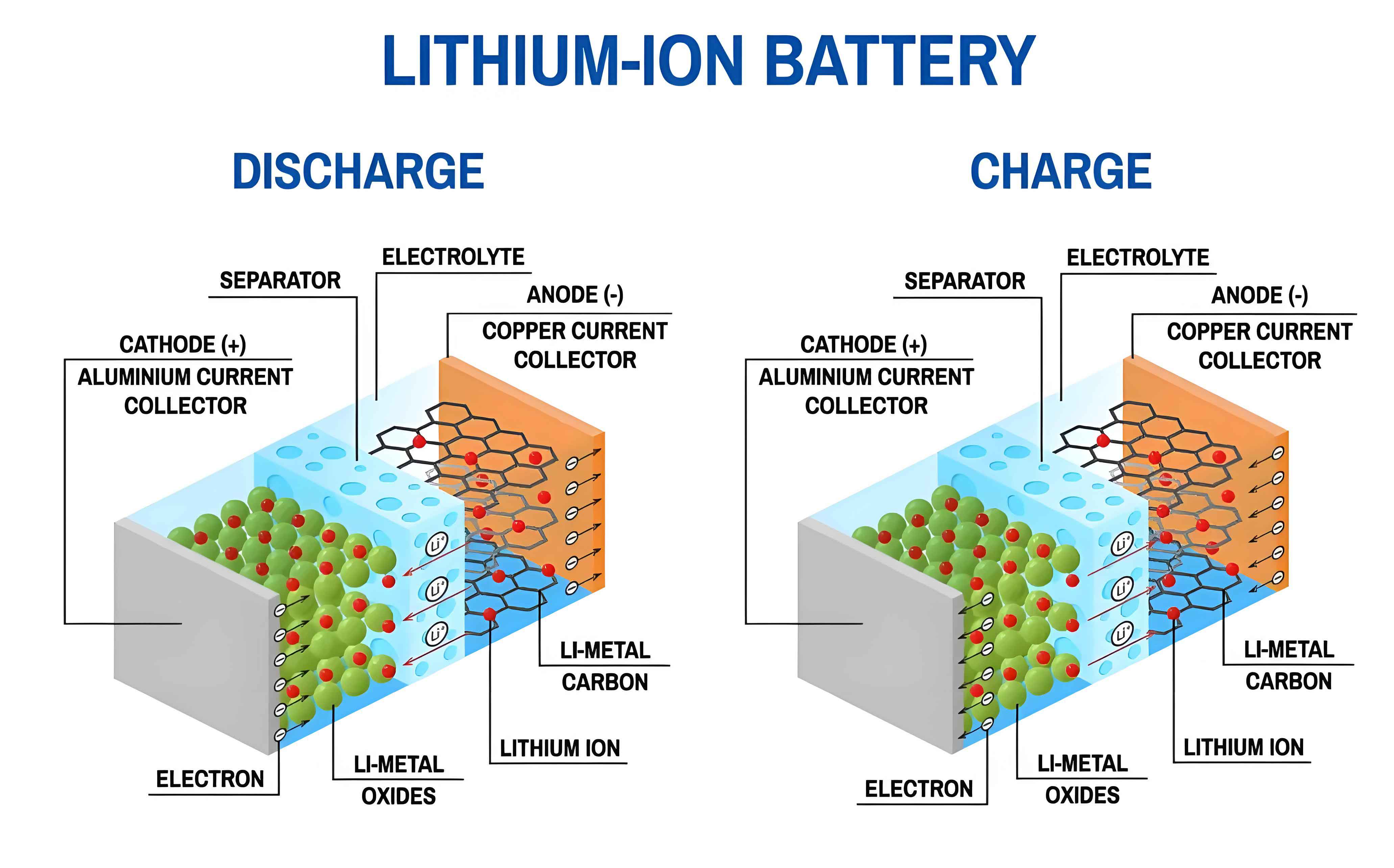
My investigation into cathode material effects began with five LFP samples having distinct primary particle size ranges, as confirmed by SEM imaging. The parameters are summarized in Table 1. These cathodes were paired with a consistent anode (D50 = 6.2 µm) and an electrolyte containing ethyl propionate (EP) as a co-solvent to isolate the cathode influence.
| Sample ID | Primary Particle Size Range (nm) | D50 (µm) | BET Surface Area (m²/g) | -20°C, 0.5C Discharge Capacity Retention (%) | -40°C, 0.2C Discharge Capacity Retention (%) | -20°C, 0.5C Charge Constant Current Ratio |
|---|---|---|---|---|---|---|
| A1 | 50–100 | 25.7 | 31.0 | 94.1 | 74.0 | 0.76 |
| A2 | 80–150 | 4.4 | 13.0 | 88.5 | 65.3 | 0.68 |
| A3 | 100–300 | 8.5 | 15.0 | 75.2 | 48.7 | 0.55 |
| A4 | 200–400 | 2.6 | 12.0 | 52.4 | 32.5 | 0.47 |
| A5 | 400–800 | 1.0 | 11.0 | 35.1 | 18.0 | 0.41 |
The data reveals a stark dependence of low-temperature performance on cathode particle size. For instance, the lithium ion battery with the smallest particles (A1) retained 74% capacity at -40°C, whereas the one with the largest particles (A5) retained only 18%. This trend aligns with the solid-state diffusion limitation. The characteristic diffusion time $\tau$ for a spherical particle is given by: $$\tau = \frac{r^2}{D}$$ where $r$ is the particle radius. Smaller $r$ reduces $\tau$, enabling faster lithium ion extraction/insertion and lower concentration polarization. At low temperatures, where $D$ is already diminished, minimizing $r$ becomes critical to maintain usable capacity. The discharge curves exhibited higher mid-point voltages for smaller particles, indicating reduced polarization. During charging at -20°C, the constant current ratio (fraction of capacity charged before voltage cutoff) dropped from 0.76 for A1 to 0.41 for A5, further emphasizing that lithium ion de-intercalation kinetics in the cathode govern charge acceptance. Thus, for a lithium ion battery targeting cold climates, cathode material with nano-sized primary particles is essential.
Next, I explored the anode contribution by varying the graphite particle size while keeping the cathode (80–150 nm LFP) and electrolyte constant. The anode properties are listed in Table 2.
| Sample ID | Graphite D50 (µm) | BET Surface Area (m²/g) | -20°C, 0.5C Discharge Capacity Retention (%) | -40°C, 0.2C Discharge Capacity Retention (%) | -20°C, 0.5C Charge Constant Current Ratio |
|---|---|---|---|---|---|
| B1 | 6.2 | 2.3 | 75.24 | 57.5 | 0.67 |
| B2 | 7.5 | 1.9 | 74.76 | 56.8 | 0.52 |
| B3 | 9.0 | 1.4 | 73.65 | 55.2 | 0.31 |
| B4 | 19.5 | 0.4 | 72.73 | 54.5 | 0.09 |
The influence of anode particle size, while significant, is less pronounced than that of the cathode. At -40°C, capacity retention varied by only ~3% across the series, compared to ~56% for the cathode series. However, the mid-point voltage during discharge decreased noticeably with larger graphite particles, suggesting increased polarization. More dramatically, the constant current charge ratio plummeted from 0.67 for B1 to 0.09 for B4. This underscores that lithium ion intercalation into graphite becomes highly resistive at low temperatures, severely limiting chargeability. The diffusion length in anode particles follows the same square dependence on radius, so smaller particles alleviate this. Additionally, the SEI resistance, $R_{\text{SEI}}$, contributes to overall impedance. The total cell impedance $Z_{\text{cell}}$ at low temperature can be modeled as: $$Z_{\text{cell}} = R_{\Omega} + R_{\text{ct}} + R_{\text{SEI}} + Z_{\text{W}}$$ where $R_{\Omega}$ is ohmic resistance, $R_{\text{ct}}$ is charge transfer resistance, and $Z_{\text{W}}$ is Warburg diffusion impedance. For graphite, $R_{\text{ct}}$ and $Z_{\text{W}}$ are strongly temperature-dependent. Thus, optimizing anode particle size is crucial, especially for charging, but the cathode remains the primary bottleneck for discharge in a lithium ion battery.
To address electrolyte effects, I formulated seven different solvent systems, all with 1.1 M LiPF6 and fixed additives. The solvents included carbonate blends and various carboxylate esters as co-solvents. The compositions and resulting performance are in Table 3.
| Sample ID | Solvent Volume Ratio (EC:EMC:Co-solvent) | Co-solvent Type | -20°C, 0.5C Discharge Capacity Retention (%) | -40°C, 0.2C Discharge Capacity Retention (%) | -20°C Discharge Mid-point Voltage (V) |
|---|---|---|---|---|---|
| C1 | 30:40:30 | Ethyl Propionate (EP) | 91.14 | 77.10 | 2.95 |
| C2 | 25:60:15 | Methyl Propionate (MP) | 90.87 | 76.52 | 2.94 |
| C3 | 25:55:20 | Methyl Propionate (MP) | 90.23 | 75.89 | 2.93 |
| C4 | 25:55:20 | Propyl Propionate (PP) | 88.45 | 70.34 | 2.90 |
| C5 | 25:55:20 | Dimethyl Carbonate (DMC) | 87.92 | 65.78 | 2.87 |
| C6 | 25:55:20 | Propyl Acetate (PA) | 87.11 | 63.45 | 2.85 |
| C7 | 30:70:0 | None (EC:EMC only) | 86.94 | 61.85 | 2.84 |
The incorporation of low-viscosity carboxylate esters like EP and MP consistently improved performance over carbonate-only systems. The ionic conductivity $\sigma$ of an electrolyte can be estimated using the Vogel-Fulcher-Tammann equation: $$\sigma = \sigma_0 \exp\left(-\frac{B}{T – T_0}\right)$$ where $\sigma_0$, $B$, and $T_0$ are fitting parameters. Esters lower the viscosity, increasing $\sigma_0$ and reducing $B$, thereby maintaining higher conductivity at low $T$. For instance, at -40°C, the conductivity of EP-based electrolytes can be ~3 times higher than that of DMC-based ones. This enhances ion transport, reducing $R_{\Omega}$ and mitigating concentration polarization. However, the capacity improvement from electrolyte optimization (up to ~15% at -40°C) is modest compared to cathode particle size effects. This indicates that while electrolyte conductivity is important, solid-state diffusion in electrodes is the rate-determining step for a lithium ion battery under deep cold conditions.
To synthesize these findings, I developed a phenomenological model linking low-temperature capacity retention $C_{\text{ret}}$ to material parameters. For discharge, $C_{\text{ret}}$ can be expressed as: $$C_{\text{ret}} = C_0 \left[1 – \frac{\alpha r_c^2}{D_c(T)} – \frac{\beta r_a^2}{D_a(T)} – \gamma \eta_{\text{elec}}(T)\right]$$ where $C_0$ is room-temperature capacity, $r_c$ and $r_a$ are cathode and anode particle radii, $D_c(T)$ and $D_a(T)$ are temperature-dependent diffusion coefficients, $\eta_{\text{elec}}(T)$ is electrolyte-related overpotential, and $\alpha, \beta, \gamma$ are proportionality constants. At very low $T$, the cathode term dominates due to the low intrinsic $D_c$ of LFP. For charging, an additional term accounting for SEI resistance and lithium plating risks becomes significant, explaining the steep drop in chargeability with larger anode particles.
My research demonstrates that the low-temperature performance of a lithium ion battery is intricately tied to material design. Among the factors studied, cathode primary particle size exerts the most substantial influence on discharge capacity, followed by anode particle size and electrolyte formulation. Specifically, reducing LFP particles to the nanoscale shortens lithium ion diffusion paths, curbing concentration polarization and preserving voltage under load. Similarly, finer graphite particles enhance charge acceptance by facilitating intercalation kinetics. Electrolytes with ester co-solvents boost ionic conductivity, offering incremental gains. However, the overarching conclusion is that solid-state diffusion limitations in electrodes, particularly the cathode, are the primary bottleneck. Future work should focus on synthesizing hierarchical electrode architectures with optimized porosity and conductivity, coupled with advanced electrolytes, to push the operational limits of lithium ion batteries in arctic and space applications. This holistic material approach will be pivotal for next-generation energy storage solutions.
In summary, every aspect of a lithium ion battery, from active material morphology to electrolyte composition, must be tailored for low-temperature resilience. The journey toward ultra-cold-tolerant lithium ion batteries is challenging but essential for expanding their utility across diverse climates and technologies. Through continuous material innovation and deep mechanistic understanding, we can unlock the full potential of lithium ion batteries even in the harshest environments.