
The relentless pursuit of higher energy density, longer cycle life, and improved safety continues to drive innovation in lithium-ion battery technology. As the cornerstone of portable electronics and the critical enabler for electric vehicles and grid-scale energy storage, the performance of a lithium-ion battery is intrinsically linked to the properties of its electrode materials. While cathodes based on layered oxides or phosphates have seen significant progress, the anode remains a focal point for breakthrough improvements. The commercial standard, graphite, offers reliable performance but is constrained by a modest theoretical capacity of 372 mAh g-1. This limitation has spurred extensive research into alternative materials capable of storing more lithium ions, thereby boosting the overall energy content of the battery. Among the myriad of candidates, conversion-type transition metal oxides (TMOs) have emerged as particularly promising due to their high theoretical capacities, which often exceed 1000 mAh g-1.
Within this family, iron oxide, specifically magnetite (Fe3O4), stands out for several compelling reasons. Its high theoretical capacity of approximately 926 mAh g-1 is more than double that of graphite. Furthermore, iron is abundant, inexpensive, and environmentally benign, making Fe3O4 an economically sustainable choice for large-scale applications. The electrochemical reaction of Fe3O<sub.4 with lithium involves a conversion mechanism, which can be summarized by the overall equation:</sub.4
$$ \text{Fe}_3\text{O}_4 + 8\text{Li}^+ + 8\text{e}^- \rightleftharpoons 3\text{Fe} + 4\text{Li}_2\text{O} $$
This multi-electron transfer process is the source of its high capacity. However, the practical deployment of Fe3O4 anodes is severely hampered by two intrinsic drawbacks common to many conversion materials. First, the reaction entails significant volumetric changes (>>100%) during lithiation and delithiation. This repeated expansion and contraction pulverizes the active material, disrupts electrical contact with the current collector, and leads to rapid capacity fading. Second, Fe3O4 suffers from poor intrinsic electronic and ionic conductivity, which limits rate capability and leads to polarization losses. Therefore, the central challenge in developing Fe3O4-based anodes for lithium-ion batteries lies in designing robust architectures that can accommodate mechanical strain while ensuring fast electron and ion transport.
A highly effective and widely adopted strategy to address these issues is nano-structuring and compositing with conductive carbon matrices. Carbon materials, such as amorphous carbon, carbon nanotubes, and graphene, provide a conductive network that facilitates electron transfer. More importantly, they can act as a flexible, confining buffer that cushions the volume changes of the embedded Fe3O4 nanoparticles, maintaining the structural integrity of the electrode over many cycles. The synergy between the high-capacity active material and the resilient carbon framework is key to unlocking stable cycling performance.
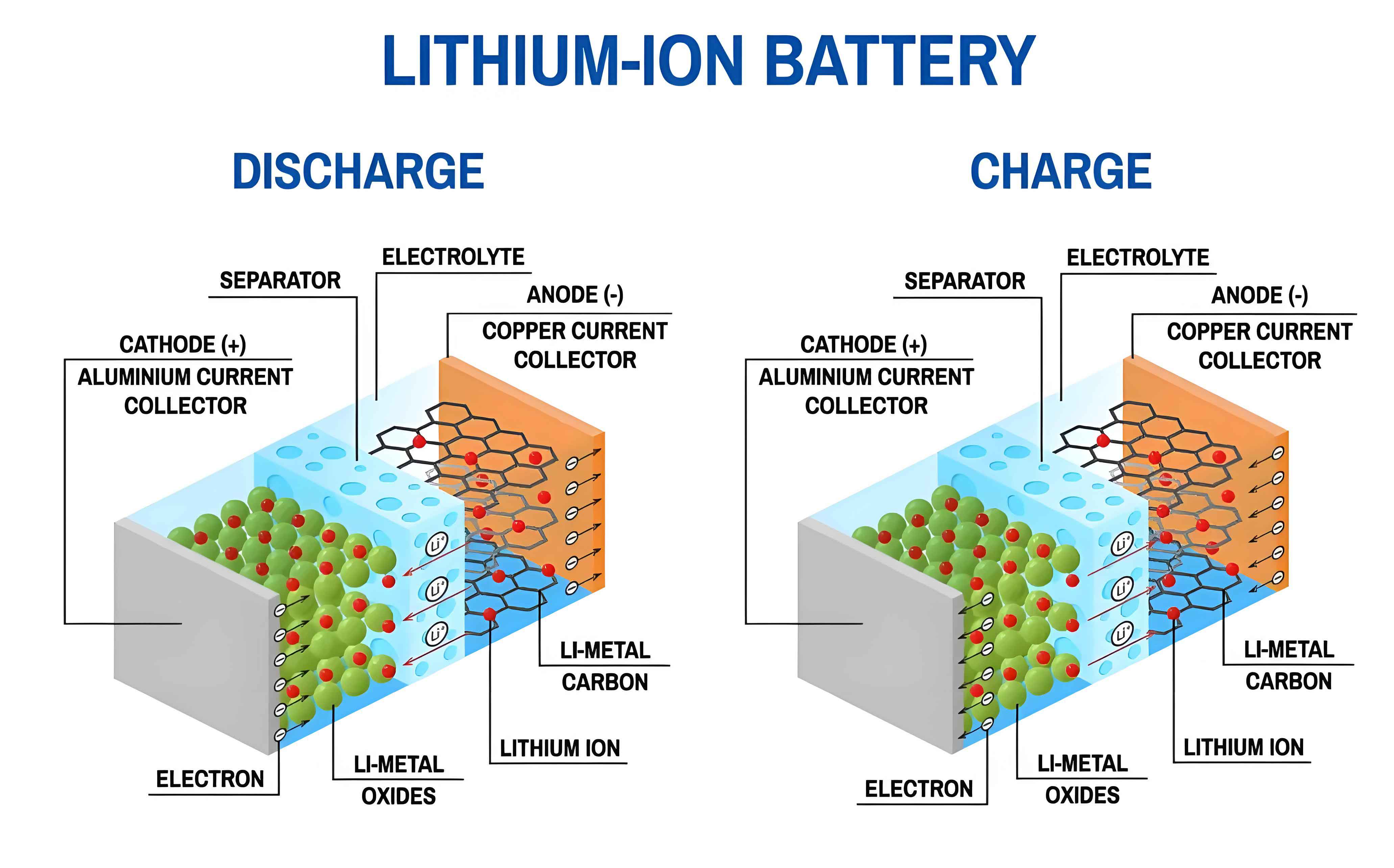
Recently, Metal-Organic Frameworks (MOFs) have gained tremendous attention as versatile precursors or templates for synthesizing advanced electrode materials. MOFs are crystalline porous materials formed by metal ions/clusters coordinated with organic linkers. Their high surface area, tunable porosity, and compositional diversity make them ideal for deriving metal oxide/carbon composites with controlled morphologies. Upon thermal treatment in an inert atmosphere, the organic components carbonize into a conductive, often porous carbon matrix, while the metal nodes are converted into well-dispersed metal or metal oxide nanoparticles. Zeolitic Imidazolate Frameworks (ZIFs), a subclass of MOFs, are especially popular due to their easy synthesis and high nitrogen content in the ligands, which leads to in-situ nitrogen doping of the derived carbon, further enhancing its conductivity and electrochemical activity.
Building upon this sophisticated materials design philosophy, this article delves into a strategic approach for fabricating high-performance Fe3O4-based anodes. The core idea involves constructing a dual-carbon encapsulated architecture, where Fe3O4 nanoparticles derived from an iron-containing ZIF are sequentially coated with a nitrogen-doped carbon (NC) layer and then embedded within a three-dimensional graphene (G) network. This multi-level design aims to synergistically tackle the conductivity and volume change challenges. The following sections will elaborate on the synthesis rationale, structural characterization, and comprehensive electrochemical evaluation of such a composite, designated as Fe3O4@NC/G, within the context of lithium-ion battery applications.
Rationale for Composite Architecture and Synthesis Strategy
The synthesis of the Fe3O4@NC/G composite is a deliberate, multi-step process designed to engineer specific functionalities at each stage. The journey begins with the selection of an Fe-based Zeolitic Imidazolate Framework (Fe-ZIF) as the precursor. This choice is pivotal. The Fe-ZIF provides a molecular-scale, homogeneous mixture of iron and organic nitrogen-rich ligands (like 2-methylimidazole). When subjected to controlled pyrolysis, this precursor ensures the formation of uniformly distributed, nano-sized Fe3O4 particles intimately embedded within a nitrogen-doped carbon matrix. This initial derived material, Fe3O4@NC, already offers improved conductivity over bare Fe3O4 due to the carbon coating and nitrogen doping. The nitrogen dopants (pyridinic N, pyrrolic N, graphitic N) introduce defect sites and enhance the carbon matrix’s affinity for lithium ions, which can be beneficial for charge storage kinetics.
However, a single carbon coating, while helpful, may be insufficient to withstand the extreme mechanical stresses of prolonged cycling, especially at high rates. Furthermore, the primary particles need to be effectively interconnected to ensure long-range electron transport across the entire electrode. This is where the second level of structural engineering comes into play: integration with graphene. Graphene, a two-dimensional sheet of sp2-hybridized carbon atoms, possesses exceptional electrical conductivity, mechanical strength, and flexibility. Wrapping or encapsulating the Fe3O4@NC particles within a graphene network serves multiple critical functions for the lithium-ion battery anode:
- Conductive Highway: The graphene sheets create a continuous, highly conductive pathway that drastically reduces the overall electrode resistance, enabling fast electron transfer.
- Mechanical Reinforcement: The flexible yet strong graphene acts as a macroscopic buffer. It can expand and contract with the volume changes of the encapsulated particles, preventing their aggregation and detachment, and maintaining the electrode’s structural cohesion.
- Electrolyte Access and Ion Transport: The three-dimensional porous structure formed by the interconnected graphene and particles facilitates electrolyte infiltration and provides short diffusion paths for lithium ions.
The assembly of the Fe3O4@NC particles with graphene is often achieved through directed interactions to ensure intimate contact. A common and effective method involves electrostatic assembly. The Fe3O4@NC particles (or their polymer-coated intermediate) can be surface-modified with a cationic surfactant (e.g., CTAB) to impart a positive charge. Meanwhile, graphene oxide (GO), bearing abundant oxygen-containing functional groups (carboxyl, hydroxyl), is negatively charged in aqueous dispersion. When mixed, the oppositely charged components attract each other, leading to a spontaneous and uniform wrapping of the particles by the GO sheets. Subsequent thermal reduction converts GO to reduced graphene oxide (rGO), restoring high conductivity and yielding the final Fe3O4@NC/G composite. This bottom-up assembly strategy is crucial for achieving the desired hierarchical architecture that is difficult to obtain through simple physical mixing.
Structural and Morphological Characterization
Confirming the successful formation of the intended hierarchical structure is essential. A combination of characterization techniques provides a comprehensive picture. Scanning Electron Microscopy (SEM) reveals the overall morphology. The initial Fe-ZIF precursor typically shows well-defined polyhedral or spherical shapes. After coating with polydopamine (PDA) and subsequent assembly with GO, the particles become enveloped within a wrinkled, sheet-like matrix. The final pyrolyzed Fe3O4@NC/G composite often retains this integrated structure, with the primary particles nestled within a conductive carbon web, preventing their exposure and aggregation.
X-ray Diffraction (XRD) is used to identify the crystalline phases. The diffraction pattern of the composite after calcination should show distinct peaks corresponding to the cubic spinel structure of Fe3O4 (JCPDS card no. 19-0629). The characteristic peaks for graphitic carbon from the rGO and the NC coating may appear as a broad hump around 24-26° (2θ), indicating the presence of partially graphitized carbon. The absence of other iron oxide phases (like Fe2O3) confirms the phase purity of the active material. The crystalline size of the Fe3O4 nanoparticles can be estimated using the Scherrer equation applied to the most intense peak:
$$ D = \frac{K\lambda}{\beta \cos\theta} $$
where \(D\) is the crystallite size, \(K\) is the shape factor (~0.9), \(\lambda\) is the X-ray wavelength, \(\beta\) is the full width at half maximum (FWHM) in radians, and \(\theta\) is the Bragg angle. Nanometer-sized crystals are desirable as they shorten lithium-ion diffusion paths.
Raman spectroscopy offers insights into the carbon structure. The spectrum of the composite features two prominent bands: the D band (~1350 cm-1) associated with structural defects and disorder in the carbon lattice, and the G band (~1580 cm-1) corresponding to the in-plane vibration of sp2-bonded carbon atoms. The intensity ratio of the D to G band (\(I_D/I_G\)) is a semi-quantitative indicator of the defect density or graphitization degree. In composites like Fe3O4@NC/G, this ratio is typically higher than that of pure rGO, suggesting that the presence of Fe3O4 and nitrogen doping introduces more defects. These defects can be beneficial as they may provide additional active sites for lithium storage.
X-ray Photoelectron Spectroscopy (XPS) provides elemental and chemical state information. The survey scan confirms the presence of Fe, O, C, and N. The high-resolution N 1s spectrum can be deconvoluted into peaks corresponding to different nitrogen species: pyridinic N (~398.7 eV), pyrrolic N (~399.9 eV), and graphitic N (~401.1 eV). This confirms successful nitrogen doping originating from the ZIF and polydopamine precursors. The Fe 2p spectrum typically shows doublet peaks for Fe 2p3/2 and Fe 2p1/2, with satellite features, characteristic of Fe3O4. The successful integration of all components is thus verified at the molecular level.
Electrochemical Performance Evaluation in Lithium-Ion Batteries
The ultimate test for the Fe3O4@NC/G composite is its performance as a working anode in a lithium-ion battery. Electrochemical characterization involves several key techniques.
Cyclic Voltammetry (CV) during the initial cycles reveals the redox processes. In the first cathodic (discharge) scan, a prominent reduction peak around 0.7-0.8 V (vs. Li/Li+) is observed. This corresponds to the reduction of Fe3O4 to metallic Fe embedded in a Li2O matrix, coupled with the inevitable formation of a Solid Electrolyte Interphase (SEI) layer due to electrolyte decomposition on the fresh carbon surface. The reaction is stepwise, which can be represented as:
$$ \text{Fe}_3\text{O}_4 + x\text{Li}^+ + x\text{e}^- \rightarrow \text{Li}_x\text{Fe}_3\text{O}_4 \quad (0 < x \leq 2) $$
$$ \text{Li}_2\text{Fe}_3\text{O}_4 + 6\text{Li}^+ + 6\text{e}^- \rightarrow 3\text{Fe}^0 + 4\text{Li}_2\text{O} $$
In the subsequent anodic (charge) scan, two oxidation peaks near 1.6 V and 1.9 V appear, attributed to the stepwise oxidation of Fe0 to Fe2+ and then to Fe3+, reforming Fe3O4. In well-designed composites, from the second cycle onward, the CV curves tend to superimpose, indicating high reversibility and stability of the electrochemical reactions, a direct consequence of the robust composite structure minimizing irreversible side reactions and capacity loss.
Galvanostatic Charge-Discharge (GCD) testing provides quantitative data on capacity, cycling stability, and coulombic efficiency. The first discharge curve typically shows a long plateau around 0.8 V, consistent with the CV reduction peak. The initial Coulombic Efficiency (ICE) – the ratio of first charge capacity to first discharge capacity – is a critical parameter. For conversion anodes, ICE is often below 80% due to irreversible processes like SEI formation and possibly incomplete conversion reactions. The dual-carbon architecture in Fe3O4@NC/G can help mitigate excessive SEI growth by providing a stable carbon surface, potentially leading to a higher ICE compared to less protected structures.
The long-term cycling performance is where the value of the composite design becomes most apparent. A comparison of different materials clearly demonstrates the progressive improvement.
| Material | Current Density | Cycle Number | Discharge Capacity (mAh g-1) | Key Architectural Feature |
|---|---|---|---|---|
| Bare Fe3O4 Nanoparticles | 0.1 A g-1 | 30 | ~140 | Unprotected, prone to pulverization. |
| Fe3O4@NC (Single Carbon Coating) | 0.1 A g-1 | 30 | ~370 | N-doped carbon buffer improves conductivity and some stability. |
| Fe3O4@NC/G (Dual Carbon) | 0.1 A g-1 | 30 | ~1005 | Synergy of NC coating and graphene network. |
| Fe3O4@NC/G (Dual Carbon) | 2.0 A g-1 | 300 | ~838 | Exceptional long-term, high-rate stability. |
The data underscores the dramatic enhancement. The graphene-wrapped composite not only delivers a much higher capacity at low rates but, more importantly, exhibits outstanding stability at high current densities. The capacity retention after hundreds of cycles at 2 A g-1 is a testament to the effectiveness of the hierarchical structure in maintaining electrical connectivity and mechanical integrity.
Rate Capability tests, where the current density is progressively increased and then returned to a low value, assess the electrode’s power performance. The Fe3O4@NC/G composite typically shows superior rate capability compared to its counterparts. It can deliver significant capacity even at high rates (e.g., 500-700 mAh g-1 at 1 A g-1), and more importantly, the capacity recovers almost fully when the current is switched back to a lower rate. This demonstrates minimal structural degradation and excellent kinetics, enabled by the highly conductive graphene network and stable interfaces.
Electrochemical Impedance Spectroscopy (EIS) provides quantitative insights into the kinetics. The Nyquist plot usually consists of a semicircle in the high-medium frequency region, corresponding to the charge-transfer resistance (\(R_{ct}\)) at the electrode/electrolyte interface, and an inclined line in the low-frequency region, representing Li+ diffusion in the solid phase (Warburg impedance). Fitting the spectra with an equivalent circuit allows for the extraction of \(R_{ct}\). For Fe3O4@NC/G, the \(R_{ct}\) value is significantly lower than that of bare Fe3O4 or even Fe3O4@NC. This lower resistance quantitatively confirms the enhanced charge transfer kinetics due to the dual-carbon conductive architecture, which is crucial for achieving high rate performance in the lithium-ion battery.
Mechanistic Insights and Synergistic Effects
The outstanding electrochemical performance of the Fe3O4@NC/G anode can be attributed to a powerful synergy between its components, creating a system where the whole is greater than the sum of its parts.
1. Hierarchical Stress Management: The volume expansion of Fe3O4 during lithiation is managed at two levels. The primary, intimate nitrogen-doped carbon (NC) coating acts as the first line of defense. It directly confines the nanoparticle, limiting its absolute expansion and preventing direct contact between adjacent Fe3O4 particles that could lead to fusion. The secondary, macroscopic graphene network serves as a flexible yet strong “exoskeleton.” It accommodates the collective expansion of the encapsulated Fe3O4@NC units, maintains the overall electrode porosity, and prevents crack propagation. This dual-buffering effect is paramount for cycle life.
2. Conductive Network Optimization: Electron transport is also enhanced through a multi-pathway mechanism. The NC coating provides a short-range conductive shell around each nanoparticle, ensuring immediate electron access to the active material. The graphene sheets then interconnect these coated particles over long distances, creating a continuous, highway-like network for electron percolation throughout the entire electrode. This drastically reduces internal resistance and polarization, especially critical at high discharge/charge rates for the lithium-ion battery.
3. Interface and Kinetics Enhancement: The nitrogen dopants in the carbon matrix play a multifaceted role. They increase the electronic conductivity of the carbon itself. More importantly, they can create localized defects and active sites that might facilitate charge transfer reactions and potentially contribute to extra pseudo-capacitive lithium storage, often expressed by the equation:
$$ C + x\text{Li}^+ + x\text{e}^- \rightleftharpoons \text{Li}_x\text{C} \quad \text{(surface/interfacial storage)} $$
Furthermore, the porous structure derived from the ZIF precursor and the voids within the graphene network ensure efficient electrolyte penetration and short diffusion lengths for Li+ ions, satisfying the equation for solid-state diffusion time constant:
$$ \tau \approx \frac{L^2}{D} $$
where \(\tau\) is the diffusion time, \(L\) is the diffusion length, and \(D\) is the diffusion coefficient. Minimizing \(L\) through nanostructuring reduces \(\tau\), enabling fast reaction kinetics.
Challenges, Perspectives, and Conclusion
Despite the impressive progress demonstrated by architectures like Fe3O4@NC/G, several challenges remain on the path to commercial viability in lithium-ion batteries. The synthesis process, while effective in the lab, often involves multiple steps (MOF synthesis, polymer coating, assembly, pyrolysis) that may be complex and costly to scale up. Simplifying the process while retaining structural control is an important engineering goal. The initial Coulombic efficiency, though improved by carbon coatings, still typically lags behind that of graphite. Pre-lithiation techniques or electrolyte additive engineering are active areas of research to compensate for this initial loss. Furthermore, achieving high mass loading of the active material in such nano-structured electrodes without compromising rate performance or stability is necessary for practical energy density.
Future research directions are vibrant. Exploring other MOF precursors with different metal nodes (Co, Ni, Mn) or mixed metals can yield diverse bimetallic oxide/carbon composites. Integrating the active material with other conductive scaffolds like carbon nanofibers or 3D-printed porous carbon structures is another promising avenue. Beyond material design, understanding the detailed degradation mechanisms at the interface between the composite and the electrolyte through advanced in-situ/operando characterization techniques (like TEM or XRD) will provide fundamental insights to guide further optimization.
In conclusion, the strategic design of dual-carbon encapsulated Fe3O4 composites, exemplified by the Fe3O4@NC/G architecture, represents a highly effective paradigm for overcoming the intrinsic limitations of conversion-type anode materials for lithium-ion batteries. By ingeniously combining a nitrogen-doped carbon buffer derived from a MOF precursor with a conductive and flexible graphene network, this approach simultaneously addresses the critical issues of poor conductivity and massive volume expansion. The result is an anode material that delivers high reversible capacity, exceptional long-term cycling stability even at high rates, and superior rate capability. This hierarchical design philosophy, centered on nano-confinement and conductive network engineering, offers a versatile and powerful blueprint that can be adapted and extended to the development of other high-capacity electrode materials, paving the way for the next generation of high-performance, durable, and safe lithium-ion batteries.