
The relentless pursuit of sustainable and high-performance energy storage solutions has positioned the li ion battery as a cornerstone technology for portable electronics, electric vehicles, and grid-scale storage systems. The performance, safety, and longevity of a li ion battery are intrinsically linked to its core components: the cathode, anode, electrolyte, and the separator. Although the separator does not participate directly in electrochemical reactions, its properties critically govern ion transport, internal resistance, and safety mechanisms.
Commercial li ion battery separators are predominantly microporous membranes fabricated from polyolefins, primarily polyethylene (PE) and polypropylene (PP), via dry (melt-stretching) or wet (thermally induced phase separation) processes. These materials are favored for their excellent chemical stability, mechanical strength, and cost-effectiveness. However, their inherent limitations—notably poor electrolyte wettability due to low surface energy and inadequate thermal stability with low melting points (PE ~130°C, PP ~160°C)—pose significant challenges. Poor wettability increases interfacial resistance, while thermal shrinkage at elevated temperatures can lead to internal short circuits, potentially triggering thermal runaway. Consequently, modifying polyolefin separators to enhance their thermomechanical and electrochemical properties has become a vital research focus for developing next-generation, high-safety li ion battery systems.
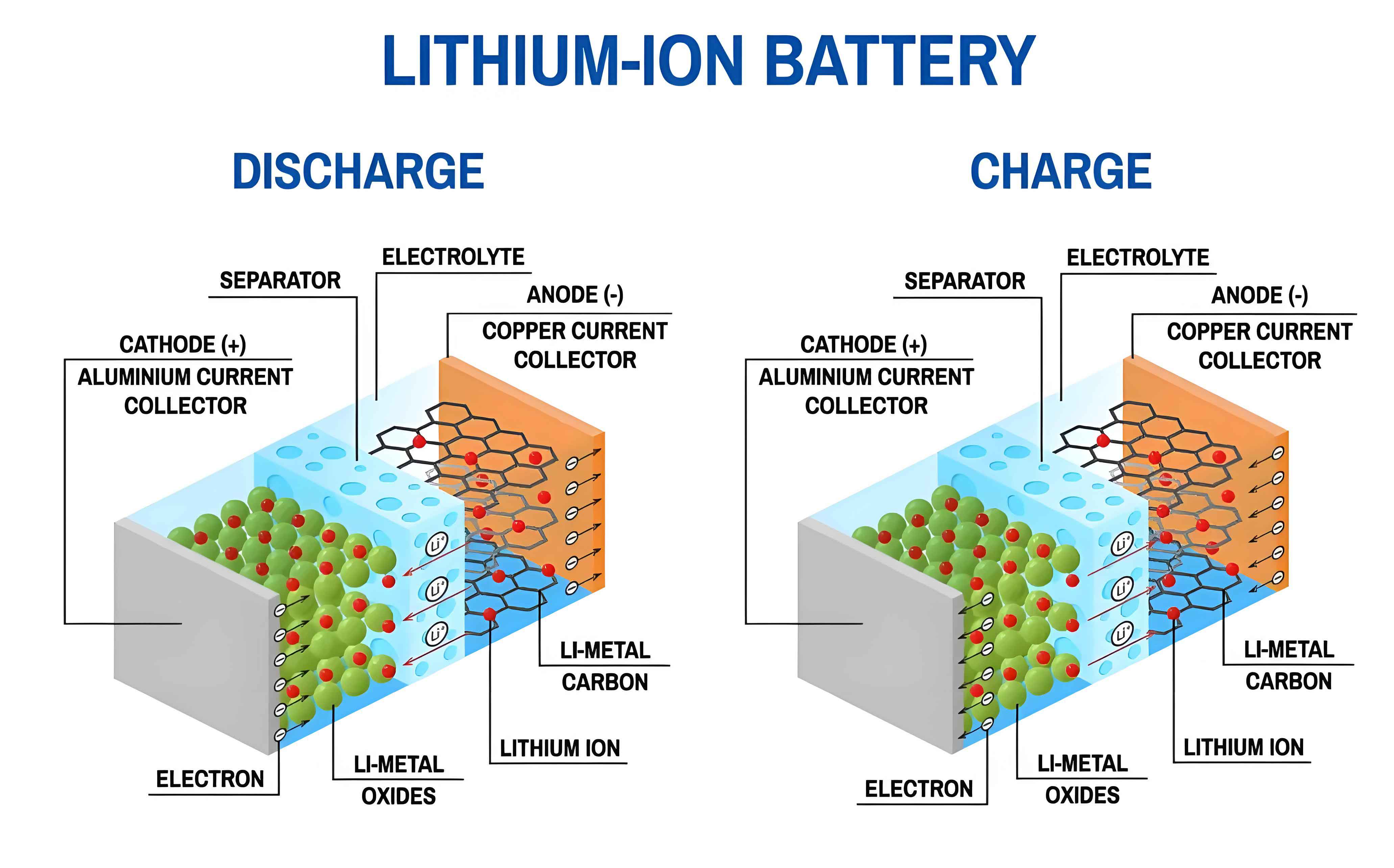
This review summarizes recent advances (primarily within the last five years) in the modification of polyolefin-based separators for li ion battery applications. The strategies are categorized into three main approaches: constructing multilayer film architectures, applying surface coatings, and employing layer-by-layer (LbL) self-assembly techniques. Furthermore, emerging separator materials beyond polyolefins are briefly discussed. The aim is to provide a systematic overview of how these strategies address the critical shortcomings of traditional separators, thereby contributing to the development of safer and more efficient li ion battery technologies.
1. Multilayer Film Structural Modification
This strategy involves co-extruding or laminating layers of different polymers to create a composite separator with synergistic properties. The primary goal is to integrate a “shutdown” function with enhanced dimensional stability. A typical commercial example is the PP/PE/PP trilayer structure. The low-melting-point PE layer (shutdown layer) melts and closes pores at around 130°C, blocking ion flow and halting reactions, while the higher-melting-point PP layers (support layers) maintain mechanical integrity to prevent electrode contact.
Recent research focuses on optimizing materials and structures to widen the safety window. For instance, replacing standard PE with other polymers or composites can adjust the shutdown temperature and improve overall thermal resistance. The properties of a multilayer separator can be described by a composite model. The overall ionic conductivity, $\sigma_{total}$, can be approximated for layers in series as:
$$
\frac{1}{\sigma_{total}} = \sum_{i=1}^{n} \frac{t_i}{\sigma_i}
$$
where $t_i$ and $\sigma_i$ are the thickness and ionic conductivity of the i-th layer, respectively. The thermal shrinkage $S(T)$ at a given temperature $T$ is dominated by the layer with the lowest thermal stability, but constrained by the higher-melting-point layers.
The following table summarizes key developments in multilayer separator design:
| Structure | Key Features & Fabrication | Enhanced Properties | Reference Insight |
|---|---|---|---|
| iPP / PPR+SiO2 / iPP | Multilayer co-extrusion & biaxial stretching. iPP skin, polypropylene random copolymer (PPR) + SiO2 core. | Shutdown at ~150°C (PPR melt). SiO2 increases Li+ transference number (tLi+ ≈ 0.51) via Lewis acid-base interactions with PF6–. | Demonstrates integration of shutdown and ion-transport enhancement in a co-extruded structure. |
| PH / Al2O3 / PE / PH (PH=PVDF-HFP) |
“Hamburger” structure via gravure printing & phase transfer. PE base, Al2O3 heat-resistant layer, PVDF-HFP outer layers. | Superior thermal stability (minimal shrinkage at 150°C). PVDF-HFP layers improve electrode-electrolyte interface. | Highlights the use of a ceramic interlayer for heat shielding and polymer layers for interface engineering. |
| SiO2@PI / m-PE / SiO2@PI | SiO2-doped Polyimide (PI) electrospun mats as outer layers, ethyl cellulose-modified PE as core. | Excellent thermal integrity (stable up to 400°C). Shutdown at 131°C. Enhanced mechanical strength. | Combines the high thermal resistance of PI nanofibers with the shutdown capability of modified PE. |
| PE-BN / PVDF-HFP | Bilayer via solution casting. Hexagonal Boron Nitride (h-BN) filled PE base, PVDF-HFP top layer. | High electrolyte uptake (348%). Low thermal shrinkage (6.6% at 140°C). Improved cycling performance. | Uses h-BN to improve interfacial adhesion between layers and enhance thermal conductivity. |
While multilayer films significantly improve safety, they often increase overall separator thickness, which can reduce the energy density of the li ion battery. The trade-off between safety enhancement and energy density remains a key consideration.
2. Surface Coating Modification
Surface coating is the most commercially adopted modification technique due to its simplicity and scalability. A slurry containing active materials (ceramic particles, polymers, or hybrids) and binders is applied onto one or both sides of a polyolefin substrate, followed by drying. This method directly addresses surface wettability and adds functional properties without altering the bulk substrate.
2.1 Inorganic (Ceramic) Coatings
Coatings with inorganic nanoparticles like Al2O3, SiO2, and TiO2 are prevalent. These particles provide high thermal stability, excellent electrolyte affinity (hydrophilicity), and improved mechanical rigidity. The coating porosity, $\epsilon_c$, significantly impacts performance and is influenced by particle packing and binder content:
$$
\epsilon_c = 1 – \frac{V_{solid}}{V_{coating}} = 1 – \left( \frac{m_p/\rho_p + m_b/\rho_b}{A \cdot t_c} \right)
$$
where $m_p$, $\rho_p$ are mass and density of particles, $m_b$, $\rho_b$ are mass and density of binder, $A$ is area, and $t_c$ is coating thickness.
| Coating Material | Function & Mechanism | Outcome for Li-Ion Battery |
|---|---|---|
| Porous-shell SiO2 | High surface area & porosity enhance electrolyte uptake and retention. | Improved ionic conductivity and rate capability. |
| Oxygen-deficient TiO2 | O-vacancies act as Lewis acid sites, adsorbing EC solvent and promoting Li+ desolvation. | Increased Li+ transference number (from 0.28 to 0.50). |
| Al2O3 & TiO2 Blends | Al2O3 (high thermal conductivity) improves heat dissipation across the separator. | Enhanced thermal stability and reduced local hot spots. |
| SiO2/CNT/Li-salt Hybrid | CNT network improves electronic insulation? (Note: Care needed). SiO2 porosity and Li-salt aid ion transport. | Reported better cycling stability and rate performance. |
Challenges include nanoparticle agglomeration, pore blockage reducing porosity, and potential delamination of brittle ceramic layers during cell cycling.
2.2 Organic Polymer Coatings
Polymer coatings using polar polymers like PVDF, PVDF-HFP, polyimide (PI), or polyethylene oxide (PEO) improve wettability and add flexibility. High-temperature polymers (PI, PEI) specifically enhance thermal stability.
The swelling ratio $Q$ of a polymer coating in electrolyte indicates its affinity and uptake capacity:
$$
Q = \frac{W_s – W_d}{W_d}
$$
where $W_s$ and $W_d$ are the swollen and dry weights of the coated separator, respectively. A higher $Q$ often correlates with lower interfacial resistance.
| Polymer Coating | Key Attribute | Impact on Separator Performance |
|---|---|---|
| Polyvinyl Alcohol (PVA) | Rich hydroxyl groups for superior wettability; forms supportive structure. | High electrolyte uptake, improved compression recovery, stable cycling. |
| PVDF / Cellulose Acetate Butyrate (CAB) | CAB’s acetyl/butyl/hydroxyl groups enhance low-temperature electrolyte compatibility. | High ionic conductivity at low temperatures (0.27 mS/cm at -20°C). |
| Polyimide (PI) Microspheres | High thermal stability (>400°C), polar groups, porous structure. | Near-zero shrinkage at 150°C, contact angle ~5°, excellent adhesion. |
| Polyimide Aerogel (PIA) | Highly porous, thermally stable support layer. | Maintains dimensional stability at 140°C, excellent wettability and cycling. |
2.3 Organic/Inorganic Hybrid Coatings
This approach synergizes the benefits of both components: the inorganic part provides thermal stability and wettability, while the organic polymer binder ensures cohesion, flexibility, and strong adhesion to the substrate. The effective medium theory can sometimes approximate the composite coating’s properties.
| Hybrid Coating System | Composition & Design | Synergistic Advantages |
|---|---|---|
| Cross-linked PAIX / Al2O3 / PVDF | Thermostable polyamide-imide (PAIX) matrix with Al2O3 filler. | No shrinkage after 1h at 150°C in electrolyte. Robust composite layer. |
| Atomic Layer Deposited Al2O3 + Polydopamine (PDA) | Ultra-thin ALD Al2O3 followed by adhesive PDA coating. | Minimal thickness increase, no separate binder needed. Enhanced cycle life (79% capacity retention). |
| Catechol-PEO-Ladder Polysilsesquioxane | Inorganic ladder framework with organic PEO and catechol groups. | Excellent wettability from PEO/roughness, strong adhesion from catechol. Stable long-term cycling. |
| Molecular Sieve (MS) / Sulfonated Melamine-Formaldehyde (SMF) | Inorganic MS and organic SMF blend. | Functional groups weaken Li+ solvation, accelerating transport. Effectively suppresses Li dendrite growth. |
| Hydroxypropyl Methylcellulose (HPMC) / SnO2 | HPMC template for in-situ growth of lithiophilic SnO2. | SnO2 promotes uniform Li deposition. Enables stable Li plating/stripping for over 2000 hours. |
Despite their effectiveness, coating techniques inevitably increase thickness and may reduce porosity if not carefully controlled. Delamination under long-term electrolyte exposure remains a concern for some systems.
3. Layer-by-Layer (LbL) Self-Assembly Modification
LbL assembly is a versatile technique for constructing ultra-thin, conformal multilayers on a substrate by alternating exposure to oppositely charged polyelectrolytes or species with specific interactions (e.g., hydrogen bonding). This method allows precise control over coating thickness at the nanometer scale without pore clogging.
The growth of an LbL film often follows a linear or exponential model. The mass or thickness $d$ after $n$ bilayers can be expressed as:
$$
d(n) = d_0 + n \cdot \Delta d_{bilayer}
$$
where $d_0$ is the initial substrate effect and $\Delta d_{bilayer}$ is the average thickness added per bilayer, dependent on deposition conditions and molecular interactions.
| LbL Assembly System | Driving Force & Components | Key Improvements for Li-Ion Battery Separator |
|---|---|---|
| Tannic Acid (TA) / Polyethyleneimine (PEI) | Hydrogen bonding and covalent interactions. | Greatly enhanced wettability. Higher ionic conductivity (0.95 mS/cm) and tLi+ (0.44). Excellent capacity retention (90.9% after 200 cycles). |
| ZrO2 / POSS (Polyhedral Oligomeric Silsesquioxane) | Electrostatic assembly of inorganic nanoparticles. | Promotes Li+ desolvation. Increases tLi+ and ionic conductivity. Suppresses Li dendrite growth. Good thermal stability from inorganic layers. |
| PEI / SiO2 | Electrostatic assembly on carboxylated PE. | Ultra-thin coating. Contact angle reduced from 124° to 24.6°. Electrolyte uptake increased to 398%. Si-O units trap anions, improving anode stability. |
| PEI / PAA with MMT or Halloysite Clay | Electrostatic assembly with clay nanoparticles. | MMT provides flame retardancy. Halloysite offers ultra-high thermal stability. Coated separator shows lower shrinkage (27% vs. 37% for PP at 150°C). |
The LbL technique’s main drawback is its sequential, time-consuming deposition process, which poses challenges for high-throughput, cost-effective manufacturing of li ion battery separators.
4. Emerging Separator Materials Beyond Polyolefins
While modifying polyolefins is crucial, exploring novel material systems is essential for breakthrough performance. These materials often intrinsically possess high thermal stability, excellent wettability, or unique functionalities.
Non-Polyolefin Porous Membranes: Materials like Poly(ether ether ketone) (PEEK), polybenzimidazole (PBI), and poly(phenylene sulfide) (PPS) are investigated for their exceptional thermal and chemical stability. For example, a sponge-like PEEK membrane showed a porosity of 78% and remained dimensionally stable at 350°C without melting, far outperforming PE. Bacterial cellulose (BC) composites with flame-retardant additives have also demonstrated high mechanical strength, intrinsic wettability, and excellent flame resistance.
Electrospun Nanofiber Membranes: Electrospinning produces separators with high porosity, interconnected pores, and large surface area, facilitating superior electrolyte uptake and ion transport. Common materials include:
- PVDF & PVDF-HFP: Good polarity and electrochemical stability.
- Polyacrylonitrile (PAN): High polarity and thermal stability.
- Polyimide (PI): Exceptional thermal and mechanical properties.
Core-shell nanofiber designs are particularly promising. For instance, a PAN@PBS (polybutylene succinate) separator with PAN as the high-melting core and PBS as the low-melting shell provided a sharp shutdown at 110°C while maintaining integrity at 250°C. The ionic conductivity $\sigma$ of such fibrous mats can be related to their porosity $\epsilon$ and tortuosity $\tau$ via the Bruggeman relation: $\sigma \propto \epsilon / \tau$.
Although these advanced materials offer outstanding properties, their high cost and more complex fabrication processes currently limit widespread adoption in commercial li ion battery production.
5. Summary and Future Perspectives
The modification of polyolefin-based separators is a dynamic field critical for advancing li ion battery technology, primarily targeting enhanced safety (thermal stability) and electrochemical performance (wettability, ion transport). Each strategy presents a distinct set of trade-offs:
| Modification Strategy | Primary Advantages | Key Challenges & Trade-offs |
|---|---|---|
| Multilayer Films | Integrated shutdown functionality; good mechanical integrity. | Increased thickness reduces energy density; complex co-extrusion processes. |
| Surface Coatings | Simple, scalable, versatile. Directly improves surface properties. | Risk of pore blockage and delamination; increased thickness and resistance. |
| Layer-by-Layer Assembly | Ultra-thin, conformal coatings; minimal impact on porosity. | Time-consuming process; not easily scalable for mass production. |
| Novel Materials (e.g., Electrospun PI, PEEK) | Intrinsically high thermal/chemical stability; often excellent wettability. | High material and processing costs; manufacturing scalability. |
Future research and development for next-generation li ion battery separators should focus on the following directions:
- Fundamental Improvement of Polyolefin Separators: Developing novel polyolefin composites or copolymer structures that intrinsically possess higher thermal stability and surface energy remains a high-impact, cost-effective goal for the existing li ion battery industry.
- Multifunctional Hybrid Designs: Research should focus on smart, multi-component coatings or layers that combine thermal shutdown, dendrite suppression (e.g., via lithiophilic or ion-redistributing materials), flame retardancy, and self-healing properties into a single, thin separator architecture.
- Advanced Manufacturing and Scalability: Bridging the gap between lab-scale innovations and industrial production is paramount. Developing continuous, roll-to-roll processes for applying advanced coatings (like LbL-inspired methods) or fabricating electrospun separators at high speed and low cost is a critical challenge that must be addressed to bring advanced separators to the market.
In conclusion, the separator is far from a passive component in a li ion battery. Its continuous evolution through material science and engineering innovations is essential for realizing the full potential of lithium-ion technology in terms of energy, power, cycle life, and, most importantly, safety for demanding applications like electric transportation and large-scale energy storage.