
I have always been fascinated by the evolution of energy storage, particularly the li ion battery. Its journey from a laboratory curiosity to a global powerhouse is a tale of missed opportunities, relentless innovation, and serendipity. As I reflect on this history, I aim to share the intricate story of how the rechargeable li ion battery came to be, weaving through scientific breakthroughs and commercial missteps. The li ion battery now powers our world, but its path was anything but straightforward.
In the early 1970s, as concerns about oil depletion grew, researchers began exploring alternatives. I remember reading about the initial forays into rechargeable batteries, where the concept of an embedded li ion battery was first realized. This early version used a titanium disulfide cathode and a lithium metal anode, operating on the principle of lithium ion intercalation. The reaction can be summarized as:
$$ \text{Li} + \text{TiS}_2 \rightleftharpoons \text{LiTiS}_2 $$
This was a groundbreaking departure from traditional batteries like nickel-cadmium, which had lower voltage outputs. The li ion battery demonstrated a remarkable 2.4 volts, hinting at its potential. However, despite this innovation, the technology languished for years. Companies failed to grasp the immense promise of the li ion battery, often dismissing it as too niche or premature.
As I delved deeper, I found that the next major leap came from academic circles. A research group at a university in the UK improved upon the original design by replacing the cathode material with lithium cobalt oxide. This change significantly boosted the voltage to 4 volts, a critical enhancement for practical applications. The electrochemical reaction for this improved li ion battery can be expressed as:
$$ \text{Li} + \text{CoO}_2 \rightleftharpoons \text{LiCoO}_2 $$
This formula highlights the higher energy density achievable with cobalt-based cathodes, a key factor in the eventual success of the li ion battery. Yet, even with this advancement, commercialization remained elusive. The academic institution showed little interest in patenting, and industrial partners were skeptical. The li ion battery seemed destined to remain in the lab.
To illustrate the progression, I have compiled a table comparing the key characteristics of these early li ion battery variants:
| Development Phase | Cathode Material | Anode Material | Nominal Voltage (V) | Key Improvement |
|---|---|---|---|---|
| Initial Concept | Titanium Disulfide (TiS₂) | Lithium Metal (Li) | 2.4 | Introduction of intercalation chemistry |
| Academic Enhancement | Lithium Cobalt Oxide (LiCoO₂) | Lithium Metal (Li) | 4.0 | Higher voltage and energy density |
| Safety Focus | Lithium Cobalt Oxide (LiCoO₂) | Carbon-based (e.g., petroleum coke) | 3.6-3.7 | Improved stability and reduced risk |
The turning point arrived when attention shifted to safety. A chemical company in Japan tackled the volatility of lithium metal anodes by experimenting with carbon-based materials. After numerous trials, they settled on petroleum coke, which offered a stable host for lithium ions. The reaction in this safer li ion battery configuration is:
$$ \text{Li}_x\text{C} + \text{LiCoO}_2 \rightleftharpoons \text{C} + \text{Li}_{1-x}\text{CoO}_2 $$
This innovation was crucial because it addressed the flammability issues that had plagued earlier designs. The li ion battery was now not only powerful but also safer for everyday use. However, the company lacked manufacturing expertise, so they sought external help to create prototypes. This step underscored the gap between scientific discovery and industrial application for the li ion battery.
As I pieced together the narrative, I realized that the commercialization saga was fraught with hesitation. Multiple entities had the chance to capitalize on the li ion battery but let it slip away. For instance, an oil giant abandoned the technology after limited production, while a European research lab filed a patent and forgot about it. The li ion battery’s potential was clear, yet it remained undervalued. To quantify these missed opportunities, consider the following table summarizing the critical junctures:
| Entity Type | Action Taken | Outcome for Li Ion Battery | Reason for Missed Opportunity |
|---|---|---|---|
| Oil Corporation | Developed early prototype, then licensed it out | Technology stagnated; no mass production | Perceived limited market and strategic shift |
| University | Refused to patent key cathode innovation | Lost intellectual property rights | Lack of commercial focus and funding |
| Chemical Company | Created safer anode but hesitated on manufacturing | Delayed entry into battery market | Uncertainty about new industry and resources |
| Research Laboratory | Patented cathode formula but ignored it | Passive royalty income later | Failure to foresee market scale and application |
The breakthrough finally came when a consumer electronics firm recognized the value of the li ion battery. They were developing portable camcorders and needed compact, high-energy batteries. Upon seeing a prototype, they swiftly integrated the technology, refining it for mass production. This involved optimizing materials like binders, electrolytes, and separators. The overall cell reaction for a modern li ion battery can be simplified as:
$$ \text{LiC}_6 + \text{CoO}_2 \rightleftharpoons \text{C}_6 + \text{LiCoO}_2 $$
This equation represents the reversible movement of lithium ions between graphite-based anode and cobalt oxide cathode, the hallmark of today’s li ion battery. The firm’s success was due to their unique position as both battery maker and device manufacturer, allowing them to appreciate the li ion battery’s dual role as component and enabler.
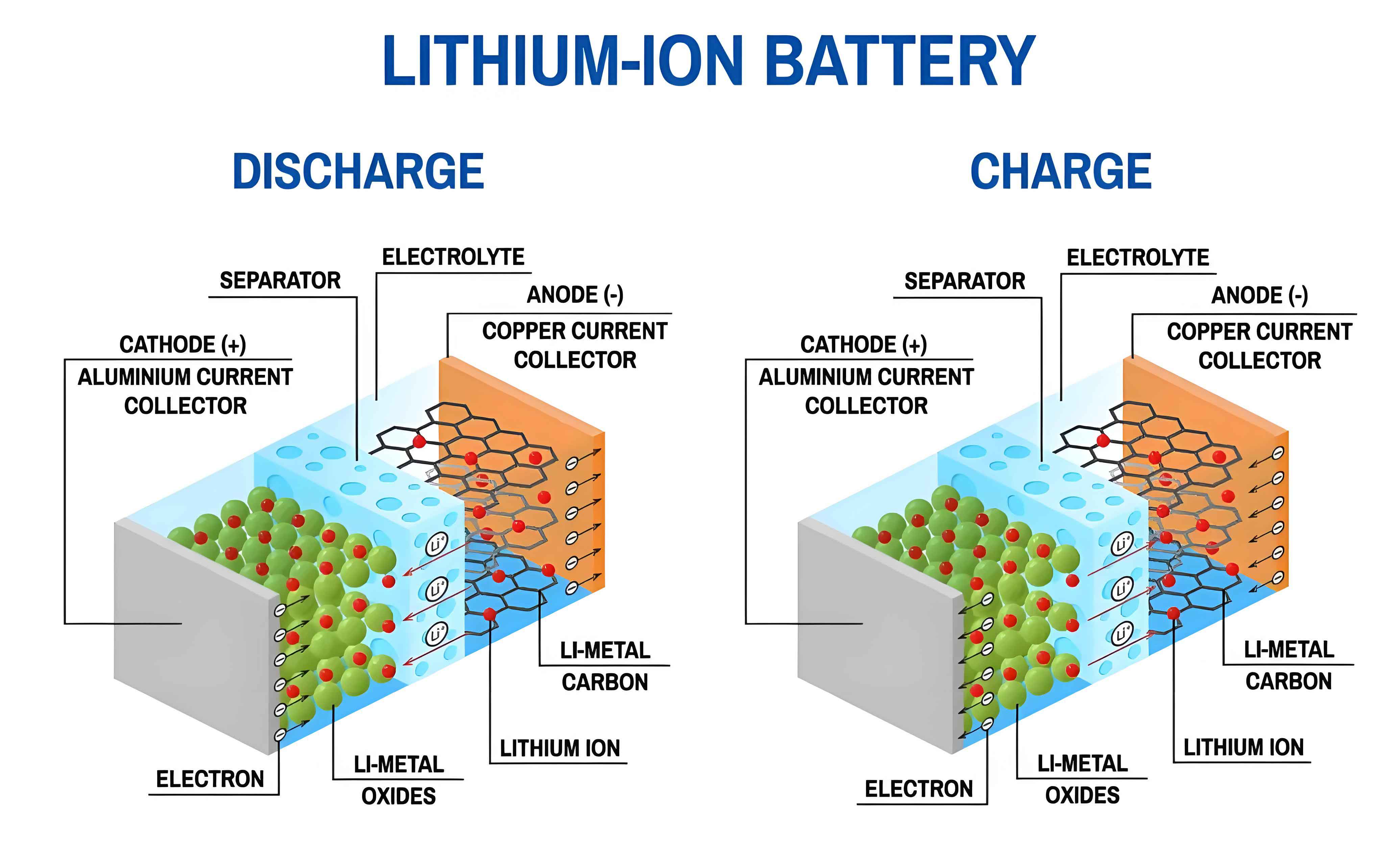
Looking back, the commercialization of the li ion battery was a blend of preparation and chance. The electronics company’s engineers had been seeking better power sources, so when a prototype arrived, they were ready to act. This aligns with the adage that fortune favors the prepared mind. The li ion battery’s journey from lab to market took nearly two decades, but once unleashed, it revolutionized industries. Today, the li ion battery is ubiquitous, yet its origins remind us that innovation often requires persistence and vision.
To understand the performance metrics that made the li ion battery dominant, let’s examine some key formulas. The energy density \( E \) of a li ion battery can be calculated as:
$$ E = \frac{V \times Q}{m} $$
where \( V \) is the voltage, \( Q \) is the capacity in ampere-hours, and \( m \) is the mass. For instance, early li ion batteries had energy densities around 100 Wh/kg, while modern versions exceed 250 Wh/kg. Another critical aspect is the cycle life, often modeled by capacity fade over cycles:
$$ C_n = C_0 \times (1 – \alpha)^n $$
Here, \( C_n \) is the capacity after \( n \) cycles, \( C_0 \) is the initial capacity, and \( \alpha \) is the degradation rate per cycle. The li ion battery’s low \( \alpha \) value, thanks to stable intercalation chemistry, enabled thousands of recharge cycles, making it ideal for consumer electronics and electric vehicles.
The evolution of cathode materials has been pivotal for the li ion battery. Beyond cobalt oxide, variants like lithium iron phosphate (LiFePO₄) and nickel manganese cobalt (NMC) have emerged. Their reactions involve similar intercalation mechanisms:
$$ \text{Li} + \text{FePO}_4 \rightleftharpoons \text{LiFePO}_4 $$
$$ \text{Li} + \text{NiMnCoO}_2 \rightleftharpoons \text{LiNiMnCoO}_2 $$
These materials offer trade-offs in cost, safety, and energy density, broadening the applications of the li ion battery. Similarly, anode innovations, such as silicon composites, aim to increase capacity. The reaction for silicon anodes is:
$$ \text{Li} + \text{Si} \rightleftharpoons \text{Li}_x\text{Si} $$
though challenges like volume expansion persist. The continuous refinement of the li ion battery underscores its dynamic nature.
In retrospect, the story of the li ion battery is a testament to collaborative science and missed commercial cues. Numerous researchers contributed pieces to the puzzle, but it took a convergence of need and capability to bring it to life. The li ion battery now stands as a cornerstone of modern technology, with annual sales soaring and future prospects bright. As I conclude this exploration, I am struck by how a simple concept—shuttling lithium ions between electrodes—transformed our world. The li ion battery’s journey reminds us that true invention often lies not just in creation, but in recognition and execution.