
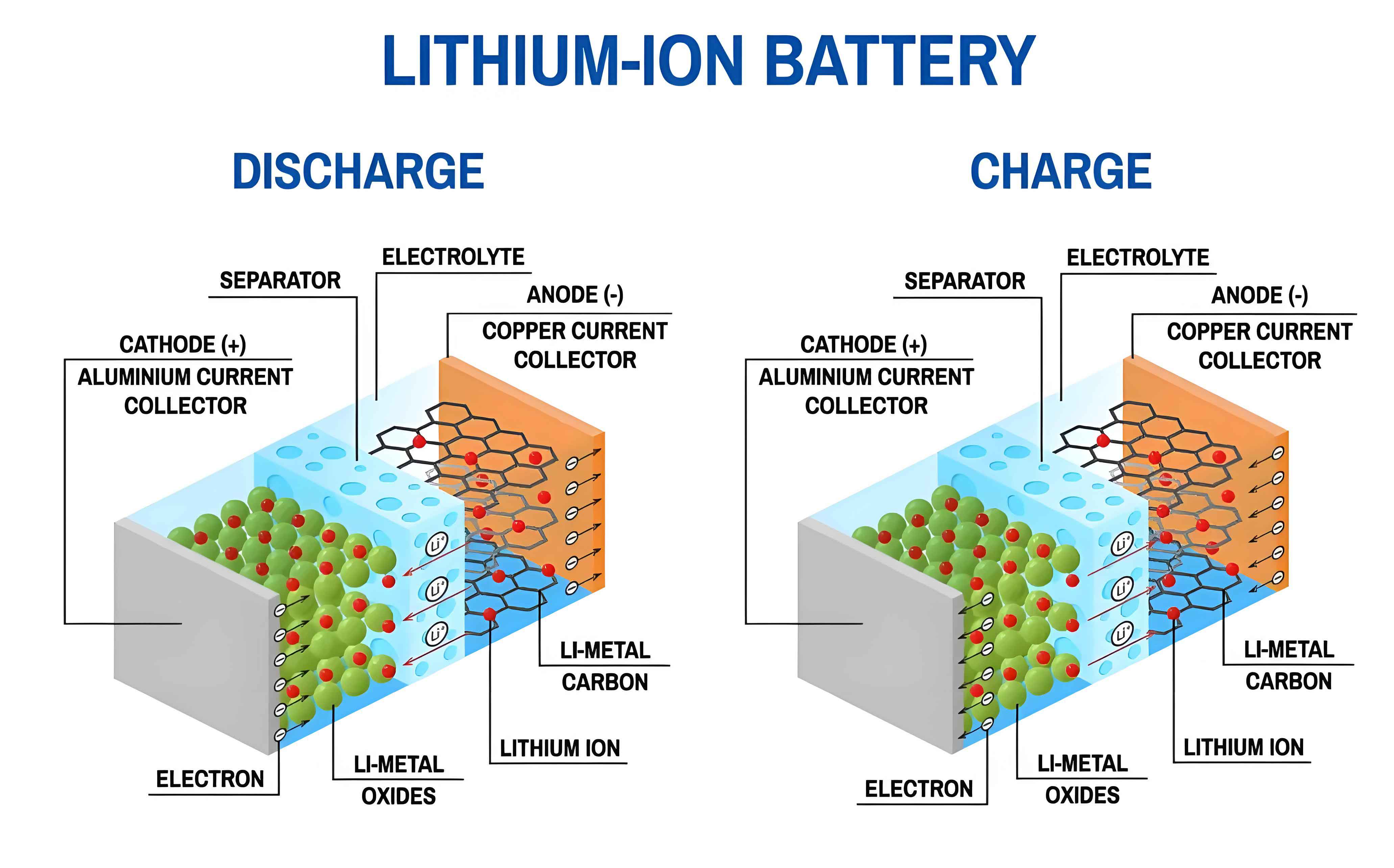
The widespread adoption of lithium iron phosphate (LiFePO₄) as a cathode material in li ion battery technology, particularly for electric vehicles and energy storage, has led to a significant accumulation of retired cells. The recycling of these spent li ion battery units is not only an environmental imperative to prevent pollution but also a strategic necessity to recover valuable elements like lithium, iron, and phosphorus, thereby closing the loop in the new energy industry chain. This article details a comprehensive wet metallurgical process for the recovery and regeneration of battery-grade materials from spent LiFePO₄ li ion battery black mass.
1. Experimental Methodology and Process Flow
The core of our recycling strategy follows the route of “electrically discharged crushing – acid leaching – chemical purification – selective separation – controlled synthesis.” The initial step involves the safe dismantling and inert-atmosphere crushing of the retired LiFePO₄ li ion battery packs to obtain a black powder, which primarily contains the cathode active material, conductive carbon, and residues from other components. The typical elemental composition of this black mass, as determined in our laboratory, is presented in Table 1.
| Element | Mass Fraction (%) | Element | Mass Fraction (%) |
|---|---|---|---|
| Lithium (Li) | 3.4 | Carbon (C) | 42.1 |
| Iron (Fe) | 30.1 | Copper (Cu) | 3.7 |
| Phosphorus (P) | 17.9 | Aluminum (Al) | 1.2 |
The overall process flow, which will be elaborated in the following sections, is summarized below:
- Calcination of the black powder under inert atmosphere.
- Sulfuric acid leaching to dissolve valuable metals.
- Purification steps: Copper removal via iron powder cementation and aluminum removal via ammonium sulfate precipitation.
- Synthesis of battery-grade anhydrous iron phosphate (FePO₄) from the purified leachate.
- Synthesis of battery-grade lithium carbonate (Li₂CO₃) from the mother liquor after FePO₄ precipitation.
- Regeneration of LiFePO₄/C cathode material via a high-temperature solid-state reaction using the recovered FePO₄ and Li₂CO₃.
2. Calcination and Acid Leaching
The black mass was first calcined at 500-600°C under a nitrogen atmosphere for 3-5 hours. This step helps to remove residual organic components (e.g., binders, electrolyte solvents) and convert any low-valent iron to a more leachable form, facilitating the subsequent acid digestion process. The leaching process is the cornerstone for liberating the valuable elements from the solid matrix into an aqueous solution. Sulfuric acid (H₂SO₄) was chosen as the lixiviant due to its effectiveness and cost-efficiency. The primary chemical reactions during the leaching of LiFePO₄ and key metallic impurities are:
$$ \text{LiFePO}_4 + \text{H}_2\text{SO}_4 \rightarrow \text{LiH}_2\text{PO}_4 + \text{FeSO}_4 \quad \text{(1)} $$
$$ 2\text{Al} + 3\text{H}_2\text{SO}_4 \rightarrow \text{Al}_2(\text{SO}_4)_3 + 3\text{H}_2 \uparrow \quad \text{(2)} $$
$$ \text{Cu} + 2\text{H}_2\text{SO}_4 \rightarrow \text{CuSO}_4 + 2\text{H}_2\text{O} + \text{SO}_2 \uparrow \quad \text{(3)} $$
The efficiency of this step is critical for the overall recovery yield of the li ion battery materials. We investigated the effects of acid dosage and reaction temperature on the leaching rate of Li, Fe, and P. The leaching rate for an element, for example lithium, is calculated as:
$$ R_{Li} = \left(1 – \frac{m_{\text{residue}} \times w_{\text{residue}}(Li)}{m_{\text{feed}} \times w_{\text{feed}}(Li)}\right) \times 100\% $$
Where \( R_{Li} \) is the lithium leaching rate (%), \( m \) represents mass, and \( w \) represents the mass fraction of lithium in the feed or residue.
The results are consolidated in Tables 2 and 3. An acid dosage of 1.6 times the stoichiometric requirement and a temperature of 90°C were identified as optimal, achieving leaching rates exceeding 97% for all three key elements, thereby ensuring a high recovery efficiency from the spent li ion battery feedstock.
| H₂SO₄ (Multiple of Stoichiometry) | Li Leaching Rate (%) | Fe Leaching Rate (%) | P Leaching Rate (%) |
|---|---|---|---|
| 1.2 | >98 | 92.15 | 94.80 |
| 1.4 | >98 | 96.50 | 97.22 |
| 1.6 | >98 | 97.85 | 98.31 |
| 1.8 | >98 | 97.20 | 97.85 |
| Temperature (°C) | Li Leaching Rate (%) | Fe Leaching Rate (%) | P Leaching Rate (%) |
|---|---|---|---|
| 70 | 97.50 | 95.01 | 96.44 |
| 80 | 98.10 | 96.88 | 97.65 |
| 90 | 98.85 | 97.85 | 98.31 |
3. Deep Purification of the Leachate: Removal of Copper and Aluminum
The leachate from the spent li ion battery material contains the target elements (Li, Fe, P) alongside impurities like Cu and Al, which originated from the current collectors and casing. Their presence is detrimental to the performance of regenerated cathode materials and must be removed to very low levels (ppm grade).
3.1 Copper Removal via Iron Powder Cementation
Copper ions (Cu²⁺) in the solution can be effectively removed by redox replacement using metallic iron powder. The standard reduction potentials dictate the reaction order: Fe³⁺ is reduced first, followed by Cu²⁺, and finally H⁺. The relevant reaction for copper removal is:
$$ \text{Cu}^{2+} + \text{Fe} \rightarrow \text{Fe}^{2+} + \text{Cu} \downarrow \quad \text{(4)} $$
This method is advantageous as it introduces no foreign anions. As shown in Table 4, adding iron powder at 1.4 times the theoretical amount required to reduce all Cu²⁺ effectively lowers the copper concentration in the solution to below 1 ppm (0.0001%), achieving deep purification suitable for li ion battery material synthesis.
| Fe Powder (Multiple of Theor.) | Cu Mass Fraction in Solution (%) | Fe:P Molar Ratio in Solution |
|---|---|---|
| 1.0 | 0.1769 | 0.960:1.000 |
| 1.3 | 0.0260 | 0.914:1.000 |
| 1.4 | <0.0001 | 1.017:1.000 |
| 1.5 | <0.0001 | 0.967:1.000 |
3.2 Aluminum Removal via Chemical Precipitation
Aluminum exists as Al³⁺ in the sulfate solution. A highly selective method for its removal is precipitation as ammonium aluminum sulfate dodecahydrate (ammonium alum), achieved by adding ammonium sulfate ((NH₄)₂SO₄):
$$ \text{Al}_2(\text{SO}_4)_3 + (\text{NH}_4)_2\text{SO}_4 + 24\text{H}_2\text{O} \rightarrow 2\text{NH}_4\text{Al}(\text{SO}_4)_2\cdot12\text{H}_2\text{O} \downarrow \quad \text{(5)} $$
The solubility of this double salt is sensitive to temperature and acidity. Our investigations, summarized in Table 5, determined that operating at 65°C and a pH of 1.0 minimizes aluminum solubility, reducing its concentration to approximately 6 ppm (0.0006%). This represents a highly effective purification step crucial for the quality of the final li ion battery materials.
| Parameter | Condition | Resulting Al Mass Fraction | Conclusion |
|---|---|---|---|
| Temperature | 40-65°C | <0.0008% | Optimum at 65°C |
| 80°C | ~0.0016% | ||
| 90°C | >0.002% | ||
| pH | 0.5 | ~0.00085% | Optimum at pH 1.0 |
| 1.0 | ~0.0006% |
4. Synthesis of Battery-Grade Anhydrous Iron Phosphate (FePO₄)
The purified solution, now containing primarily Fe²⁺, Li⁺, PO₄³⁻, and SO₄²⁻, is the feedstock for FePO₄ synthesis. Hydrogen peroxide (H₂O₂) is first added to oxidize all ferrous iron to ferric iron:
$$ 2\text{Fe}^{2+} + \text{H}_2\text{O}_2 + 2\text{H}^+ \rightarrow 2\text{Fe}^{3+} + 2\text{H}_2\text{O} $$
Subsequently, the pH of the solution is carefully raised to between 1.2 and 2.0 using ammonia water. Within this controlled pH window, FePO₄ precipitates selectively according to its very low solubility product, while impurities like Li⁺, Cu²⁺, and the trace amounts of Al³⁺ remain in solution. The relevant solubility product constants (K_sp) explain this selectivity:
| Compound | Dissolution Equilibrium | K_sp |
|---|---|---|
| FePO₄ | FePO₄ ⇌ Fe³⁺ + PO₄³⁻ | 1.30 × 10⁻²² |
| AlPO₄ | AlPO₄ ⇌ Al³⁺ + PO₄³⁻ | 9.84 × 10⁻²¹ |
| Fe(OH)₃ | Fe(OH)₃ ⇌ Fe³⁺ + 3OH⁻ | 4.01 × 10⁻³⁸ |
The precipitated FePO₄·xH₂O is filtered, washed, dried, and finally calcined at 700-750°C to obtain anhydrous, crystalline FePO₄. The key properties of the product are listed in Table 7, confirming it meets the stringent specifications for battery-grade material, which is essential for manufacturing high-performance li ion battery cathodes.
| Parameter | Synthesized Product | Battery-Grade Specification |
|---|---|---|
| Fe Mass Fraction (%) | 36.48 | ≥35.8 |
| P Mass Fraction (%) | 20.78 | ≥20.0 |
| Cu Mass Fraction (%) | <0.0001 | ≤0.005 |
| Al Mass Fraction (%) | 0.0016 | ≤0.01 |
| n(Fe):n(P) Molar Ratio | 0.972:1.000 | 0.96-1.02:1.00 |
| D₅₀ (µm) | 2.11 | 2-6 |
| BET Surface Area (m²/g) | 7.50 | 7-16 |
5. Recovery of Lithium as Battery-Grade Carbonate
Following FePO₄ precipitation, the mother liquor is rich in lithium sulfate (Li₂SO₄). Residual iron is first removed by adjusting the pH to 7.0. The clarified solution is then concentrated by evaporation to increase the lithium ion concentration to 15-20 g/L. Lithium carbonate is precipitated by adding a saturated sodium carbonate (Na₂CO₃) solution:
$$ \text{Li}_2\text{SO}_4 + \text{Na}_2\text{CO}_3 \rightarrow \text{Li}_2\text{CO}_3 \downarrow + \text{Na}_2\text{SO}_4 \quad \text{(6)} $$
The crude Li₂CO₃ is washed, dried, and analyzed. As shown in Table 8, the product purity exceeds 99.5% with impurity levels well below the limits for battery-grade carbonate, making it a perfect precursor for synthesizing new li ion battery cathode materials.
| Impurity Element | Mass Fraction in Product (%) | Battery-Grade Limit (%) |
|---|---|---|
| Na | 0.0051 | ≤0.025 |
| K | 0.0003 | ≤0.001 |
| Ca | 0.0036 | ≤0.005 |
| Fe | 0.0002 | ≤0.001 |
| Cu | 0.0001 | ≤0.0003 |
| SO₄²⁻ | 0.0327 | ≤0.08 |
| Li₂CO₃ Purity | 99.54 | ≥99.5 |
6. Regeneration of LiFePO₄/C Cathode Material and Electrochemical Performance
The closed-loop regeneration was completed by synthesizing new LiFePO₄ cathode material from the recovered precursors. The battery-grade FePO₄ and Li₂CO₄ were mixed with glucose (as a carbon source) in a stoichiometric ratio (n(Li):n(Fe) ≈ 1.04:1.00). The mixture was ball-milled, spray-dried, and then subjected to a high-temperature solid-state reaction at 750°C under a nitrogen atmosphere. This process yields a carbon-coated LiFePO₄ (LiFePO₄/C) powder.
The electrochemical performance of the regenerated li ion battery cathode material was evaluated by assembling CR2032-type coin cells. The charge-discharge profiles at 0.1C rate (between 2.00 V and 3.75 V) are shown in Figure 6. The regenerated LiFePO₄ delivered a charge specific capacity of 162.96 mAh/g and a discharge specific capacity of 159.31 mAh/g in the first cycle, corresponding to a high initial Coulombic efficiency of 97.76%. These values are comparable to those of commercial LiFePO₄ products derived from virgin materials, unequivocally demonstrating the technical feasibility and high quality of the recycling and regeneration process for li ion battery components.
7. Conclusion
This work establishes a viable and efficient wet process for the comprehensive recovery of key materials from spent LiFePO₄ li ion battery cells. The optimized sulfuric acid leaching achieved extraction rates over 97% for Li, Fe, and P. The developed purification sequence employing iron powder cementation and ammonium sulfate precipitation enabled deep removal of critical impurities like Cu and Al to ppm levels. The purified solution was successfully converted into high-purity, battery-grade anhydrous iron phosphate and lithium carbonate. Finally, these recovered materials were used to regenerate a LiFePO₄/C cathode material that exhibited excellent electrochemical performance, matching that of commercially available products. This process provides a complete technical route for the sustainable and circular management of retired li ion battery resources, contributing significantly to the environmental and economic sustainability of the electric vehicle and energy storage industries.