
In the rapidly evolving landscape of portable electronics and electric vehicles, the demand for high-performance energy storage systems has never been greater. As a leading candidate, lithium-ion batteries have dominated the market due to their high energy density, long cycle life, and environmental friendliness. However, the ongoing quest for higher capacity and improved efficiency drives continuous research into advanced electrode materials. The anode, in particular, plays a pivotal role in determining the overall performance of a li ion battery. Traditional graphite anodes, while reliable, offer a limited theoretical capacity of 372 mAh/g, which falls short of the requirements for next-generation applications. This has spurred interest in silicon-based materials, which boast an exceptionally high theoretical capacity of 4200 mAh/g. Despite this advantage, silicon suffers from significant volume expansion during lithiation and delithiation cycles, leading to particle pulverization and rapid capacity fade. Moreover, its poor electrical conductivity further hampers performance in li ion battery systems. To address these challenges, silicon-carbon composites have emerged as a promising solution, combining the high capacity of silicon with the structural stability and conductivity of carbon. In this study, we explore the fabrication of silicon-carbon composite anode materials using industrial graphite scrap and micron-sized silicon, with a focus on optimizing composition and coating parameters to enhance electrochemical performance. The integration of carbon coatings, derived from pitch, aims to mitigate the drawbacks of silicon while leveraging its high capacity, ultimately contributing to the development of superior li ion battery technologies.
The core objective of this work is to systematically investigate the effects of silicon-to-carbon mass ratio and pitch coating content on the structural and electrochemical properties of silicon-carbon composites. By employing a coating technique, we aim to produce a material that balances high reversible capacity with stable cycling performance. The use of industrial by-products, such as graphite electrode scraps, not only reduces costs but also aligns with sustainable practices in li ion battery manufacturing. Through detailed characterization and electrochemical testing, we seek to establish optimal processing conditions that can be scaled for practical applications. This research underscores the importance of material engineering in advancing li ion battery technology, particularly for high-demand sectors like electric vehicles and grid storage. As we delve into the experimental details, we will present findings using tables and mathematical models to provide a comprehensive analysis, ensuring that key insights are clearly communicated for further innovation in the field.
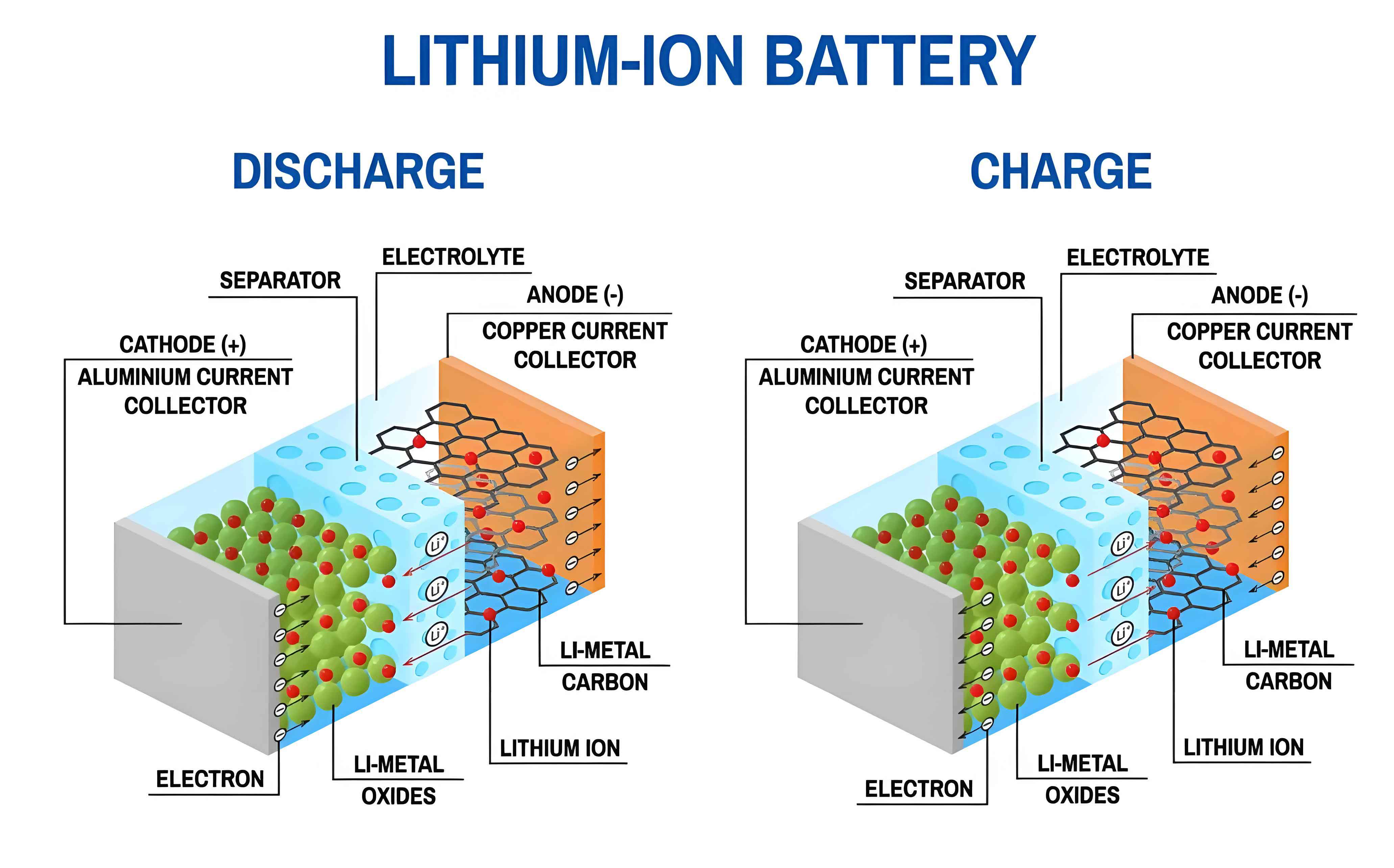
In our experimental approach, we utilized industrial graphite electrode scraps as the primary carbon source. These scraps were crushed and sieved to obtain particles in the range of 400 to 800 mesh (approximately 38 to 18 μm). Micron-sized silicon powder, with a median particle diameter (D50) of 1 μm, was blended with the graphite in varying mass fractions to study the impact of silicon content. The mixtures were homogenized via ball milling for one hour to ensure uniform distribution. Subsequently, medium-temperature pitch was added as a coating precursor in different proportions relative to the silicon-graphite mixture. The coating process was conducted in a reactor under nitrogen atmosphere at 170°C with continuous stirring for three hours. After cooling, the coated materials were carbonized in a tube furnace at 900°C for two hours under nitrogen flow, resulting in the final silicon-carbon composites. This method leverages the carbonization of pitch to form a conductive carbon layer that encapsulates the silicon particles, potentially alleviating volume changes and enhancing electrical connectivity within the li ion battery anode.
For electrochemical evaluation, coin cells were assembled in an argon-filled glovebox. The composite materials were mixed with acetylene black and polyvinylidene fluoride (PVDF) binder in a mass ratio of 8:1:1, using N-methyl-2-pyrrolidone (NMP) as the solvent to form a slurry. This slurry was coated onto copper foil, dried at 80°C under vacuum for 12 hours, and punched into 12 mm diameter discs as working electrodes. Lithium metal foil served as the counter electrode, with a Celgard-2400 polypropylene membrane as the separator and 1 M LiPF6 in a mixture of ethylene carbonate, dimethyl carbonate, and ethyl methyl carbonate (EC:DMC:EMC = 1:1:1 by volume) as the electrolyte. The cells were subjected to galvanostatic charge-discharge tests between 0.01 and 3.0 V at 25°C to assess capacity, cycle life, and rate capability. Structural characterization was performed using scanning electron microscopy (SEM) to examine morphology and coating uniformity. All these steps are critical for understanding the behavior of the materials in a li ion battery context.
The influence of silicon content on the electrochemical performance of the composites was first examined. We prepared samples with silicon mass fractions of 0%, 4%, 8%, and 12%, while keeping other parameters constant. The discharge capacity and cycling stability were measured, and the data are summarized in Table 1. As expected, the initial discharge capacity increased with higher silicon content, due to the contribution from silicon’s high theoretical capacity. However, this came at the cost of reduced coulombic efficiency and cycle retention. For instance, the composite with 12% silicon exhibited an initial discharge capacity of 707.4 mAh/g but a low first-cycle coulombic efficiency of 69.2% and a poor capacity retention of only 21.1% after 30 cycles. In contrast, the sample with 4% silicon showed a more balanced performance, with an initial capacity of 451.3 mAh/g and a retention of 78.4%. This trade-off highlights the challenges associated with silicon’s volume expansion and irreversible lithium consumption, which are exacerbated at higher loading. To quantify the capacity contribution, we can express the composite capacity as a weighted average:
$$C_{\text{composite}} = w_{\text{Si}} \cdot C_{\text{Si}} + w_{\text{C}} \cdot C_{\text{C}}$$
where $C_{\text{composite}}$ is the specific capacity of the composite, $w_{\text{Si}}$ and $w_{\text{C}}$ are the mass fractions of silicon and carbon, respectively, and $C_{\text{Si}}$ and $C_{\text{C}}$ are their theoretical capacities (4200 mAh/g for silicon and 372 mAh/g for graphite). However, in practice, the observed capacities are lower due to irreversible losses and kinetic limitations, which can be modeled using an efficiency factor $\eta$:
$$C_{\text{observed}} = \eta \cdot C_{\text{composite}}$$
For our composites, $\eta$ decreases with increasing silicon content, as seen in the declining coulombic efficiency. Based on these results, we selected an 8% silicon composition for further optimization, as it offered a reasonably high initial capacity (652.0 mAh/g) while leaving room for improvement via coating strategies.
| Silicon Mass Fraction (%) | Initial Discharge Capacity (mAh/g) | First-Cycle Coulombic Efficiency (%) | Discharge Capacity after 30 Cycles (mAh/g) | Capacity Retention after 30 Cycles (%) |
|---|---|---|---|---|
| 0 | 342.8 | 81.4 | 291.1 | 84.9 |
| 4 | 451.3 | 73.1 | 353.6 | 78.4 |
| 8 | 652.0 | 74.0 | 181.1 | 27.8 |
| 12 | 707.4 | 69.2 | 149.0 | 21.1 |
To enhance the cycling stability of the 8% silicon composite, we applied pitch coatings with different mass fractions relative to the silicon-graphite mixture: 0%, 6%, 10%, and 14%. SEM analysis revealed that without coating, silicon particles were merely adhered to the graphite surface, whereas with increasing pitch content, a more uniform carbon layer formed, encapsulating the silicon and creating a core-shell structure. At 10% pitch, the coating appeared continuous and smooth, effectively shielding the silicon from direct electrolyte contact and buffering volume changes. This structural improvement is crucial for maintaining integrity during repeated charge-discharge cycles in a li ion battery. The electrochemical results, presented in Table 2, demonstrate that pitch coating significantly improved the first-cycle coulombic efficiency and cycle life. For the 10% pitch-coated sample, the initial discharge capacity was 645.8 mAh/g with a coulombic efficiency of 87.8%, and after 30 cycles, it retained 87.4% of its capacity (546.4 mAh/g). In contrast, the uncoated sample had a lower efficiency of 70.6% and a retention of only 27.8%. These enhancements can be attributed to the carbon coating’s role in stabilizing the solid-electrolyte interphase (SEI) and facilitating lithium-ion transport. The relationship between coating thickness and performance can be approximated by considering the diffusion length $L$ for lithium ions:
$$L = \sqrt{D \cdot t}$$
where $D$ is the diffusion coefficient and $t$ is time. A thicker coating may increase $L$, potentially hindering kinetics, which explains why the 14% pitch sample showed slightly reduced performance. Optimizing the coating thickness is thus essential for balancing conductivity and protection in li ion battery anodes.
| Pitch Mass Fraction (%) | Initial Discharge Capacity (mAh/g) | First-Cycle Coulombic Efficiency (%) | Discharge Capacity after 30 Cycles (mAh/g) | Capacity Retention after 30 Cycles (%) |
|---|---|---|---|---|
| 0 | 652.0 | 70.6 | 181.1 | 27.8 |
| 6 | 644.2 | 87.6 | 486.3 | 75.5 |
| 10 | 645.8 | 87.8 | 546.4 | 87.4 |
| 14 | 640.2 | 82.5 | 471.5 | 74.2 |
Further analysis of the charge-discharge profiles provides insights into the electrochemical behavior. The voltage profiles for the optimized composite (8% silicon, 10% pitch) exhibited typical characteristics of silicon-carbon materials, with plateaus corresponding to lithium insertion into graphite and alloying with silicon. The capacity retention over multiple cycles can be modeled using an exponential decay function:
$$C_n = C_0 \cdot e^{-k \cdot n}$$
where $C_n$ is the capacity at cycle $n$, $C_0$ is the initial capacity, and $k$ is the degradation rate constant. For our best sample, $k$ was calculated to be approximately 0.0045 per cycle, indicating slow degradation and high stability. This is a marked improvement over uncoated composites, where $k$ values exceeded 0.05 per cycle. The enhancement is directly linked to the carbon coating’s ability to accommodate strain from silicon expansion, as described by the strain energy $U$:
$$U = \frac{1}{2} E \cdot \epsilon^2 \cdot V$$
where $E$ is the elastic modulus, $\epsilon$ is the strain, and $V$ is the volume. By reducing $\epsilon$ through confinement, the coating minimizes mechanical failure, thereby prolonging the life of the li ion battery anode. Additionally, the coating improves electrical conductivity, which can be expressed using the effective conductivity $\sigma_{\text{eff}}$ of the composite:
$$\sigma_{\text{eff}} = \phi_{\text{C}} \cdot \sigma_{\text{C}} + \phi_{\text{Si}} \cdot \sigma_{\text{Si}}$$
where $\phi$ represents volume fractions and $\sigma$ denotes conductivity. Since $\sigma_{\text{C}} \gg \sigma_{\text{Si}}$, the carbon coating significantly boosts overall conductivity, enhancing rate capability and efficiency.
In terms of practical applications, the optimized silicon-carbon composite demonstrates promising performance for high-energy li ion battery systems. Its capacity of over 600 mAh/g substantially exceeds that of conventional graphite, while the cycling stability meets the requirements for consumer electronics and electric vehicles. The use of industrial graphite scrap also offers economic and environmental benefits, reducing waste and raw material costs. However, challenges remain, such as scaling up the coating process and ensuring consistent quality. Future work could explore alternative coating materials, such as polymers or other carbon precursors, to further improve performance. Moreover, advanced characterization techniques, like in situ TEM or XRD, could provide deeper insights into the structural dynamics during cycling. As research progresses, silicon-carbon composites are poised to play a key role in the next generation of li ion battery technologies, driving innovations in energy storage.
To summarize, we have successfully fabricated silicon-carbon composite anode materials via a pitch-coating method, using industrial graphite scrap and micron-sized silicon. Through systematic investigation, we determined that a silicon content of 8% and a pitch coating of 10% yield the best electrochemical performance, with an initial discharge capacity of 645.8 mAh/g, a first-cycle coulombic efficiency of 87.8%, and a capacity retention of 87.4% after 30 cycles. These results underscore the effectiveness of carbon coatings in mitigating silicon’s drawbacks while harnessing its high capacity. The findings contribute to the ongoing development of advanced anode materials for li ion battery applications, highlighting the importance of material design and optimization. As the demand for high-performance batteries grows, such composites offer a viable path toward meeting the energy storage needs of the future.
In conclusion, the integration of silicon and carbon through controlled coating processes represents a strategic approach to enhancing li ion battery performance. Our study provides a framework for optimizing composite anodes, with potential extensions to other material systems. By continuing to refine these materials, we can accelerate the adoption of lithium-ion batteries in diverse sectors, from portable devices to large-scale energy storage. The journey toward better batteries is complex, but with focused research and innovation, significant advancements are within reach, paving the way for a more sustainable and energy-efficient world.