
As a researcher deeply immersed in the field of energy storage, I have witnessed the transformative journey of li-ion battery technology over the past few decades. From its humble beginnings in portable electronics to its current pivotal role in electric vehicles and grid-scale energy storage, the li-ion battery has become a cornerstone of modern technological advancement. At the heart of this evolution lies the continuous innovation in negative electrode materials, which are critical for enhancing energy density, power density, cycle life, and safety. In this review, I aim to provide a detailed, first-person perspective on the technical progress of negative electrode materials for li-ion batteries, spanning from traditional carbon-based systems to emerging silicon-based alternatives. I will incorporate tables and formulas to summarize key findings and trends, ensuring that the discussion is both comprehensive and accessible. Throughout, I will emphasize the importance of the li-ion battery as a platform for these material advancements.
The li-ion battery, or lithium-ion secondary battery, operates on the principle of lithium ion intercalation and de-intercalation between the positive and negative electrodes during charge and discharge cycles. This mechanism allows for high energy density, minimal memory effect, low self-discharge, and long operational life compared to other battery chemistries. The core components include current collectors, positive and negative active materials, separators, electrolytes, and casing. The negative electrode, in particular, has undergone significant refinement to meet the growing demands of applications ranging from consumer electronics to electric mobility and renewable energy integration. The development of negative electrode materials for li-ion batteries has been marked by a series of breakthroughs, each addressing limitations in capacity, stability, and cost. Below, I delve into the major material classes, starting with carbon-based systems.
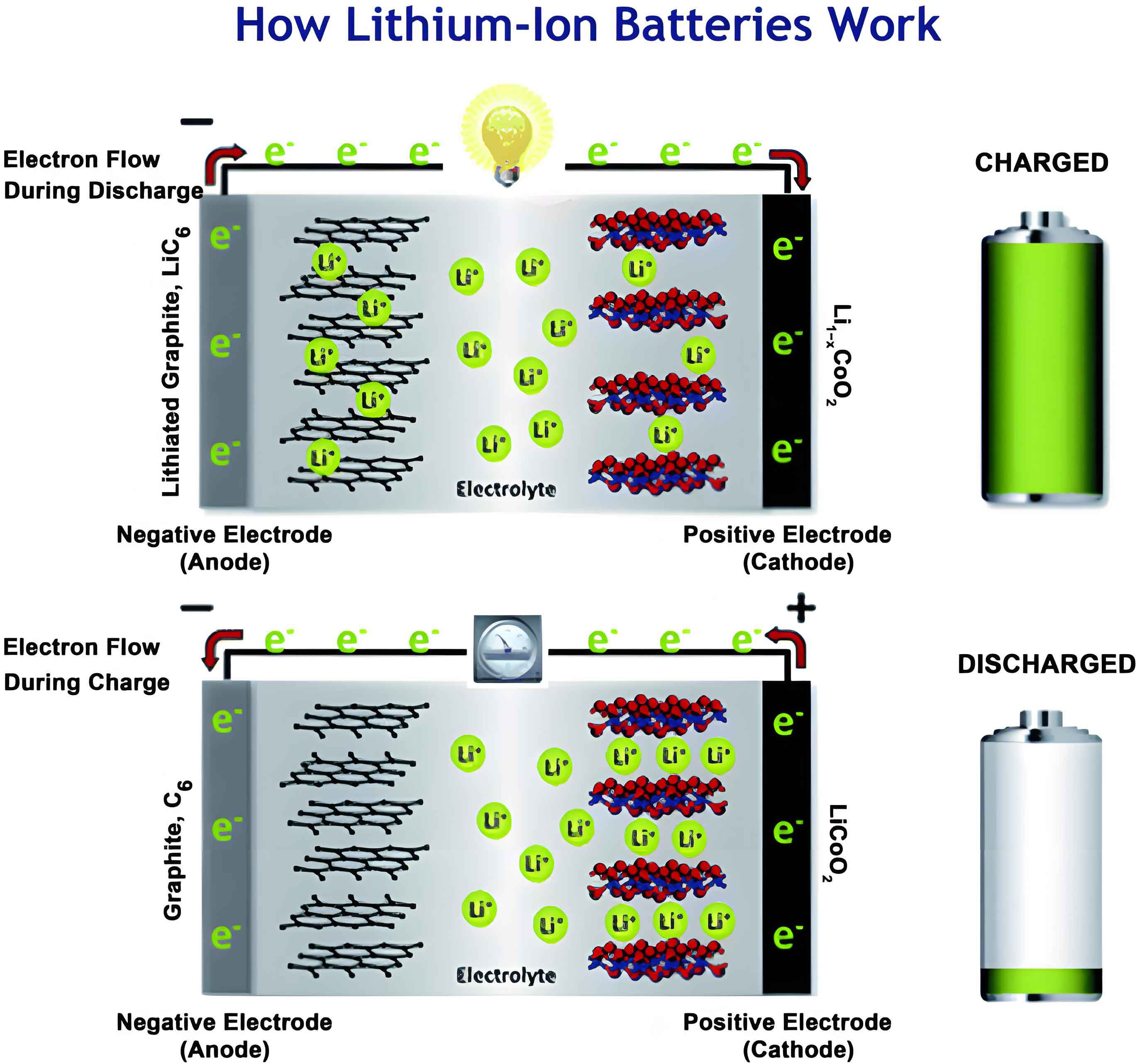
Graphite-based materials have dominated the negative electrode market for li-ion batteries since the early 1990s, when Sony commercialized the first generation using petroleum coke-derived carbon. This innovation addressed safety concerns associated with lithium metal anodes and set the stage for decades of optimization. Graphite offers a theoretical capacity of 372 mAh/g, derived from the formation of LiC$_6$ through intercalation. The reaction can be represented as:
$$ \text{C}_6 + \text{Li}^+ + e^- \rightleftharpoons \text{LiC}_6 $$
This process involves the insertion of lithium ions into the layered structure of graphite, with a volume expansion of approximately 10–13%, which is manageable for long-term cycling. Graphite anodes are broadly categorized into natural graphite and artificial graphite, each with distinct properties and processing routes. In my analysis, I will explore the technical advancements in both, highlighting how material engineering has overcome initial challenges.
Natural graphite, sourced from mined deposits, exhibits high crystallinity and low cost. However, its anisotropic morphology leads to issues such as low tap density, particle exfoliation during lithium intercalation, and significant irreversible capacity loss due to solid electrolyte interphase (SEI) formation. The initial Coulombic efficiency (ICE) of natural graphite is often below 90%, primarily due to side reactions at surface defects. To mitigate these problems, various modification strategies have been developed. For instance, oxidative treatment in air can create a dense oxide layer that passivates the surface, reducing SEI growth and enhancing lithium ion diffusion. The reaction for surface oxidation can be simplified as:
$$ \text{C} + \text{O}_2 \xrightarrow{\Delta} \text{C}_x\text{O}_y $$
Additionally, carbon coating via pyrolysis of pitch or resins has become an industry standard. This coating acts as a barrier between the graphite and electrolyte, suppressing irreversible reactions and providing mechanical support to accommodate volume changes. The coating process typically involves heating a mixture of graphite and carbon precursor (e.g., coal tar pitch) to 1000–1200°C under inert atmosphere, resulting in a core-shell structure. The effectiveness of this approach can be quantified by the improvement in ICE, often raising it above 93%. Furthermore, sphericalization techniques have been employed to increase the tap density of natural graphite, thereby boosting the volumetric energy density of li-ion batteries. These advancements have stabilized the market share of natural graphite at around 20% of total graphite anode production.
Artificial graphite, derived from petroleum or coal tar pitch precursors, accounts for over 80% of graphite anode usage in li-ion batteries, especially for high-performance applications like electric vehicles. Its production involves graphitization at high temperatures (2500–3000°C), which yields a more isotropic structure with tunable particle size and porosity. The theoretical capacity of artificial graphite ranges from 310 to 360 mAh/g, slightly lower than natural graphite due to structural imperfections, but its practical performance is superior in terms of cycle life and rate capability. Key technological innovations include secondary granulation and sphericalization. Secondary granulation reduces primary particle size and assembles them into dense secondary particles, shortening lithium ion diffusion paths and enhancing rate performance. The relationship between particle size and diffusion time can be expressed using Fick’s law:
$$ t = \frac{L^2}{2D} $$
where $t$ is the diffusion time, $L$ is the particle radius, and $D$ is the diffusion coefficient of lithium ions. By minimizing $L$, the rate capability of the li-ion battery is significantly improved. Sphericalization, on the other hand, increases the packing density, leading to higher volumetric energy density—a critical parameter for compact battery designs. The following table summarizes the properties of commercial graphite anodes:
| Material Type | Theoretical Capacity (mAh/g) | Initial Coulombic Efficiency (%) | Cycle Life (cycles at 80% capacity retention) | Rate Performance | Relative Cost |
|---|---|---|---|---|---|
| Natural Graphite | 340–370 | >93 | 500–1000 | Moderate | Low |
| Artificial Graphite | 310–360 | >93 | 1000–2000 | Good | Low to Moderate |
Despite these advances, graphite anodes are approaching their theoretical limit, prompting the exploration of higher-capacity materials for next-generation li-ion batteries. Silicon-based systems have emerged as the most promising alternatives due to their exceptional theoretical capacities. Silicon itself can alloy with lithium to form Li$_x$Si phases, with a maximum theoretical capacity of 3579 mAh/g for Li$_15$Si$_4$ at room temperature. The reaction is:
$$ \text{Si} + x\text{Li}^+ + x e^- \rightleftharpoons \text{Li}_x\text{Si} \quad (0 \leq x \leq 4.4) $$
However, this alloying process is accompanied by a massive volume expansion of up to 300%, which causes particle pulverization, loss of electrical contact, and continuous SEI formation, leading to rapid capacity fade. To address these challenges, two main silicon-based material systems have been developed: silicon monoxide (SiO) and silicon-carbon composites. I will discuss each in detail, focusing on the technical strategies that have been devised to stabilize their performance in li-ion batteries.
Silicon monoxide (SiO) has a theoretical capacity of 2043 mAh/g, which is lower than pure silicon but still substantially higher than graphite. It is typically produced by sintering quartz and metallurgical silicon, resulting in a material composed of Si nanodomains dispersed in a SiO$_2$ matrix. Upon lithiation, SiO undergoes a conversion-alloying mechanism:
$$ \text{SiO} + 2\text{Li}^+ + 2e^- \rightarrow \text{Li}_2\text{O} + \text{Si} $$
followed by:
$$ \text{Si} + x\text{Li}^+ + x e^- \rightarrow \text{Li}_x\text{Si} $$
This process leads to an irreversible capacity loss in the first cycle due to the formation of Li$_2$O and lithium silicates, resulting in a low ICE (often below 75%). Moreover, the volume expansion of SiO is around 200%, which, while lower than pure silicon, still poses stability issues. To enhance the performance of SiO anodes, carbon coating has been widely adopted. Carbon layers provide conductive pathways, buffer volume changes, and limit direct contact between SiO and the electrolyte. Common carbon coating methods include mechanical mixing with carbon precursors (e.g., glucose) followed by pyrolysis, and chemical vapor deposition (CVD). For example, pyrolysis of glucose with SiO at 800°C yields a composite with a specific capacity of 1259 mAh/g and ICE of 71.9%. CVD techniques, such as fluidized bed thermal CVD, can produce uniform carbon coatings, improving ICE to 82% and maintaining high Coulombic efficiency over cycles. Pre-lithiation or pre-magnesium treatments have also been explored to compensate for irreversible capacity loss and stabilize the structure. The table below compares key parameters of SiO-based anodes:
| Modification Strategy | Specific Capacity (mAh/g, initial) | Initial Coulombic Efficiency (%) | Cycle Life (cycles at 80% retention) | Volume Expansion (%) |
|---|---|---|---|---|
| Pure SiO | 1500–1800 | 60–70 | 50–100 | ~200 |
| Carbon-coated SiO (pyrolysis) | 1200–1600 | 70–80 | 200–500 | Reduced by 10–20% |
| Carbon-coated SiO (CVD) | 1400–1700 | 80–85 | 500–800 | Reduced by 15–25% |
| Pre-lithiated SiO/C | 1300–1600 | >90 | 800–1000 | Further reduced |
Despite these improvements, SiO anodes still face challenges in achieving high silicon content and long-term stability, limiting their widespread adoption in li-ion batteries. This has shifted focus toward silicon-carbon composites, which aim to harness the high capacity of silicon while mitigating its drawbacks through nanostructuring and carbon integration.
Pure silicon anodes, with their ultra-high capacity, have been the subject of intensive research. Nanostructuring is a key strategy to accommodate volume changes. For instance, silicon nanowires (SiNWs) grown directly on current collectors can withstand expansion without pulverization, offering capacities over 2000 mAh/g and cycle lives exceeding 2000 cycles. The stress in nanowires can be modeled using the equation for radial expansion:
$$ \sigma = E \cdot \frac{\Delta r}{r} $$
where $\sigma$ is the stress, $E$ is Young’s modulus, $\Delta r$ is the change in radius, and $r$ is the initial radius. By reducing $r$ to nanoscale dimensions, $\sigma$ is minimized, preventing fracture. Similarly, hollow silicon nanostructures, synthesized via template methods (e.g., using SiO$_2$ spheres), allow inward expansion, preserving electrode integrity. These structures have demonstrated capacities of 1420 mAh/g for 700 cycles. However, the high cost and low tap density of such nanomaterials hinder their commercial scalability for li-ion batteries.
To balance performance and practicality, silicon-carbon composites have become the forefront of development. These composites typically consist of silicon nanoparticles embedded in a carbon matrix, which provides electronic conductivity, mechanical support, and SEI stabilization. The carbon matrix can be derived from various precursors, such as polymers, pitches, or graphene, and processed via methods like ball-milling, spray-drying, or CVD. A common approach involves coating silicon particles with carbon through pyrolysis of organic precursors. For example, using polyvinylpyrrolidone (PVP) and citric acid with NaCl as a pore-forming agent, followed by carbonization and CVD, yields a composite with ICE of 89.8% and capacity retention of 87.1% after 820 cycles. The composite’s performance can be optimized by adjusting the silicon content, carbon thickness, and porosity. The effective capacity of a silicon-carbon composite can be estimated using the rule of mixtures:
$$ C_{\text{composite}} = f_{\text{Si}} \cdot C_{\text{Si}} + f_{\text{C}} \cdot C_{\text{C}} $$
where $f_{\text{Si}}$ and $f_{\text{C}}$ are the weight fractions of silicon and carbon, and $C_{\text{Si}}$ and $C_{\text{C}}$ are their respective capacities. However, this idealized model does not account for interfacial effects or irreversible losses, which are critical in real li-ion battery systems. To address this, advanced designs like porous carbon scaffolds with silicon deposited via chemical vapor deposition (CVD) of silane are being explored. These structures offer high silicon loading (up to 50 wt%) while maintaining stable cycling. The following table outlines the evolution of silicon-carbon composite technologies:
| Composite Type | Silicon Content (wt%) | Specific Capacity (mAh/g) | Initial Coulombic Efficiency (%) | Cycle Life (cycles at 80% retention) | Key Innovation |
|---|---|---|---|---|---|
| Si nanoparticles in carbon | 5–10 | 400–600 | 85–90 | 300–500 | Simple mixing and pyrolysis |
| Core-shell Si@C | 10–30 | 800–1200 | 88–92 | 500–800 | Uniform carbon coating |
| Porous Si/C composites | 30–50 | 1000–1500 | 90–94 | 800–1200 | Porous carbon buffers expansion |
| Si-graphene hybrids | 20–40 | 1200–1800 | 91–95 | 1000–1500 | Graphene enhances conductivity and flexibility |
The progress in silicon-based anodes is closely tied to advancements in electrolyte formulations and electrode engineering for li-ion batteries. For instance, the use of electrolyte additives (e.g., fluoroethylene carbonate) can promote a stable SEI on silicon surfaces, reducing irreversible capacity loss. Additionally, binder systems (e.g., carboxymethyl cellulose or polyacrylic acid) have been optimized to adhere silicon particles during volume changes. These holistic approaches are essential for realizing the full potential of high-capacity anodes in practical li-ion battery cells.
Looking ahead, the future of negative electrode materials for li-ion batteries lies in the integration of multiple strategies. For graphite, further improvements may come from doping with heteroatoms (e.g., nitrogen or boron) to enhance ionic conductivity and rate performance. The doping effect can be described by changes in the density of states near the Fermi level, which influences lithium ion adsorption energy. For silicon-based materials, the development of advanced composites with optimized morphologies and pre-lithiation techniques will be crucial. Moreover, emerging materials like lithium metal anodes (protected by solid electrolytes) and alloy-based systems (e.g., tin or antimony) are being researched for beyond-li-ion battery technologies, but they face significant challenges in safety and cyclability.
In conclusion, the journey of negative electrode materials for li-ion batteries has been marked by continuous innovation, from the commercialization of graphite to the ongoing development of silicon-based systems. Each material class has its strengths and limitations, and the choice depends on application requirements such as energy density, cycle life, cost, and safety. Graphite anodes, through decades of refinement, offer reliable performance for current li-ion battery markets. Silicon-based anodes, despite their challenges, hold the promise of dramatically higher energy densities, which are essential for next-generation electric vehicles and grid storage. As research progresses, I anticipate that hybrid materials and novel manufacturing processes will bridge the gap between laboratory discoveries and commercial viability. The li-ion battery, as an enabling technology, will continue to evolve, driven by material science breakthroughs that push the boundaries of energy storage.
To quantify the advancements, I present a formula for the overall energy density improvement in li-ion batteries due to anode materials. The gravimetric energy density $E_g$ of a cell can be approximated as:
$$ E_g = \frac{V \cdot C_{\text{anode}} \cdot C_{\text{cathode}}}{C_{\text{anode}} + C_{\text{cathode}}} $$
where $V$ is the average cell voltage, and $C_{\text{anode}}$ and $C_{\text{cathode}}$ are the specific capacities of the anode and cathode, respectively. By increasing $C_{\text{anode}}$ from 372 mAh/g (graphite) to 2000 mAh/g (silicon-based), the energy density can be boosted significantly, assuming cathode limitations are addressed. This underscores the importance of anode material research for the future of li-ion batteries.
In summary, this review has covered the technical evolution of negative electrode materials for li-ion batteries, emphasizing graphite and silicon-based systems. Through tables and formulas, I have highlighted key performance metrics and underlying principles. The li-ion battery remains a dynamic field, and I am confident that ongoing efforts will yield even more efficient and sustainable energy storage solutions. As we move forward, collaboration between academia and industry will be vital to translate these material advances into real-world applications, ensuring that li-ion batteries continue to power our technological progress.