
As a researcher in the field of energy storage and electric mobility, I have witnessed the rapid proliferation of electric bicycles as a cornerstone of urban transportation. These vehicles, which integrate an electric motor, controller, battery, and display systems onto a bicycle frame, are designed with a maximum speed of 25 km/h, a weight limit of 55 kg, and a power output not exceeding 400 W. Their convenience and efficiency have made them indispensable. However, the increasing incidence of fires, often linked to the li ion battery systems, has raised significant safety concerns. In this article, I will systematically explore the performance testing methodologies and quality standards for li ion batteries used in electric bicycles, aiming to provide a detailed framework for enhancing reliability and safety.
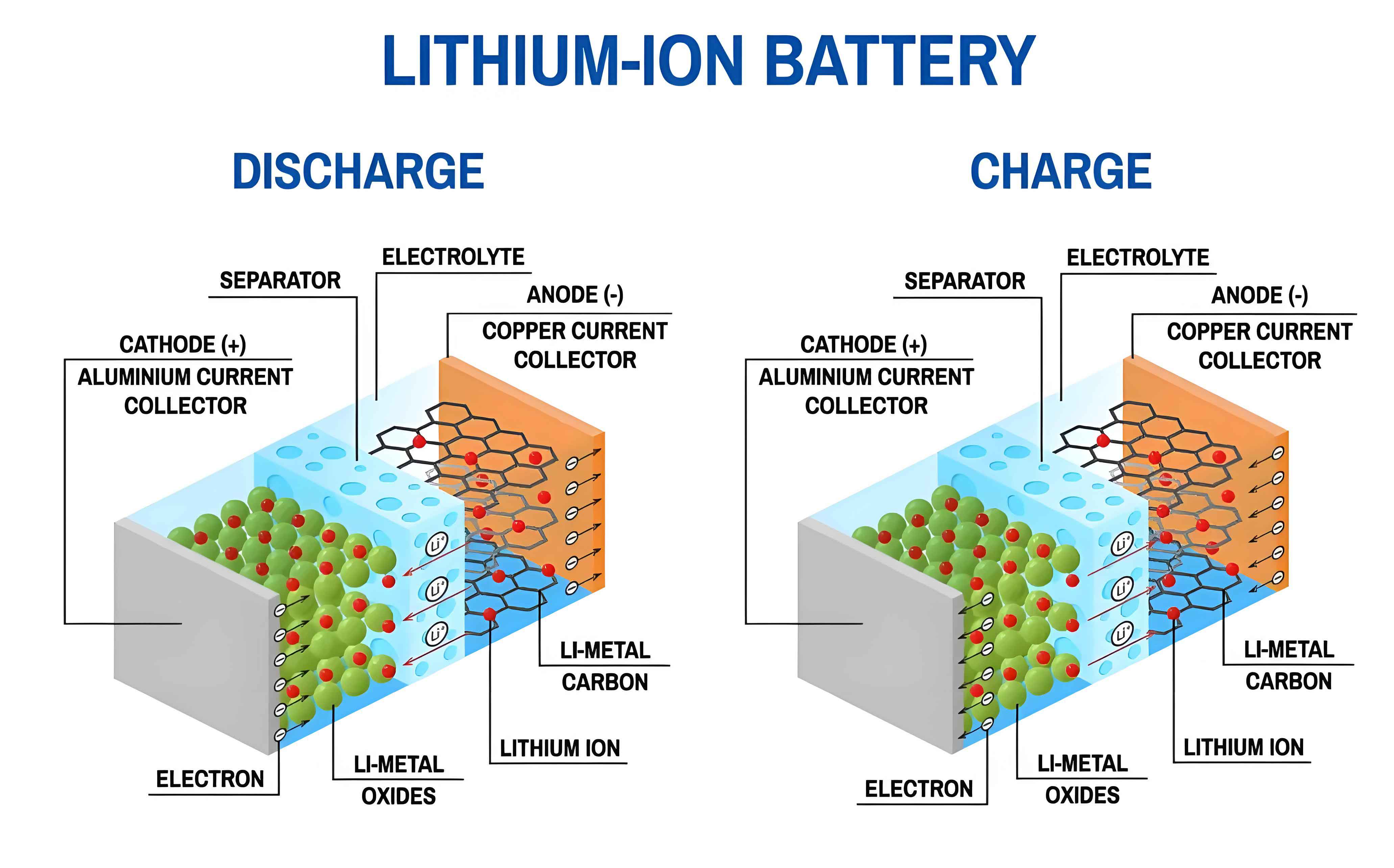
The heart of an electric bicycle’s propulsion system is the li ion battery, which stores and delivers energy efficiently. Various chemistries are employed, each with distinct characteristics that influence performance and safety. To understand these differences, I have compiled a comparative analysis of the most common li ion battery types used in electric bicycles.
| Battery Type | Cathode Material | Energy Density (W·h/kg) | Cycle Life (Cycles) | Key Advantages | Key Disadvantages | Typical Applications |
|---|---|---|---|---|---|---|
| Ternary Li Ion Battery | Nickel-Cobalt-Manganese (NCM) or Nickel-Cobalt-Aluminum (NCA) | 180–250 | 1000–1500 | High energy density, excellent rate capability, good low-temperature performance | Lower thermal stability, prone to thermal runaway under overcharge or high temperature | Mid to high-end electric bicycles for long-range use |
| Lithium Iron Phosphate (LFP) Battery | LiFePO₄ | 110–160 | >2000 | High thermal stability, strong overcharge tolerance, long cycle life, good safety | Lower energy density, larger volume and weight for same capacity | Shared bicycles and short-distance urban commuting |
| Lithium Manganese Oxide (LMO) Battery | LiMn₂O₄ | 100–120 | 500–800 | Low cost, stable discharge plateau, environmentally friendly | Poor cycle life, manganese dissolution at high temperatures, limited high-load performance | Low-speed electric bicycles for cost-sensitive markets |
The performance of a li ion battery is not solely determined by its chemistry; it also depends on how well it can handle real-world operating conditions. Electric bicycles experience dynamic loads due to frequent acceleration, deceleration, and varying terrains. To accurately assess battery behavior, I have developed and refined two key testing methodologies: the Constant Power Variable Load Test and the Micro-Interval Self-Recovery Test.
The Constant Power Variable Load Test simulates urban riding conditions by applying a dynamic power profile based on real-world data. The power curve, denoted as \( P(t) \), is constructed from sampled urban commuting paths, including acceleration, hill climbing, constant speed, and low-speed resistance segments. The test sequence is defined at a high resolution (e.g., 1-second intervals) to capture rapid load changes. The battery pack is subjected to this profile, and parameters such as voltage \( V(t) \), current \( I(t) \), internal resistance \( R_i(t) \), and temperature \( T(t) \) are recorded synchronously. The core objective is to evaluate the battery’s ability to handle sudden power demands and its energy conversion efficiency. The energy loss ratio \( \eta_{\text{loss}} \) can be calculated as:
$$ \eta_{\text{loss}} = \frac{\int_0^t (P_{\text{in}}(t) – P_{\text{out}}(t)) \, dt}{\int_0^t P_{\text{in}}(t) \, dt} \times 100\% $$
where \( P_{\text{in}}(t) \) is the input power and \( P_{\text{out}}(t) \) is the output power. Additionally, the voltage dip threshold \( V_{\text{dip}} \) under transient loads is monitored to assess stability. The internal resistance variation, a critical indicator of performance degradation, is modeled as:
$$ R_i(t) = R_{i0} + \alpha \cdot \int_0^t I(\tau) \, d\tau + \beta \cdot \Delta T(t) $$
where \( R_{i0} \) is the initial internal resistance, \( \alpha \) and \( \beta \) are coefficients related to current integral and temperature change \( \Delta T(t) \), respectively.
The Micro-Interval Self-Recovery Test focuses on the battery’s behavior during intermittent use, such as at traffic lights or brief stops. This test evaluates the kinetics of active material migration and ion diffusion equilibrium within the li ion battery. The procedure involves discharging at a specified C-rate (e.g., 1.0C) to a voltage threshold \( V_{\text{th}} \), pausing for a set duration (e.g., 10 minutes), and then resuming discharge at the same rate. Key metrics include the capacity difference between stages, voltage rebound \( \Delta V_{\text{rebound}} \), and surface temperature change \( \Delta T_s \). During the pause, the voltage recovery rate \( \frac{dV}{dt} \) is recorded, which correlates with ion diffusion dynamics. The recovery efficiency \( \epsilon_{\text{rec}} \) can be expressed as:
$$ \epsilon_{\text{rec}} = \frac{V_{\text{final}} – V_{\text{pause}}}{V_{\text{initial}} – V_{\text{pause}}} \times 100\% $$
where \( V_{\text{initial}} \) is the voltage at the start of the pause, \( V_{\text{pause}} \) is the voltage at the end of the pause, and \( V_{\text{final}} \) is the voltage after recovery. The temperature-driven migration index \( \kappa \) is derived from embedded thermal sensor data:
$$ \kappa = \frac{\Delta T_s}{\Delta t} \cdot \frac{1}{I_{\text{avg}}} $$
where \( \Delta t \) is the pause duration and \( I_{\text{avg}} \) is the average current. This test reveals the self-balancing capability of the li ion battery under transient conditions.
Beyond performance testing, establishing robust quality standards is crucial for ensuring the safety and longevity of li ion batteries in electric bicycles. I propose a multi-dimensional framework covering material safety, electrical performance consistency, and structural design.
First, the safety of the material system must be rigorously evaluated. Key indicators include thermal stability, capacity retention, and structural integrity after cycling. Based on adaptations from standards like GB 38031-2020, I have defined threshold values for li ion battery safety, as summarized below.
| Safety Parameter | Test Method | Threshold Requirement | Remarks |
|---|---|---|---|
| Thermal Runaway Onset Temperature | Heating test until thermal runaway | ≥ 200°C | Higher values indicate better thermal stability |
| Capacity Retention after Cycling | Charge-discharge cycles at 1C rate | ≥ 80% after 300 cycles | Reflects long-term material degradation |
| SEI Membrane Integrity | Electrochemical impedance spectroscopy (EIS) | No significant increase in interfacial resistance | Ensures stable electrolyte interface |
| Electrolyte Leakage or Rupture | Nail penetration or crush test | No leakage, fire, or explosion | Critical for failure containment |
The thermal stability criterion can be modeled using the Arrhenius equation for degradation rate \( k \):
$$ k = A \exp\left(-\frac{E_a}{RT}\right) $$
where \( A \) is the pre-exponential factor, \( E_a \) is the activation energy, \( R \) is the gas constant, and \( T \) is the temperature. A higher \( E_a \) indicates better resistance to thermal runaway in a li ion battery.
Second, electrical performance consistency and capacity fade control are vital for battery packs composed of multiple cells. Inconsistencies can lead to reduced range and premature failure. I recommend the following control indicators for li ion battery packs.
| Consistency Parameter | Measurement Condition | Allowable Deviation | Impact on Performance |
|---|---|---|---|
| Initial Internal Resistance | At 50% state of charge (SOC), 25°C | ≤ 3 mΩ between cells | Affects heat generation and efficiency |
| Cell Voltage Variation | At full charge, open circuit | ≤ 20 mV | Prevents overcharge or over-discharge |
| Rated Capacity Deviation | Discharge at 0.5C rate to cut-off voltage | ≤ 2% from nominal capacity | Capacity Fade Rate | Over defined cycle intervals (e.g., 100-300 cycles) | ≤ 15% after 300 cycles | Ensures predictable lifespan |
| Power Output Fluctuation | Under dynamic load testing | ≤ 5% of maximum power | Maintains ride smoothness |
Capacity fade over cycles \( n \) can be modeled using a semi-empirical formula:
$$ C_n = C_0 \cdot \exp(-\lambda n^\gamma) $$
where \( C_n \) is the capacity after \( n \) cycles, \( C_0 \) is the initial capacity, \( \lambda \) is the fade coefficient, and \( \gamma \) is the exponent characterizing fade kinetics. For a high-quality li ion battery, \( \lambda \) should be less than 0.001 and \( \gamma \) around 0.5 to indicate gradual degradation. Additionally, the performance under high temperature (e.g., 45°C) should show a capacity drop of less than 10% compared to 25°C, validating the li ion battery’s耐候性.
Third, structural design and protection等级 standards are essential to withstand harsh operating environments such as vibration, moisture, and impact. Drawing from standards like GB 43854-2024 and IEC 62133, I have formulated requirements for li ion battery enclosures and systems.
| Structural Aspect | Standard Requirement | Test Method | Purpose |
|---|---|---|---|
| Ingress Protection (IP) Rating | 至少 IPX5 (water jet protection) | IP rating test per IEC 60529 | Prevents water damage from rain or washing |
| Impact Resistance (IK) Rating | 至少 IK08 (5 J impact energy) | IK code test per IEC 62262 | Withstands mechanical shocks |
| Thermal Management | Uniform heat dissipation, no local hot spots | Thermal imaging under load | Avoids thermal runaway propagation |
| Overcurrent Protection Response Time | ≤ 30 ms | Short-circuit test with measurement | Quickly interrupts fault currents |
| BMS Monitoring Parameters | Real-time voltage, current, temperature | Embedded sensor validation | Enables proactive safety controls |
The heat dissipation efficiency can be quantified using the thermal resistance model:
$$ R_{\text{th}} = \frac{T_{\text{hot}} – T_{\text{ambient}}}{P_{\text{dissipated}}} $$
where \( R_{\text{th}} \) is the thermal resistance, \( T_{\text{hot}} \) is the hotspot temperature, \( T_{\text{ambient}} \) is the ambient temperature, and \( P_{\text{dissipated}} \) is the power dissipated. For a well-designed li ion battery pack, \( R_{\text{th}} \) should be minimized to below 5 K/W. The BMS (Battery Management System) plays a critical role by implementing active balancing algorithms to maintain cell uniformity. The balancing current \( I_{\text{bal}} \) can be expressed as:
$$ I_{\text{bal}} = K_p \cdot (V_{\text{max}} – V_{\text{min}}) + K_i \cdot \int (V_{\text{max}} – V_{\text{min}}) \, dt $$
where \( K_p \) and \( K_i \) are proportional and integral gains, and \( V_{\text{max}} \) and \( V_{\text{min}} \) are the maximum and minimum cell voltages in the pack.
In conclusion, my analysis underscores the importance of advanced performance testing and comprehensive quality standards for li ion batteries in electric bicycles. Traditional static tests are inadequate for capturing the complexities of real-world usage, whereas dynamic methods like the Constant Power Variable Load Test and Micro-Interval Self-Recovery Test offer superior insights into battery behavior under practical conditions. The proposed quality standards, encompassing material safety, electrical consistency, and structural robustness, provide a framework for manufacturers and regulators to enhance product reliability. Looking ahead, future research should focus on modeling the full lifecycle degradation of li ion batteries, integrating BMS with standardized testing protocols, and adapting standards for emerging technologies such as solid-state batteries and silicon-carbon anodes. Through continuous innovation and rigorous standards, the safety and performance of li ion batteries can be significantly improved, supporting the sustainable growth of electric mobility.
Throughout this discussion, the term li ion battery has been emphasized to highlight its central role in electric bicycle systems. The li ion battery’s evolution in terms of chemistry, testing, and standards is pivotal for addressing current challenges. By adhering to the methodologies and criteria outlined here, stakeholders can ensure that li ion batteries deliver both high performance and inherent safety, thereby reducing fire risks and increasing user confidence. The journey toward optimal li ion battery implementation requires collaborative efforts across research, industry, and policy domains, with a steadfast commitment to quality and innovation.