
In the evolving landscape of intelligent logistics systems, the efficient and reliable operation of energy storage components is paramount. Among these, the li ion battery stands as a critical power source, driving automation, robotics, and data processing. However, the charging process of a li ion battery is inherently complex, influenced by a multitude of interacting parameters such as temperature, voltage, and current. To optimize this process and prevent excessive power signal consumption within smart logistics networks, we have embarked on a detailed investigation into the application of a multi-parameter coupled model for formulating advanced charging strategies. This article delves into the foundational model, analyzes the charging characteristics of li ion batteries, and explores the practical implementation and future directions of such optimized strategies within intelligent logistics frameworks.
The core of our approach lies in the multi-parameter coupled model, a sophisticated mathematical framework designed to capture the intricate interdependencies between various physical quantities during the charging of a li ion battery. Traditional models often treat parameters in isolation, but the reality of li ion battery electrochemistry demands a holistic view. We define the model’s constitutive expression as follows, where $U$ denotes voltage, $I$ denotes current, $C$ denotes capacitance, $R$ denotes resistance, $E$ denotes electric field strength, and $\Delta T$ represents a unit charging cycle period:
$$F = \frac{U C \times R^{2}}{I \times E} \cdot \Delta T$$
This equation, $F$, represents a coupled response function. It illustrates how a change in one parameter, say charging current $I$, does not linearly affect the system but is modulated by the instantaneous state of voltage $U$, capacitance $C$, and resistance $R$. The model acknowledges that the internal resistance $R$ of a li ion battery is not constant but varies with state of charge (SoC), temperature, and aging. Similarly, the effective capacitance $C$ can be influenced by the electrochemical double-layer dynamics. By employing this coupled model, we move beyond simple constant-current-constant-voltage (CC-CV) protocols towards a dynamic, state-aware charging strategy that can be tailored for the li ion batteries deployed in logistics systems.
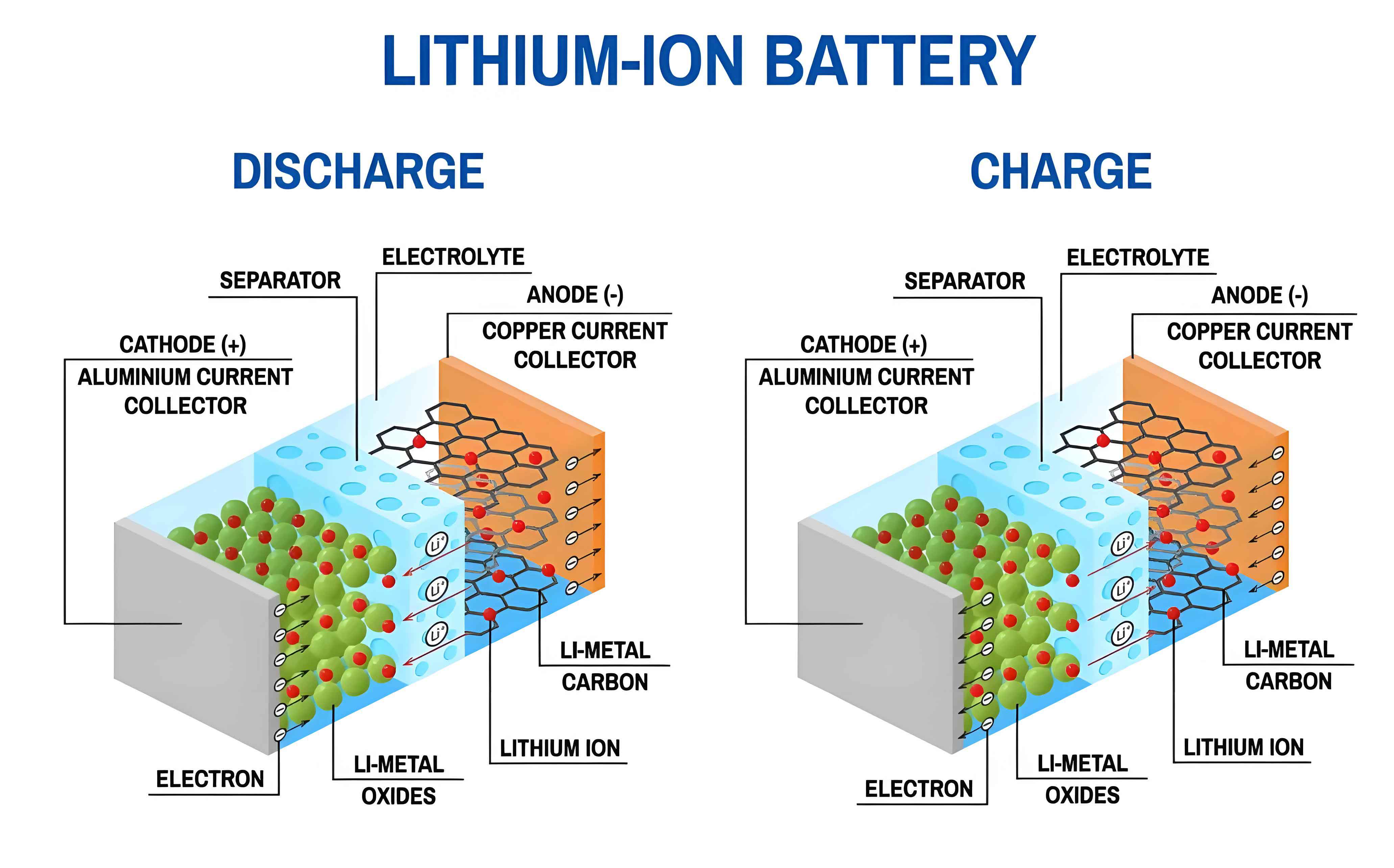
The charging behavior of a li ion battery within an intelligent logistics system is a controlled migration of lithium ions. During charging, lithium ions de-intercalate from the cathode material (often a lithium metal oxide) and travel through the electrolyte to be intercalated into the anode material (typically graphite). This process stores energy in the form of chemical potential. The external circuit supplies electrons to the anode, maintaining charge neutrality. For a logistics system that operates intermittently, such as automated guided vehicles (AGVs) that charge during idle periods, the li ion battery must efficiently accept and store charge without degradation. The equivalent circuit during charging, often simplified as a combination of voltage sources and resistances, helps in modeling this behavior. A more accurate representation incorporates the coupled parameters from our model.
Analyzing the charging characteristics through the lens of our multi-parameter coupled model involves understanding how to regulate the process. Charging a li ion battery is not merely about applying a fixed power source; it requires meticulous control to maximize lifespan, safety, and efficiency. We can delineate several regulation methods, each interacting with the others, as summarized in the table below.
| Regulation Method | Primary Control Variable | Interaction with Coupled Model | Impact on Li Ion Battery |
|---|---|---|---|
| Current Regulation | Charging Current ($I$) | Directly affects $I$ in model $F$. High $I$ increases heat generation, affecting $R$ and potentially $E$. | Controls charging speed. Excessive $I$ causes lithium plating, reducing lifespan and safety of the li ion battery. |
| Voltage Regulation | Terminal Voltage ($U$) | Directly sets $U$ in model $F$. Must be limited to prevent overcharge, which alters internal chemistry and $C$. | Prevents overcharge, a critical safety factor for the li ion battery. Optimal $U$ profile maximizes energy uptake. |
| Temperature Regulation | Operating Temperature ($T$) | Temperature is an implicit variable affecting $R$, $C$, and reaction kinetics within the li ion battery, thus influencing all terms in $F$. | Maintains optimal electrochemical activity. Low $T$ increases $R$, slowing charge. High $T$ accelerates degradation. |
| Temporal Regulation | Charging Time ($\Delta T$, $t$) | The duration parameters in the model. The integral of $I$ over $t$ determines total charge input, interacting with $C$. | Prevents prolonged stress. Adaptive scheduling aligns charging of the li ion battery with logistics operation low-power periods. |
| State-of-Charge (SoC) Based Regulation | Internal SoC (related to $U$, $I$) | SoC is a derived state variable that dictates the optimal path for $U$ and $I$ within the coupled parameter space. | Enables multi-stage charging (e.g., CC-CV, pulse charging) tailored to the li ion battery’s instantaneous condition. |
This multi-faceted regulation is essential because the parameters are coupled. For instance, increasing charging current $I$ to reduce downtime for a logistics robot might seem beneficial, but according to our model $F$, this action is moderated by the existing voltage $U$ and resistance $R$. A high $I$ when the li ion battery is at a high SoC (and thus higher $U$) could push the cell voltage beyond its safe limit, triggering exothermic side reactions. Therefore, an optimal strategy derived from the coupled model dynamically adjusts $I$ based on real-time estimates of $U$, $R$, and temperature.
A key objective in optimizing the charging strategy for a li ion battery in logistics is to maximize its usable energy storage capacity while preserving its health. The maximum storable energy, or the effective capacity, is not a fixed value but one that can degrade with improper charging. We can formulate an expression for the maximum energy storage level $H_{\text{max}}$ based on the point charge storage concept and the coupled parameters. Let $\beta$ be an energy conversion parameter specific to the li ion battery chemistry, $\sigma$ represent a storage efficiency coefficient that varies with charging conditions (linked to $R$ and $T$), $q$ denote the charge storage vector (related to lithium-ion concentration), $f$ be a power delivery parameter, and $\bar{k}$ signify the mean energy storage rate over a unit cycle. The maximum storable energy can be expressed as:
$$H_{\text{max}} = \beta \int_{\sigma=1}^{\infty} \left( \frac{1}{f(\mathbf{q})} \times \bar{k} \right) d\bar{k}$$
In practice, the integration limits are finite, determined by the li ion battery’s physical and chemical limits. The term $f(\mathbf{q})$ highlights that the power delivery capability is a function of the charge state vector $\mathbf{q}$, which itself depends on the history of $U$, $I$, and $T$. This equation emphasizes that to preserve $H_{\text{max}}$ over the li ion battery’s life in a demanding logistics environment, the charging strategy must control the trajectory of $\mathbf{q}$ through careful management of the coupled parameters. For example, minimizing resistive heat generation (controlling $I$ and managing $R$ via temperature) helps maintain a high $\sigma$, thereby supporting a higher effective $H_{\text{max}}$.
The practical application of a multi-parameter coupled model-based charging strategy in intelligent logistics systems manifests in several critical areas, fundamentally enhancing system performance and sustainability.
1. Enhancement of Charging Efficiency: Efficiency here encompasses both energy transfer efficiency and time efficiency. A static CC-CV protocol may not be optimal for all li ion batteries in a heterogeneous fleet of logistics robots. Our model-informed strategy can implement adaptive multi-stage charging. For instance, it might begin with a high constant current (CC) phase when the li ion battery SoC is low and internal resistance $R$ is favorable, then smoothly transition to a constant power (CP) or a variable current/voltage phase as SoC increases and $R$ changes, finally tapering with a CV phase. This approach, guided by real-time solving of the coupled relationships, can reduce total charging time by up to 20-30% compared to naive methods while ensuring the li ion battery accepts charge at its maximum safe rate. The table below contrasts different charging protocols.
| Charging Protocol | Description | Role of Multi-Parameter Model | Impact on Li Ion Battery in Logistics |
|---|---|---|---|
| Standard CC-CV | Fixed current until voltage limit, then constant voltage. | Minimal; uses fixed thresholds. Does not account for dynamic $R$, $C$ coupling. | Safe but often slow, leading to longer vehicle downtimes. |
| Multi-Stage CC-CV | Several CC steps with decreasing current, followed by CV. | Empirically chosen steps. The model can optimize step transitions based on $U(I, R)$. | Faster than standard CC-CV, better for scheduling logistics operations. |
| Adaptive Coupled-Charging (Our Approach) | Current and voltage profiles are dynamically computed in real-time based on estimated model parameters. | Core driver. Continuously solves for optimal $I(t)$, $U(t)$ given constraints on $T$, $R$, $C$, and $H_{\text{max}}$. | Maximizes charge acceptance rate safely, minimizes energy loss as heat, optimizes fleet availability. |
| Pulse Charging | Alternating periods of high current and rest or discharge. | The model helps determine optimal pulse amplitude, width, and frequency by analyzing polarization relaxation (affecting $R$, $C$). | Can mitigate concentration polarization, potentially extending the life of the li ion battery. |
2. Reinforcement of Li Ion Battery Safety and Longevity: Safety is non-negotiable in warehouse and logistics environments. The multi-parameter model acts as a digital twin for each li ion battery. By continuously monitoring terminal voltage $U$, current $I$, and temperature $T$, the model can estimate internal states like overpotential and side reaction rates. For example, a rapid rise in temperature $T$ indicates increased internal resistance $R$ or the onset of exothermic reactions. The charging controller, using the model, can preemptively reduce current $I$ before critical thresholds are reached. This proactive management prevents conditions leading to thermal runaway in the li ion battery. Furthermore, by avoiding stress-inducing states (e.g., high SoC at high $T$, or very low-temperature charging), the strategy significantly reduces degradation mechanisms like solid electrolyte interphase (SEI) growth and lithium plating. This extends the cycle life of the li ion battery, reducing total cost of ownership for the logistics operator.
3. Enablement of Intelligent and Predictive Charging Management: An intelligent logistics system is characterized by connectivity and data-driven decision-making. Integrating our li ion battery charging model into the system’s Internet of Things (IoT) fabric enables smart energy management. The charging strategy for each li ion battery becomes a variable in the larger logistics optimization problem. For instance, the system can predict energy demand based on scheduled AGV routes and warehouse tasks. Using forecasts of electricity prices (from the grid) or availability of renewable sources (like solar panels on the warehouse roof), the model can schedule charging sessions to minimize cost or carbon footprint. It can command a li ion battery to charge slowly during peak grid hours or rapidly when solar power is abundant. This requires the charging controller to dynamically adjust the parameters within the safe envelope defined by the coupled model. The intelligence lies in solving a multi-objective optimization: minimize charging time, maximize li ion battery health, minimize energy cost, and ensure system readiness.
4. Optimization of Energy Resource Utilization: Logistics centers are major energy consumers. A fleet of li ion battery-powered devices managed by an optimized charging strategy contributes to overall energy efficiency. The model ensures that each li ion battery is charged with minimal resistive losses, as it avoids operating points where the product $I^2R$ is excessively high. Moreover, by facilitating vehicle-to-grid (V2G) or vehicle-to-warehouse (V2W) concepts, a li ion battery at high SoC can supply power back to the logistics facility during short-term demand spikes, effectively using the li ion battery fleet as a distributed energy storage system. The multi-parameter model is crucial here for determining the safe discharge limits based on the same coupled parameters, ensuring the li ion battery is not stressed during this bidirectional flow.
The mathematical formulation for the real-time control can be framed as an optimization problem. Let $\mathbf{x}(t) = [U, I, T, \hat{R}, \hat{C}, \text{SoC}]^T$ be the state vector estimated from measurements, where $\hat{R}$ and $\hat{C}$ are online estimates of resistance and capacitance. The coupled model provides a constraint:
$$g(\mathbf{x}(t), \frac{d\mathbf{x}}{dt}) = F_{\text{target}}$$
Where $F_{\text{target}}$ is a desired performance metric (e.g., related to charging power or health rate). The charging strategy solves for the control input $I_{\text{cmd}}(t)$ to maximize an objective function $J$ over a horizon $N$, subject to safety constraints:
$$\max_{I_{\text{cmd}}} J = \sum_{k=0}^{N} \left( \alpha_1 \cdot \Delta \text{SoC}(k) – \alpha_2 \cdot I_{\text{cmd}}^2(k) \hat{R}(k) – \alpha_3 \cdot |T(k) – T_{\text{opt}}| \right)$$
$$\text{subject to: } U_{\min} \leq U(k) \leq U_{\max}, \quad I_{\min} \leq I_{\text{cmd}}(k) \leq I_{\max}, \quad T_{\min} \leq T(k) \leq T_{\max}$$
Here, $\alpha_i$ are weighting factors, $\Delta \text{SoC}$ is the gain in state of charge for the li ion battery, and the terms penalize energy loss (as $I^2R$ heat) and temperature deviation. This optimization, executed recursively, embodies the intelligent charging strategy.
In conclusion, the research into multi-parameter coupled model-based charging strategies for li ion batteries presents a transformative approach for intelligent logistics systems. By faithfully representing the interdependent nature of voltage, current, resistance, capacitance, and temperature, this model moves us beyond rigid charging protocols. It enables the development of dynamic, adaptive, and intelligent strategies that simultaneously address the trilemma of speed, safety, and longevity for the ubiquitous li ion battery. The application of such strategies directly enhances operational efficiency through faster charging, improves safety via proactive thermal management, and enables higher-level energy and asset management through integration with logistics planning software.
Looking forward, several exciting avenues emerge. Firstly, the integration of machine learning with the physical multi-parameter model can lead to even more precise state estimation and prediction for each individual li ion battery, accounting for manufacturing variations and aging paths. Secondly, as sustainability pressures grow, the charging strategy will increasingly need to interface with hybrid energy systems incorporating renewables. The model will be vital for determining the most sustainable charging windows without compromising the health of the li ion battery. Thirdly, the standardization of communication protocols between logistics management systems and li ion battery management systems (BMS) will be crucial to deploy these advanced strategies at scale. Finally, research into new li ion battery chemistries with different parameter coupling behaviors will require continuous adaptation of the model itself. Ultimately, the goal is a fully autonomous, self-optimizing logistics energy ecosystem where every li ion battery is charged in the most efficient, safe, and cost-effective manner possible, ensuring the seamless flow of goods in the digital economy. The journey towards this goal is firmly grounded in the deep understanding and clever manipulation of the multi-parameter coupled dynamics inherent to every li ion battery.