
As a researcher in the field of advanced energy storage, I have witnessed the rapid evolution of flexible electronics, which demand power sources that can withstand mechanical deformation without compromising performance. The advent of wearable devices, rollable displays, and smart textiles has propelled the need for flexible lithium-ion batteries. These batteries must maintain electrochemical functionality under bending, stretching, or twisting, making traditional rigid components like metal current collectors and liquid electrolytes unsuitable. In this article, I explore the pivotal role of graphene in enabling flexible lithium-ion batteries, summarizing key advancements, characterization methods, and future prospects. Graphene, with its exceptional electrical conductivity, mechanical strength, and flexibility, offers transformative potential for next-generation energy storage solutions.
The transition to flexible lithium-ion batteries is driven by the limitations of conventional designs. Standard lithium-ion batteries rely on metallic foils (e.g., copper for anodes, aluminum for cathodes) as current collectors, which are prone to fracture under repeated deformation. Moreover, liquid electrolytes pose leakage risks, and binder-based electrode coatings can delaminate during flexing. To overcome these issues, researchers have focused on developing flexible electrodes using lightweight, conductive, and robust materials. Graphene, a two-dimensional carbon allotrope, has emerged as a cornerstone material due to its unique properties: high electron mobility (exceeding 15,000 cm²/V·s), theoretical specific surface area (≈2630 m²/g), Young’s modulus (≈1 TPa), and tensile strength (≈130 GPa). These attributes make graphene an ideal candidate for constructing flexible electrodes that can integrate active materials, provide mechanical support, and facilitate efficient charge transport.
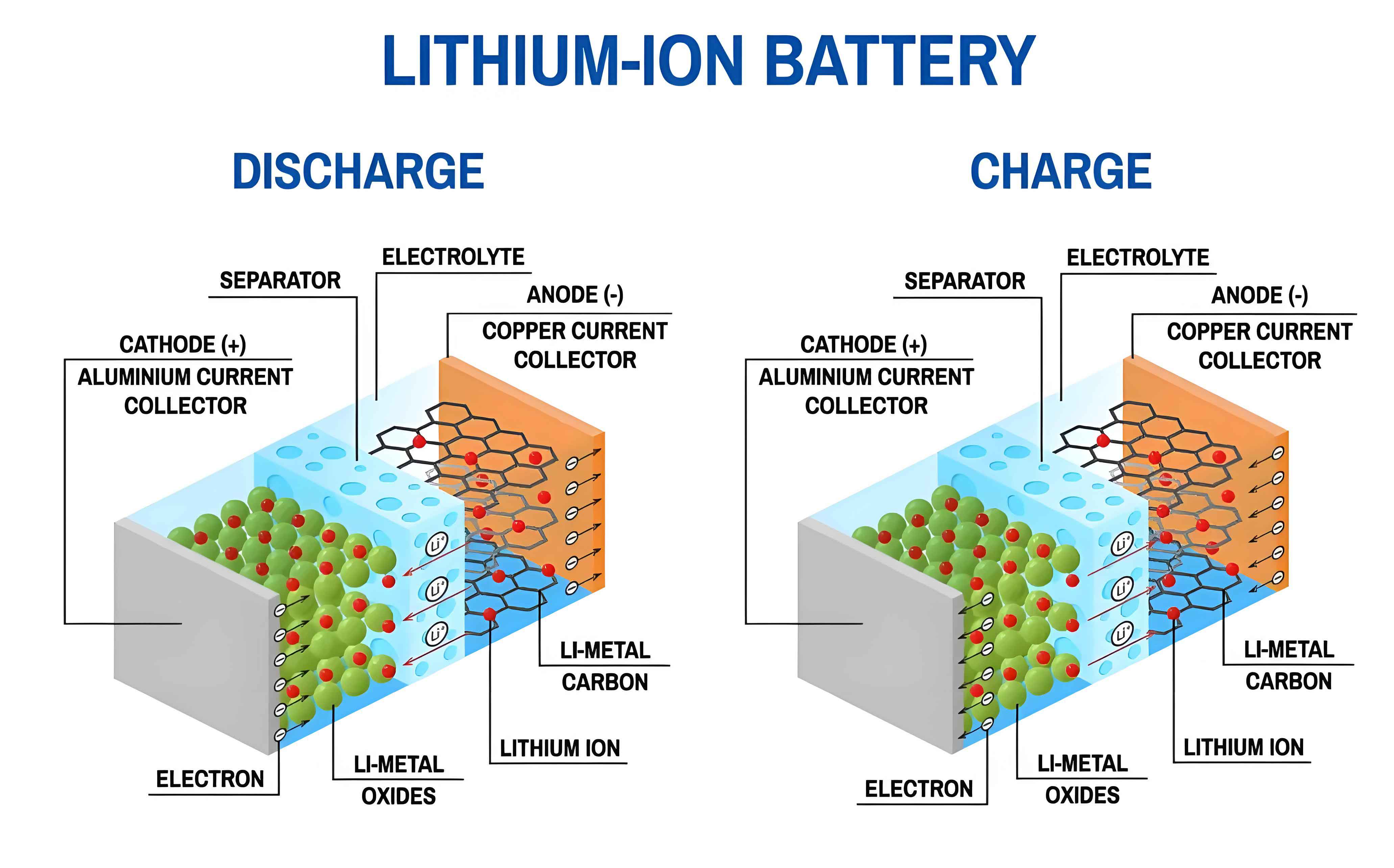
Flexible lithium-ion batteries are broadly categorized based on their deformation modes: bendable and stretchable. Bendable batteries undergo elastic bending with curvature radii typically above 1 cm, while stretchable batteries can tolerate tensile strains, often through pre-designed architectures like wavy or island-mesh structures. The maximum elastic strain (ε) of battery materials dictates their flexibility. For a bent electrode, the strain can be approximated by:
$$ \epsilon = \frac{h}{2r} $$
where \( h \) is the thickness and \( r \) is the bending radius. For instance, if a graphene-based electrode has a thickness of 100 μm and is bent to a radius of 1 cm, the strain is only 0.5%, well within the elastic limits of many materials. However, achieving stretchability requires more intricate designs, as most active materials (e.g., LiCoO₂, silicon) have low fracture strains (<0.5%). Graphene’s flexibility allows it to accommodate such deformations when integrated into composite structures.
Graphene contributes to flexible lithium-ion batteries in two primary ways: as a conductive additive in flexible substrates (e.g., polymers, paper, textiles) and as a freestanding flexible electrode or current collector. In the first approach, graphene coatings enhance the electrical conductivity of insulating flexible matrices. For example, graphene-coated polyethylene terephthalate (PET) films exhibit sheet resistances below 100 Ω/sq, making them viable current collectors. In the second approach, graphene films or foams serve as both conductive networks and mechanical scaffolds, enabling high active-material loading and improved energy density. The following table summarizes the properties of various graphene-based flexible substrates used in lithium-ion batteries:
| Substrate Type | Electrical Conductivity (S/m) | Maximum Strain (%) | Specific Capacity Contribution (mAh/g) | Advantages |
|---|---|---|---|---|
| Graphene/PET Composite | 10³ – 10⁴ | 5 – 10 | Negligible | Lightweight, bendable, easy fabrication |
| Graphene/Cellulose Paper | 10² – 10³ | 3 – 5 | ≈50 (from graphene) | Biodegradable, porous, low-cost |
| Graphene/Textile Composite | 10¹ – 10³ | 20 – 50 | Negligible | Highly flexible, wearable integration |
| Freestanding Graphene Film | 10³ – 10⁵ | 0.5 – 1.5 | 100 – 500 | High conductivity, self-supporting |
| 3D Graphene Foam | 10² – 10⁴ | 50 – 100 | ≈200 (from graphene) | Ultralight, stretchable, high surface area |
The electrochemical performance of graphene-based electrodes in lithium-ion batteries depends on factors like defect density, functional groups, and composite morphology. For instance, reduced graphene oxide (rGO) sheets often contain oxygenated groups that can enhance lithium-ion storage via pseudocapacitance, but may reduce electrical conductivity. The specific capacity of a graphene anode can be estimated using a simplified model based on lithium-ion intercalation and surface adsorption:
$$ C = C_{\text{intercalation}} + C_{\text{adsorption}} = \frac{xF}{3.6M} + \frac{\sigma A}{3.6} $$
where \( C \) is the specific capacity in mAh/g, \( x \) is the lithium intercalation stoichiometry (e.g., LiC₆ for graphite gives \( x = 1 \)), \( F \) is Faraday’s constant (96485 C/mol), \( M \) is the molar mass of carbon (12 g/mol), \( \sigma \) is the surface charge density in C/m², and \( A \) is the specific surface area in m²/g. For graphene with \( A \approx 2630 \) m²/g and assuming \( \sigma = 0.1 \) C/m², the adsorption contribution can exceed 700 mAh/g, explaining the high capacities observed in porous graphene electrodes.
In practice, graphene composites with active materials like transition metal oxides or silicon are crucial for high-performance flexible lithium-ion batteries. These composites leverage graphene’s conductivity to mitigate the poor kinetics of oxide materials, while its flexibility buffers volume changes during lithiation/delithiation. For example, a SnO₂/graphene composite anode can achieve capacities over 1000 mAh/g through synergistic effects. The lithium-ion storage mechanism in such composites often involves conversion and alloying reactions, described by:
$$ \text{SnO}_2 + 4\text{Li}^+ + 4e^- \rightarrow \text{Sn} + 2\text{Li}_2\text{O} $$
$$ \text{Sn} + x\text{Li}^+ + xe^- \leftrightarrow \text{Li}_x\text{Sn} \quad (0 \leq x \leq 4.4) $$
Graphene sheets in the composite prevent nanoparticle aggregation and maintain electrical connectivity during cycling, which is critical for flexibility. Similarly, for cathodes like LiFePO₄, graphene wrapping enhances rate capability by reducing charge-transfer resistance. The table below compares the electrochemical performance of various graphene-based flexible electrodes in lithium-ion batteries:
| Electrode Material | Specific Capacity (mAh/g) | Cycle Life (Cycles) | Rate Capability (Capacity Retention at High Current) | Flexibility (Bending Radius) |
|---|---|---|---|---|
| Graphene Film Anode | 84 – 500 | 100 – 1000 | 50% at 10 C | 1 – 5 mm |
| SnO₂/Graphene Composite | 800 – 1200 | 200 – 500 | 40% at 5 C | 5 – 10 mm |
| LiFePO₄/Graphene Cathode | 120 – 160 | 500 – 2000 | 80% at 10 C | 3 – 8 mm |
| 3D Graphene Foam with LiCoO₂ | 140 – 180 | 300 – 1000 | 70% at 20 C | Stretchable up to 50% strain |
| Graphene/Silicon Composite | 1500 – 2000 | 100 – 500 | 30% at 2 C | 10 – 20 mm |
Characterizing the mechanical and electrochemical properties of flexible lithium-ion batteries is essential for assessing their viability. Mechanical tests include tensile straining, cyclic bending, and shear measurements. For instance, the stress-strain behavior of graphene papers can be modeled using a modified Hooke’s law for anisotropic materials:
$$ \sigma = E \epsilon + \eta \frac{d\epsilon}{dt} $$
where \( \sigma \) is stress, \( E \) is Young’s modulus, \( \epsilon \) is strain, and \( \eta \) is a viscoelastic coefficient. Graphene oxide papers typically show \( E \approx 32 \) GPa and fracture strain around 0.6%, while graphene/cellulose composites can reach 3% strain due to fiber reinforcement. During bending, the resistance change \( \Delta R/R_0 \) of a flexible electrode is monitored to ensure electrical stability. For a graphene-based electrode, \( \Delta R/R_0 \) often remains below 5% after 1000 bending cycles at a radius of 5 mm, indicating robust conductivity.
Electrochemical characterization under deformation is challenging but crucial. In-situ tests involve measuring capacity, impedance, and cycle life while bending or stretching the battery. The capacity retention \( Q \) after \( n \) bending cycles can be expressed empirically as:
$$ Q(n) = Q_0 \exp(-\beta n) $$
where \( Q_0 \) is the initial capacity and \( \beta \) is a degradation coefficient dependent on materials and bending severity. For a well-designed graphene-based flexible lithium-ion battery, \( \beta \) can be as low as 10⁻⁴ per cycle, implying negligible decay over thousands of bends. Impedance spectroscopy reveals interface stability; graphene’s high conductivity helps maintain low charge-transfer resistance (\( R_{ct} \)) even under strain, often below 50 Ω for composite electrodes.
Despite progress, several challenges hinder the commercialization of graphene-based flexible lithium-ion batteries. First, achieving high active-material loading without compromising flexibility remains difficult. Second, graphene production at scale—whether by chemical vapor deposition or liquid-phase exfoliation—must become more cost-effective. Third, integrating graphene electrodes with solid-state electrolytes (e.g., gel polymers) requires improved interface engineering to reduce ionic resistance. Future trends are likely to focus on multifunctional designs. For example, self-healing graphene composites can repair cracks during cycling, extending battery lifespan. The self-healing efficiency \( \eta_{\text{SH}} \) can be defined as:
$$ \eta_{\text{SH}} = \frac{C_{\text{after healing}}}{C_{\text{before damage}}} \times 100\% $$
where \( C \) is capacity. Preliminary studies show \( \eta_{\text{SH}} > 90\% \) for graphene-polymer hybrids. Additionally, rapid charging capabilities are being enhanced through 3D graphene architectures that reduce lithium-ion diffusion paths. The diffusion-limited current \( I_d \) in a porous electrode is given by:
$$ I_d = nFAD \frac{C^*}{\delta} $$
with \( n \) electrons transferred, \( F \) Faraday’s constant, \( A \) electrode area, \( D \) diffusion coefficient, \( C^* \) bulk concentration, and \( \delta \) diffusion layer thickness. 3D graphene foams increase \( A \) and reduce \( \delta \), enabling high \( I_d \) for fast charging. Moreover, advanced manufacturing techniques like inkjet printing or 3D printing allow precise patterning of graphene inks into flexible electrodes, opening avenues for customizable battery shapes.
In conclusion, graphene is a transformative material for flexible lithium-ion batteries, addressing key limitations in conductivity, mechanical resilience, and lightweight design. Its integration into composites and freestanding films has demonstrated promising electrochemical performance under deformation. However, ongoing research must optimize scalability, interfacial properties, and multifunctionality to meet the demands of emerging flexible electronics. With continued innovation, graphene-based flexible lithium-ion batteries could power a new generation of wearable devices, rollable screens, and smart textiles, marking a significant leap in energy storage technology. The journey toward truly stretchable, self-healing, and high-power flexible lithium-ion batteries is underway, with graphene at its core.
As I reflect on the advancements, it is clear that the synergy between graphene science and battery engineering will drive future breakthroughs. The flexibility of graphene not only enables mechanical compliance but also fosters novel electrode architectures that enhance energy and power densities. For instance, textile-based lithium-ion batteries woven with graphene fibers could seamlessly integrate into clothing, providing unobtrusive power for health monitors or communication devices. Similarly, ultra-thin graphene films could enable transparent batteries for see-through electronics. The key metrics for such applications—energy density (Wh/kg), power density (W/kg), and cycle life—must be balanced with flexibility requirements, and graphene’s tunable properties offer a versatile platform for optimization.
From a materials perspective, the quality of graphene—whether pristine, oxidized, or doped—profoundly impacts battery performance. Nitrogen-doped graphene, for example, introduces active sites for lithium-ion storage, potentially boosting capacity. The doping level can be quantified by the atomic percentage of nitrogen, and its effect on capacity can be modeled using density functional theory calculations. Moreover, hybridizing graphene with carbon nanotubes or conductive polymers can create hierarchical networks that enhance both mechanical toughness and electrical percolation. These hybrids are particularly promising for stretchable lithium-ion batteries, where maintaining conductivity under large strains is paramount.
Looking ahead, standardization of testing protocols for flexible lithium-ion batteries will be crucial. Currently, bending cycles are often performed ad hoc, but established norms (e.g., ISO standards) could ensure reliability comparisons across studies. Additionally, environmental sustainability must be considered; graphene production should aim for green methods to minimize ecological impact. Despite hurdles, the rapid pace of research suggests that graphene-based flexible lithium-ion batteries will soon transition from labs to markets, powering the flexible electronics revolution. As a researcher, I am optimistic that these batteries will become as ubiquitous as their rigid counterparts, enabling a future where energy storage is as flexible as our imaginations.