
The relentless pursuit of higher energy density in li-ion batteries, targeting beyond 500 Wh/kg, places immense pressure on advancing cathode materials with superior reversible capacity and extended cycle life. Among various candidates, nickel-rich layered oxides, particularly LiNi0.8Co0.1Mn0.1O2 (NCM), have emerged as frontrunners due to their high specific capacity, favorable kinetics, and relative cost advantage. However, the practical deployment of NCM cathodes in li-ion batteries is severely hampered by intrinsic structural degradation during cycling. This degradation manifests as anisotropic volume changes, lattice collapse, intergranular cracking, and exacerbated Li+/Ni2+ cation mixing, especially at high cut-off voltages, leading to rapid capacity fade and impedance growth. To address these challenges, modification strategies such as bulk doping, surface coating, and morphological engineering have been extensively explored. Doping, in particular, involves the substitution of host ions with foreign species to stabilize the crystal structure and suppress detrimental phase transitions. In this comprehensive study, we introduce a novel one-step synthesis strategy for the simultaneous incorporation of Rb+ and Cl– ions into the NCM lattice. This dual-site co-doping approach is designed to synergistically enhance Li+ transport kinetics and structural integrity, thereby unlocking superior rate capability and cycling stability for next-generation li-ion batteries.
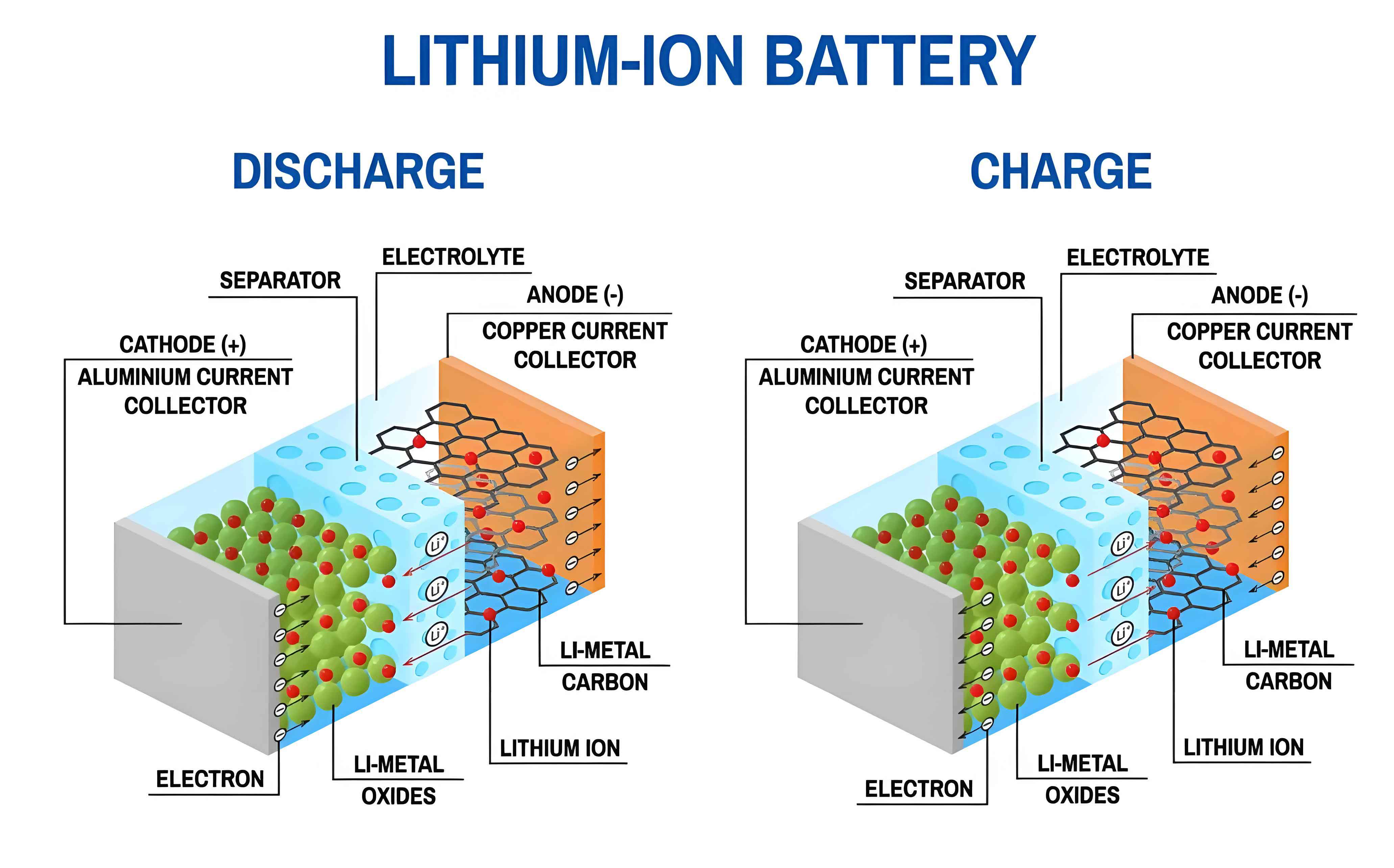
The fundamental operation of a li-ion battery revolves around the reversible intercalation and de-intercalation of Li+ ions between the cathode and anode. A typical schematic representation of the components and ion flow in a li-ion battery is provided below to contextualize the discussion on cathode material development.
Our strategy is rooted in the hypothesis that larger Rb+ ions (ionic radius ~1.52 Å for coordination number 6) substituting for Li+ ions (0.76 Å) can pillar the Li slab, expanding the interlayer spacing and facilitating Li+ diffusion. Concurrently, partial substitution of O2- by Cl– (ionic radius ~1.81 Å) is expected to modify the metal-oxygen bonding, potentially strengthening the lattice and mitigating oxygen loss. The one-step calcination method simplifies the synthesis process, ensuring homogeneous incorporation of dopants. The performance of this modified cathode, termed RbCl-NCM, is systematically compared against pristine NCM across multiple characterization techniques and electrochemical tests, all critical for evaluating its viability in commercial li-ion batteries.
The synthesis of pristine NCM and Rb+/Cl– co-doped Li0.99Rb0.01(Ni0.8Co0.1Mn0.1)O1.99Cl0.01 (RbCl-NCM) was performed via a solid-state reaction. Stoichiometric amounts of (Ni0.8Co0.1Mn0.1)(OH)2 precursor, LiOH·H2O, and RbCl (for the doped sample) were thoroughly mixed. The mixture was subjected to a two-stage calcination process: pre-calcination at 480°C for 5 hours followed by a main calcination at 780°C for 15 hours under an oxygen atmosphere, with controlled heating and cooling rates. The specific molar ratios used for the synthesis are summarized in Table 1. This one-step process is crucial for achieving uniform doping without the need for complex post-synthesis treatments, a significant advantage for scaling up the production of advanced cathode materials for li-ion batteries.
| Material | (Ni0.8Co0.1Mn0.1)(OH)2 (mol) | LiOH·H2O (mol) | RbCl (mol) | Nominal Formula |
|---|---|---|---|---|
| NCM (Pristine) | 1.00 | 1.05 | 0.00 | Li(Ni0.8Co0.1Mn0.1)O2 |
| RbCl-NCM (Doped) | 1.00 | 1.05 | 0.01 | Li0.99Rb0.01(Ni0.8Co0.1Mn0.1)O1.99Cl0.01 |
The crystal structure and phase purity of the synthesized powders were investigated using X-ray diffraction (XRD). All diffraction patterns could be indexed to the hexagonal α-NaFeO2 structure with the R$\bar{3}$m space group, characteristic of layered cathode materials for li-ion batteries. No secondary impurity phases were detected, confirming the successful integration of Rb+ and Cl– into the host lattice. A detailed analysis of the lattice parameters, derived from Rietveld refinement, is presented in Table 2. The co-doped sample exhibits a noticeable increase in the lattice parameter c, while the parameter a shows minimal change. This expansion along the c-axis is directly attributed to the incorporation of larger Rb+ ions in the Li layer, which is quantitatively described by the following relationship for the unit cell volume V:
$$V = \frac{\sqrt{3}}{2} a^2 c$$
The increase in interlayer spacing reduces the energy barrier for Li+ ion hopping, a critical factor for the rate performance of li-ion batteries. Furthermore, the intensity ratio of the (003) to (104) peaks, I(003)/I(104), is a sensitive indicator of cation mixing. A higher ratio signifies lower Li+/Ni2+ disorder. As shown in Table 2, the RbCl-NCM sample possesses a significantly higher I(003)/I(104) ratio compared to pristine NCM, demonstrating that the dual-site doping effectively suppresses cation mixing, a common source of capacity degradation in li-ion batteries.
| Material | Lattice Parameter a (Å) | Lattice Parameter c (Å) | c/a Ratio | I(003)/I(104) | Unit Cell Volume V (Å3) |
|---|---|---|---|---|---|
| NCM (Pristine) | 2.871 | 14.208 | 4.949 | 1.62 | 101.45 |
| RbCl-NCM (Doped) | 2.873 | 14.241 | 4.957 | 1.80 | 101.92 |
Microstructural analysis via scanning electron microscopy (SEM) revealed that both materials consist of spherical secondary particles with a size distribution of 10-15 μm, composed of densely packed primary nanoparticles. The co-doping process did not alter the overall particle morphology. However, high-resolution transmission electron microscopy (HRTEM) images provided deeper insights. The measured interplanar spacing corresponding to the (003) plane increased from approximately 0.472 nm in NCM to 0.478 nm in RbCl-NCM, visually confirming the lattice expansion deduced from XRD. This expanded pathway is instrumental for faster Li+ diffusion, a key requirement for high-power li-ion batteries. X-ray photoelectron spectroscopy (XPS) was employed to probe the surface chemical states. The presence of characteristic Rb 3d and Cl 2p peaks in the RbCl-NCM survey spectrum confirmed the successful incorporation of both dopants. Deconvolution of the Ni 2p spectrum showed a decrease in the relative proportion of Ni2+ species in the doped material, providing direct evidence for the suppression of Ni2+ migration into the Li layer, thereby enhancing structural stability for long-term cycling in li-ion batteries.
The electrochemical performance, the ultimate metric for any cathode material, was evaluated in CR2032 coin-type half-cells versus lithium metal. The electrolyte was a standard solution of 1 M LiPF6 in a carbonate-based solvent mixture. Figure 1 shows the initial charge-discharge profiles at 0.1C (1C = 200 mA g-1) within a voltage window of 2.8-4.5 V. The RbCl-NCM electrode delivered a slightly higher initial discharge capacity of 220.2 mAh g-1 with an initial Coulombic efficiency of 84.8%, compared to 217.4 mAh g-1 and 83.9% for the pristine NCM. This improvement, though modest, indicates better reversibility in the first cycle. The rate capabilities of both cathodes were assessed at progressively higher current densities from 0.2C to 10C, as summarized in Table 3. The superiority of the co-doped material is unequivocal, especially at high rates. For instance, at a demanding 10C rate, the RbCl-NCM retained a discharge capacity of 176.9 mAh g-1, while the pristine NCM delivered only 154.3 mAh g-1. This represents a remarkable 14.6% improvement, underscoring the efficacy of the doping strategy in enhancing Li+ transport kinetics. The enhanced rate performance can be linked to the increased Li+ diffusion coefficient (DLi+), which can be estimated from galvanostatic intermittent titration technique (GITT) data and is described by Fick’s second law:
$$D_{Li^+} = \frac{4}{\pi \tau} \left( \frac{n_m V_m}{A} \right)^2 \left( \frac{\Delta E_s}{\Delta E_\tau} \right)^2$$
where τ is the constant current pulse time, nm is the number of moles, Vm is the molar volume, A is the electrode area, ΔEs is the steady-state voltage change, and ΔEτ is the voltage change during the pulse. The expanded lattice and reduced cation disorder in RbCl-NCM contribute to a higher DLi+, which is fundamental for the high-rate operation of li-ion batteries.
| Current Density (C-rate) | Discharge Capacity – NCM (mAh g-1) | Discharge Capacity – RbCl-NCM (mAh g-1) | Capacity Retention vs. 0.2C – NCM (%) | Capacity Retention vs. 0.2C – RbCl-NCM (%) |
|---|---|---|---|---|
| 0.2C | 217.6 | 216.2 | 100.0 | 100.0 |
| 0.5C | 210.0 | 213.1 | 96.5 | 98.6 |
| 1C | 200.2 | 205.4 | 92.0 | 95.0 |
| 2C | 189.9 | 198.6 | 87.3 | 91.9 |
| 3C | 182.2 | 193.5 | 83.7 | 89.5 |
| 5C | 172.1 | 186.5 | 79.1 | 86.3 |
| 10C | 154.3 | 176.9 | 70.9 | 81.8 |
The long-term cycling stability, a paramount concern for the commercial adoption of any li-ion battery technology, was evaluated at 1C for 200 cycles. The results are graphically summarized in Figure 2 and numerically in Table 4. The pristine NCM cathode suffered from severe capacity decay, retaining only 57.3% of its initial capacity after 200 cycles. In stark contrast, the RbCl-NCM cathode exhibited exceptional stability, maintaining 87.8% of its initial capacity under identical testing conditions. This dramatic improvement in capacity retention directly correlates with the structural stabilization imparted by Rb+/Cl– co-doping. The larger Rb+ acts as a structural pillar, mitigating the anisotropic lattice strain during Li+ (de)intercalation. Simultaneously, Cl– substitution strengthens the TM-O bond, as the bond energy of TM-Cl is generally different from TM-O, potentially increasing the activation energy for oxygen vacancy formation and transition metal dissolution. The synergy of these effects can be modeled by considering the total Gibbs free energy change (ΔG) for a degradation reaction (e.g., layer-to-spinel transformation) as a function of doping concentration (x for Rb, y for Cl):
$$\Delta G_{doped}(x,y) = \Delta G_{pristine} + \alpha x + \beta y + \gamma xy$$
where α and β represent the individual stabilizing contributions from Rb and Cl doping, respectively, and the cross-term γxy captures their synergistic interaction. A more positive ΔGdoped indicates a higher energy barrier for the degradation pathway, leading to improved cycling life for the li-ion battery.
| Material | Initial Discharge Capacity at 1C (mAh g-1) | Discharge Capacity after 200 cycles at 1C (mAh g-1) | Capacity Retention (%) | Average Coulombic Efficiency over 200 cycles (%) |
|---|---|---|---|---|
| NCM (Pristine) | 204.3 | 117.1 | 57.3 | 99.1 |
| RbCl-NCM (Doped) | 203.5 | 178.6 | 87.8 | 99.6 |
Electrochemical impedance spectroscopy (EIS) measurements were conducted on cells after different cycle numbers to unravel the interfacial kinetics. The Nyquist plots typically consist of a high-frequency semicircle related to the surface film resistance (Rsf), a medium-frequency semicircle associated with the charge transfer resistance (Rct), and a low-frequency Warburg tail corresponding to Li+ solid-state diffusion. An equivalent circuit model, Rs(RsfCPEsf)(RctCPEdl)Wo, was used for fitting. The fitted Rct values for both materials after the 1st and 100th cycles are compared in Table 5. The RbCl-NCM electrode consistently exhibited a lower Rct value, indicating faster charge transfer kinetics at the electrode-electrolyte interface. This reduced polarization is crucial for maintaining high power density throughout the life of a li-ion battery. Furthermore, the Warburg coefficient (σw), derived from the low-frequency data, is inversely related to the Li+ diffusion coefficient. The calculated DLi+ for RbCl-NCM was consistently higher than for NCM, quantitatively validating the enhanced ionic conductivity from doping.
| Material | Cycle Number | Rs (Ω) | Rsf (Ω) | Rct (Ω) | Estimated DLi+ (cm2 s-1) |
|---|---|---|---|---|---|
| NCM (Pristine) | 1 | 3.2 | 12.5 | 45.8 | 3.2 × 10⁻¹² |
| RbCl-NCM (Doped) | 1 | 3.5 | 11.8 | 28.4 | 8.1 × 10⁻¹² |
| NCM (Pristine) | 100 | 4.1 | 25.6 | 112.3 | 1.5 × 10⁻¹² |
| RbCl-NCM (Doped) | 100 | 3.8 | 18.9 | 65.7 | 5.3 × 10⁻¹² |
To understand the thermodynamic aspects of Li+ (de)intercalation, cyclic voltammetry (CV) was performed at a slow scan rate. The redox peaks correspond to the phase transitions between hexagonal (H1, H2, H3) phases during cycling. The voltage difference (ΔEp) between the anodic and cathodic peaks is a measure of polarization. For the RbCl-NCM electrode, ΔEp was significantly smaller (0.142 V) than that for the pristine NCM (0.295 V), indicating superior reaction reversibility and lower overpotential. This reduced hysteresis is beneficial for the energy efficiency of the li-ion battery. The integrated area under the CV peaks also correlates with the capacity, and the doped material showed better-defined and more symmetric peaks, suggesting more stable phase transitions. The interplay between kinetics and thermodynamics can be described by the Butler-Volmer equation, where the current density i is:
$$i = i_0 \left[ \exp\left(\frac{\alpha n F \eta}{RT}\right) – \exp\left(-\frac{(1-\alpha) n F \eta}{RT}\right) \right]$$
Here, i0 is the exchange current density, α is the charge transfer coefficient, n is the number of electrons, F is Faraday’s constant, η is the overpotential, R is the gas constant, and T is the temperature. The lower Rct for RbCl-NCM implies a higher i0, leading to lower η for a given current, which aligns perfectly with the observed superior rate and cycling performance.
In conclusion, we have successfully demonstrated a facile one-step synthesis route for fabricating Rb+ and Cl– dual-site co-doped LiNi0.8Co0.1Mn0.1O2 cathode material. The synergistic effect of these dopants manifests in an expanded Li layer spacing, suppressed Li+/Ni2+ cation mixing, and reinforced crystal structure. These structural advantages translate directly into outstanding electrochemical properties: enhanced rate capability (176.9 mAh g-1 at 10C) and exceptional long-term cycling stability (87.8% capacity retention after 200 cycles at 1C). This work provides a compelling and scalable materials design strategy to overcome the key limitations of nickel-rich layered oxide cathodes. The principles elucidated here—using large-radius cation doping to facilitate ionic transport and anion doping to strengthen the lattice—are broadly applicable and offer a valuable roadmap for the development of next-generation, high-energy, and durable cathode materials. The continuous improvement of such cathodes is indispensable for meeting the ever-growing performance targets for advanced li-ion batteries powering everything from consumer electronics to electric vehicles and grid-scale energy storage systems. Future work will focus on optimizing the doping concentrations, exploring other dopant pairs, and evaluating the full-cell performance of this promising material in practical li-ion battery configurations to accelerate its path towards commercialization.