
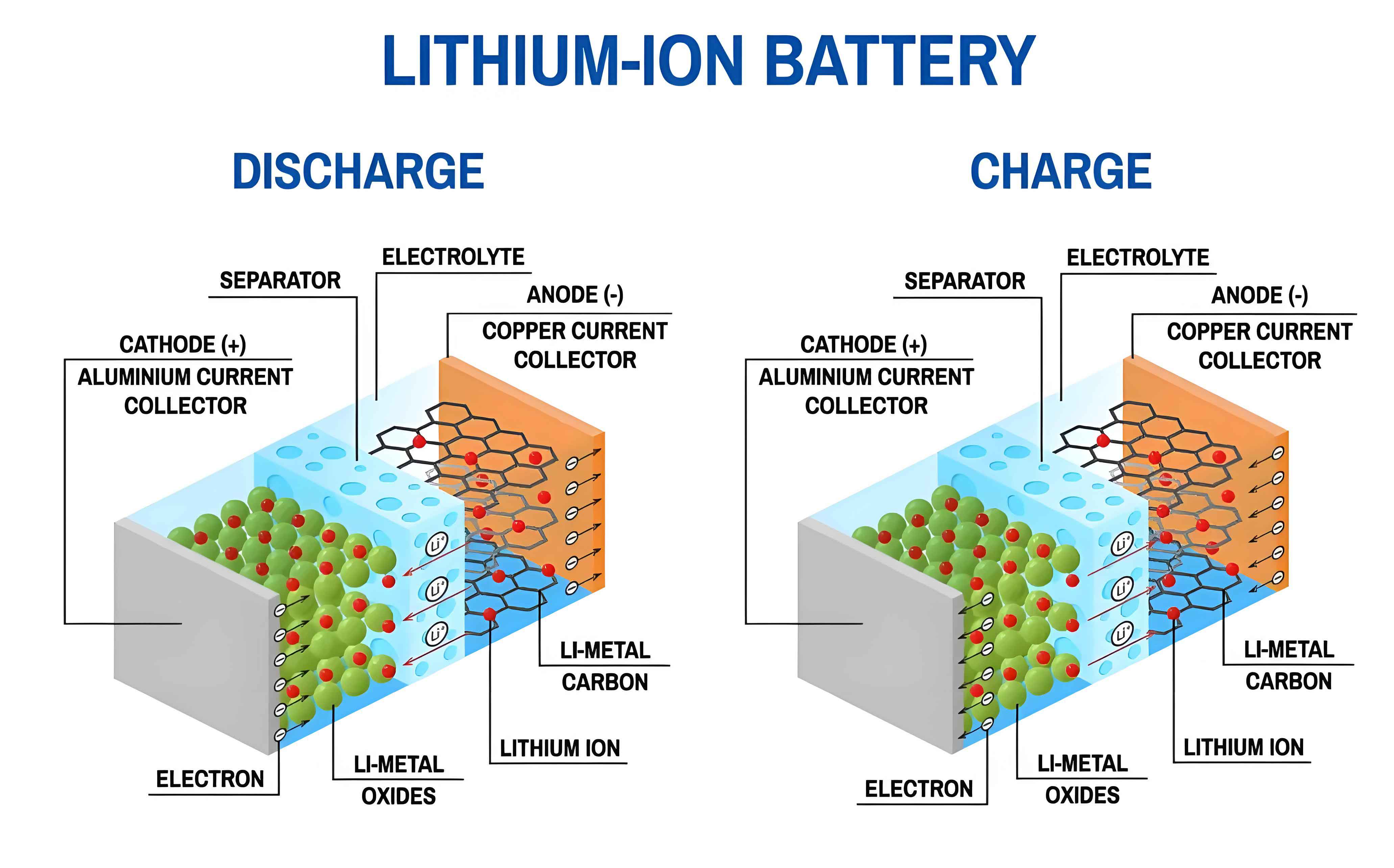
The widespread adoption of li-ion batteries in electric vehicles, portable electronics, and energy storage systems is driven by their high energy density, long cycle life, and power capabilities. However, operational challenges persist, particularly during fast charging or low-temperature charging, where the li-ion battery anode is susceptible to lithium plating—a parasitic reaction where lithium ions are reduced to metallic lithium on the anode surface instead of intercalating into the active material. This phenomenon accelerates capacity fade, increases safety risks such as thermal runaway, and undermines the reliability of li-ion battery systems. Consequently, real-time detection of lithium plating has emerged as a critical functionality for next-generation Battery Management Systems (BMS), aiming to enhance the safety, longevity, and performance of li-ion batteries. This review systematically examines online lithium plating detection methods with potential for BMS integration, categorizing them into model-driven, data-driven, and advanced sensor-based approaches. Each category is analyzed in terms of principles, implementation, advantages, and limitations, with a focus on five key evaluation dimensions: sensitivity, timeliness, robustness, implementability, and quantitativeness. The goal is to provide insights into current progress and future directions for integrating these methods into BMS for li-ion batteries.
Model-Driven Lithium Plating Detection Methods
Model-driven methods leverage electrochemical models to simulate internal states of li-ion batteries, enabling the detection of lithium plating by estimating critical parameters such as anode potential. These approaches are grounded in physics-based models that describe the complex interplay of ion transport, reaction kinetics, and thermodynamics within a li-ion battery.
Development of Lithium Plating Mechanism Models
The foundation for most model-driven methods is the pseudo-two-dimensional (P2D) model, which uses coupled partial differential equations to represent li-ion battery dynamics. Key equations include solid-phase electron conduction:
$$i_s = -\sigma_{ef} \frac{d\phi_s}{dx}$$
where \(i_s\) is the electronic current density, \(\sigma_{ef}\) is the effective solid-phase conductivity, and \(\phi_s\) is the solid-phase potential. Liquid-phase ion transport is described by:
$$i_l = -\kappa_{ef} \frac{d\phi_l}{dx} + \frac{2RT\kappa_{ef}}{F} (1 – t_+) \frac{d \ln c_l}{dx}$$
with \(i_l\) as the ionic current density, \(\kappa_{ef}\) as the effective liquid-phase conductivity, \(\phi_l\) as the liquid-phase potential, \(t_+\) as the lithium ion transference number, \(c_l\) as the liquid-phase lithium concentration, \(R\) as the gas constant, \(T\) as temperature, and \(F\) as Faraday’s constant. The material balance in the liquid phase is:
$$\frac{\partial (\epsilon c_l)}{\partial t} = \frac{\partial}{\partial x} \left( D_{ef} \frac{\partial c_l}{\partial x} \right) + \frac{1 – t_+}{F} \frac{\partial i_l}{\partial x}$$
where \(\epsilon\) is porosity and \(D_{ef}\) is the effective diffusion coefficient. Solid-phase diffusion in active particles follows:
$$\frac{\partial c_s}{\partial t} = D_s \left( \frac{\partial^2 c_s}{\partial r^2} + \frac{2}{r} \frac{\partial c_s}{\partial r} \right)$$
with \(c_s\) as the solid-phase lithium concentration and \(D_s\) as the solid-phase diffusion coefficient. Charge conservation is given by:
$$\frac{\partial i_s}{\partial x} + \frac{\partial i_l}{\partial x} = 0$$
and the interfacial reaction kinetics are modeled using the Butler-Volmer equation:
$$j_p = j_0 \left[ \exp\left( \frac{\alpha_a F \eta}{RT} \right) – \exp\left( -\frac{\alpha_c F \eta}{RT} \right) \right]$$
where \(j_p\) is the pore wall flux, \(j_0\) is the exchange current density, \(\alpha_a\) and \(\alpha_c\) are charge transfer coefficients, and \(\eta\) is the overpotential. To incorporate lithium plating, additional equations are introduced. The lithium plating reaction current \(j_{Li}\) is often expressed as:
$$j_{Li} = j_{0,Li} \left[ \exp\left( \frac{\alpha_{a,Li} F \eta_{Li}}{RT} \right) – \exp\left( -\frac{\alpha_{c,Li} F \eta_{Li}}{RT} \right) \right]$$
with \(\eta_{Li} = \phi_s – \phi_l – U_{Li}^{ref}\), where \(U_{Li}^{ref}\) is the reference potential for lithium plating (typically 0 V vs. Li/Li\(^+\)). The total reaction current becomes \(j_p = j_{in} + j_{Li}\), where \(j_{in}\) is the intercalation current. Models have evolved to include effects like marginal current distribution, reversible lithium stripping, and dead lithium formation. For instance, dead lithium accumulation can be modeled as:
$$\frac{\partial c_{Li,de}}{\partial t} = \frac{a (1 – \beta) j_{Li,st}}{F}$$
where \(c_{Li,de}\) is the dead lithium concentration, \(a\) is the specific surface area, \(\beta\) is the reversibility coefficient, and \(j_{Li,st}\) is the stripping current. To reduce computational complexity for BMS integration, model order reduction techniques such as orthogonal decomposition, state-space reformulation, and polynomial approximation are employed, transforming partial differential equations into ordinary differential equations. This can accelerate simulation speeds by up to 5000 times, making model-driven approaches more feasible for real-time applications in li-ion battery management.
Model-Based Lithium Plating Detection
Detection strategies using these models focus on estimating the anode potential or overpotential to identify conditions favoring lithium plating. A common indicator is the anode potential relative to Li/Li\(^+\), where values below 0 V suggest plating onset. For example, an empirical formula for plating onset state-of-charge (SOC) \(y\) as a function of charging rate \(c\), loading density \(x\), and temperature \(T\) can be derived:
$$y(c, x, T) = \frac{\alpha \cdot c + \beta \cdot x + \gamma \cdot T + \epsilon}{1 + \gamma \cdot T}$$
where parameters \(\alpha, \beta, \gamma, \epsilon\) are fitted from experimental data. Alternatively, state observers are designed to track the overpotential \(\eta_{Li}(x,t)\) in real-time. A discrete-time observer might use:
$$\hat{x}_k = f(\hat{x}_{k-1}, u_k) + h(\hat{z}_k – z_k)$$
with \(\hat{x}_k\) as estimated states (e.g., lithium concentrations), \(u_k\) as input current, \(z_k\) as measured voltage, and \(h\) as a feedback gain function. The overpotential at the anode-separator interface \(\delta_n\) is then computed to diagnose plating. Model-driven methods offer high sensitivity and timeliness, as they can detect plating instantaneously without requiring accumulated lithium. However, their implementability in BMS is limited by computational demands, though cloud-BMS architectures and advanced chips may mitigate this. Robustness is enhanced by coupling with thermal or aging models, and quantitativeness is inherent due to the physics-based nature.
Data-Driven Lithium Plating Detection Methods
Data-driven methods utilize measurable parameters from li-ion batteries, such as voltage, current, and temperature, to extract features indicative of lithium plating. These approaches avoid complex models and rely on pattern recognition, making them promising for BMS integration given the availability of sensor data in li-ion battery systems.
Coulombic Efficiency Method
Coulombic efficiency (CE) is defined as the ratio of discharged charge to charged charge over a cycle:
$$E = \frac{Q_{di}}{Q_{ch}}$$
For a healthy li-ion battery, CE typically ranges from 0.995 to 1, but lithium plating introduces irreversible lithium loss, reducing CE to around 0.97 or lower. Thus, a CE below 0.97 can signal plating. This method requires high-precision current measurement and complete charge-discharge cycles, resulting in low timeliness. Sensitivity is moderate, as it needs accumulated plating (e.g., 1.3% of capacity) for reliable detection. Robustness is affected by factors like SEI growth, but it offers quantitative insights into irreversible lithium. Implementability is moderate due to precision requirements.
Voltage Curve Analysis Methods
Voltage profiles during relaxation or discharge exhibit distinct features when lithium plating occurs. After charging, a voltage plateau may appear during relaxation, deviating from the logarithmic decay trend. The derivative of relaxation voltage \(dV/dt\) shows a trough corresponding to reversible lithium re-intercalation. Similarly, discharge voltage curves can have an additional plateau, and differential voltage analysis \(dQ/dV\) reveals troughs. For example, the trough in \(dV/dt\) during relaxation is used to quantify reversible plating. The detection limit is around 1% of graphite capacity. Methods include:
- Relaxation Voltage Method: Analyzes \(dV/dt\) post-charging; timeliness is low as it requires rest periods, but sensitivity is moderate.
- Discharge Voltage Method: Examines \(dQ/dV\) during low-rate discharge; timeliness is low, sensitivity moderate.
- Charging Voltage Method: Looks for minima in charging voltage curves; timeliness is high but less validated.
These methods are highly implementable in BMS due to reliance on standard voltage data. Robustness is moderate, as temperature and aging can affect voltage signatures.
Machine Learning Methods
Machine learning techniques, such as neural networks and support vector machines, fuse multiple features (e.g., capacity fade, CE, voltage curves) to detect and quantify lithium plating. For instance, a deep learning model trained on cycling data from li-ion batteries can predict plating amounts with high accuracy. These methods achieve high sensitivity, timeliness (potentially real-time during charging), and quantitativeness. Robustness is enhanced with diverse training data, but they require large labeled datasets and suffer from black-box limitations. Implementability is high as BMS can integrate pre-trained models.
Advanced Sensor-Based Lithium Plating Detection Methods
These methods employ specialized sensors to monitor physical or electrochemical changes in li-ion batteries associated with lithium plating. While not yet standard in BMS, advancements in sensor technology could enable future integration.
Reference Electrode Method
By inserting a reference electrode (e.g., lithium metal) into the li-ion battery, the anode potential relative to Li/Li\(^+\) is directly measured. Plating is indicated when the potential drops below 0 V. This approach offers high sensitivity and timeliness, but implementability is low due to challenges in electrode integration and longevity. Robustness is high, but quantitativeness is limited to qualitative detection.
Thickness Measurement Method
Lithium plating causes greater volume expansion compared to intercalation. Sensors like micrometers, laser displacement sensors, or pressure transducers measure cell thickness or external pressure changes. The differential pressure sensing (DPS) method monitors \(dP/dQ\) during charging, with deviations indicating plating. Sensitivity is moderate (detection at ~0.1% capacity), and timeliness is moderate. However, robustness is low due to temperature and mechanical influences, and implementability is low for embedded systems.
Electrochemical Impedance Spectroscopy Method
EIS measures impedance spectra of li-ion batteries, where mid-frequency arcs reflect charge-transfer processes affected by plating. Techniques include:
- Relaxation EIS: Post-charging impedance analysis; timeliness low but robust.
- Dynamic EIS (DEIS): In-operando impedance tracking during charging; timeliness moderate.
- Intermittent Charging: Measures internal resistance \(R_i\) during pauses; timeliness moderate.
Sensitivity is moderate (~1% capacity), and implementability is low due to need for AC impedance hardware, though single-frequency chips may help.
Acoustic Wave Measurement Method
Ultrasonic waves propagate through li-ion battery materials, and changes in time-of-flight (TOF) or signal strength correlate with mechanical property shifts due to plating. A TOF increase during charging suggests lithium deposition. Sensitivity is moderate, timeliness moderate, but robustness is low due to gas interference. Implementability is low, though sensors are inexpensive.
Thermal Feature Measurement Method
Isothermal calorimetry detects heat flow variations during charging; a missing heat flow peak at high SOC indicates plating. Other thermal methods, like thermal conductivity mapping, show potential. Sensitivity is moderate, timeliness moderate, but robustness and implementability are low due to environmental factors and sensor needs.
Comparative Analysis of Lithium Plating Detection Methods
To evaluate the suitability of each method for BMS integration in li-ion batteries, five dimensions are considered: sensitivity (required plating accumulation), timeliness (detection delay), robustness (resistance to disturbances), implementability (ease of BMS integration), and quantitativeness (ability to measure plating amount). Ratings are summarized in Table 1.
| Method Category | Specific Method | Sensitivity | Timeliness | Robustness | Implementability | Quantitativeness |
|---|---|---|---|---|---|---|
| Model-Driven | Mechanism Model + Observer | High | High | High | Medium | High |
| Empirical Formula-Based | High | High | Medium | Medium | High | |
| Reduced-Order Models | High | High | High | Medium | High | |
| Data-Driven | Coulombic Efficiency | Low | Low | Medium | Medium | High |
| Relaxation Voltage Analysis | Medium | Low | Medium | High | High | |
| Discharge Voltage Analysis | Medium | Low | Medium | High | High | |
| Machine Learning | High | Medium | High | High | High | |
| Advanced Sensor-Based | Reference Electrode | High | High | High | Low | Low |
| Thickness/Pressure Measurement | Medium | Medium | Low | Low | Low | |
| Electrochemical Impedance Spectroscopy | Medium | Medium | High | Low | Low | |
| Acoustic Wave Measurement | Medium | Medium | Low | Low | Medium | |
| Thermal Feature Measurement | Medium | Medium | Low | Low | Low |
The sensitivity dimension assesses the minimum lithium plating accumulation needed for detection, expressed as a percentage of li-ion battery capacity. High sensitivity methods like model-driven and reference electrode approaches can detect plating onset immediately (\(\eta = 0\)), while medium sensitivity methods require \(\eta \leq 1\%\), and low sensitivity methods need \(\eta > 1\%\). Timeliness refers to the delay between plating onset and detection; high timeliness indicates real-time detection, medium implies detection during or shortly after charging, and low involves post-cycle analysis. Robustness evaluates resistance to external factors like temperature fluctuations, aging, or vibrations in li-ion battery systems. Implementability considers the feasibility of integrating the method into current BMS hardware, with high ratings for methods using existing sensors and low for those needing new sensors. Quantitativeness reflects the ability to estimate the amount of plated lithium, which is crucial for assessing degradation in li-ion batteries.
From the comparison, no single method excels in all dimensions. Model-driven methods offer excellent performance but face computational hurdles; data-driven methods like voltage analysis are implementable but lack timeliness; sensor-based methods provide direct measurements but suffer from robustness and integration issues. The choice depends on the specific li-ion battery application—e.g., electric vehicles may prioritize timeliness and quantitativeness, while grid storage could favor robustness.
Conclusions and Future Perspectives
Lithium plating detection is vital for the safe and efficient operation of li-ion batteries, and integrating these methods into BMS represents a key advancement. This review has categorized and analyzed model-driven, data-driven, and advanced sensor-based approaches, highlighting their principles and trade-offs. Future directions for research and development in li-ion battery management include:
- Enhanced Model-Driven Integration: Leveraging cloud-BMS architectures to offload computational tasks, enabling real-time state estimation for li-ion batteries. Further model reduction and parameter identification techniques can improve implementability.
- Advanced Data-Driven Techniques: Developing charging voltage curve features for real-time detection in li-ion batteries. Expanding machine learning datasets through synthetic data from models or collaborative platforms to enhance robustness and accuracy.
- Sensor Technology Innovation: Miniaturizing and cost-reducing sensors for impedance, acoustic, or thermal measurements to embed in li-ion battery packs. Improving reference electrode designs for commercial li-ion batteries.
- Hybrid Method Fusion: Combining multiple detection approaches to compensate for individual weaknesses. For example, using model-driven methods to generate training data for machine learning, or integrating sensor data with voltage analysis for cross-validation in li-ion battery systems.
- Standardization and Validation: Establishing benchmarks for evaluating detection methods under diverse operating conditions of li-ion batteries, ensuring reliability across different chemistries and form factors.
As li-ion batteries continue to power modern technology, advancing lithium plating detection will be crucial for unlocking fast-charging capabilities, extending lifespan, and preventing safety incidents. By addressing current limitations through interdisciplinary efforts, next-generation BMS can achieve robust, real-time monitoring, ultimately enhancing the performance and sustainability of li-ion battery systems.