
The ever-accelerating pace of societal development is predicated on a massive and reliable supply of energy. Currently, the global energy landscape remains heavily reliant on fossil fuels. The over-exploitation and consumption of these finite resources have precipitated a rapid decline in their reserves, leading to looming energy security concerns. Furthermore, this dependence has resulted in significant emissions of pollutants, triggering severe environmental degradation. In this context, the development of efficient, clean, and sustainable energy storage systems is paramount. The lithium-ion battery stands out as a preeminent electrochemical energy storage device, capable of storing energy in chemical form and releasing it as electricity on demand.
The modern lithium-ion battery, as we know it, evolved from the “rocking-chair” battery concept proposed by Armand in 1972. It operates on the principle of reversible lithium-ion intercalation and de-intercalation within host materials at the positive and negative electrodes, generating an electric current in the external circuit. Taking the most widely used combination of lithium cobalt oxide (LCO) cathode and graphite anode as an example, the electrochemical reactions during charge and discharge can be represented as:
Anode: $$6C + xLi^+ + xe^- \rightleftharpoons Li_xC_6$$
Cathode: $$LiCoO_2 \rightleftharpoons Li_{1-x}CoO_2 + xLi^+ + xe^-$$
Overall: $$LiCoO_2 + 6C \rightleftharpoons Li_{1-x}CoO_2 + Li_xC_6$$
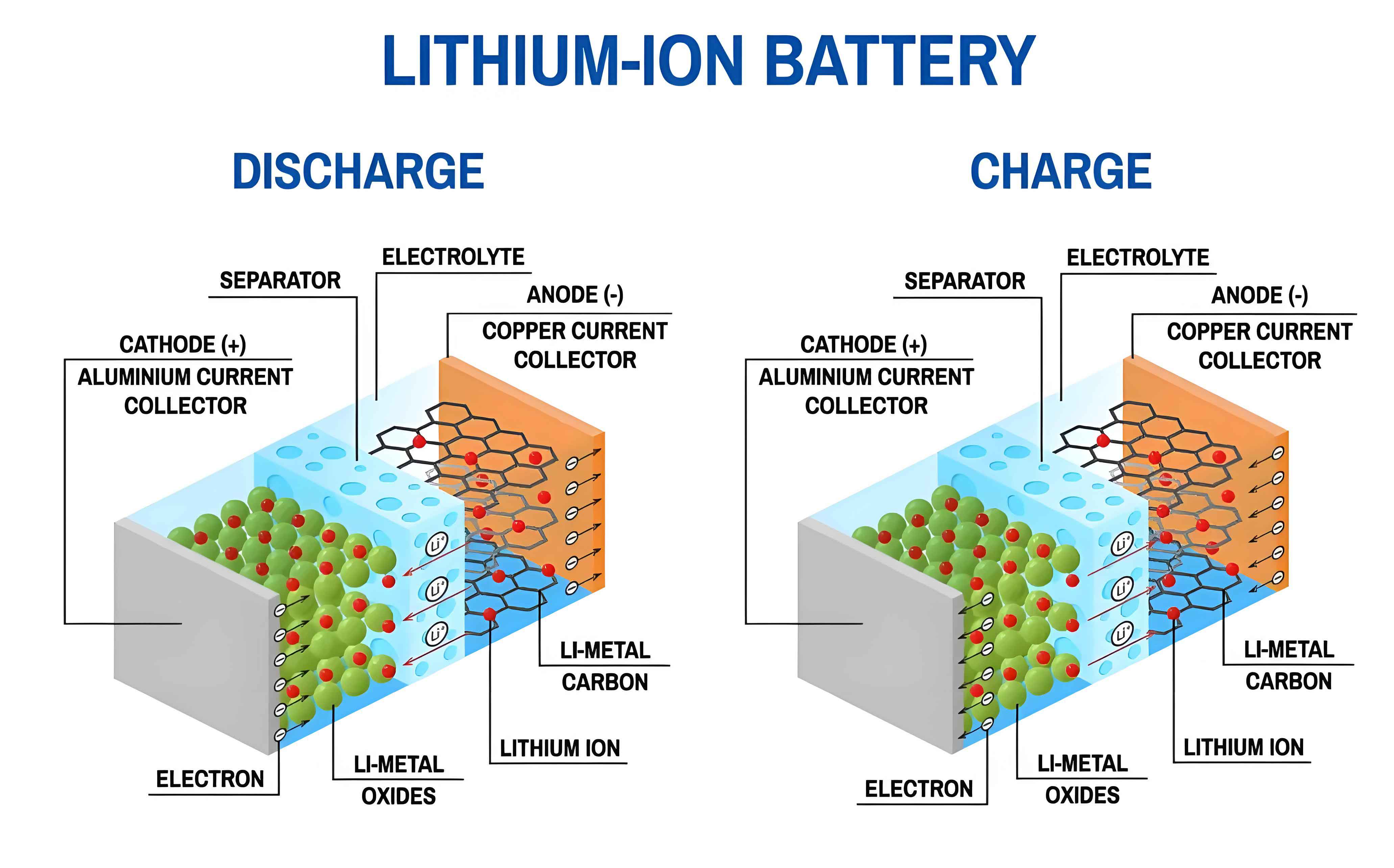
A standard lithium-ion battery comprises five main components: the cathode, anode, electrolyte, separator, and casing. Among these, the cathode and anode materials are critically important, as they fundamentally determine key performance metrics of the battery, such as energy density, specific capacity, and cycle life. Both electrodes are typically composites consisting of an active material, a conductive additive, and a polymeric binder. Commercial cathode materials primarily include layered oxides (e.g., LCO and its derivatives), spinel-type lithium manganese oxide (LMO), and olivine-type lithium iron phosphate (LFP). On the anode side, graphite and lithium titanate (LTO) are the dominant commercial materials. Due to their pivotal role, electrode materials remain a central focus of research. Current efforts for cathodes often concentrate on elemental doping and surface coating strategies to enhance stability and performance. While graphite is the most mature anode material due to its good conductivity and low cost, its specific capacity is approaching its theoretical limit. Therefore, developing anode materials with higher capacities is a crucial direction for the future advancement of lithium-ion battery technology.
Anode Materials for Lithium-Ion Batteries
The anode in a lithium-ion battery typically does not supply lithium ions but acts as a host for their storage. An ideal anode material should accommodate a large number of Li⁺ ions to provide high capacity and should allow their insertion and extraction at a potential as low as possible versus Li⁺/Li to enable a high output voltage for the full cell. In theory, metallic lithium is the ultimate anode, boasting an exceptionally high theoretical specific capacity of 3,862 mAh/g and a low potential of -3.04 V (vs. standard hydrogen electrode). However, its commercialization faces a formidable challenge: during repeated charge-discharge cycles, lithium tends to deposit unevenly on the anode surface, forming dendritic structures known as lithium dendrites. These dendrites can grow and eventually pierce the separator, causing an internal short circuit, which may lead to thermal runaway, fire, or even explosion. Consequently, research has focused on developing intercalation or alloying-based anodes. Currently, the most widely used anode materials are graphite and lithium titanate.
Graphite
Graphite is the workhorse anode material in commercial lithium-ion batteries, prized for its safety, low cost, excellent cycle life, minimal volume expansion upon lithiation (≈10%), and decent rate capability. During the operation of a lithium-ion battery, Li⁺ ions intercalate between the graphene layers of graphite, forming a staged intercalation compound with a maximum theoretical composition of LiC₆, corresponding to a specific capacity of 372 mAh/g. The intercalation reaction is relatively gentle, contributing to graphite’s long-term stability. However, as the demand for higher energy density grows, this limited capacity has become a bottleneck. Researchers have attempted to enhance its performance by creating composites with silicon or metals or through nanostructuring. While these modifications can yield improvements, they often increase manufacturing complexity and cost, and the intrinsic capacity ceiling of graphite remains a fundamental limitation.
Lithium Titanate (LTO)
Spinel-structured lithium titanate (Li₄Ti₅O₁₂) can incorporate three additional Li⁺ ions to form Li₇Ti₅O₁₂, delivering a specific capacity of 175 mAh/g. A remarkable feature of LTO is its negligible volume change (≈0.2%) during lithium insertion/extraction, earning it the title of a “zero-strain” material. This attribute endows it with exceptional cycling stability. Furthermore, LTO operates at a relatively high potential plateau of about 1.55 V vs. Li⁺/Li. This voltage is high enough to prevent lithium plating and dendrite formation under normal conditions, significantly enhancing the safety profile of the battery. The lithiation mechanism involves Li⁺ diffusion in the electrolyte, charge transfer at the LTO/electrolyte interface (where Ti⁴⁺ is reduced to Ti³⁺), and subsequent solid-state diffusion of Li⁺ within the LTO lattice. The rate performance of LTO is often constrained by the solid-state diffusion kinetics of Li⁺ within its bulk structure.
Silicon: The Promising Candidate
Silicon (Si) emerges as a highly promising alternative to graphite, primarily due to its extraordinarily high theoretical specific capacity. Silicon undergoes an alloying reaction with lithium to form various Li-Si phases, with a maximum theoretical capacity of approximately 4,200 mAh/g (for the Li₂₂Si₅ phase), which is more than ten times that of graphite. Furthermore, silicon is the second most abundant element in the Earth’s crust, making it inexpensive and environmentally benign. These compelling advantages position silicon-based anodes at the forefront of next-generation high-energy lithium-ion battery research. However, several intrinsic and severe challenges have hindered its practical application.
| Property | Graphite | Lithium Titanate (LTO) | Silicon (Si) |
|---|---|---|---|
| Theoretical Capacity | 372 mAh/g | 175 mAh/g | ~4,200 mAh/g |
| Working Potential | ~0.1 V vs. Li⁺/Li | ~1.55 V vs. Li⁺/Li | ~0.4 V vs. Li⁺/Li |
| Volume Change | ~10% | ~0.2% (“zero-strain”) | ~300-400% |
| Key Advantage | Mature, stable, low cost | Ultra-safe, long cycle life | Extremely high capacity |
| Key Disadvantage | Low capacity limit | Low capacity, low energy density | Huge volume expansion, poor cycle life |
1. Colossal Volume Expansion and Particle Pulverization: The alloying reaction between silicon and lithium is accompanied by dramatic volumetric changes. Depending on the specific Li-Si phase formed, the volume expansion can reach up to approximately 400% for the Li₂₂Si₅ phase. This massive, anisotropic expansion generates immense mechanical stress within the electrode. It causes cracking and pulverization of the silicon particles, loss of electrical contact between active material and the current collector, and ultimately, rapid capacity fade. Upon delithiation, the silicon particles contract, and this repeated expansion/contraction over cycles accelerates structural degradation.
2. Unstable Solid Electrolyte Interphase (SEI): The SEI layer is a passivating film that forms on the electrode surface during the initial cycles due to the reductive decomposition of electrolyte components. A stable and compact SEI is crucial as it allows Li⁺ transport while blocking further electrolyte decomposition, thus preserving the lithium inventory. The formation of this layer consumes active Li⁺ from the cathode, which is irreversibly lost, lowering the initial Coulombic Efficiency (ICE). For silicon anodes, the problem is exacerbated. The huge volume changes during cycling continuously fracture the initially formed SEI. Fresh silicon surfaces are exposed to the electrolyte, leading to ongoing, parasitic side reactions that thicken the SEI layer with each cycle. This process continuously depletes both lithium and electrolyte, increases electrode polarization and impedance, and severely degrades cycle life. The capacity loss can be described by an equation accounting for active material loss and lithium consumption:
$$ Q_{loss}(n) = Q_{active\_loss}(n) + Q_{Li\_consumption}(n) $$
where $Q_{loss}(n)$ is the total capacity loss at cycle $n$, $Q_{active\_loss}(n)$ is the capacity loss due to silicon particle isolation/disconnection, and $Q_{Li\_consumption}(n)$ is the capacity loss from continuous SEI reformation.
3. Poor Intrinsic Electronic and Ionic Conductivity: Silicon is a semiconductor with relatively low electronic conductivity. Additionally, the solid-state diffusion of Li⁺ within bulk silicon is slow. These factors collectively result in poor reaction kinetics, limiting the rate capability and leading to polarization, especially at high current densities. This is a significant barrier for applications requiring fast charging in a lithium-ion battery.
| Li-Si Phase | Composition (Li:Si) | Theoretical Capacity (mAh/g) | Volume Expansion vs. Si (%) |
|---|---|---|---|
| a-LixSi (amorphous) | ~3.75 | ~3,600 | ~280 |
| Li12Si7 | 12:7 ≈ 1.71 | 2,048 | ~160 |
| Li14Si6 | 14:6 ≈ 2.33 | 3,578 | ~300 |
| Li13Si4 | 13:4 = 3.25 | 3,579 | ~250 |
| Li22Si5 | 22:5 = 4.4 | 4,200 | ~400 |
Research Progress on Silicon-Based Anode Materials
To overcome the aforementioned challenges and unlock the potential of silicon for use in high-performance lithium-ion batteries, extensive research has been conducted worldwide. The primary strategies can be categorized into several key approaches: particle size and morphology engineering, alloying, composite development, and prelithiation.
Particle Size and Morphology Engineering
Reducing the primary particle size of silicon to the nanoscale is one of the most fundamental and effective strategies. Nanomaterials possess a higher surface-to-volume ratio and, more importantly, can better accommodate mechanical strain. The critical size below which silicon particles can resist fracture during lithiation has been studied. Research has indicated that when the silicon particle diameter is below approximately 150 nm, the material can undergo lithiation/delithiation without catastrophic cracking. This is because smaller particles have a shorter absolute path for lithium diffusion and can relax stress more effectively. Furthermore, designing specific nanostructures such as nanoparticles, nanowires, nanotubes, and particularly porous or hollow structures provides internal void space to accommodate volume expansion. These engineered voids act as a buffer, mitigating mechanical stress and preserving the structural integrity of the electrode. The porous architecture also facilitates better electrolyte infiltration, enhancing Li⁺ transport kinetics. For instance, one study demonstrated that combining nano-silicon with micron-sized silicon particles created a robust network, delivering a capacity of 2,500 mAh/g after 30 cycles. The performance enhancement from nanostructuring can be conceptually linked to reduced diffusion lengths and stress, as shown in simplified models for diffusion time and stress:
Diffusion Time: $$ \tau \propto \frac{L^2}{D} $$ where $\tau$ is the characteristic diffusion time, $L$ is the particle radius, and $D$ is the diffusion coefficient. Reducing $L$ drastically decreases $\tau$, improving rate capability.
Stress (simplified): $$ \sigma \propto \frac{E \beta \Delta c}{1-\nu} $$ where $\sigma$ is stress, $E$ is Young’s modulus, $\beta$ is the partial molar volume, $\Delta c$ is the concentration gradient, and $\nu$ is Poisson’s ratio. Smaller particles help reduce $\Delta c$ and thus $\sigma$.
Alloying
Incorporating other metallic elements into silicon to form alloys or intermetallics is another valuable approach. The goals of alloying are multi-faceted:
- Conductivity Enhancement: Metals like silver (Ag), copper (Cu), or iron (Fe) can significantly improve the overall electronic conductivity of the electrode material.
- Active/Inactive Buffering: Elements such as tin (Sn) or antimony (Sb) can themselves alloy with lithium, contributing additional capacity (active buffers). Others, like titanium (Ti) or nickel (Ni), may remain electrochemically inactive but provide a rigid, conductive matrix that mechanically supports the silicon, buffers volume changes, and prevents agglomeration (inactive buffers).
- Performance Stabilization: The alloy phase can sometimes modify the lithium insertion mechanism or the formation of Li-Si phases, leading to improved cycle life. For example, a Si-Sn-Sb alloy demonstrated the ability to retain 90% of its capacity after 100 cycles. Another approach involved creating a Fe-Si alloy composite via a covalent-bonding method, which exhibited a stable capacity of over 1,300 mAh/g for more than 1,000 cycles, highlighting the effectiveness of a well-designed alloy matrix in a lithium-ion battery.
Composite Material Development
While nanostructuring helps, it does not fully solve issues like continuous SEI growth and particle isolation. Therefore, creating sophisticated composites where silicon is embedded within or coated by a secondary phase is the most prevalent and successful strategy. The secondary phase typically serves one or more of the following functions:
- Mechanical Buffering/Confinement: A compliant or rigid matrix (e.g., carbon, polymers, metal oxides) surrounds the silicon, constraining its expansion and maintaining electrical connectivity.
- Conductive Network: Highly conductive materials like graphene, carbon nanotubes (CNTs), or metallic networks ensure efficient electron transport throughout the electrode.
- SEI Stabilization: A stable coating can act as an artificial SEI, preventing direct contact between silicon and the electrolyte, thus mitigating parasitic reactions.
Silicon-Carbon Composites: This is the most researched category. Carbon materials (amorphous carbon, graphite, graphene, CNTs) are ideal partners for silicon due to their conductivity, mechanical flexibility, and ability to form stable SEI. For example, silicon nanoparticles combined with a CNT network showed significantly enhanced rate performance. In another advanced design, porous silicon microspheres derived from SiO₂ were coated with a nitrogen-doped carbon (N-C) layer derived from polybenzimidazole. The porous structure accommodated volume change, the carbon layer improved conductivity and formed a stable interface, and the nitrogen doping further enhanced lithium storage capabilities, creating a high-performance anode for lithium-ion batteries.
Core-Shell and Yolk-Shell Structures: These are elaborate designs where silicon forms the core, and a protective shell (often carbon or TiO₂) surrounds it. In yolk-shell structures, there is an intentional empty space between the core and the shell, providing dedicated room for silicon expansion without breaking the shell. This design has proven highly effective in achieving long cycle life.
Prelithiation
Prelithiation is a technique to introduce extra, compensatable lithium into the battery system before its normal operation. This compensates for the irreversible lithium loss during the initial SEI formation and ongoing cycles, thereby increasing the initial Coulombic efficiency and the overall cycle life of the full cell. Methods include:
- Chemical Prelithiation: Treating the electrode with a lithium-containing compound (e.g., stabilized lithium metal powder, SLMP).
- Electrochemical Prelithiation: Using a half-cell to pre-cycle the anode against a lithium metal counter electrode.
- Physical Prelithiation: Direct contact with lithium metal foil or adding prelithiated additives to the electrode.
Applying SLMP to a SiO-based anode, for instance, dramatically increased the ICE from 68.1% to 98.5%, effectively countering the first-cycle capacity loss. Prelithiation is considered an essential enabling technology for the practical deployment of high-capacity silicon-dominant anodes in commercial lithium-ion batteries.
| Modification Strategy | Key Mechanism / Advantage | Typical Materials / Structures | Remaining Challenge |
|---|---|---|---|
| Nanostructuring | Mitigates fracture, shortens Li⁺ path | Si nanoparticles, nanowires, porous Si | High surface area leads to excessive SEI; complex synthesis |
| Alloying | Improves conductivity, provides buffer matrix | Si-Sn, Si-Fe, Si-Zr, Si-Mg | Overall capacity may decrease; synthesis control |
| Carbon Composites | Conductive buffer, stable interface | Si@C core-shell, Si/graphene, Si/CNT | Optimizing carbon content & structure for energy density |
| Yolk-Shell Design | Dedicated space for expansion | Si@void@C, Si@void@TiO₂ | Low volumetric capacity; complex fabrication |
| Binders & Electrolytes | Maintains electrode integrity, forms stable SEI | Functional polymers (e.g., PAA, alginate), electrolyte additives (FEC, VC) | Compatibility with high Si loading |
| Prelithiation | Compensates for initial Li loss, boosts ICE | Stabilized Li metal powder (SLMP), direct contact | Safety, cost, and integration in manufacturing |
Conclusion and Perspective
Lithium-ion batteries have established themselves as the dominant technology for portable electronics and are rapidly expanding into electric vehicles and grid storage, thanks to their high energy density. However, the energy density of current lithium-ion batteries, limited by the capacity of graphite anodes, is approaching a plateau. Silicon, with its ultra-high theoretical capacity, low working potential, and natural abundance, stands out as the most promising successor to graphite for next-generation high-energy lithium-ion batteries. The path to commercialization, however, is paved with significant material science challenges, primarily stemming from its colossal volume expansion during cycling, which leads to mechanical degradation, unstable interphases, and rapid capacity fade.
Substantial research progress has been made in addressing these challenges. Strategies such as engineering silicon into nano-architectures, forming alloys and composites (especially with carbon), and employing prelithiation techniques have yielded remarkable improvements in cyclability and efficiency. These advancements bring silicon-based anodes closer to practical reality. Looking forward, the focus must shift towards translating these laboratory successes into commercially viable products. This necessitates the development of simple, scalable, and cost-effective synthesis methods for these advanced silicon composites. The search for low-cost and sustainable silicon precursors (e.g., from agricultural waste like rice husks) is also crucial. Furthermore, innovations in electrode design (e.g., high-loading electrodes), electrolyte formulation, and battery manufacturing processes must advance in tandem. With continued interdisciplinary efforts in materials science, electrochemistry, and engineering, silicon-based anodes are poised to overcome existing hurdles and become a cornerstone technology, enabling a new era of lithium-ion batteries with significantly higher energy density, longer life, and broader applications in our sustainable energy future.