
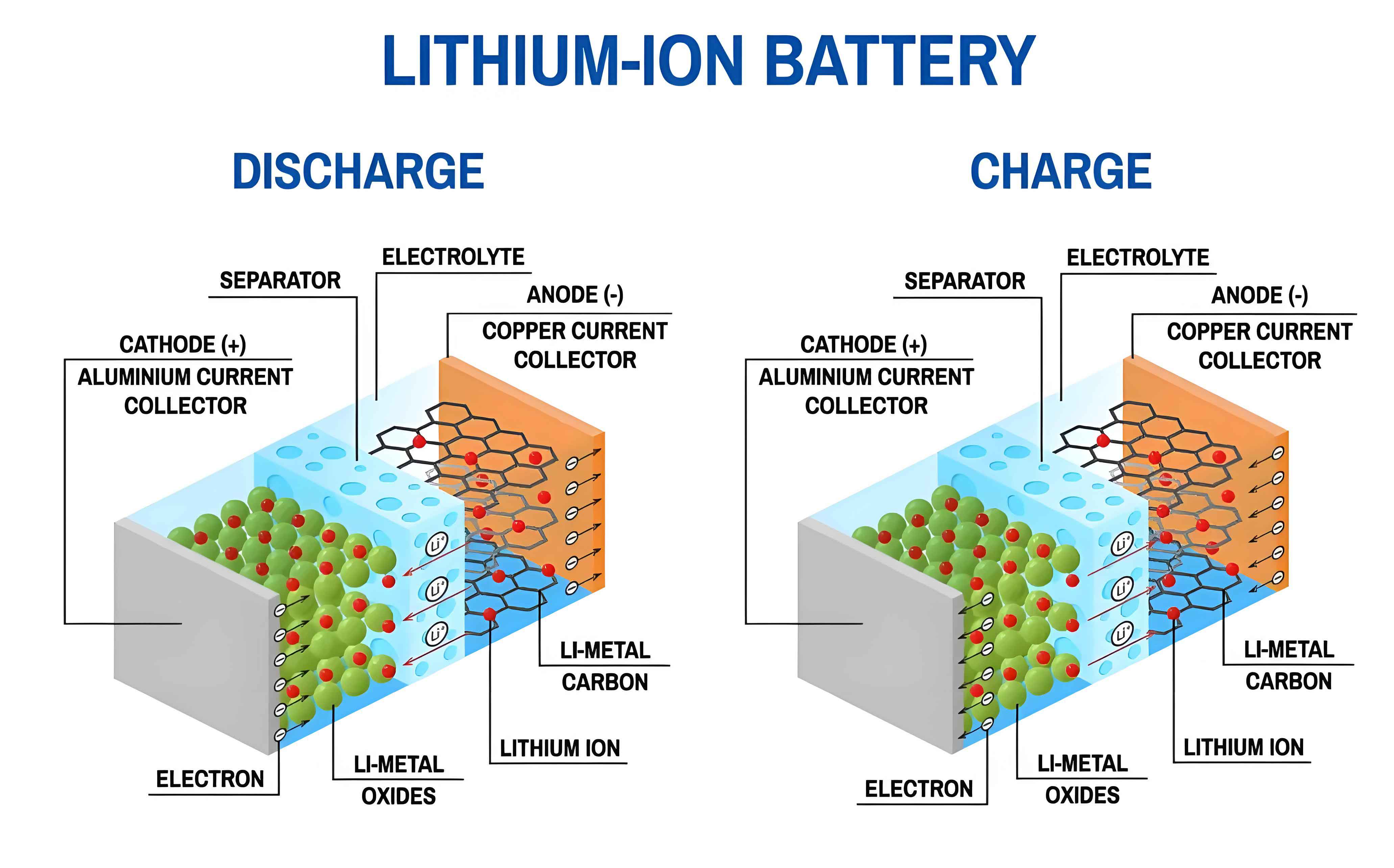
In recent years, the depletion of traditional fossil fuels has driven advancements in renewable energy, and energy storage technologies based on renewables are seen as crucial for mitigating global warming and replacing fossil fuels. Among these, lithium-ion batteries have become a core focus of global technological innovation and the transition to a green economy due to their high energy density, long cycle life, and low self-discharge rate. However, traditional electrode materials for lithium-ion batteries are increasingly revealing limitations under stringent performance requirements such as high-capacity output and high-rate charging/discharging, making it difficult to meet the evolving needs of future energy storage scenarios. In this context, vanadium oxides, as members of transition metal oxides, exhibit rich oxidation states, diverse crystal structures, and unique electrochemical properties, positioning them as promising candidates for next-generation lithium-ion battery electrodes. The multivalent reversibility of vanadium atoms enables multi-electron reactions during lithium ion insertion and extraction, theoretically offering high specific capacities. For instance, V2O5 can intercalate up to three lithium ions as a cathode material, with a theoretical capacity of 442 mAh/g. This review, from our perspective, systematically analyzes the electrochemical properties of vanadium oxides, summarizes synthesis methods and modification strategies, and discusses future directions to address challenges in practical applications. Throughout this discussion, we emphasize the critical role of lithium-ion batteries in modern energy systems and the potential of vanadium oxides to enhance their performance.
The electrochemical characteristics of vanadium oxides stem from their varied oxidation states and crystal structures. Vanadium can form multiple oxides, including VO, VO2, V2O3, V2O5, V3O5, V3O7, V4O5, V4O7, V5O9, V6O11, V6O13, V7O13, and V8O15, as depicted in the V-O phase diagram calculated using FactSage software. Commonly used materials in lithium-ion batteries include V2O5, V3O7, VO2, V2O3, and V6O13, each with distinct structural and electrochemical features. For example, V2O5 exhibits a layered structure facilitating lithium ion diffusion, while V2O3 possesses a tunnel-like framework with metallic conductivity. The general lithium insertion reaction for vanadium oxides can be expressed as:
$$ \text{Li}^+ + e^- + \text{Vanadium Oxide} \rightarrow \text{Li}_x\text{Vanadium Oxide} $$
where x represents the number of intercalated lithium ions. The theoretical specific capacity (C) is given by:
$$ C = \frac{nF}{M} $$
Here, n is the number of electrons transferred per formula unit, F is Faraday’s constant (96485 C/mol), and M is the molar mass (g/mol). For V2O5 with n=3 and M=181.88 g/mol, C ≈ 442 mAh/g, demonstrating the high capacity potential of vanadium oxides in lithium-ion batteries.
We begin by detailing the electrochemical properties of key vanadium oxides. V2O5, with vanadium in the +5 oxidation state, has a two-dimensional layered structure that allows easy lithium ion intercalation. Its multi-electron transfer capability contributes to high charge storage, making it a popular cathode material for lithium-ion batteries. Studies have shown that nanostructured V2O5, such as nanosheets, can achieve reversible capacities around 250 mAh/g with good cycling stability. V3O7, containing mixed V4+ and V5+ states, forms a complex three-dimensional network with large interlayer spacing, beneficial for lithium ion mobility. It exhibits multiple redox activities, enabling stepwise lithium insertion. VO2 exists in various polymorphs, with the layered monoclinic structure providing conductive pathways and accommodating ions between layers. When used in lithium-ion batteries, VO2-based cathodes have shown minimal capacity decay over cycles. V2O3 features a tunnel-rich crystal structure and inherent metallic behavior due to V 3d electron delocalization along V-V chains, leading to high electrical conductivity. This, combined with its hollow structures, enhances lithium ion adsorption and battery performance. V6O13, a mixed-valence oxide with predominant V5+ and some V4+, has an alternating single and double vanadium oxide layer configuration that offers abundant lithium insertion sites. Its theoretical capacity is high, with operating voltages above 1.5 V, making it attractive for lithium-ion battery applications.
To quantify the electrochemical performance, we summarize key data from various studies in the table below. This table compares different vanadium oxides used as electrodes in lithium-ion batteries, highlighting their current densities, cycle numbers, and specific capacities. The data underscores the diversity and potential of these materials for enhancing lithium-ion battery technology.
| Vanadium Oxide | Current Density | Cycles | Specific Capacity (mAh/g) | Notes |
|---|---|---|---|---|
| V2O5 | 100 mA/g | 50 | 250.3 | Nanosheet structure, good cycling stability |
| V2O5-based composite | 100 mA/g | 100 | 427.0 | EuVO4-V2O5 composite, high capacity |
| V2O5/CNT | 0.2C | 80 | 223.8 | Carbon nanotube composite, improved stability |
| V3O7·H2O | 100 mA/g | 100 | 202.0 | Nanobelt structure, moderate capacity |
| V3O7·H2O | 500 mA/g | 100 | 245.0 | Ultrathin nanoribbons, enhanced performance |
| V3O7·H2O/PECNTs | 400 mA/g | 100 | 379.0 | Carbon-based composite, high rate capability |
| V3O7·H2O/CNT | 200 mA/g | 50 | 198.9 | Nanocomposite, good reversibility |
| VO2/CNTs | 100 mA/g | 100 | 536.5 | Nano-micro sphere composite, high capacity |
| VO2(B) | 200 mA/g | 200 | 529.2 | Flower-like structure, excellent cycling |
| VO2(B)/g-C3N4 | 2C | 5000 | 265.0 | Hybrid structure, long cycle life |
| VO2(B)/rGO | 1000 mA/g | 500 | 134.0 | Reduced graphene oxide composite, stable |
| V2O3/CNS | 0.2C | 10 | 730.0 | Carbon nanocomposite, high initial capacity |
| V2O3/MCCNFs | 5 A/g | 5000 | 487.8 | Multichannel carbon nanofibers, ultralong lifespan |
| Ni-V2O3@NC | 500 mA/g | 200 | 98.0 | Nickel-doped composite, improved conductivity |
| V2O3/CN | 100 mA/g | 50 | 538.0 | Sulfur-doped nanofibers, good lithium storage |
| Fe-doped V6O13 | 42 mA/g | 100 | 203.0 | Iron doping, enhanced capacity retention |
| Cr-doped V6O13 | 42 mA/g | 50 | 281.0 | Chromium doping, increased capacity |
| Pre-lithiated V6O13 | 1000 mA/g | 150 | 174.0 | Ultrathin nanosheets, fast ion transport |
The synthesis of vanadium oxides for lithium-ion battery electrodes involves various methods, each influencing the material’s morphology and performance. Hydrothermal synthesis is widely used due to its ability to produce nanostructures like nanobelts and nanosheets under controlled temperature and pressure. For example, V2O5 nanosheets synthesized hydrothermally exhibit high reversible capacities and rate capabilities. Solid-state methods involve high-temperature reactions to form crystalline phases, such as EuVO4-V2O5 composites, which show enhanced specific capacities. Electrospinning is employed to create fibrous structures, like V2O3/carbon nanofibers, offering free-standing electrodes with excellent flexibility and cycling stability. Other techniques include sol-gel processes, liquid-phase precipitation, and spray drying, which enable the fabrication of porous microspheres and hybrid architectures. These methods allow precise control over particle size, morphology, and crystallinity, critical for optimizing lithium-ion battery performance. In our view, the choice of synthesis method depends on the desired electrode properties, such as high surface area for rapid ion diffusion or robust structures for volume change accommodation during cycling.
Modification strategies are essential to overcome the inherent limitations of vanadium oxides, such as poor electrical conductivity and significant volume expansion during lithium ion insertion/extraction in lithium-ion batteries. Compositing with carbon materials, such as carbon nanotubes (CNTs) or graphene, is a common approach. For instance, V2O5/CNT porous microspheres demonstrate improved electronic conductivity and structural stability, leading to high specific capacities and cycling retention. The carbon network facilitates electron transfer and buffers volume changes, enhancing the overall efficiency of lithium-ion batteries. Elemental doping, with ions like Fe, Cr, or Mn, alters the crystal structure and electronic properties. Doping can expand interlayer distances, as seen in Fe-doped V6O13, promoting easier lithium ion diffusion and higher capacities. The doping effect can be modeled using the following formula for lattice parameter change:
$$ \Delta a = k \cdot r_{\text{dopant}} $$
where Δa is the change in lattice constant, k is a proportionality factor, and rdopant is the ionic radius of the dopant. This modification optimizes the electrochemical behavior of vanadium oxides in lithium-ion batteries. Nanostructuring, such as creating nanoflowers, nanoribbons, or hollow spheres, increases the surface area and shortens ion diffusion paths. For example, VO2 nanoflower structures exhibit high specific capacities due to their hierarchical porosity. Additionally, pre-lithiation techniques, as applied to V6O13 nanosheets, enhance structural stability and conductivity by pre-incorporating lithium ions. These strategies collectively address key challenges, making vanadium oxides more viable for practical lithium-ion battery applications.
We further analyze the electrochemical performance through kinetic considerations. The lithium ion diffusion coefficient (D) in vanadium oxides can be estimated using the Randles-Sevcik equation for cyclic voltammetry:
$$ I_p = 0.4463 \cdot nFAC \sqrt{\frac{nFvD}{RT}} $$
where Ip is the peak current, A is the electrode area, C is the concentration, v is the scan rate, R is the gas constant, and T is the temperature. Higher D values indicate faster ion transport, which is crucial for high-rate performance in lithium-ion batteries. For vanadium oxides like V2O5 nanosheets, D values on the order of 10-12 to 10-11 cm2/s have been reported, contributing to their good rate capability. Moreover, the capacity retention over cycles can be modeled by a decay function:
$$ C_n = C_0 \cdot e^{-kn} $$
where Cn is the capacity at cycle n, C0 is the initial capacity, and k is the decay constant. For modified vanadium oxides, k values decrease due to improved structural stability, leading to longer cycle life in lithium-ion batteries. These mathematical insights help quantify the benefits of synthesis and modification approaches.
Looking ahead, we identify several challenges and opportunities for vanadium oxides in lithium-ion batteries. Key challenges include the relatively low intrinsic conductivity of many vanadium oxides, which limits charge transfer kinetics, and the volume changes during cycling, causing mechanical stress and capacity fading. To address these, we propose intensified research into advanced composites, such as integrating vanadium oxides with conductive polymers or two-dimensional materials like MXenes, to create synergistic effects. Additionally, atomic-level engineering through doping or defect creation could optimize electronic structures. For example, introducing oxygen vacancies in V2O5 might enhance conductivity, as described by:
$$ \text{V}_2\text{O}_5 \rightarrow \text{V}_2\text{O}_{5-x} + x\text{V}_{\text{defect}} $$
where x represents vacancy concentration. Furthermore, scalable synthesis methods need development to enable cost-effective production for commercial lithium-ion batteries. We also emphasize the importance of in-situ characterization techniques, such as X-ray diffraction and electron microscopy, to monitor structural evolution during operation and guide material design. Future work should explore the integration of vanadium oxides into flexible or solid-state lithium-ion batteries, aligning with trends in wearable electronics and electric vehicles. By tackling these aspects, vanadium oxides can move from laboratory curiosities to practical components in next-generation energy storage systems.
In conclusion, vanadium oxides offer a versatile platform for advancing lithium-ion battery technology due to their rich electrochemistry and structural diversity. Through methods like hydrothermal synthesis and modifications such as carbon compositing and doping, significant progress has been made in enhancing specific capacities, rate capabilities, and cycling stability. However, challenges remain in conductivity and volume change management. We believe that continued innovation in material design and processing will unlock the full potential of vanadium oxides, contributing to more efficient and durable lithium-ion batteries. As the demand for energy storage grows, these materials are poised to play a pivotal role in sustainable energy solutions, underscoring the importance of ongoing research in this field. Ultimately, the development of high-performance vanadium oxide electrodes will support the widespread adoption of lithium-ion batteries across various applications, from portable electronics to grid storage.
To summarize the key points, we present a comparative formula for the overall performance index (P) of a vanadium oxide electrode in a lithium-ion battery:
$$ P = \alpha \cdot C + \beta \cdot S + \gamma \cdot R $$
where C is the specific capacity, S is the cycling stability (expressed as capacity retention after N cycles), R is the rate performance (measured at high current densities), and α, β, γ are weighting factors based on application requirements. This holistic approach encourages balanced optimization of multiple properties. As we advance, interdisciplinary collaboration will be essential to translate fundamental insights into practical innovations, ensuring that vanadium oxides contribute meaningfully to the evolution of lithium-ion battery technology.